DeFi for Beginners

DeFi lets you exchange digital assets, supply funds to lending markets, and interact with financial applications through a crypto wallet. That access comes with responsibility: You must understand the network, protect your recovery information, and review what you authorize.
In this guide to DeFi for beginners you will learn how wallets and protocols fit together, how to approach a first transaction, where potential returns come from, and what can go wrong.
At FoxWallet, we build a non-custodial, multi-chain wallet that connects users to supported blockchain applications. The wallet is your access and signing tool, not the underlying lending protocol or source of investment returns.
Important: DeFi can cause partial or total loss of funds. This article is educational, not personalized financial, legal, or tax advice.
DeFi for beginners: Understand the foundations
Decentralized finance, or DeFi, describes financial applications that use blockchain assets and smart contracts. Common activities include exchanging tokens, supplying assets to borrowers, and providing trading liquidity.
Unlike a conventional custodial account, a self-custody wallet puts you in control of your signing credentials. However, assets deposited into a protocol become subject to that protocol's contracts and withdrawal rules. If this distinction is new, compare custodial and non-custodial wallets.
How DeFi works
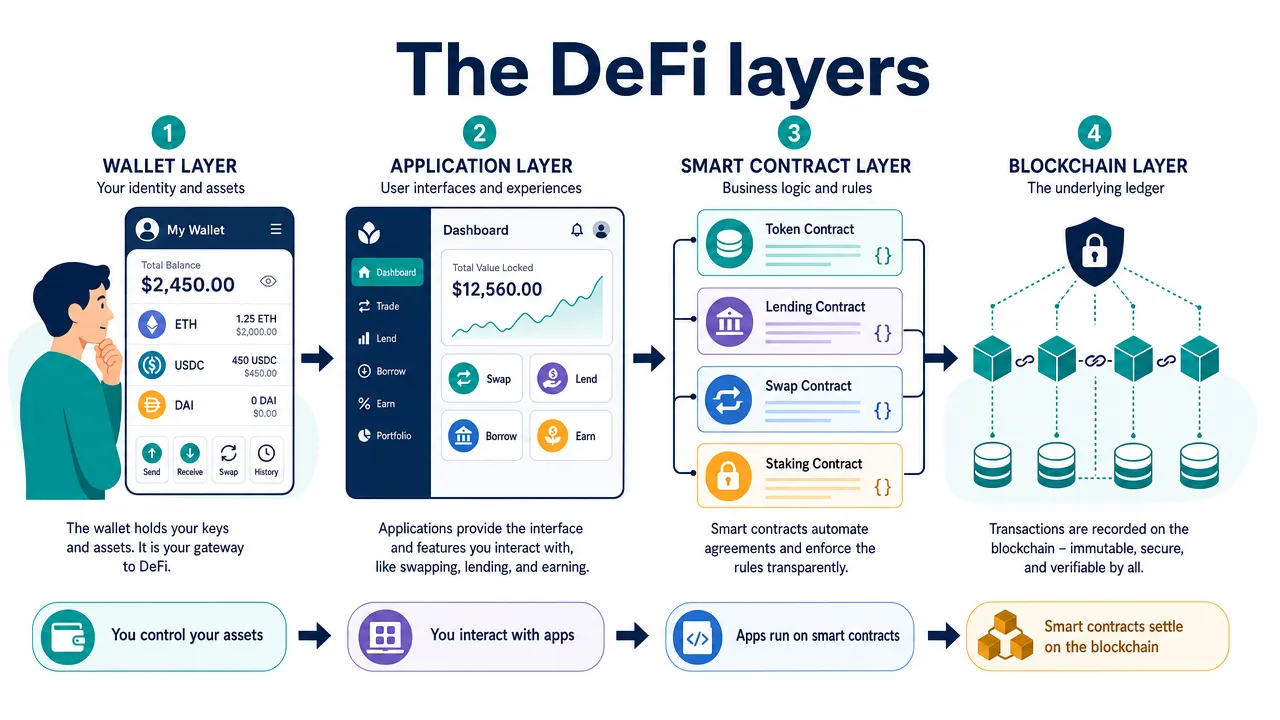
Understanding how DeFi works is easier when you separate four layers:
| Layer | What it does | What you should check |
|---|---|---|
| Wallet | Manages accounts and authorizes interactions | Recovery method, network support, signing details |
| Blockchain | Records balances and executes transactions | Correct network, gas asset, transaction status |
| Smart contract | Executes programmed rules | Permissions, administrative controls, security disclosures |
| DApp interface | Provides screens for using a protocol | Authentic domain, requested action, displayed costs |
A wallet does not literally contain your coins. It displays blockchain information and manages the credentials used to authorize actions.
A smart contract is code, not a guarantee. It can contain bugs, depend on external price data, or include privileged controls that allow changes or pauses. Ethereum's introduction to blockchain-based finance provides further background.
Decentralized finance basics you need before funding
These decentralized finance basics will help you avoid common operational mistakes:
- Public address: An identifier used to receive assets. Sharing it may reveal associated transaction history.
- Private key: A secret credential that authorizes account actions.
- Recovery phrase: Words used to reconstruct compatible wallet keys. Anyone who obtains them may control the associated accounts.
- Network: A particular blockchain environment. An asset on one network is not automatically available on another.
- Gas: The network fee required for many transactions. Ethereum uses ETH; other networks have their own requirements.
- Stablecoin: A token designed to track a reference value. Its peg is not guaranteed.
DeFi is also not automatically anonymous, unrestricted, or free of intermediaries. Interfaces, asset issuers, node providers, and governance participants can remain important dependencies. Access and legal obligations vary by location.
Choose DeFi wallets with self-custody in mind
DeFi wallets help you view assets, connect to applications, and authorize transactions. Choosing one means evaluating more than its appearance.
Ask whether it supports your intended network, explains transaction requests clearly, and provides a recovery model you understand.
Where FoxWallet fits
FoxWallet is a multi-chain, non-custodial wallet. You retain control over your private keys and recovery information; FoxWallet does not custody your funds.
FoxWallet mobile is the primary multi-chain product. On confirmed supported networks and assets, it provides multi-chain asset management, supported NFT visibility, Discover/DApp access, Swap, Bridge, and network-specific staking. Its current mobile security controls include local key encryption, sandbox isolation, phishing-site blocking, high-risk signature warnings, and malicious authorization checks.
These mobile capabilities are separate:
- Swap: Uses 1inch on confirmed supported networks.
- Bridge: Uses LI.FI on confirmed supported networks. Bridge is not the same as Swap.
- Discover/DApp access: Helps users find and connect to compatible DApps. A listing does not mean FoxWallet endorses, partners with, or guarantees the availability or safety of that DApp.
- Staking: Available only on confirmed supported mobile networks and assets. It should not be inferred from general network support.
The FoxWallet browser extension has a narrower scope. It supports EVM and Aleo for basic wallet actions, but it does not have full mobile feature parity and does not include Swap, Bridge, or staking.
Multi-chain management means viewing and managing assets across networks. Cross-chain transactions move value between networks. These are related capabilities, but viewing several balances does not itself move any funds.
Our multi-chain product overview explains the broader approach. Check current platform, network, feature, and regional availability before following a workflow. Network support alone does not establish Swap, Bridge, staking, or DApp availability.
FoxWallet is the access and signing layer, not the underlying protocol or source of returns. Integrated routing may reduce operational friction, but it does not establish that every route is cheapest or guarantee a particular price. Always compare the complete quote, especially if you transact frequently.
What self-custody does not solve
Self-custody protects your control over signing credentials. It does not prevent you from signing a harmful transaction or depositing into a vulnerable protocol.
Likewise:
- Asset detection is not an endorsement of a token.
- A DApp directory is not a safety guarantee.
- A missing warning does not prove a transaction is safe.
- A wallet password is not a substitute for a recovery backup.
Read the custody and recovery information before funding. An integrated interface can reduce switching between applications, but connections, signatures, approvals, and confirmations may still be required.
A practical DeFi for beginners walkthrough
This beginner DeFi guide uses a small same-chain swap as its practical example. Keeping both assets on one network avoids adding bridge dependencies to your first lesson.
You do not need to complete a transaction to learn. If you cannot explain a request or its costs, stop.
Step 1: Install through the official route
Start with the FoxWallet installation options and follow the appropriate platform link.
Avoid unsolicited download links, advertisements impersonating support, and installation files sent through private messages. Check the complete domain and publisher details. HTTPS alone does not establish authenticity.
The steps below are general guidance, not version-specific button instructions.
Step 2: Create a wallet and protect recovery information
Generate a new wallet inside the authenticated application. If importing an existing wallet, use only the intended recovery flow in the verified wallet software.
Follow the documentation for creating and importing wallets, then:
- Record the recovery information accurately offline.
- Protect the backup from theft and physical damage.
- Avoid screenshots, cloud notes, email, and messaging apps.
- Never enter the phrase into a DApp, support form, or AI tool.
A private key and a seed phrase serve different purposes, but either can expose control of an account if mishandled. Creating another account under the same recovery phrase does not protect it if that phrase is compromised.
Step 3: Match the network and reserve gas
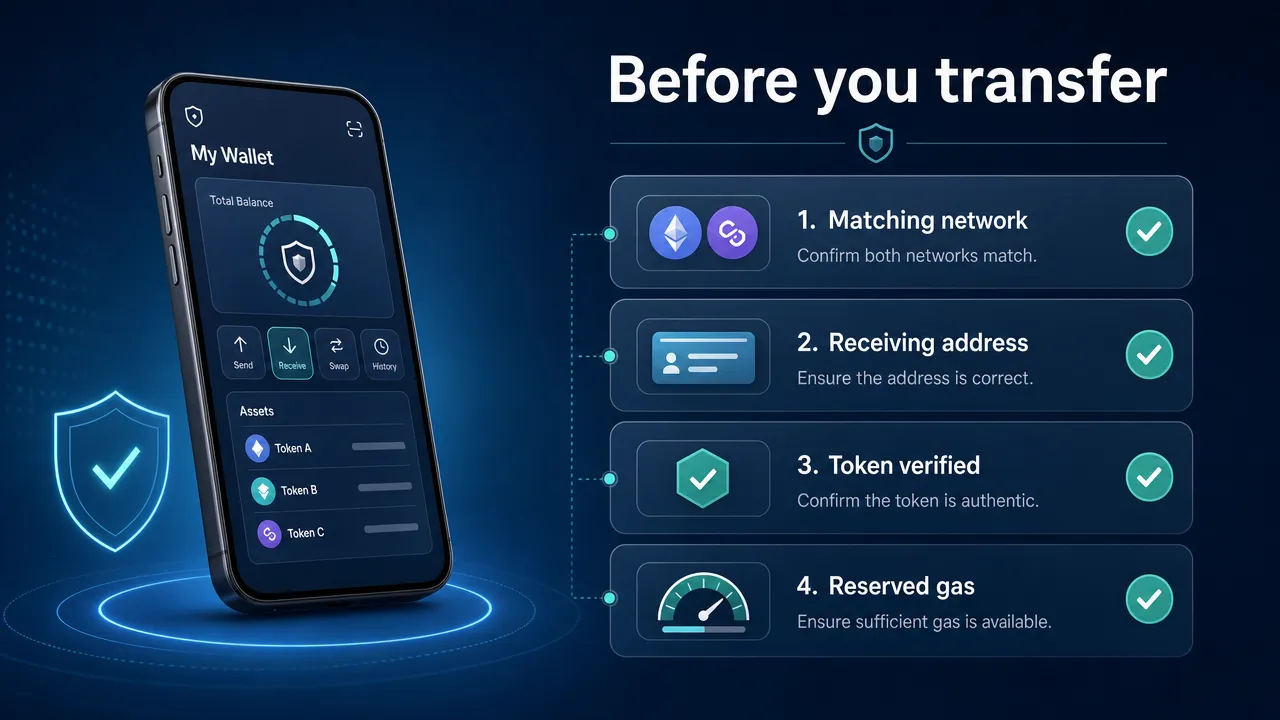
Before transferring assets, confirm:
- The sending service's withdrawal network.
- The network selected in your wallet.
- The receiving address and any required memo or tag.
- The token's identity on that network.
- The native asset needed for transaction fees.
Matching address formats do not prove that two networks match.
Keep enough gas for the intended transaction and a possible exit. Holding a token does not necessarily mean you can pay that network's fees.
For readers budgeting in Nigerian naira, evaluate the total amount at risk and expected gas and route fees in NGN as well as token units. On a small transaction, a modest token fee can still consume a meaningful share of the amount. A token-denominated gain does not necessarily translate into a gain in your reporting currency.
Acquiring crypto with fiat and using DeFi are separate steps. Once compatible assets are in a self-custody wallet, the DeFi interaction happens on-chain. Any third-party on-ramp, payment method, DApp, or service availability in Nigeria should be checked at the time of use; wallet or network support alone does not establish regional eligibility.
Step 4: Send a small test transfer
Transfer a small amount first. Confirm the transaction status, network, and received asset before sending more.
The network and transfer guidance provides additional context. A successful test reduces uncertainty about the transfer route; it does not prove that a future DApp interaction is safe.
Step 5: Understand every permission
Visit a DApp through an address verified against its official documentation. Then distinguish these requests:
| Request | Typical purpose | Important caution |
|---|---|---|
| Connect wallet | Shares selected account information and establishes a session | Does not inherently grant unrestricted spending |
| Sign a message | Proves account control or authorizes instructions | A gasless signature can still authorize spending |
| Approve a token | Gives a spender permission to move specified tokens | Permission may remain after the intended action |
| Execute a transaction | Requests an on-chain change | Confirmation does not prove the action was sensible |
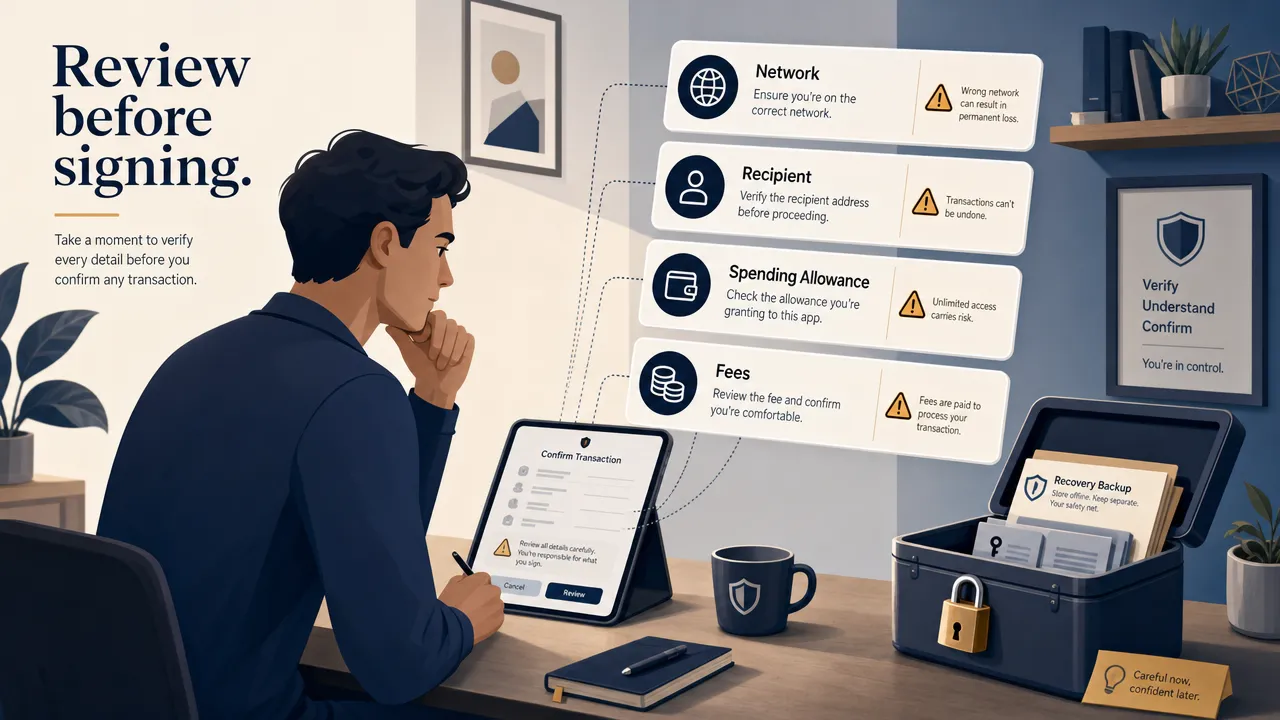
Inspect the network, spender, token, amount, expiry where available, and intended effect.
Approvals may appear as separate transactions, signature-based permits, or bundled requests. Never assume every application follows the same sequence.
Step 6: Review and execute a small same-chain swap
Confirm that both assets belong to your intended network. Review:
- Input amount and output asset.
- Expected output and minimum received.
- Price impact and slippage tolerance.
- Route and recipient.
- Network, protocol, and interface fees.
- Any spending permission requested.
On FoxWallet mobile, Swap uses 1inch on confirmed supported networks. Confirm that Swap is supported for the specific network rather than inferring it from general wallet support. For more route context, see how DEX aggregators help compare swap execution.
Authorize only requests you understand. After submission, inspect the receipt and resulting balances. Do not repeatedly resubmit a pending transaction without checking its status.
Step 7: Review permissions afterward
Disconnecting a website does not revoke existing token allowances. Review unnecessary permissions through an authenticated permission-management tool, allowing for applicable gas costs.
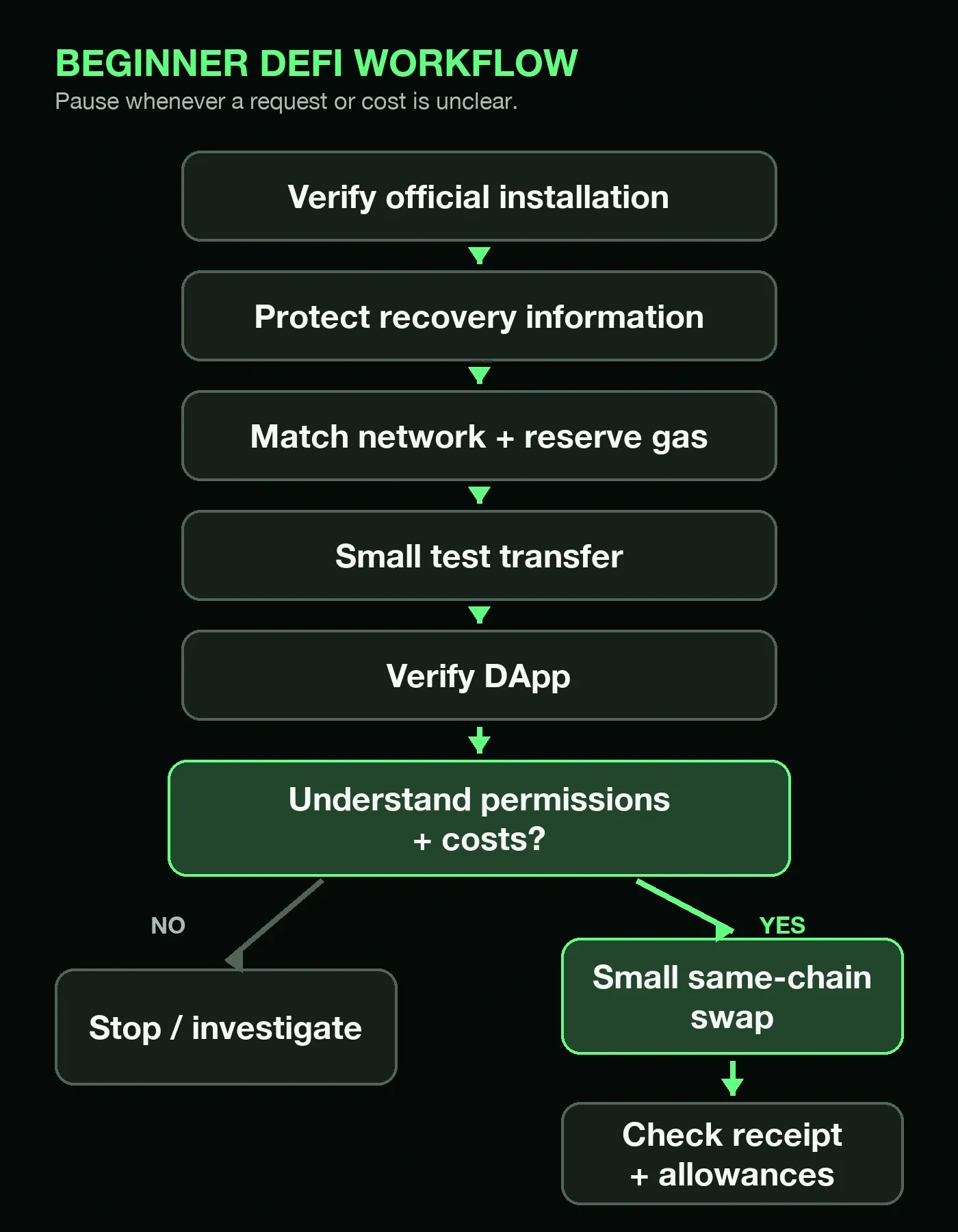
The following sequence summarizes the learning workflow, not a guarantee of safety:
Understand lending, staking, and other activities
DeFi activities have different purposes and risk profiles. Do not group them together simply because an interface displays a percentage return.
DeFi lending and borrowing
DeFi lending and borrowing are related but distinct actions.
When supplying assets to a lending market, you make them available under the protocol's rules. Interest primarily comes from borrowers, sometimes supplemented by incentive tokens. Rates can change, and withdrawals depend on liquidity and protocol conditions.
A supply-only learning path is:
- Identify the network, market, and asset.
- Read the interest and withdrawal rules.
- Review permissions and supply a small amount.
- Inspect the resulting position.
- Understand withdrawal before increasing exposure.
A supply-only position without debt does not acquire borrower liquidation exposure merely by earning interest. It still carries contract, asset, liquidity, and potentially bad-debt risks.
Borrowing adds collateral obligations. If collateral becomes insufficient, the protocol can liquidate part of the position under its rules.
For example, Aave's V3 documentation describes a health factor measuring collateral-adjusted debt coverage.
Hypothetical example: With collateral worth 1,000 units, an 80% liquidation threshold, and debt of 500 units:
- Health factor = 1,000 x 0.80 / 500 = 1.6.
- If collateral falls to 600 units, health factor = 0.96.
Under this simplified model, falling below 1 makes the position eligible for liquidation. Actual parameters vary. Liquidation can occur without a personal warning or time to react.
Crypto staking for beginners
The first lesson in crypto staking for beginners is that staking is not lending.
Native proof-of-stake staking contributes to network consensus. Depending on the network, users may operate validators or delegate through supported mechanisms. Rewards, penalties, fees, and exit rules differ.
Liquid staking adds a transferable token representing a staking position. That introduces additional contract, provider, and token-market dependencies.
Before participating, check:
- How rewards arise and are accounted for.
- Validator or provider fees.
- Whether penalties or slashing apply.
- Unstaking delays or withdrawal queues.
- Whether exit means redeeming through the protocol or selling a token.
Selling a liquid staking token and redeeming the underlying stake are not equivalent. Market prices can differ from redemption value. Ethereum's network participation overview explains its staking model.
Liquidity provision and incentive programs
Liquidity providers deposit assets into pools used for trading. Potential returns come from trading fees and sometimes incentives.
However, a pool position can underperform simply holding the deposited assets. This is commonly called impermanent loss. The name does not mean the loss is harmless or guaranteed to reverse.
Some pool designs also require active price-range management. Yield farming can layer additional incentive tokens and contracts onto an underlying position, increasing complexity.
Cross-chain transfers are a separate operation
A bridge or cross-chain swap moves value between networks, sometimes changing the asset along the way. It does not inherently produce investment returns.
Before using a route, understand the source and destination networks, asset representations, settlement process, recovery options, and destination gas requirements. Ethereum's bridge documentation outlines additional dependencies.
On FoxWallet mobile, Bridge uses LI.FI on confirmed supported networks. Bridge and Swap are separate capabilities, and general network support does not establish support for either one. Review the cross-chain swap guide before comparing routes.
This is an asset-transfer workflow, not a staking mechanism. Learn it separately.
| Activity | Main purpose | Potential return source | Exit consideration |
|---|---|---|---|
| Same-chain swap | Exchange assets | No inherent yield | Liquidity and reverse-trade costs |
| Lending supply | Make assets available to borrowers | Borrower interest, possible incentives | Available withdrawal liquidity |
| Native staking | Participate in consensus | Network rewards | Network-specific exit rules |
| Liquidity provision | Enable trading | Trading fees, possible incentives | Pool composition and removal costs |
| Cross-chain transfer | Move value between networks | No inherent yield | Settlement and destination access |
Calculate fees and potential returns realistically
Displayed rates and quotes are starting points, not complete outcomes.
Separate the different transaction costs
Depending on the activity, costs may include:
- Network gas for approvals and execution.
- Protocol or liquidity-pool fees.
- Interface or aggregator charges.
- Bridge or relayer fees for cross-chain routes.
- Withdrawal, redemption, or conversion costs.
Some quotes already include particular fees. Avoid counting them twice.
For small transactions, fixed network costs can consume a large share of the amount involved. Failed transactions can also consume gas, depending on the network and failure stage.
Price impact is not slippage
Price impact is the effect of your own trade on the execution price.
Slippage is the difference between expected and actual execution. Slippage tolerance sets a permitted execution boundary; it is not a fee.
For a hypothetical quote of 100 output tokens, a directly applied 1% tolerance would set minimum received at 99 tokens. That does not mean the trade necessarily loses 1%.
An excessively loose tolerance can permit worse execution. A very tight tolerance can cause a transaction to fail.
APR, APY, and net results
APR expresses an annualized rate before compounding. APY includes specified compounding assumptions. Neither guarantees what you will earn.
At a hypothetical fixed 5% APR compounded monthly, APY is approximately 5.12%, assuming reinvestment and no costs or price changes.
Consider a simpler illustration:
| Hypothetical one-year outcome | Amount |
|---|---|
| Starting value | 100 units |
| Gross return at 5% | 5 units |
| Entry and exit costs | 3 units |
| Net gain before taxes and price changes | 2 units |
The net return is 2%, not 5%. Asset-price losses could outweigh that gain entirely.
Keep records of deposits, withdrawals, rewards, fees, and transaction identifiers. If you evaluate your finances in naira, use a consistent conversion method rather than assuming token returns equal naira returns.
DeFi risks and security: Evaluate before committing
Good habits reduce avoidable mistakes, but DeFi risks and security extend beyond wallet setup.
Recognize the major risk categories
| Risk | What can happen | Practical response |
|---|---|---|
| Phishing | A fake application steals credentials or requests harmful signatures | Verify installation routes and full domains |
| Malicious permissions | A spender gains authority over tokens | Review spender, amount, purpose, and expiry |
| Contract failure | Assets are lost, frozen, or incorrectly accounted for | Examine scoped audits and incident disclosures |
| Oracle or administrative failure | Incorrect prices or privileged changes affect positions | Understand dependencies and control powers |
| Market loss or stablecoin depeg | Asset value falls or a peg breaks | Avoid treating a target price as guaranteed |
| Liquidation | Collateral is used to repay eligible debt | Understand debt metrics and repayment actions |
| Withdrawal restrictions | Liquidity shortages, pauses, or queues delay exit | Learn withdrawal conditions before depositing |
Audits reduce uncertainty within a defined scope; they do not certify permanent safety. Likewise, a familiar website can be compromised.
How to evaluate the best DeFi platforms for beginners
There is no universal list of the best DeFi platforms for beginners. A wallet, exchange protocol, and lending market perform different jobs.
Evaluate the specific application and task:
- Compatibility: Does your wallet platform support the network and interaction?
- Documentation: Are entry, monitoring, and exit explained clearly?
- Permissions: Can you understand the requested authority?
- Security evidence: Are reports scoped to relevant versions?
- Costs: Can you distinguish fees from execution effects?
- Dependencies: Who can upgrade, pause, or influence the system?
- Exit: Can you explain how to recover the underlying assets?
A high advertised yield or recognizable interface is not enough.
Know what to do when something looks wrong
If a request is unexpected, reject it and investigate through independently verified resources. Do not follow instructions from unsolicited support contacts.
If a recovery phrase or private key is exposed, changing the wallet password or revoking approvals does not repair the compromised credential. A clean replacement requires a new recovery secret on a clean device.
Avoid sending additional gas into a compromised account without a recovery plan. Automated theft can make asset recovery more complicated.
Common beginner questions
Can I withdraw whenever I want?
Not necessarily. Available liquidity, collateral obligations, queues, pauses, and protocol rules can restrict withdrawals.
Is connecting my wallet the same as approving spending?
No. Connection and spending authorization are different, but subsequent signatures can grant meaningful permissions. Review every request.
Does FoxWallet provide the yield?
No. The wallet provides access and signing capabilities. Any returns depend on the underlying network or protocol activity.
What should I do first?
Read the wallet security guidance, verify the FoxWallet installation options, and confirm support for your intended network. Protect recovery information before considering a small test transfer.
The strongest starting point is not a particular yield or token. It is being able to explain what you are signing, what it costs, what could go wrong, and how you would exit.