


Custodial vs Non-Custodial Wallets: Which Is Safer? (2026)

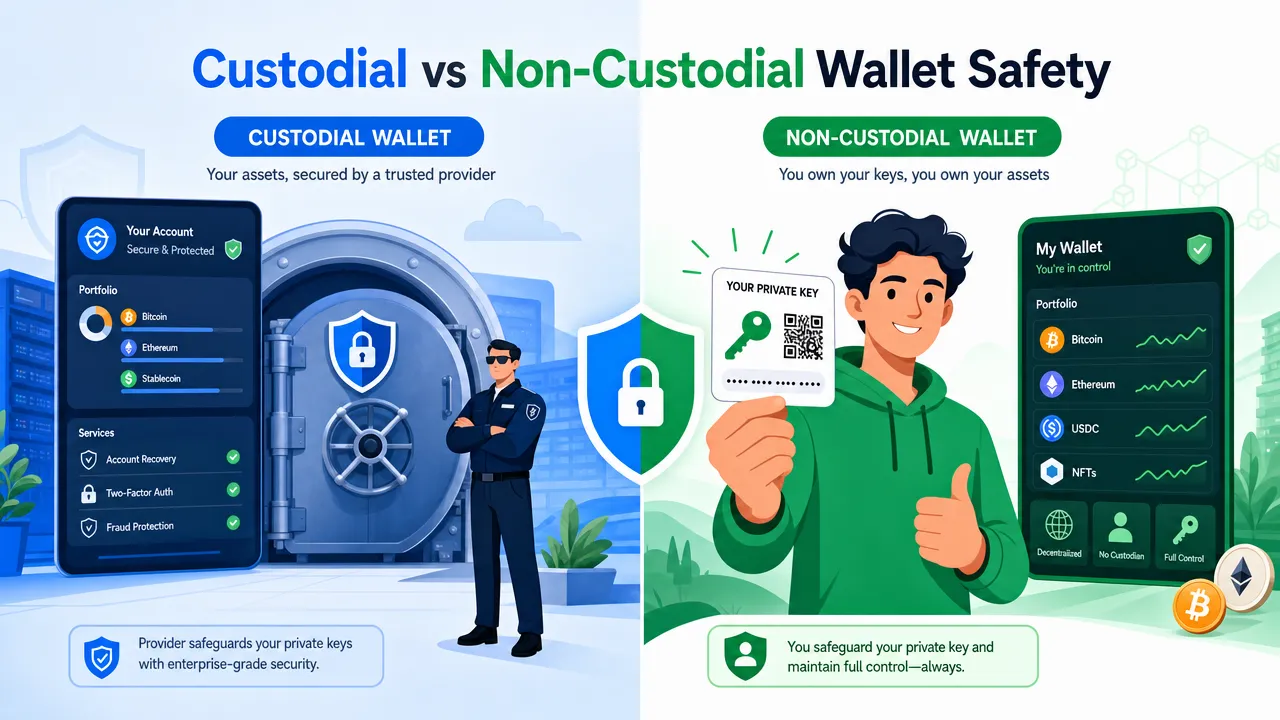
If you are comparing custodial vs non-custodial wallets in 2026, the honest answer is not "one is always safer." The safer wallet depends on the risk you are trying to reduce.
A custodial wallet can feel safer if you are new to crypto, worry about losing passwords, and want customer support. But it requires trusting a third party to control the crypto wallet private keys. A non-custodial wallet, also called a self-custody crypto wallet, gives you direct control of your private keys and assets. But it also makes you responsible for seed phrase backup, phishing protection, transaction review, and device security.
In short: custodial wallets reduce some user-error risks, while non-custodial wallets reduce third-party custody risk. This wallet security comparison explains the crypto wallet pros and cons, which crypto wallet is safer by scenario, and how FoxWallet fits users who are ready for secure self-custody across mobile, browser extension, DeFi, DApps, and multi-chain asset management.
Custodial vs non-custodial wallets: Quick safety answer
Custodial vs non-custodial wallets differ mainly by who controls the private keys.
In a custodial wallet, a third party such as an exchange, broker, or custody provider holds the private keys for you. You access funds through an account login, password, and often two-factor authentication. If you forget your password, the provider may help you recover access.
In a non-custodial wallet, you control the private keys or recovery phrase. The wallet helps you sign transactions, manage assets, and connect to on-chain applications, but the wallet provider does not hold your funds. That gives you more control, but it also means no traditional password reset if you lose your recovery phrase.
| Question | Custodial wallet | Non-custodial wallet |
|---|---|---|
| Who controls the private keys? | A third-party provider | The user |
| Is account recovery easier? | Usually yes | Only if the user has the recovery phrase or private key backup |
| Can the provider freeze withdrawals? | Yes, depending on policy, compliance, outages, or platform risk | The wallet provider does not custody funds, though networks and DApps have their own risks |
| Is it better for direct DeFi and DApp access? | Usually limited or platform-mediated | Usually yes |
| Main safety advantage | Support, recovery, simplified onboarding | Direct asset control and reduced platform custody risk |
| Main safety risk | Counterparty risk, account freezes, platform hacks, withdrawal restrictions | Seed phrase loss, phishing, malicious approvals, transaction mistakes |
The best answer to "which crypto wallet is safer?" is:
Custodial wallets may be safer for users who are most likely to lose access credentials and need customer support. Non-custodial wallets may be safer for users who want direct control, reduced platform dependence, and better access to DeFi, DApps, and multi-chain activity.
For broader market context, blockchain analytics firms continue to report that scams, hacks, and social-engineering attacks remain major crypto security concerns. Chainalysis has published ongoing research on crypto scams and fraud trends, while TRM Labs reported major hack activity in its 2026 Crypto Crime Report. The takeaway is simple: wallet type matters, but user behavior and risk awareness matter too.
Custodial vs non-custodial wallets: Crypto wallet private keys explained
Before choosing a wallet, you need to understand what a wallet actually does. A crypto wallet does not literally store coins inside an app. Assets exist on blockchains. The wallet manages the credentials needed to view balances, create addresses, and sign transactions.
Those credentials are the core of crypto wallet private keys.
A private key is a cryptographic secret that authorizes transactions from a blockchain address. If someone controls the private key, they can sign transactions for that address. If you lose access to the private key or recovery phrase, you may lose access to the assets connected to that address.
This is why custodial vs non-custodial wallets is really a question of key control.
Custodial wallet safety depends on the provider. The provider controls the keys, operates security systems, and may provide account recovery. That can help beginners, but it also creates counterparty risk. You depend on the provider's solvency, security practices, compliance decisions, and withdrawal systems.
Non-custodial wallet safety depends heavily on the user. You control the private keys, so a centralized platform cannot independently move your assets. But if you reveal your seed phrase, download a fake wallet, approve a malicious contract, or lose your backup, the loss may be irreversible.
Here is the core distinction:
| Concept | What it means | Why it matters |
|---|---|---|
| Public address | The blockchain address that can receive assets | Safe to share for receiving funds |
| Private key | The secret that signs transactions | Must never be shared |
| Seed phrase or mnemonic phrase | A human-readable backup that can restore wallet keys | Must be stored offline and protected |
| Custody | Who controls the private keys | Determines whether you or a provider controls asset movement |
| Transaction signing | The act of authorizing an on-chain action | Mistakes can be permanent once confirmed |
For self-custody users, the recovery phrase is especially important. Store it offline, never enter it into random websites, never send it through chat or email, and never save it as a cloud screenshot. A non-custodial wallet provider generally cannot recover a lost seed phrase for you.
That responsibility can sound intimidating, but it is also the source of self-custody's main advantage: direct control.
Custodial vs non-custodial wallets: Wallet security comparison
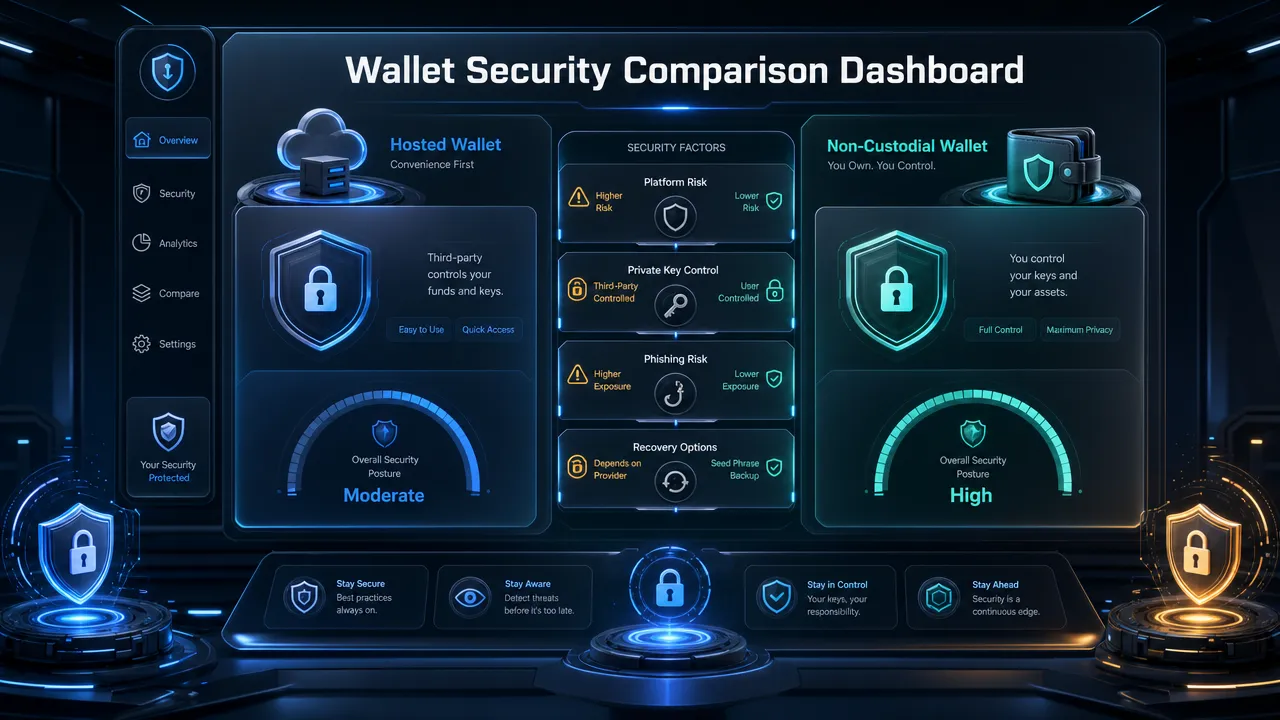
A useful wallet security comparison should look at several types of risk, not just one.
Custodial vs non-custodial wallets: Asset control
Custodial wallets give you account access, but the provider controls the private keys. That means you rely on the platform to process withdrawals and honor access to your funds.
Non-custodial wallets give you direct key control. If you hold the seed phrase or private key, you control the ability to sign transactions. This is why self-custody crypto wallet users often prefer non-custodial wallets for long-term holding, DeFi, NFTs, DApps, and multi-chain asset management.
Custodial vs non-custodial wallets: Recovery
Custodial wallets usually provide easier recovery. If you forget a password, customer support may help verify your identity and restore account access.
Non-custodial wallets are stricter. If your device is lost but you have your recovery phrase, you can restore the wallet. If both the device and recovery phrase are gone, the wallet provider typically cannot reset access.
This is one of the biggest beginner crypto wallet choice factors. If a user is not ready to protect a recovery phrase, they should start small and learn before moving meaningful funds into self-custody.
Custodial vs non-custodial wallets: Platform risk
Custodial wallets introduce third-party risk. Platforms can be hacked, become insolvent, pause withdrawals, restrict accounts, experience outages, or enforce compliance rules that affect access.
Non-custodial wallets reduce that risk because the wallet provider does not hold user funds. However, this does not eliminate all risk. Networks can be congested, DApps can be risky, smart contracts can contain bugs, and users can still sign harmful transactions.
Custodial vs non-custodial wallets: Phishing and scam risk
Both wallet types face phishing.
Custodial users may encounter fake exchange login pages, fake support messages, SIM-swap attempts, and account takeover attacks.
Non-custodial users may encounter fake wallet apps, fake DApp websites, malicious token approvals, seed phrase phishing, and misleading transaction prompts.
This is why "which crypto wallet is safer?" cannot be answered without asking how the user behaves online. A careful self-custody user may be safer in a non-custodial wallet. A careless user who enters seed phrases into fake sites can lose funds quickly.
Custodial vs non-custodial wallets: DeFi, DApps, and smart contracts
For direct DeFi and DApp access, non-custodial wallets are usually the practical choice. Users need to connect a wallet, review transaction prompts, approve spending permissions, and sign on-chain actions.
That creates new responsibilities:
| Risk area | What to check |
|---|---|
| DApp website | Confirm the URL before connecting |
| Token approval | Avoid unlimited approvals when unnecessary |
| Transaction prompt | Read what the wallet is asking you to sign |
| Smart contract | Be cautious with unknown or unaudited contracts |
| Wallet download | Use official sources only |
| Device security | Keep your browser, phone, OS, and extensions updated |
For active Web3 use, a wallet with risk alerts, contract recognition, and phishing protection can help users slow down and review actions before signing. FoxWallet emphasizes these safety layers in its official guide to wallet security features.
Custodial vs non-custodial wallets: Beginner crypto wallet choice
For beginners, the best wallet is not always the most advanced wallet. The best beginner crypto wallet choice is the one that matches the user's current skill level, balance size, and risk tolerance.
A beginner with a tiny test balance may choose a custodial wallet while learning basic concepts such as addresses, transactions, network fees, and two-factor authentication. That can be reasonable, as long as the user understands the trade-off: the custodian controls the keys.
A beginner who wants to learn self-custody can use a non-custodial wallet, but should start with small amounts and build safe habits before using DeFi, cross-chain swaps, or higher-value holdings.
Here is a practical path:
- Learn the difference between an account password and crypto wallet private keys.
- Download a wallet only from the official source.
- Create a new wallet in a private environment.
- Write the seed phrase offline.
- Never photograph, upload, email, or share the seed phrase.
- Send a small test transaction first.
- Verify the receiving address carefully.
- Use separate wallets or accounts for long-term holding and active DApp use.
- Review token approvals regularly.
- Keep devices and wallet software updated.
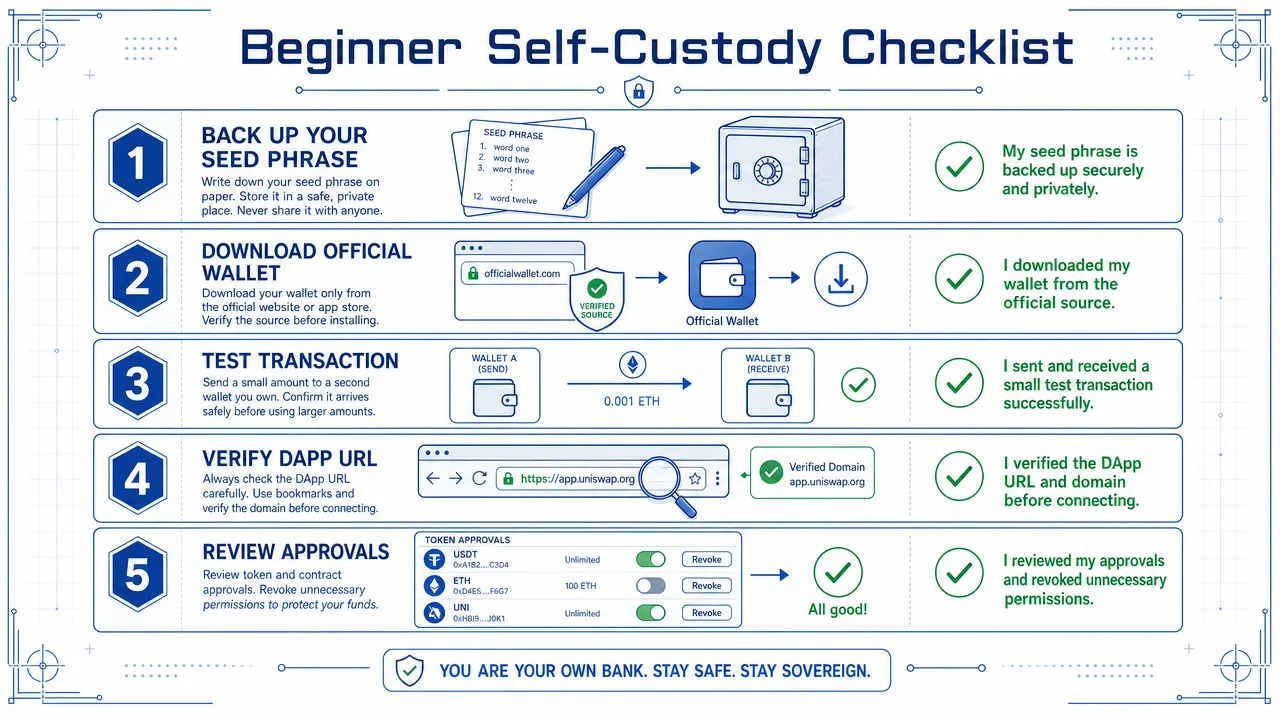
The safest beginner approach is often gradual. Use small amounts while learning. Do not rush into complex contracts. Do not treat social media links as trusted. Do not assume a familiar-looking website is legitimate.
Custodial wallet safety for beginners
Custodial wallets may be acceptable for beginners when:
- The balance is small.
- The user needs customer support.
- The user is primarily learning basic buying, selling, or transfer mechanics.
- The user enables strong account security such as two-factor authentication.
- The user understands that the platform controls the private keys.
Non-custodial wallet safety for beginners
Non-custodial wallets can be suitable for beginners when:
- The wallet has clear onboarding.
- The user understands seed phrase responsibility.
- The user starts with small test transactions.
- The user is willing to verify DApp URLs and transaction prompts.
- The user wants to move beyond exchange-only storage.
FoxWallet is designed for users at different experience levels, from beginners who want guided onboarding to advanced users who need multi-chain, cross-chain, and DeFi-native workflows. For readers comparing wallet options more broadly, FoxWallet's guide to the best crypto wallets of 2026 gives additional context.
Custodial vs non-custodial wallets: Multi-chain self-custody with FoxWallet
For users who manage assets across multiple blockchains, custodial vs non-custodial wallets becomes more than a basic security question. It becomes an operational question.
Multi-chain users face more complexity:
- Different networks.
- Different token standards.
- Different addresses and fee assets.
- Different DApps.
- Different transaction prompts.
- Different swap routes and liquidity sources.
- More opportunities to choose the wrong network or sign the wrong approval.
A non-custodial multi-chain wallet can reduce wallet sprawl by giving users one place to view and manage assets across chains. That does not remove all risk, but it can reduce confusion when combined with careful transaction review.
FoxWallet is a non-custodial, multi-chain decentralized wallet. Users retain control of their private keys and assets, while FoxWallet does not access or hold user funds. According to FoxWallet's official overview of its secure multi-chain wallet, the wallet supports local encrypted storage of mnemonic phrases and private keys, sandbox isolation, multi-chain asset management, real-time on-chain synchronization, DApp access, and risk-aware transaction features.
For users comparing crypto wallet pros and cons, FoxWallet fits the self-custody side of the decision:
| FoxWallet capability | Why it matters for non-custodial wallet safety |
|---|---|
| Non-custodial architecture | Users retain control of private keys and assets |
| Local encrypted key storage | Helps protect mnemonic phrases and private keys on the device |
| Secure sandbox isolation | Adds separation in the wallet security architecture |
| Pre-transaction risk alerts | Helps users review actions before signing |
| Smart contract recognition | Supports safer DApp interaction |
| Phishing protection strategies | Helps reduce exposure to malicious links and contracts |
| Multi-chain asset view | Reduces complexity across networks |
| Automatic asset and NFT detection | Helps users track assets across supported chains |
| Built-in DApp browser | Enables direct access to Web3 use cases |
| Mobile and browser extension support | Supports both on-the-go and desktop workflows |
For cross-chain users, FoxWallet also supports built-in cross-chain swap aggregation. This is different from staking and should not be mixed with staking. Cross-chain swaps involve exchanging assets across networks, where users need to understand routing, liquidity, slippage, network fees, and smart contract risk. FoxWallet's official content on its multi-chain BTC wallet highlights cross-chain asset management and integrated swap workflows designed to reduce operational friction.
For DeFi users, FoxWallet's built-in DApp access helps users interact with Web3 applications from the wallet experience. Its guide to DeFi wallet and DApp access explains how a wallet can act as an entry point for on-chain activities such as swaps, NFTs, GameFi, lending, and other DApp interactions.
The important caveat: FoxWallet is not risk-free, and no non-custodial wallet is. Users remain responsible for protecting recovery phrases, verifying DApps, reviewing transaction prompts, and understanding that on-chain transactions are generally irreversible.

FoxWallet is best positioned for users who are ready to practice self-custody and want a wallet built around multi-chain asset management, cross-chain swaps, DeFi and DApp access, and mobile plus browser-extension workflows.
Custodial vs non-custodial wallets: Final verdict and FAQs
The final verdict on custodial vs non-custodial wallets is scenario-based.
| User type | Safer default | Why |
|---|---|---|
| Total beginner with a tiny balance | Custodial may be acceptable at first | Easier account recovery and support |
| Beginner ready to learn self-custody | Non-custodial with small test amounts | Builds private-key ownership habits |
| Long-term holder | Non-custodial with strong backup practices | Reduces platform custody and withdrawal risk |
| Active exchange trader | Custodial for exchange trading funds | Centralized trading tools can be convenient |
| DeFi and DApp user | Non-custodial | Direct wallet connection and transaction signing are usually required |
| Multi-chain user | Non-custodial multi-chain wallet | Better direct control across networks |
| Cross-chain swap user | Non-custodial wallet with integrated swap tools | Helps manage routing, fees, and operational complexity |
| User afraid of seed phrase loss | Custodial until trained, or self-custody only with strong backup | Lost recovery phrases can mean lost access |
| User afraid of platform failure | Non-custodial | Reduces dependence on a custodian |
If your main concern is losing a password, custodial wallet safety may feel stronger. If your main concern is platform failure, withdrawal restrictions, or lack of asset control, non-custodial wallet safety may be stronger. If you want DeFi, DApps, multi-chain asset management, or cross-chain swaps, a self-custody crypto wallet is usually the more practical choice.
Ready to take control with self-custody? FoxWallet is a non-custodial, multi-chain wallet built for secure asset management, DApp access, and cross-chain swaps across mobile and browser extension. Start small, back up your mnemonic phrase offline, and use test transactions while you build safe habits.
Custodial vs non-custodial wallets: Are non-custodial wallets safer?
Non-custodial wallets are safer against platform custody risk because users control their own private keys. However, they are not automatically safer for every user. Seed phrase loss, phishing, malware, malicious approvals, and mistaken transactions can still cause irreversible losses.
Custodial vs non-custodial wallets: Can a custodial wallet lose my funds?
Yes. With a custodial wallet, you rely on the provider's security, solvency, internal controls, compliance policies, and withdrawal systems. Custodial platforms may restrict withdrawals, freeze accounts, suffer outages, or become targets for attacks.
Custodial vs non-custodial wallets: What happens if I lose my seed phrase?
If you lose your seed phrase and cannot access the wallet through an existing device or backup, your assets may become permanently inaccessible. Non-custodial wallet providers generally cannot reset or recover a lost seed phrase.
Custodial vs non-custodial wallets: Should beginners use custodial or non-custodial wallets?
Beginners can use a custodial wallet for small learning balances if they need support and recovery. Beginners who choose a non-custodial wallet should start small, back up the seed phrase offline, verify wallet downloads, and learn transaction safety before using complex DApps.
Custodial vs non-custodial wallets: Are non-custodial wallets safe for DeFi?
They can be, but safety depends on behavior. Non-custodial wallets are commonly used for DeFi because they allow direct DApp access. Users should verify DApp URLs, review transaction prompts, avoid unnecessary token approvals, and keep devices secure.
Custodial vs non-custodial wallets: Can FoxWallet access my funds?
No. FoxWallet is non-custodial, meaning users retain control of their private keys and assets. FoxWallet does not access or hold user funds. However, users are responsible for protecting their mnemonic phrase, private keys, devices, and transaction decisions.
Custodial vs non-custodial wallets: Which crypto wallet is safer for multi-chain users?
A non-custodial multi-chain wallet is often safer from an asset-control perspective because users can manage assets directly across networks without relying on a custodian. FoxWallet's unified multi-chain asset view, automatic asset and NFT detection, real-time on-chain synchronization, and cross-chain swap support are designed to reduce multi-chain complexity while keeping users in control.