


Private Key vs Seed Phrase: What’s the Difference?

Private Key vs Seed Phrase: The Quick Answer
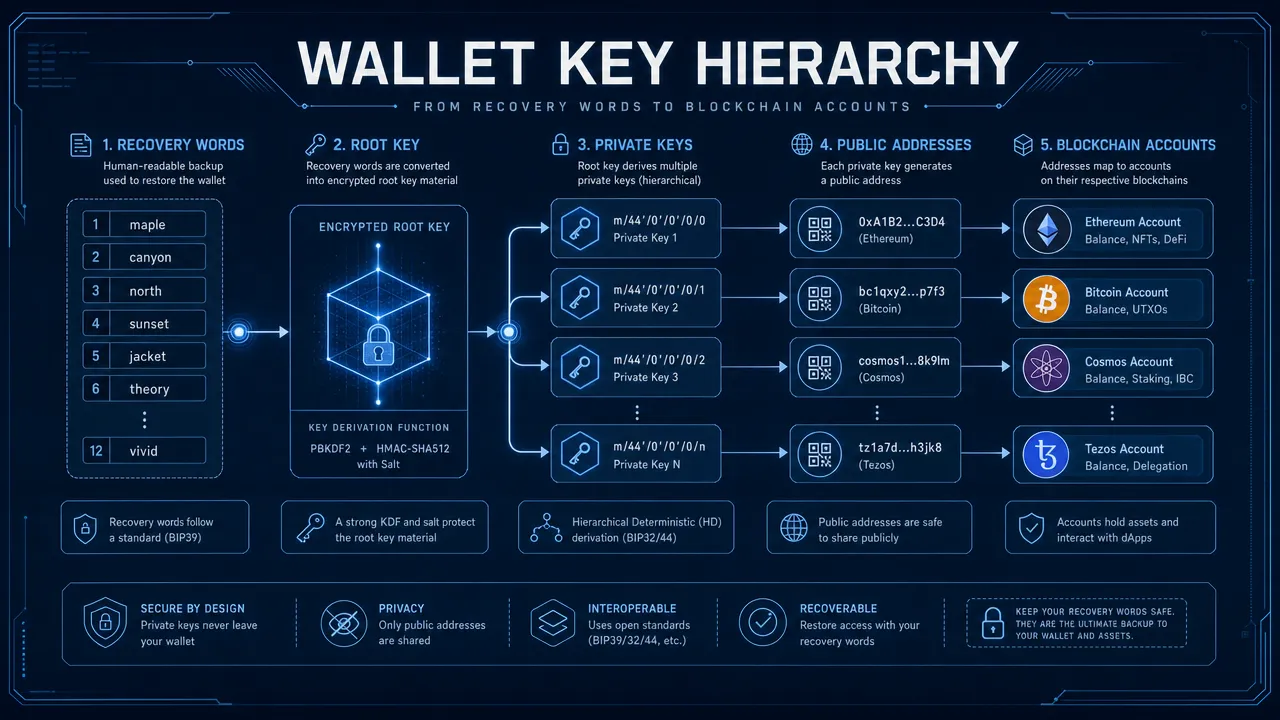
The private key vs seed phrase distinction is one of the most important concepts in cryptocurrency self-custody. Both are highly sensitive secrets, but they serve different roles.
A private key is the direct cryptographic secret used to authorize transactions for a specific account or address context. A seed phrase, also called a mnemonic phrase or wallet recovery phrase, is commonly a series of words that can regenerate the underlying wallet structure, including multiple private keys and accounts.
In practical terms:
- A private key usually controls one account.
- A seed phrase can often restore an entire compatible hierarchical deterministic wallet.
- Either secret can be used to control assets associated with it.
- If someone obtains your seed phrase, the potential impact is usually much broader than exposure of one private key.
| Feature | Private key | Seed phrase |
|---|---|---|
| Main purpose | Signs transactions for a specific account | Backs up wallet material that can derive multiple keys |
| Typical format | Long encoded string | Ordered list of words |
| Scope | Usually one account or imported key | Often multiple accounts and supported chains |
| Can sign transactions directly | Yes | No, the wallet derives private keys first |
| Recovery use | Restores the associated account | Can restore a compatible wallet structure |
| Exposure impact | Puts the related account at risk | Can put many derived accounts at risk |
| Best backup role | Targeted private key backup | Primary backup for a mnemonic-based wallet |
The difference between private key and seed phrase matters because blockchain assets do not live inside the app on your phone or browser. Assets remain recorded on the blockchain. Your wallet holds the credentials needed to prove control and authorize transactions.
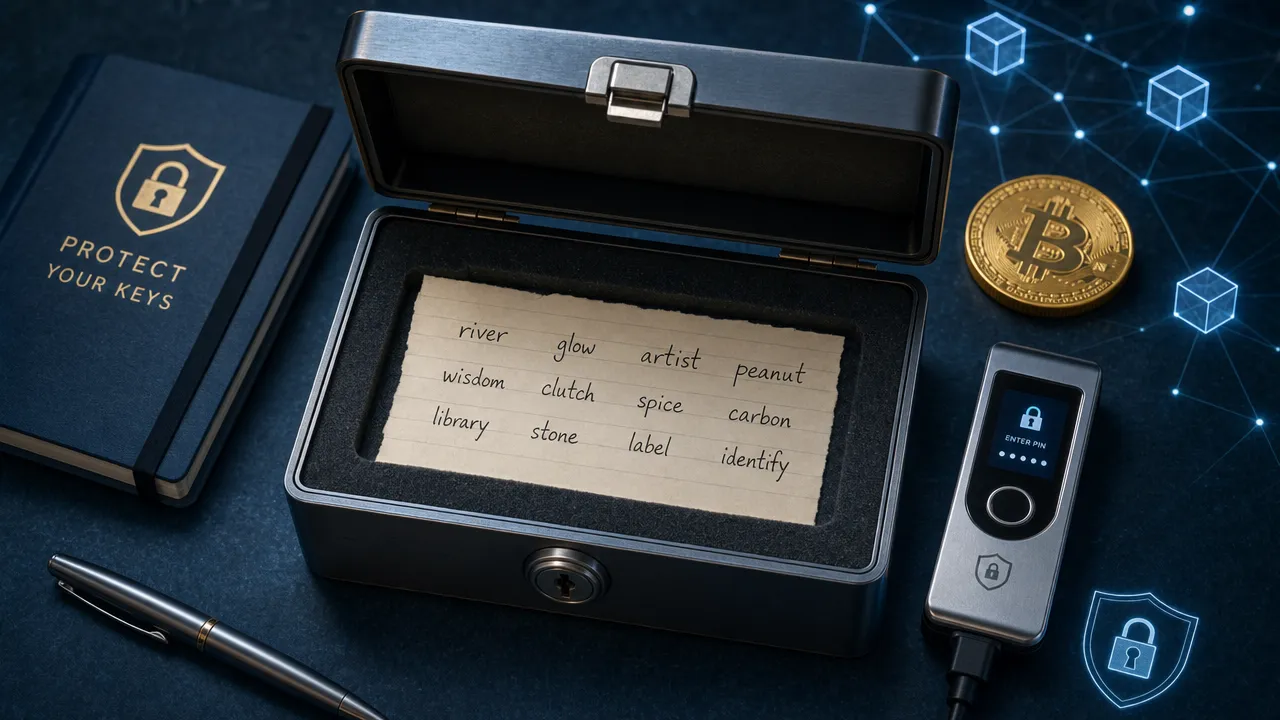
For users practicing cryptocurrency self-custody, the rule is simple: never share either secret, and never enter them into a website, chat, form, or unexpected support request.
Private Key vs Seed Phrase: What Each Secret Does
A private key is a cryptographic value used to produce valid transaction signatures. When you send tokens, approve a transaction, or interact with a decentralized application, the wallet uses the private key for the relevant account to authorize that action.
A public address is derived from public cryptographic information associated with the keypair. You can share a wallet address to receive assets or view its on-chain activity. However, a public address cannot reveal the private key and cannot spend funds.
A seed phrase has a broader role. In many wallets built around BIP-39 and hierarchical deterministic wallet standards, the words are converted into seed material. That seed material is then used to derive a structured tree of private keys.
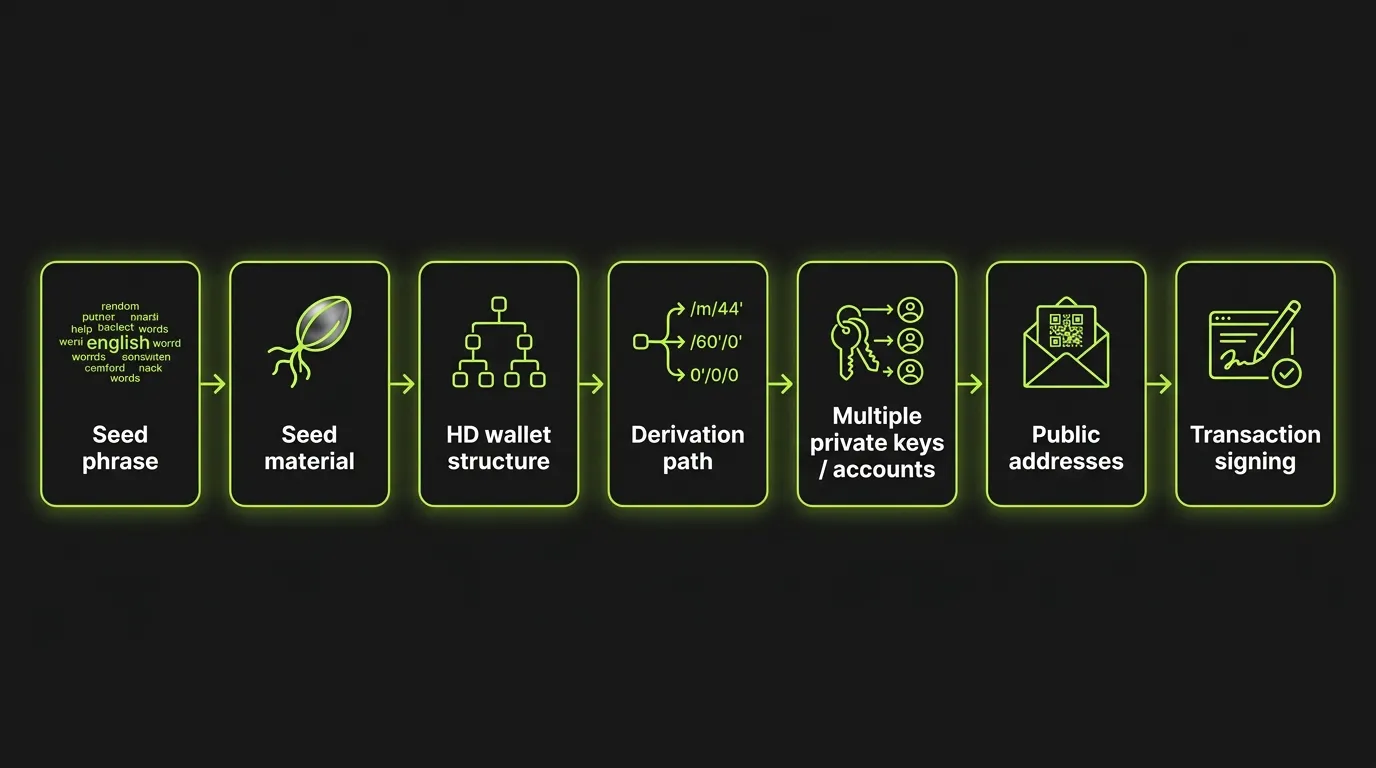
This structure is common, but it is not universal. Different chains and wallet implementations can use different account models, derivation paths, and recovery systems.
According to the BIP-39 mnemonic standard, mnemonic words are converted into a binary seed. The BIP-32 standard describes how hierarchical child keys can be derived, while BIP-44 provides a widely used path convention for organizing accounts across chains.
A useful analogy is:
- A private key is like one key to one secure compartment.
- A seed phrase is like a protected master backup capable of recreating the keyring.
The analogy has limits. A seed phrase does not hold coins, tokens, or NFTs. It gives a compatible wallet the ability to regenerate the signing credentials that control assets recorded on-chain.
Why one seed phrase can create multiple accounts
A typical HD wallet can derive multiple accounts from one seed phrase. Each account can have a separate private key and address, while still being recoverable from the same original recovery phrase.
This is useful for wallet organization. For example, someone might separate long-term holdings from regular DApp activity. However, all accounts derived from one exposed seed phrase should generally be treated as compromised.
FoxWallet account system documentation explains that its mnemonic-based account structure follows BIP-44 conventions, with one mnemonic capable of deriving multiple accounts and each address having its own private key.
Why the same words may show different results elsewhere
A correct seed phrase does not always produce an identical wallet view in every application. Possible reasons include:
- The other wallet uses a different derivation path.
- The account index is different.
- A network is not enabled in the interface.
- The original wallet included imported accounts that were not derived from the phrase.
- The wallet does not scan enough accounts or address indexes automatically.
- An optional BIP-39 passphrase was used.
A BIP-39 passphrase creates different seed material. The same recovery words with and without that optional passphrase lead to different wallet results. Never assume that missing assets mean the seed phrase is invalid before checking compatible wallet settings, account discovery, and supported networks.
Private Key vs Seed Phrase: Recovery and Backup Limits
Seed phrase recovery is often misunderstood. A seed phrase is usually the broader recovery credential, while a private key typically restores only the specific account it controls.
| Available material | What you may be able to do | Important limitation |
|---|---|---|
| Seed phrase | Restore a compatible HD wallet and derived accounts | May require the same passphrase, derivation path, and supported chain |
| Private key | Import and control one associated account | Usually does not restore sibling accounts from the original wallet |
| Keystore file and password | Restore encrypted key material in a compatible wallet | Both the file and correct password are normally needed |
| Unlocked original device | Export or back up the wallet through official settings, if supported | Device security must be assessed first |
| Hardware wallet that still works | Move assets to a newly backed-up wallet | Do not reset it before confirming replacement backup options |
| Public address only | View balances and transactions | Cannot sign transactions or recover credentials |
A wallet password or PIN is also not the same as a wallet recovery phrase. A password generally protects local access to the app or encrypted data on one device. It is not normally a universal recovery method for restoring the wallet elsewhere.
Similarly, a transaction hash is not a recovery credential. It identifies an on-chain transaction but cannot reconstruct a private key. A public address can reveal a balance and transaction history, but it cannot prove ownership or authorize a transfer.
When a private key is enough
If you have the private key for a specific account, you can often import it into a compatible wallet and regain control of that account. This can help if the wallet app was deleted or if you need access to a standalone imported account.
However, private key backup is narrower than seed phrase backup. A single private key usually does not recreate:
- Other accounts derived from the same seed phrase.
- Accounts using other derivation paths.
- Imported keys that were stored separately.
- A complete multi-account wallet structure.
For this reason, exporting private keys unnecessarily can increase risk. Use only trusted wallet flows and avoid copying a private key into notes, cloud storage, email, or messaging apps.
When seed phrase recovery works
If you still have your wallet recovery phrase, use only the official import or restore flow in a trusted wallet application. Install the app from an official source, confirm you are on the legitimate domain or verified app-store listing, and enter the phrase only inside the wallet's intended recovery interface.
FoxWallet provides official guidance for users who need to create or import a wallet. Before sending substantial funds after restoration, verify that you see the expected accounts, networks, and token balances.
If funds appear missing after importing a phrase, do not enter your words into random online recovery tools. First investigate whether the issue involves a different network, an account index, a derivation path, an imported account, or an optional passphrase.
For a detailed look at what can still be possible when the phrase is unavailable, read how to recover a crypto wallet without a seed phrase.
Private Key vs Seed Phrase: What to Do After Exposure
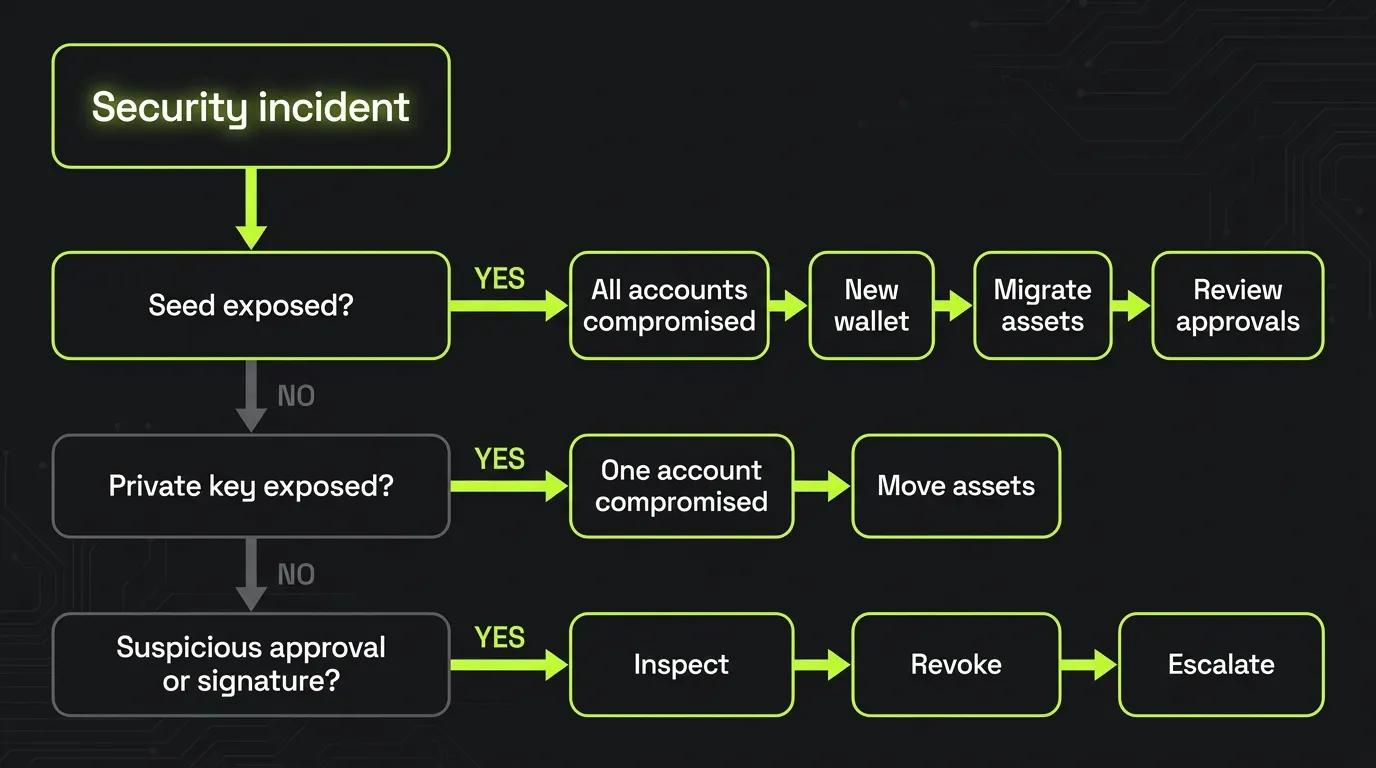
The security consequences of a leaked private key and leaked seed phrase are different, but both require immediate action.
A person who controls a private key may be able to authorize transactions from the account associated with that key. A person who obtains a seed phrase may be able to restore multiple accounts derived from that phrase, depending on wallet compatibility and chain support.
If one private key was exposed
Treat the affected account as compromised. Changing a wallet password or PIN does not invalidate an exposed private key.
Take these steps:
- Create a new wallet or a fresh account with new key material on a trusted device.
- Back up the new recovery phrase offline before moving funds.
- Transfer remaining assets from the exposed account as soon as practical.
- Verify the network and recipient address carefully.
- Review token approvals and connected DApps.
- Stop using the old private key for new deposits.
If a seed phrase was exposed
A leaked seed phrase has a larger potential blast radius. Assume that all relevant accounts derived from that phrase could be accessible to another party.
Do not try to "change" the phrase for the existing wallet. The safe response is migration:
- Create a completely new wallet with a new seed phrase.
- Store the new phrase offline in the correct order.
- Move assets from every relevant account and supported chain.
- Leave enough native network token to cover transaction fees where needed.
- Review and revoke risky token approvals where applicable.
- Update saved receiving addresses and stop using the old wallet.
If you signed a suspicious approval
Not every wallet incident involves a stolen seed phrase or private key. A malicious DApp can sometimes drain approved tokens if you granted it permission to spend them.
If you signed an approval you do not understand:
- Disconnect the DApp.
- Review the transaction history.
- Revoke or reduce unneeded approvals where applicable.
- Consider moving assets if you suspect a broader account or device compromise.
- Do not assume approval revocation reverses a completed theft. It can only limit future use of an active allowance.
You can review relevant guidance in FoxWallet's approval management documentation.
Be especially cautious about messages claiming you must "verify," "sync," "upgrade," or "validate" a wallet by submitting a recovery phrase. Legitimate support teams do not need your seed phrase or private key to help with a public transaction question.
For more warning signs, see how to spot a crypto wallet recovery scam.
Private Key vs Seed Phrase: Crypto Wallet Security Checklist
Strong crypto wallet security combines offline backup habits, device hygiene, transaction awareness, and careful DApp use.

Do this
- Write your seed phrase offline in the exact order shown.
- Keep physical backups in secure locations.
- Consider maintaining a second secure backup in a separate location.
- Use a strong device lock and a distinct wallet password or PIN.
- Download wallet software only from official sources.
- Verify the full domain before connecting to a DApp.
- Read transaction, signature, and approval prompts carefully.
- Check recipient addresses before confirming a transfer.
- Use small test transactions before high-value transfers or unfamiliar cross-chain actions.
- Review token approvals periodically.
- Separate long-term holdings from experimental DApp activity when practical.
Avoid this
- Do not share a seed phrase or private key with anyone.
- Do not take screenshots of recovery words.
- Do not store private credentials in cloud drives, email drafts, notes apps, chats, or photo libraries.
- Do not enter a recovery phrase into a website.
- Do not trust unsolicited direct messages claiming to be wallet support.
- Do not approve unclear or unlimited token permissions without understanding the request.
- Do not rely on a familiar logo alone. Check the full domain and the actual transaction details.
- Do not assume a wallet app can recover secrets that only you controlled.
FoxWallet security tips recommend keeping mnemonic phrases offline and checking DApp domains, transfer details, signature messages, and function calls before confirming an action.
How FoxWallet supports responsible self-custody
FoxWallet is a non-custodial wallet designed to help users manage assets across supported networks while retaining control of their credentials and assets.
FoxWallet Mobile is the primary product for broader multi-chain and Web3 use, including supported-network asset visibility, Discover and DApp access, transaction-risk warnings, and approval-management tools. Availability can vary by chain, feature, and app version. The browser extension has a narrower scope and should not be assumed to match the mobile app feature for feature.
Because FoxWallet is non-custodial, the FoxWallet provider does not hold or have access to users' recovery phrases or private keys and cannot reconstruct or reset them for the user. The wallet app can use locally stored, encrypted credentials to operate the wallet and may expose backup or export workflows when the user authorizes them; that local behavior is different from provider custody.
If you are comparing custody models, custodial vs. non-custodial wallets explains the trade-off between direct control and personal recovery responsibility.
The best final safeguard is a disciplined process: create a wallet through an official channel, record the recovery phrase offline, verify it carefully, fund the wallet with a small test transaction, and remain alert whenever a site asks you to connect, sign, or approve something.