


Best DEX Aggregators for Solana in 2026

A Solana DEX aggregator compares routes across pools, exchanges and, in some cases, request-for-quote liquidity to build a token swap. Different systems can return different results for the same pair because they search different sources, model routes differently and handle execution in different ways. This guide compares five current options, Jupiter, Titan, Kamino Meta-Swap, 1inch and OKX DEX, by routing approach, quote transparency, advanced execution and practical limitations. The best choice depends on the token pair, trade size, available liquidity and conditions at the moment you request a quote.
Best Solana DEX Aggregators at a Glance
No single platform is best for every Solana swap. Jupiter is the strongest general starting point for Solana-native route discovery, while Titan and Kamino add meta-aggregation or competing quote sources. 1inch offers intent-based Solana execution, and OKX DEX provides a multi-chain aggregation stack with a documented Solana integration.
| Platform | Routing approach | Best suited to | Advanced execution | Key limitation |
|---|---|---|---|---|
| Jupiter | Solana-native smart routing across on-chain liquidity, with RFQ liquidity incorporated where available | Most users comparing same-chain Solana routes | Split and multi-hop routing; current Swap V2 integration options | A quote is still time-sensitive, and the most complex route is not always the easiest to evaluate |
| Titan | Solana meta-aggregator that compares aggregator quotes and its own routing | Users who want another price-discovery layer above individual routers | Live quote simulation and route comparison | A meta-aggregated quote can add another layer of execution logic to review |
| Kamino Meta-Swap | Compares on-chain routes, aggregators and RFQ/searcher quotes | Users comparing simulated output across different execution types | Active simulations and Pyth Express Relay RFQ | Some route-level claims depend on the underlying source selected for that swap |
| 1inch | Intent-based Solana swaps fulfilled by competing resolvers | Users who prefer an auction-style execution model | Dutch-auction competition and possible partial fills | An intent can take time, fill partially or remain unfilled |
| OKX DEX | Multi-chain aggregation engine with Solana swap API and SDK support | Users or developers who value one aggregation stack across multiple networks | Solana API/SDK workflow and transaction construction | Less Solana-native than Jupiter, Titan or Kamino as a specialist comparison surface |
The table is a decision aid, not a permanent performance ranking. A route that is competitive for SOL/USDC may not be best for a thinly traded token, and the result can reverse when the amount or liquidity changes. For a broader chain-by-chain view, see FoxWallet’s general DEX aggregator comparison.
How Solana DEX Aggregators Find Better Routes
Solana liquidity is fragmented. The same token pair may be available through constant-product pools, concentrated-liquidity pools, dynamic-liquidity designs, order-style venues, professional market makers or RFQ systems. An aggregator tries to turn those separate sources into one executable path.
The process normally begins with a quote request containing the input token, output token and amount. A router then evaluates possible paths. It may choose a direct pool, route through an intermediate token, split the amount across several pools or compare an on-chain route with a market-maker quote. The output is packaged into a transaction that the user reviews and signs in a wallet.
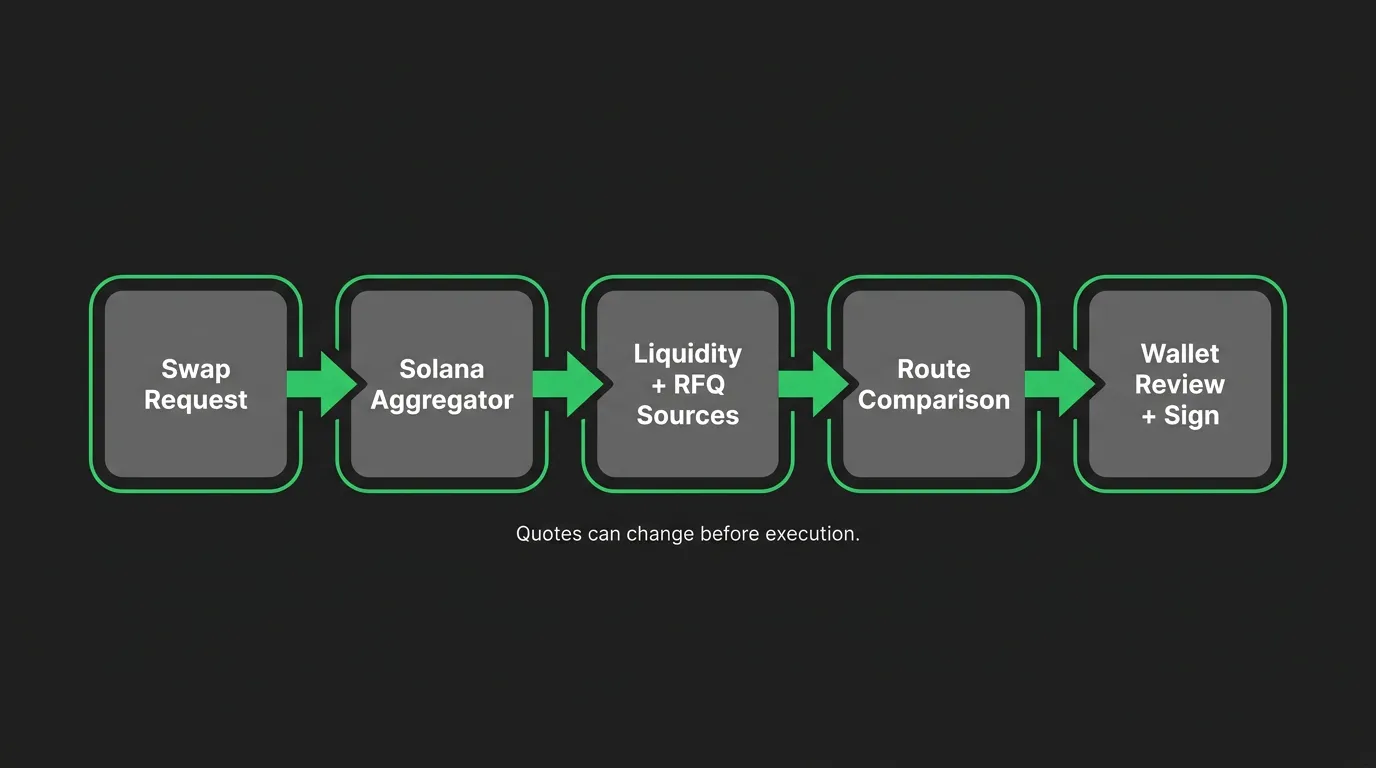
A Solana aggregator compares available execution sources before presenting a transaction for wallet review. Quotes can change before execution.
Two aggregators can show different output for the same pair because they may:
- index different pools or market makers;
- use different intermediate tokens;
- allow or avoid split routes;
- estimate transaction cost and price impact differently;
- refresh quotes at different speeds;
- simulate the route at different points in the process;
- use pool liquidity, RFQ liquidity or a mixture of both.
Split routing can improve output when no single pool has enough depth, but it also creates a larger transaction with more moving parts. Multi-hop routing can unlock a better price through an intermediate asset, but each hop adds execution dependencies. An RFQ route may offer a firm price from a market maker, while a pool route derives output from current on-chain reserves. Neither mechanism wins in every market.
This is why the largest estimated output should not be read in isolation. Compare minimum received, price impact, route complexity, platform or partner fees, expected network cost and whether the quote has been simulated. FoxWallet’s explainer on how DEX aggregators find better swap prices covers those mechanics in more depth.
How We Compare Solana Routing Tools
The most useful comparison starts with execution rather than brand recognition. These are the criteria that matter when deciding whether a quote is worth signing:
- Liquidity access: Which pools, routers, market makers or RFQ systems can contribute to the quote?
- Routing flexibility: Can the platform use direct, multi-hop or split routes when they improve the outcome?
- Expected output and minimum received: Does the interface distinguish the headline quote from the lowest acceptable output after slippage?
- Price impact: Does it show how the trade itself could move the price in the selected liquidity?
- Route transparency: Can you see the intermediate tokens, venues and number of hops involved?
- Execution model: Is the transaction pool-routed, simulated, intent-based or fulfilled by a market maker?
- Transaction handling: Does the platform help set compute, priority or other Solana transaction parameters?
- Token identification: Can you verify the mint address rather than relying on a ticker or logo?
- Practical failure modes: Can the route expire, fail, fill partially or become stale before confirmation?
- Wallet fit: Can the user review and sign the transaction from a compatible self-custody wallet?
Small swaps in deep pools often produce similar results across platforms. Differences become more visible with larger amounts, volatile tokens and fragmented liquidity. Readers evaluating those cases can also use FoxWallet’s focused comparisons for low-slippage routes and large crypto trades.
1. Jupiter: The Strongest General Solana Starting Point
Best for: Users who want a Solana-native default with broad route discovery and detailed swap infrastructure.
Jupiter’s current Swap documentation centers on Swap V2 rather than the older product labels that appeared in earlier generations of its API. Its routing stack can search Solana liquidity, construct multi-hop or split routes and return transaction data to applications and wallets. Jupiter’s 2026 Metis update also explains how JupiterZ V2 RFQ liquidity can participate inside the routing process, allowing market-maker quotes to function as part of a route when available.
That breadth is Jupiter’s main advantage. A route may go directly through one venue, use an intermediate token or divide an amount across sources. Developers get a mature integration surface, while retail users get a familiar Solana swap interface.
Jupiter is still a router, not a guarantee. The displayed quote can change before signing, and a route with more hops can be more complex to inspect. Fast or simplified routing modes may prioritize latency over exhaustive price discovery. Users should compare the expected output with minimum received, confirm the token mint and retain enough SOL for the transaction and any account-creation requirements.
Jupiter should be the first comparison for many same-chain Solana swaps, especially when the pair is available across several venues. It is less relevant when the real objective is moving value to another blockchain; that belongs to a cross-chain routing comparison, not a Solana-only leaderboard.
2. Titan: Meta-Aggregation for Comparing Aggregators
Best for: Users who want to compare the outputs of multiple Solana routing systems rather than depend on one router.
Titan describes itself as both a DEX aggregator and a Solana meta-aggregator. Its official documentation says the interface combines quotes from multiple aggregators with routes produced by its own algorithm. The user sees the selected quote and transaction details, while Titan’s quick-start documentation says quotes are refreshed and simulated on-chain during their valid period.
This differs from a router that searches only its own venue set. A meta-aggregator can discover that another aggregator has a better route for a particular amount and surface that result.
The trade-off is another decision layer. Users should still inspect which underlying route won, what fees apply downstream and whether the route is understandable. Simulation can improve quote realism, but it does not freeze market conditions or eliminate transaction failure. A quote can become stale between simulation, wallet review and landing on-chain.
Titan is most useful as a second opinion. If Jupiter shows a straightforward deep-liquidity path and Titan shows the same outcome, the decision may be simple. If Titan selects a different aggregator or a materially different route, compare minimum received and route details rather than assuming that the highest headline number must be superior.
3. Kamino Meta-Swap: Competing Routes With Active Simulation
Best for: Users who want pool routes, aggregator routes and RFQ-style quotes compared through one Solana interface.
Kamino introduced Meta-Swap as a route-comparison layer that can evaluate sources including Jupiter, DFlow, Raydium and Pyth Express Relay. Its official launch explanation describes an Active Simulation mechanism that repeatedly tests quotes so unavailable or outdated paths can be removed before execution.
Kamino’s distinguishing idea is not simply “more venues.” It is the attempt to compare the realistic received amount across different route types. A pool quote, an aggregator route and an RFQ response can look similar in a table while behaving differently during execution. Re-simulation helps reveal whether a quoted path is still viable at the requested amount.
RFQ competition can be particularly relevant for larger trades because professional searchers or market makers may quote against the request rather than requiring the full amount to move through public pools. That does not mean an RFQ will always win. Availability depends on the pair, size and active participants, and the selected route can still rely on an underlying system with its own assumptions.
Kamino Meta-Swap is worth checking when route realism matters more than having the simplest interface. Users should identify the final execution source, verify the token mint and understand whether the selected quote is an on-chain pool path, an aggregator path or an RFQ response.
4. 1inch: Intent-Based Solana Execution
Best for: Users who want to compare an intent-and-resolver model with conventional pool routing.
1inch is widely known as a DEX aggregator on EVM networks, but it also supports Solana. Its current Solana Fusion documentation describes an on-chain intent submitted to a Dutch auction. Resolvers compete to fill the order and submit the final transaction.
That model changes the user experience. Instead of immediately signing a pre-built multi-pool route, the user publishes the intent and waits for resolvers. The competition can produce a useful rate and includes MEV-resistant execution features described by 1inch, but the fill is not guaranteed. An order may take time, fill partially or remain unfilled if no resolver accepts it competitively. The user also needs a small amount of SOL to place the intent.
1inch therefore belongs in this comparison even though its Solana route is not identical to Jupiter’s smart-order-routing model. It gives users another form of price discovery and may appeal to those who prefer intent-based execution. It is less suitable when the user needs immediate certainty that the full amount will execute in one conventional transaction.
FoxWallet’s current mobile product uses 1inch for built-in Solana Swap. That is a wallet-native workflow: FoxWallet remains the self-custody and signing layer, while 1inch provides the swap execution route. Availability and the exact quote should still be checked inside the current mobile interface before confirming.
5. OKX DEX: Multi-Chain Aggregation With Solana Support
Best for: Users and developers who value a documented aggregation stack that also covers networks beyond Solana.
OKX DEX provides a multi-chain aggregation engine rather than a Solana-only product. Its official Solana integration guide documents both API-first and SDK approaches for requesting a Solana quote, constructing the transaction and broadcasting it. The integration uses Solana-specific addresses and transaction handling rather than treating the chain as an EVM clone.
The advantage is breadth. A wallet or application can use one provider across several networks while still accessing a Solana swap workflow. The developer surface exposes quote and transaction-building steps for products that embed routing.
The limitation is the inverse of that strength: OKX DEX is not as Solana-native in focus as Jupiter, Titan or Kamino. A user comparing only Solana routes may find those specialist interfaces more transparent about Solana-specific venue selection. Developers also need API credentials and should account for integration requirements, response changes and the availability of simulation features.
OKX DEX is most relevant when the decision includes both routing and infrastructure. For a simple retail SOL-to-token swap, it is one quote source to compare—not an automatic replacement for a Solana-native router.
Where Raydium, Orca, Meteora and Lifinity Fit
Raydium, Orca, Meteora and Lifinity remain important to Solana swap execution, but they should not be treated as five interchangeable aggregators. They are primarily DEXs or liquidity venues. Aggregators may route into their pools, and each venue’s design can influence the final path, price impact and available liquidity.
| Venue | Primary role in this comparison | Why an aggregator may use it |
|---|---|---|
| Raydium | Solana DEX and liquidity venue | Pools can provide direct or intermediate liquidity for routed swaps |
| Orca | Solana DEX with concentrated-liquidity pools | Concentrated liquidity can be competitive for specific price ranges and pairs |
| Meteora | Solana liquidity infrastructure and dynamic pool designs | Different pool types can serve volatile, launch-stage or established assets |
| Lifinity | Solana DEX using a proactive market-making design | Its pricing model may create a competitive direct leg for some pairs |
Sometimes the best aggregator route is simply a direct trade through one of these venues. Aggregation does not require a complicated path; it should select complexity only when it improves the expected result. Users who already know a pair has deep liquidity on one DEX can compare the direct quote with the aggregator’s result before signing.
What to Check Before Signing a Solana Swap
Start with the token mint, not the ticker. Solana can contain multiple tokens with similar names and logos. Verify the mint address using an official project source or a trusted registry before reviewing price.
Next, compare quoted output and minimum received. The quote is an estimate; minimum received reflects the lowest output permitted under the transaction’s slippage settings. A very loose tolerance can make execution more likely but expose the swap to a worse price. An extremely tight tolerance can cause failure in a moving market.
Review price impact separately from slippage. Price impact estimates how much the trade changes the pool price because of its size. Slippage tolerance is the execution boundary the user accepts. They are related, but they are not the same value.
Keep enough SOL for network fees and account creation where required. Solana transaction costs are usually small, but a wallet with no spare SOL may be unable to complete the swap or create a needed token account. Intent-based systems can also require SOL when the order is submitted, even if another party handles later execution.
Finally, inspect the route and transaction. Check intermediate tokens, number of hops, selected venues, platform fees and any warning shown by the wallet. If the quote has changed materially during review, refresh it rather than approving an old transaction.
Using Solana Aggregators With FoxWallet
FoxWallet is not another Solana DEX aggregator. On mobile, it is the self-custody wallet layer used to manage Solana assets, review transactions and approve or reject on-chain actions. Its built-in Solana Swap flow currently uses 1inch, while external Solana DApps can be reached through the mobile DApp browser when compatible.
A practical workflow is:
- Verify the input and output token mint addresses.
- Request a current quote through the built-in Swap flow or a compatible external aggregator.
- Compare expected output, minimum received, price impact and fees.
- Confirm the network and route shown in the wallet.
- Sign only when the transaction matches the intended swap.
FoxWallet’s browser extension should not be assumed to have the same swap surface as the mobile app. Users who want the documented mobile Swap and DApp flows should use the current FoxWallet mobile product and check the available options in-app.
Solana DEX Aggregator FAQs
What is a Solana DEX aggregator?
A Solana DEX aggregator is a routing service that compares liquidity and execution paths across multiple Solana sources. It can select a direct pool, use intermediate tokens, split a trade or compare pool-based routes with RFQ liquidity, depending on the platform.
Which Solana DEX aggregator gives the best price?
There is no permanent winner. Jupiter is the strongest general starting point, but Titan, Kamino Meta-Swap, 1inch or OKX DEX may return a different result for a particular pair and amount. Compare current output, minimum received, fees and route details immediately before signing.
Why do Jupiter and other aggregators show different routes?
They may search different liquidity sources, apply different routing algorithms, refresh at different times or use different execution models. One may split the trade across pools, another may choose an intermediate token, and another may use an RFQ or resolver quote.
Can a Solana aggregator split one swap across multiple pools?
Yes. Split routing is supported by some aggregators when dividing the amount is expected to improve output. A split route can reduce price impact, but it also creates a more complex transaction and is not always superior to a deep direct pool.
Does a Solana DEX aggregator charge fees?
Fee models vary. A platform may charge no additional interface fee while the underlying route includes pool fees, network fees or partner fees. Intent and RFQ systems can account for costs differently. Review the current quote and transaction rather than relying on a general “zero fee” label.
Do I need SOL to use a DEX aggregator?
Usually, yes. SOL is used for Solana network fees and may be needed for token-account creation or publishing an intent. Keep a small balance outside the amount being swapped so the transaction can be submitted.
Is using an aggregator safer than trading directly on a DEX?
Aggregation can improve route discovery, but it does not remove smart-contract, token, wallet, liquidity or execution risk. Verify the domain, token mint, route and transaction details. A direct DEX route can be reasonable when its liquidity is deep and the user understands the venue.
Which Solana Aggregator Should You Try First?
Start with Jupiter when you want a broad Solana-native route comparison. Check Titan when you want a meta-aggregated second opinion, and Kamino Meta-Swap when active simulation and competing route types are important. Consider 1inch for intent-based resolver execution and OKX DEX when multi-chain infrastructure or developer integration is part of the decision.
The final choice should be made per swap. Verify the token mint, compare minimum received rather than headline output alone, keep enough SOL for execution and review the transaction in a self-custody wallet before signing.