


Best DEX Aggregators for Low Slippage in 2026

The best DEX aggregators for low slippage in 2026 are CoW Swap for MEV-protected intent execution, Hashflow for RFQ-based quote certainty, 1inch for broad multi-chain route optimization, ParaSwap/Velora for aggregation plus intent-based execution, and Odos for advanced smart order routing on EVM chains. The right choice depends on your trade size, token pair, chain, and whether MEV protection matters more than raw output.
In 2026, finding a DEX aggregator low slippage route is less about chasing a single headline quote and more about understanding execution quality. A swap can look attractive at first glance, then become less competitive once price impact, gas, MEV exposure, bridge fees, route complexity, and failed transaction risk are included.
A decentralized exchange aggregator helps users compare liquidity across multiple decentralized exchanges and routing sources instead of relying on one pool. As CoinGecko explains in its DEX aggregator overview, aggregators scan multiple DEXs to find better swap paths. Slippage, as Uniswap defines it, is the difference between the expected price and the actual executed price.
That means the best DEX aggregator for one swap may not be the best DEX aggregator for another. The right choice depends on trade size, token pair, chain, liquidity depth, routing logic, MEV protection swaps, and whether you are doing same-chain swaps or cross-chain token swaps.
FoxWallet approaches this topic from the wallet layer: a secure, non-custodial, multi-chain wallet that helps users manage assets, review routes, and execute built-in swaps without giving up control of private keys.
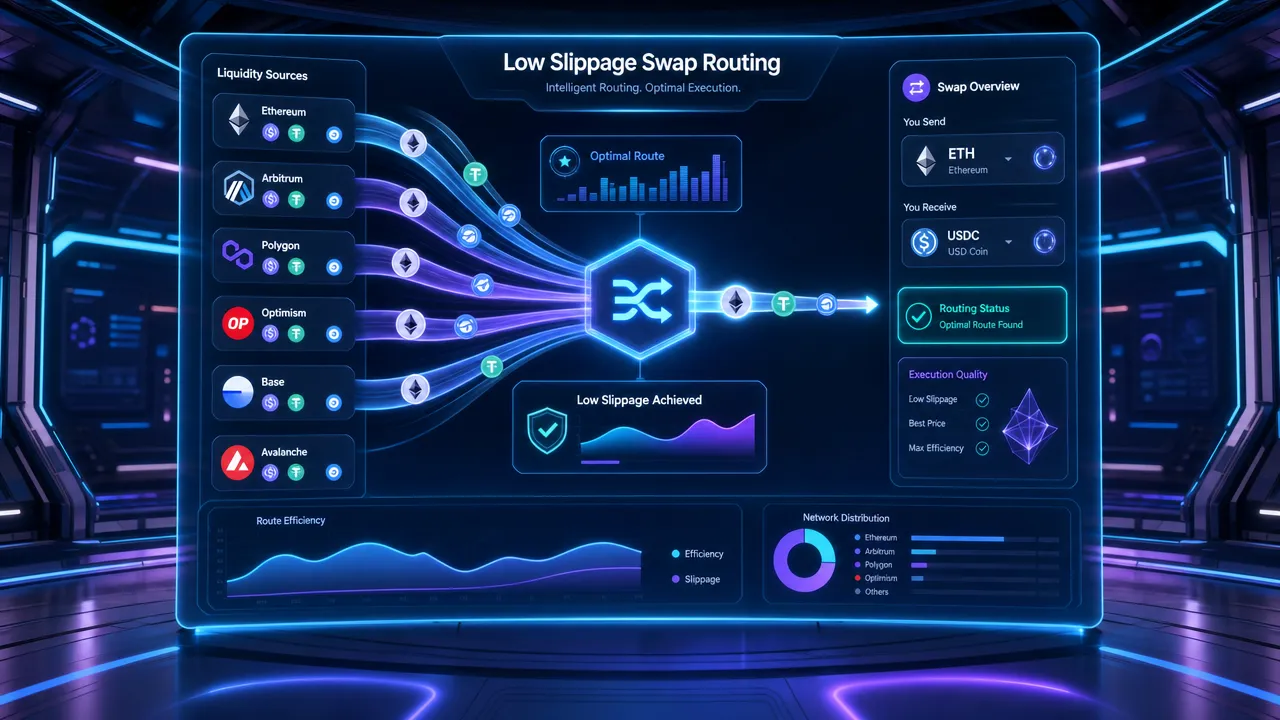
DEX aggregator low slippage basics: what a DEX swap aggregator actually does
A DEX swap aggregator is a routing layer. Instead of asking one decentralized exchange for a price, it checks multiple liquidity venues and estimates which route can produce the strongest execution outcome. That may include a direct pool, a multi-hop route, a split route across several pools, an RFQ quote, an intent-based route, or a cross-chain path.
For low slippage trading, the key is not just "best quoted output." A route should be judged by minimum received, price impact, gas, fees, bridge assumptions, execution time, and risk signals.
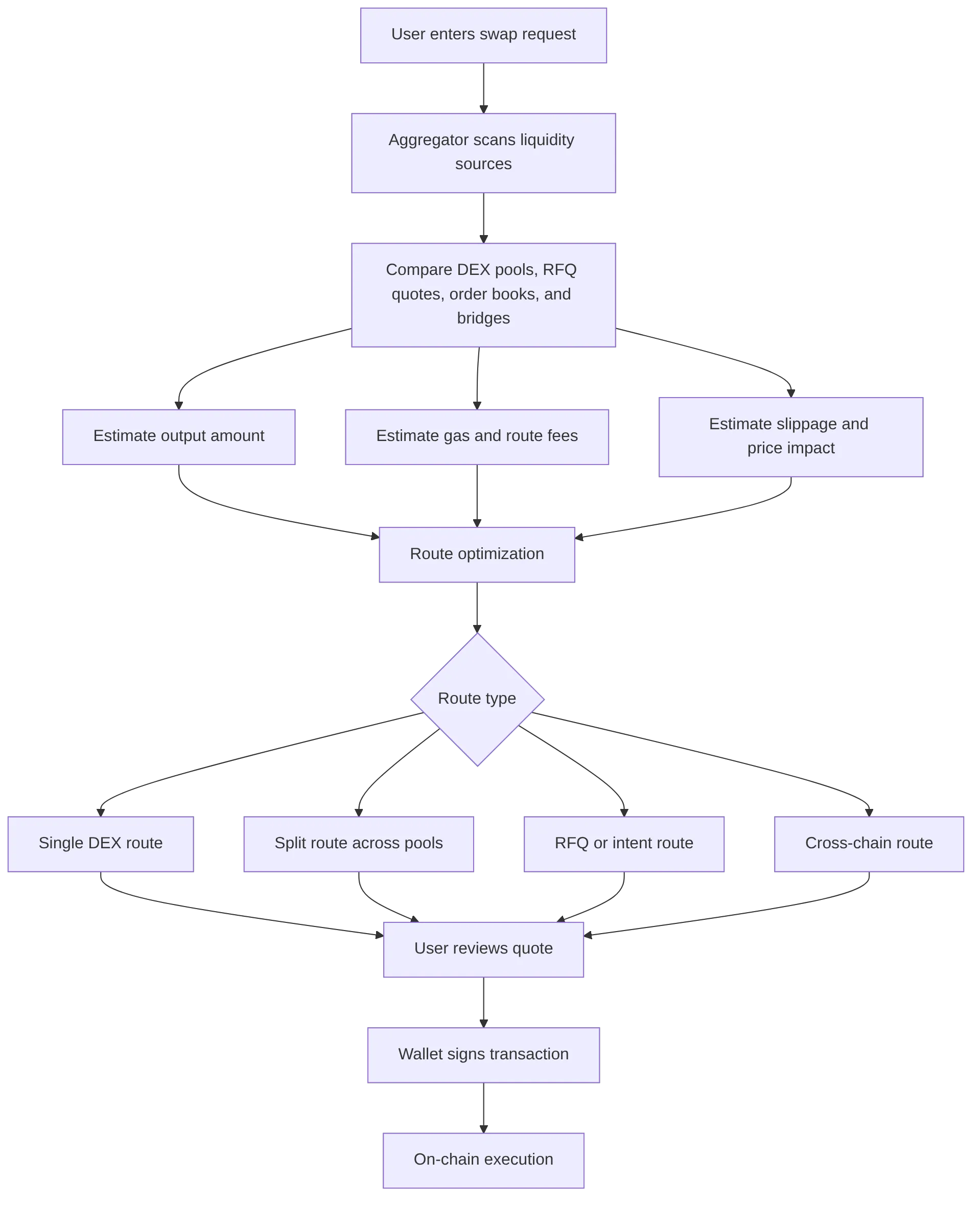
In practical terms, a decentralized exchange aggregator is useful because DeFi liquidity is fragmented. Liquidity can sit on different chains, L2s, AMMs, on-chain order books, bridge networks, and private quote systems. Manually checking each route is slow and risky. Aggregators automate comparison, but users still need to understand what the route is doing.
A "best price crypto swaps" experience should therefore show more than one number. It should help users evaluate:
| Factor | Why it matters for low slippage trading | What to check before swapping |
|---|---|---|
| Expected output | Shows the estimated token amount | Compare across routes |
| Minimum received | Shows the worst acceptable execution amount | Avoid setting tolerance blindly |
| Price impact | Shows how much the trade affects liquidity | Watch for high impact on thin pools |
| Gas and fees | Affects final value received | Compare total execution cost |
| Route complexity | More hops can add risk or cost | Review pools, bridges, and steps |
| MEV exposure | Public mempool execution can worsen fills | Look for protection mechanisms |
| Cross-chain assumptions | Bridges add technical and timing risk | Review destination chain and ETA |
FoxWallet's own swap education also emphasizes practical concepts like gas fees, slippage, and minimum received in its guide to seamless cross-chain ETH swaps. For users, these details are often the difference between a route that looks cheap and a route that actually settles well.
DEX aggregator low slippage ranking factors for 2026
A DEX aggregator low slippage comparison should focus on mechanisms, not marketing claims. No aggregator can reliably be "always lowest slippage" across every chain, pool, token, and market condition. A better framework is to ask which tool has the strongest mechanism for the route you need.
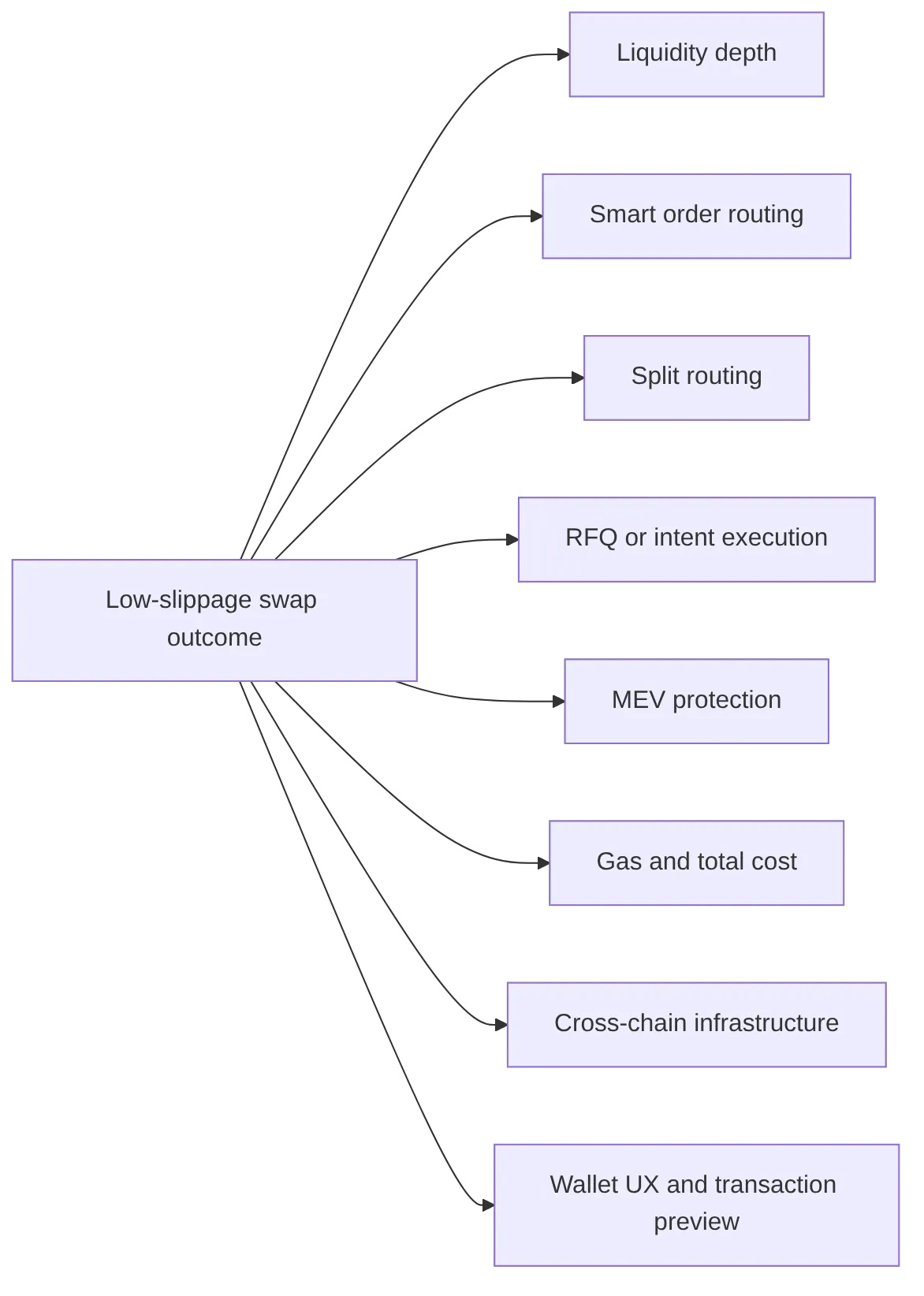
Liquidity depth
Deep liquidity reduces price impact. If a pool is shallow and your swap is large relative to its liquidity, your own trade can move the price. This is why two routes can show very different outcomes for the same token pair.
For low slippage trading, users should compare output and price impact across several sources, especially for volatile or long-tail tokens.
Multi-DEX routing and split routing
Multi-DEX routing lets an aggregator check multiple venues. Split routing goes further by dividing a swap across several pools to avoid overloading one source of liquidity. This can be especially useful for larger trades.
However, more complex routing is not always better. A route with many hops may increase gas costs. The best route is the one with the strongest total execution result, not necessarily the most complicated route.
RFQ and intent-based execution
RFQ routes use quotes from market makers. Intent-based execution lets users specify an outcome while solvers or agents compete to execute it. These models can help reduce uncertainty in certain conditions, especially when AMM liquidity is fragmented or when MEV risk is meaningful.
MEV protection
MEV can affect DEX execution through transaction ordering, sandwich attacks, or other adverse behaviors. MEV protection swaps try to reduce these risks through private order flow, batch auctions, solver competition, or other mechanisms. MEV protection can reduce certain risks, but it does not eliminate all execution uncertainty.
Gas and total execution cost
A route with slightly more output may be worse after gas. For cross-chain token swaps, bridge or messaging fees may also matter. Users should compare final value, not just token output.
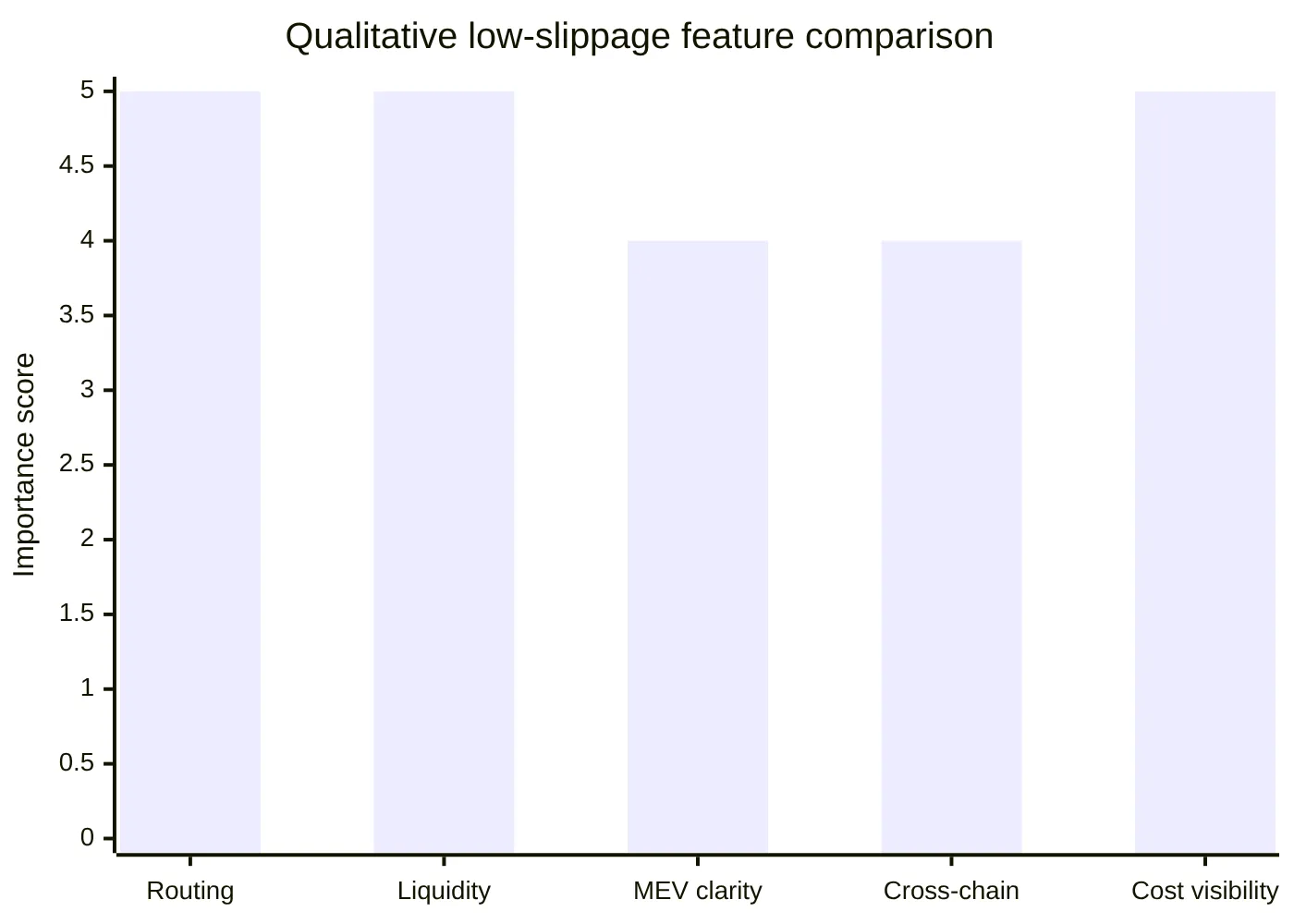
This chart is qualitative, not a live benchmark. It shows how important each category is when evaluating a DEX aggregator low slippage route.
DEX aggregator low slippage list: best-fit aggregators by mechanism
Below is a mechanism-based list of notable DEX aggregator options users commonly compare in 2026. This is not investment advice, not a live performance benchmark, and not a claim that any one platform always delivers the lowest slippage.
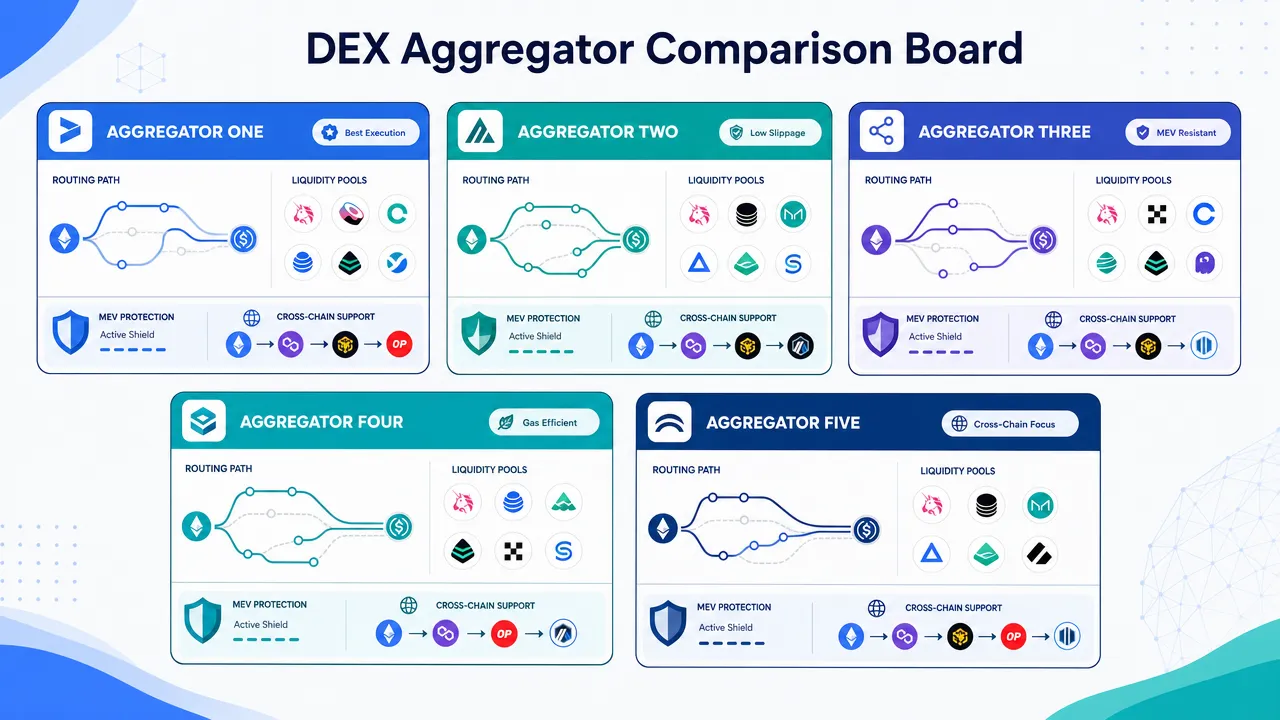
The more useful question is: "Which execution model fits this swap?" A user swapping a large liquid asset pair may need deep routing. A user worried about sandwich attacks may prioritize MEV protection swaps. A user moving assets across chains may care more about cross-chain route clarity and wallet-side review.
| Aggregator | Primary model | Low-slippage strength | MEV protection clarity | Cross-chain relevance | Best-fit user |
|---|---|---|---|---|---|
| Hashflow | RFQ-based trading | Quote-driven execution and market-maker liquidity | Public messaging emphasizes no MEV | Multi-chain positioning | Users seeking quote certainty |
| CoW Swap | Intent and batch auctions | Solver competition and batch execution | Strong public MEV protection positioning | Multi-chain availability varies by deployment | MEV-sensitive traders |
| ParaSwap / Velora | Aggregation plus intent-based execution | Route aggregation and agent competition | Public MEV protection messaging | Cross-chain trading positioning | Users wanting aggregation plus intents |
| Odos | Smart order routing | Complex routing and multi-token paths | Less central in public positioning | Stronger same-chain/EVM routing emphasis | Advanced DeFi route optimization |
| 1inch | Broad aggregation and routing | Route optimization and split routing | Product-level protection features | Broad multi-chain positioning | Users who want wide chain and liquidity coverage |
Hashflow: RFQ-style certainty
Hashflow is often associated with RFQ-based trading. The main idea is that market makers provide quotes, which can help reduce uncertainty around AMM price impact. This can be useful when a user wants clearer execution terms, although users should still check quote expiry, supported chains, and total cost.
CoW Swap: MEV-aware intent execution
CoW Swap is known for intent-based trading, batch auctions, and solver competition. Its model is especially relevant for users who care about MEV protection swaps. That said, chain support, token availability, and route quality still vary by market conditions.
ParaSwap / Velora: aggregation plus intents
ParaSwap, now associated with Velora branding in current materials, combines DEX aggregation with intent-based concepts. Its appeal is a blend of routing and competitive execution. Users should pay attention to naming, supported networks, and route details to avoid confusion.
Odos: advanced smart order routing
Odos is known for sophisticated smart order routing and complex pathing, including multi-token workflows. This makes it especially interesting for advanced users who understand route construction. As always, route complexity should be compared against gas and execution risk.
1inch: broad route optimization
1inch is one of the most recognized DEX aggregator brands, with broad multi-chain positioning and route optimization. It can be a strong option for users comparing many liquidity sources, but the best route still depends on the token pair, chain, fees, and timing.
The important takeaway: the best DEX aggregator is route-specific. For one swap, RFQ may be attractive. For another, multi-DEX routing may win. For another, MEV protection may matter more than the headline output.
DEX aggregator low slippage and cross-chain token swaps
Cross-chain token swaps add another layer of complexity. A same-chain swap usually involves liquidity pools and routing on one network. A cross-chain swap may involve a bridge, messaging layer, relayer, destination-chain execution, wrapped assets, and gas requirements on the receiving chain.
For this reason, DEX aggregator low slippage comparisons should treat cross-chain routes differently from same-chain routes. The lowest quoted output difference may not matter if the route has higher bridge risk, slower settlement, unclear fees, or confusing destination asset details.
Chainlink's bridge vulnerability guide explains that cross-chain bridge risks can include smart contract bugs, validator assumptions, and key management issues. Chainalysis has also highlighted bridge hacks as a major historical DeFi security concern.
For users, that means cross-chain token swaps require a broader checklist:
| Cross-chain consideration | Why it matters | What users should review |
|---|---|---|
| Bridge or messaging route | Adds technical assumptions | Which route moves the asset between chains |
| Destination asset type | Output may be native or wrapped | Confirm the exact token received |
| Destination gas | Users may need gas on the receiving chain | Check whether you can transact after receiving |
| Estimated time | Cross-chain routes may take longer | Review ETA and status tracking |
| Fees | Bridge, relayer, and gas fees can vary | Compare total cost, not only output |
| Security signals | Malicious contracts and phishing remain risks | Use wallets with transaction warnings |
| Route failure handling | Cross-chain failures can be harder to resolve | Understand refund or recovery process |
FoxWallet has published additional guidance on cross-chain swap risks in 2026, including why route review, approval hygiene, and destination-chain verification matter. For users who move assets across chains often, this education is just as important as finding the lowest slippage number.
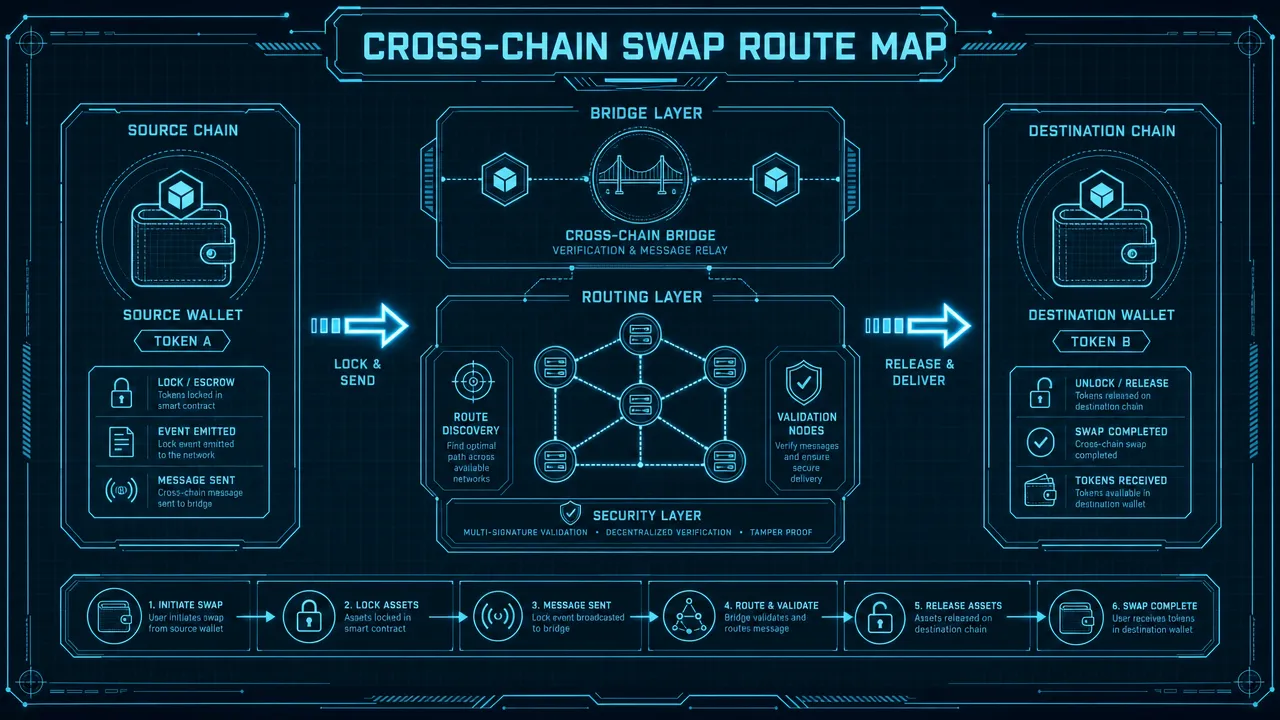
Cross-chain routes can be powerful, but they should not be treated as simple one-click trades without review. A route may include both swap and bridge logic. Users should confirm the source chain, destination chain, expected output, minimum received, estimated time, and any additional permissions before signing.
DEX aggregator low slippage with FoxWallet: why the wallet layer matters
Because swap execution depends on routes, liquidity, fees, permissions, and risk signals, the wallet layer matters. FoxWallet is not positioned here as a standalone DEX aggregator. Instead, FoxWallet is a non-custodial, multi-chain decentralized wallet that helps users manage assets and interact with DeFi and DApps across mobile and browser extension environments.
With FoxWallet, users retain control of their private keys and assets. Private keys and mnemonic phrases are stored locally with encryption, and FoxWallet does not access or hold user funds. This non-custodial structure is especially important when users are signing swaps, approvals, and cross-chain transactions.
FoxWallet is relevant to DEX aggregator low slippage workflows in four practical ways:
| FoxWallet capability | User value in swap execution |
|---|---|
| Multi-chain asset management | View assets and balances across chains in one place |
| Built-in swap access | Reduce the need to jump between external interfaces |
| Route and fee review | Help evaluate output, slippage, fees, and execution steps |
| Security-first transaction flow | Use risk alerts, contract recognition, and phishing protection |
| Mobile and browser extension support | Swap and manage assets across different user workflows |
| Non-custodial signing | Keep control of private keys while interacting with DeFi |
FoxWallet's article on multi-chain wallet bottlenecks explains why multi-chain usability is not only about bridging. Asset visibility, route transparency, fee clarity, and security alerts all affect the final user experience.
For beginners, a wallet-integrated swap experience can reduce confusion. For advanced users, it can help streamline high-frequency, multi-chain, and DeFi-native interactions. For professional users, it supports more structured asset management and route review while maintaining self-custody.
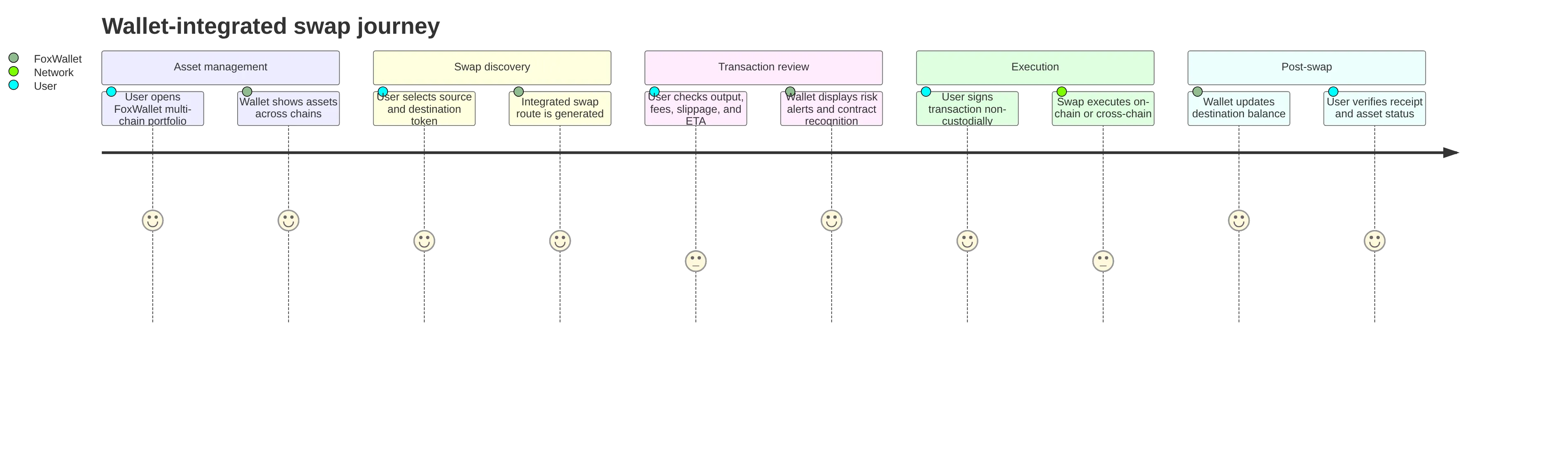
FoxWallet's role is to make the swap process more understandable and safer to review. It can help users access built-in multi-chain swap capabilities and evaluate route details, but users should still compare quotes and understand that no wallet or aggregator can guarantee the lowest slippage in every market condition.
For readers who want a broader comparison of aggregator mechanics, FoxWallet also provides a related guide to the top DEX aggregators in 2026.
DEX aggregator low slippage checklist: how to choose the best route
The best DEX aggregator decision starts with your specific swap. Before signing, use this checklist to evaluate whether a route supports low slippage trading and reasonable total execution cost.
| Question | Why it matters |
|---|---|
| Is the token pair liquid? | Thin liquidity increases price impact |
| Does the route use multi-DEX routing? | More sources may improve execution |
| Is the route split across pools? | Split routing can reduce large-trade impact |
| Is the output firm or estimated? | RFQ and AMM routes behave differently |
| Is MEV protection available? | MEV exposure can worsen execution |
| What is the minimum received? | This is your downside execution threshold |
| What are the gas and route fees? | Best output may not mean best net result |
| Is the swap cross-chain? | Bridge and destination-chain risks apply |
| Are approvals reasonable? | Excessive approvals can create security risk |
| Does your wallet show risk alerts? | Warnings can help prevent unsafe signing |
For a practical process, follow these steps:
- Start with the token pair and chain. Confirm whether you need a same-chain swap or cross-chain token swaps.
- Compare at least two route options when available. Do not rely only on a headline number.
- Review minimum received, gas, route steps, and estimated time.
- Watch for high price impact warnings, especially on long-tail assets.
- Consider MEV protection swaps for routes where sandwich risk may be relevant.
- Use a secure, non-custodial wallet that helps you review permissions and transaction details.
- Keep enough native gas on both source and destination chains when needed.
- Avoid signing if the route, token contract, or approval request looks suspicious.
For most users, the "best price crypto swaps" experience comes from combining a strong DEX swap aggregator route with a secure wallet workflow. Aggregators help search liquidity. Wallets help users manage assets, review transactions, and sign safely.
Final takeaway: DEX aggregator low slippage execution in 2026 is about route quality, not slogans. Hashflow, CoW Swap, ParaSwap / Velora, Odos, and 1inch each highlight different mechanisms, from RFQ quotes and intent execution to smart order routing and broad multi-chain coverage. The best DEX aggregator for your swap depends on your token pair, chain, trade size, MEV exposure, and cross-chain needs.
Use FoxWallet to manage multi-chain assets, review swap routes, and execute cross-chain swaps from a secure, non-custodial wallet experience.
FAQ
What is the best DEX aggregator for low slippage in 2026?
The best DEX aggregator for low slippage depends on your swap type. CoW Swap is the strongest option for MEV protection through batch auctions and solver competition. Hashflow is best for quote certainty through RFQ-based execution. 1inch offers the broadest multi-chain route optimization. Odos excels at complex smart order routing on EVM chains. ParaSwap/Velora combines aggregation with intent-based execution. For all of these, access is available through FoxWallet's built-in DApp browser.
What is slippage in crypto swaps?
Slippage is the difference between the expected price when you submit a swap and the actual executed price when it confirms on-chain. It happens because liquidity pools change between the time you request a quote and the time your transaction executes. Low slippage is especially important for large trades, volatile token pairs, and shallow liquidity pools.
What is MEV and why does it affect slippage?
MEV (Maximal Extractable Value) refers to profit that can be extracted by reordering, inserting, or censoring transactions in a block. Sandwich attacks are the most common MEV impact on swaps — a bot detects your pending transaction, executes a trade before and after it to profit from the price movement. MEV protection mechanisms (used by CoW Swap, Hashflow, and others) reduce this risk through private order flow, batch auctions, or solver competition.
What is RFQ trading in DeFi?
RFQ (Request for Quote) is a model where market makers provide firm price quotes for a swap rather than relying on AMM pool math. This can reduce price impact uncertainty because the quote is pre-agreed before execution. Hashflow is the most commonly cited RFQ-based DEX aggregator in 2026.
What is the difference between same-chain and cross-chain slippage?
Same-chain slippage comes from liquidity pool price impact and MEV exposure on one network. Cross-chain slippage adds bridge fees, messaging layer costs, wrapped asset risks, and destination-chain gas requirements. Cross-chain routes need a separate checklist — a low-slippage same-chain route comparison does not automatically apply to cross-chain token swaps.
How does FoxWallet help with low slippage swaps?
FoxWallet is a non-custodial multi-chain wallet that provides built-in swap access, route and fee review, risk alerts, and phishing protection across 30+ chains. It does not replace DEX aggregators — it gives users a secure wallet layer to review and sign swap transactions without giving up control of private keys. All major DEX aggregators including CoW Swap, 1inch, Odos, and Hashflow are accessible through FoxWallet's DApp browser.
How do I reduce slippage on a DEX swap?
To reduce slippage: use an aggregator that splits routes across multiple pools, compare at least two route options before signing, check price impact warnings especially on long-tail tokens, consider MEV protection for larger trades, avoid swapping during high network congestion, and set a reasonable minimum received threshold — not too tight (transaction failure) and not too loose (poor execution).