


Top 5 DEX Aggregators in 2026: Find Your Best Crypto Route

A DEX aggregator compares swap routes across decentralized exchanges, pools, market makers and, in some cases, solver or bridge networks. This guide compares five established options, 1inch, LI.FI, Jupiter, Odos and Velora, because they represent different routing models and ecosystem strengths. Route quality is not fixed: the best result can change with the token pair, blockchain, trade size, liquidity, gas and market conditions. There is no universal winner, so the useful question is which aggregator fits the transaction you actually need to make.
Top 5 DEX Aggregators in 2026 at a Glance
| Platform | Primary routing model | Best suited to | Ecosystem positioning | Cross-chain capability | Key limitation |
|---|---|---|---|---|---|
| 1inch | Liquidity aggregation, split routing and resolver-based execution | General EVM swaps and users comparing classic and intent-style execution | Multi-network, with deep EVM roots | Available through selected 1inch products and routes | Product modes and route details can be complex |
| LI.FI | Route composition across DEXs, bridges and solvers | Cross-chain transfers and embedded wallet or app flows | Multi-chain infrastructure | Core product focus | Execution inherits the risks and constraints of underlying providers |
| Jupiter | Competing Solana routing engines, on-chain routes and RFQ liquidity | Solana token swaps | Solana-focused | Not the focus of this comparison entry | Limited relevance for users who primarily trade on EVM networks |
| Odos | Smart order routing with multi-path and multi-token execution | Advanced EVM routing and portfolio rebalancing | EVM-focused | Separate cross-chain functionality exists, but route availability must be checked | Advanced routes can require more careful review |
| Velora, formerly ParaSwap | Multipath routing, RFQ liquidity and intent-based execution | EVM users comparing aggregator and market-maker routes | EVM and selected cross-chain flows | Supported through current Velora products on selected routes | The rebrand and multiple execution modes can confuse returning ParaSwap users |
These are use-case positions, not permanent rankings. A platform that produces the strongest quote for one pair may not do so for another. Compare the minimum amount received, gas, platform or integrator fees, approval requirements and execution model before signing.
What DEX Aggregators Do, and Why the Best Quote Can Change
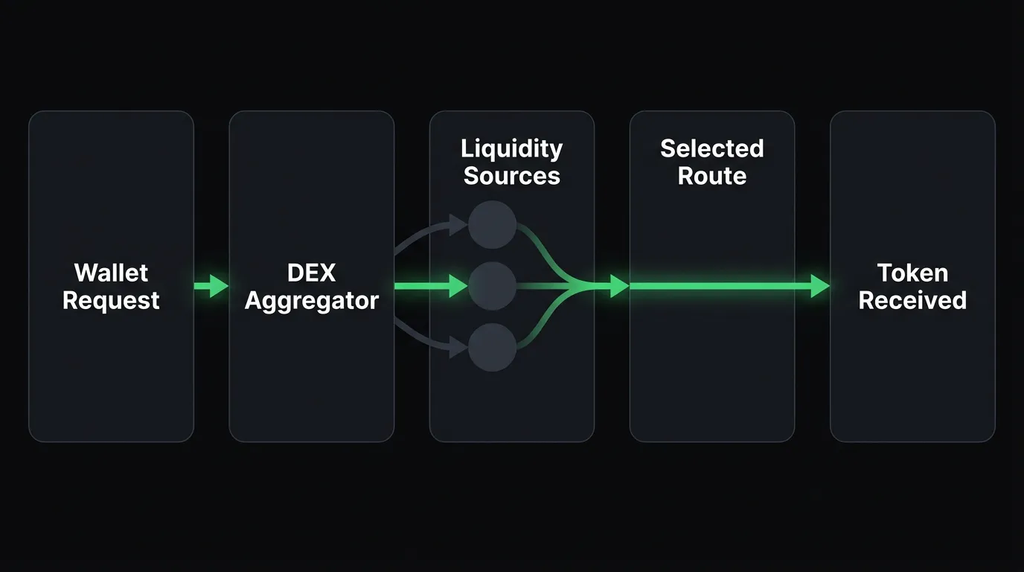
A decentralized exchange normally exposes the liquidity available through its own pools, order books or market makers. A DEX aggregator queries multiple sources and constructs a route intended to improve execution. That route may use one pool, split an order across several pools, pass through an intermediate token or request quotes from professional market makers.
For a deeper explanation of the underlying price-discovery process, see FoxWallet’s guide to how DEX aggregators help users find better swap prices.
The displayed exchange rate is only one part of the outcome. A useful comparison includes:
- Expected output: the quantity shown before the transaction is submitted.
- Minimum received: the protected minimum after the selected slippage tolerance.
- Price impact: the effect of the trade on the liquidity used by the route.
- Network cost: gas and any additional transaction required for approval.
- Platform or integration fees: any fees disclosed by the interface or route provider.
- Execution risk: the possibility that the quote expires, the transaction fails or the market moves before settlement.
- Route complexity: the number of pools, intermediaries, bridges or solver steps involved.
This is why “supports the most chains” does not mean “delivers the best execution.” Coverage is useful only when the relevant pair has competitive liquidity and a route the user can understand. Likewise, splitting a trade across more pools may reduce price impact, but an extra hop can add gas or another contract interaction. The best route is the best net result for that transaction, not the most elaborate path.
A DEX aggregator is also different from a wallet and a bridge. The aggregator searches for or constructs execution. The wallet controls keys and signs the resulting transactions. A bridge or cross-chain liquidity network moves value between blockchains. Some products combine these roles in one interface, but the underlying risks remain distinct.
How We Compared the Five Platforms
We compare the five platforms using routing quality, liquidity access, chain coverage, slippage controls, gas awareness, execution model, usability, wallet compatibility and transparency. Rather than assigning arbitrary scores, these criteria are used as a decision framework for different types of swaps.
We retained five primary entries because each represents a distinct route type:
- 1inch for broad multi-source aggregation and resolver-based execution.
- LI.FI for cross-chain route composition.
- Jupiter for Solana-native aggregation.
- Odos for advanced EVM routing and multi-token swaps.
- Velora, formerly ParaSwap, for multipath, RFQ and intent-based execution.
Current product documentation was prioritized over historical volume, user or liquidity-source counts. Those figures can change quickly and rarely tell a user whether a specific quote is good. The comparison therefore focuses on how each platform routes, where it fits, and what a user should verify.
1. 1inch: Broad Routing for EVM-Focused Swaps
Best for: users who want to compare liquidity across major EVM ecosystems and choose between conventional aggregation and resolver-based execution.
1inch uses aggregation to compare routes across liquidity sources. Its routing can split a transaction across sources when that produces a better result than sending the entire amount through one pool. The platform also offers Fusion-style execution, where resolvers compete to fill signed orders and can cover gas through the execution model.
That distinction matters. A classic on-chain route and an intent-style order are not simply two visual themes for the same transaction. They can differ in how the trade is filled, who submits it, whether native gas is required and what can happen if no resolver accepts the order.
Main advantage: 1inch gives users several execution paths within a mature aggregation environment. It is a useful baseline quote for many EVM token pairs, particularly when a direct DEX route would otherwise concentrate the order in one pool.
What to watch: route details can be demanding for new users. Check whether the interface is showing classic aggregation, Fusion or a cross-chain product; review the minimum received; and confirm any token approval before signing. Availability can vary by network, token and jurisdiction.
Who should consider it: EVM users who want a general-purpose aggregator, active users who compare more than one quote, and developers or wallets that need an established aggregation stack. It should still be compared with a direct DEX or another aggregator for larger or less-liquid pairs.
2. LI.FI: Cross-Chain Route Composition
Best for: users and applications that need a route combining source-chain swaps, cross-chain transfer and destination-chain execution.
LI.FI is better described as multi-chain routing infrastructure than as a conventional same-chain DEX interface. Its routing engine can request liquidity from DEXs, DEX aggregators, bridges and solvers, then compose those components into a route. A wallet or application can expose that routing through its own interface.
The core value is orchestration. A user may start with one asset on one chain and want a different asset on another chain. Fulfilling that request can involve a source swap, a bridge or solver, and a destination swap. LI.FI can evaluate combinations rather than forcing the user to assemble every step manually.
Main advantage: LI.FI is designed for routes that cross network boundaries and for products that want to embed those routes. Its API can return a single quote or multiple alternatives, depending on the integration.
What to watch: the route is only as reliable as its components. Bridge liquidity, destination gas, solver behavior, token support and transaction status all matter. A multi-step route may also take longer to recover from a failure than a same-chain swap. Review the named providers rather than treating “LI.FI” as the only protocol involved.
Who should consider it: users making genuinely cross-chain transactions, wallets offering embedded bridge flows, and developers building multi-chain experiences. Readers evaluating that specific use case should use the dedicated cross-chain DEX aggregator comparison rather than treating this general list as a complete bridge assessment.
3. Jupiter: Solana-Native Aggregation
Best for: users swapping tokens inside the Solana ecosystem.
Jupiter’s current Swap API uses a meta-aggregator model in which multiple routing engines can compete for the order. Its documented engines include Metis for on-chain multi-hop and split routing, JupiterZ for RFQ liquidity, and third-party sources. For custom transaction composition, Jupiter also exposes a router path centered on Metis.
This is a meaningful change from older descriptions that treated Jupiter as a single routing algorithm. Current execution can combine on-chain liquidity with market-maker quotes, while the available route depends on the product path being used. Jupiter’s former Ultra API has been superseded by Swap V2, so older integration descriptions should not be treated as the current default.
Main advantage: Jupiter is built around Solana liquidity and transaction execution. It can compare several route types within that ecosystem instead of asking users to check individual Solana DEXs one by one.
What to watch: Jupiter is not the natural comparison for an EVM-only transaction. Solana users should also verify token mint addresses, minimum received, slippage handling and whether they have enough SOL for network and account-related costs when gasless support does not apply.
Who should consider it: Solana users, applications building Solana swap flows, and traders who want on-chain and RFQ liquidity considered together. For Solana-specific alternatives and routing criteria, use FoxWallet’s Solana DEX aggregator comparison.
4. Odos: Advanced EVM Routing and Multi-Token Swaps
Best for: EVM users who need sophisticated route construction, multi-token input or output, or portfolio rebalancing.
Odos uses smart order routing to search for paths across liquidity sources. Its current router supports standard one-token-to-one-token swaps as well as atomic multi-input and multi-output transactions. That can reduce the number of separate swaps required when a user wants to consolidate several assets or rebalance into several outputs.
Odos also visualizes routes, which helps users understand when a path passes through intermediate assets or splits across venues. The visualization is useful, but it should not replace review of the minimum output, approval and contract request.
Main advantage: multi-token routing differentiates Odos from interfaces designed mainly around a single input and output. It can be practical for portfolio operations where separate transactions would otherwise repeat approval and gas costs.
What to watch: multi-token and multi-path execution introduces more moving parts. Users should understand which assets are being approved, the minimum total value expected, and any fee or positive-slippage treatment disclosed by the route. A more complex transaction is not automatically better than several simple swaps.
Who should consider it: experienced EVM users, portfolio managers and developers who need flexible swap construction. For a straightforward liquid pair, compare Odos with simpler routes as well; the advanced feature set matters only when it improves the transaction.
5. Velora, Formerly ParaSwap: Multipath and Intent-Based Execution
Best for: EVM users and integrators comparing multipath routing, RFQ liquidity and intent-based execution.
Velora is the current brand developed by the team behind ParaSwap. The existing ParaSwap infrastructure remains visible in developer tooling and contract names, but public-facing descriptions should use Velora while acknowledging the former name for readers and searchers who still recognize ParaSwap.
The underlying routing stack includes simple paths, multipath swaps and larger “mega-path” combinations. Current Velora products also use intent-based execution in which settlement agents compete to fulfil a trade. Its RFQ systems can incorporate market-maker liquidity alongside on-chain sources.
Main advantage: Velora combines established aggregation infrastructure with newer intent-based and cross-chain execution options. That makes it a useful comparison for users evaluating more than conventional AMM routing.
What to watch: the rebrand means older documentation, API packages and contract names may still say ParaSwap. Confirm that the interface, spender and execution route correspond to the current official product. Fees can also depend on the integration or execution mode, so inspect the quote instead of assuming one fee rule applies everywhere.
Who should consider it: experienced EVM users, developers integrating route discovery, and traders who want multipath or RFQ execution considered. Returning ParaSwap users should review current Velora documentation before relying on an old workflow.
How to Choose the Best DEX Aggregator for a Specific Swap
Start with the transaction, not the leaderboard.
- Define the complete route. Record the source chain, input token, output token, amount and destination chain. A cross-chain request should not be compared as though it were a same-chain trade.
- Check token identity. Verify the token contract or mint address from a trusted source. Similar names and symbols are not enough.
- Compare net output. Look beyond the headline rate. Include gas, platform fees, approval costs, bridge costs and the minimum received.
- Inspect price impact. Large trades or thin pairs can move the market. A split route may help, but only if the additional complexity and gas are justified.
- Understand the execution model. An AMM route, RFQ, solver-filled intent and bridge route create different dependencies.
- Review approvals. Confirm the spender contract and amount. Avoid granting an unlimited approval merely because it is the default.
- Plan for failure. Know whether the transaction can expire, refund, partially settle or require support from an underlying provider.
- Compare again immediately before signing. Quotes can change between page load and transaction submission.
Specialized comparisons are more useful for some transactions. Stablecoin pairs have different liquidity and price-impact patterns, so FoxWallet maintains a separate guide to DEX aggregators for stablecoin swaps. Large transactions deserve their own execution analysis; see the comparison of DEX aggregators for large trades.
How FoxWallet Fits Into the Swap Workflow
FoxWallet is a non-custodial multi-chain wallet, not a sixth DEX aggregator in this ranking. On FoxWallet mobile, Swap uses 1inch on supported networks, while Bridge uses LI.FI on supported networks. These are separate capabilities: a network being supported by the wallet does not automatically mean Swap or Bridge is available there.
This distinction gives users two routes into DeFi:
- Use the built-in mobile Swap or Bridge where the relevant capability is supported.
- Use FoxWallet’s mobile DApp browser to connect to compatible decentralized applications and review their transaction requests in the wallet.
Private keys remain under the user’s control and are stored locally in encrypted form. FoxWallet also provides Connected Sites management and security-warning surfaces that help users review wallet activity. These controls reduce operational friction, but they do not verify every token or remove smart-contract, bridge, liquidity or market risk.
The FoxWallet browser extension supports basic wallet actions for EVM networks and Aleo. It does not support Swap or Bridge, so those FoxWallet capabilities should be described as mobile features.
When using an external aggregator through a DApp connection, confirm the site, selected network, token addresses, requested approval and minimum output before signing. When using the built-in mobile route, the same transaction-level checks still apply.
Download FoxWallet if you want to compare supported mobile Swap and Bridge routes from a self-custody wallet.
Risks a DEX Aggregator Cannot Remove
Aggregation improves route discovery; it does not make a swap risk-free. The main risks include:
- Smart-contract risk: the aggregator and every protocol in the route may contain vulnerabilities.
- Token risk: malicious, restricted or low-liquidity tokens can still appear in a routing interface.
- Approval risk: a broad approval can expose more tokens than the immediate trade requires.
- Slippage and price impact: a quote may change or execute near the minimum accepted amount.
- MEV exposure: public transaction submission can expose some routes to reordering or sandwich attacks.
- Cross-chain risk: bridges, solvers and message systems add security and settlement dependencies.
- Interface risk: phishing sites can imitate official products and request dangerous signatures.
- Operational risk: a transaction may fail, expire or require destination-chain gas before the received asset can be used.
No single label—“aggregated,” “gasless,” “intent-based” or “MEV-protected”—eliminates every risk. Read the actual transaction request and use the route whose dependencies you understand.
DEX Aggregator FAQ
What is a DEX aggregator?
A DEX aggregator compares liquidity and swap routes across decentralized exchanges or other execution sources. It may split an order, use intermediate tokens or request market-maker quotes to improve the expected result.
How does a DEX aggregator find better prices?
It queries available liquidity, estimates different paths and compares the expected output after relevant routing costs. A route can use one venue, several pools or multiple hops. The winning path can change as liquidity, gas and market prices move.
Are DEX aggregators cheaper than using a DEX directly?
Not always. Aggregation may reduce price impact or find a better exchange rate, especially for larger or fragmented pairs. A direct DEX can still be cheaper when liquidity is deep and the aggregator’s additional hops or fees outweigh the improvement. Compare the final minimum received and total transaction cost.
Do DEX aggregators charge fees?
Fee models differ. A platform, integrator, resolver, bridge or liquidity provider may charge a fee, and network gas still applies unless the selected execution model sponsors it. Review the live quote because one fee rule does not apply to every platform or route.
Can a DEX aggregator route across chains?
Some can. LI.FI focuses on cross-chain route composition, while 1inch, Odos and Velora have cross-chain products or selected cross-chain paths. Jupiter’s entry in this comparison is Solana-focused. Cross-chain capability should be evaluated separately from same-chain routing quality.
Can a DEX aggregator guarantee the best rate?
No. A quote reflects the liquidity, gas assumptions and market state available at that moment. The route can change before execution, and another aggregator may return a better result for a different amount or pair. Compare current quotes and minimum received rather than relying on a permanent ranking.
Is FoxWallet a DEX aggregator?
No. FoxWallet is a non-custodial multi-chain wallet. Its mobile Swap capability uses 1inch on supported networks, and its mobile Bridge capability uses LI.FI on supported networks. FoxWallet provides the wallet and signing environment rather than replacing the underlying routing providers.
Which DEX Aggregator Should You Use?
Use 1inch as a broad EVM comparison point, LI.FI when the transaction genuinely crosses chains, Jupiter for Solana routing, Odos for advanced EVM or multi-token execution, and Velora when you want to compare multipath, RFQ and intent-based routes. Then compare at least one live alternative for the exact pair and amount.
The practical winner is the route with an acceptable minimum received, transparent fees, suitable approvals and dependencies you understand. Brand recognition and chain count are secondary to the execution shown immediately before you sign.