


Web3 Growth in Asia: How Blockchain Technology Is Shaping the Future Internet

Blockchain Technology Is Driving Asia's Next Phase of Web3
Asia is no longer just participating in the digital economy. It is actively redefining it. In my view, one of the clearest reasons is the rise of Blockchain Technology as the foundation for a more open, user-owned internet. Across Singapore, Hong Kong, Japan, India, South Korea, Vietnam, Indonesia, and the Philippines, the momentum behind Web3 is no longer theoretical. It is visible in trading behavior, developer activity, digital asset regulation, NFT communities, DeFi participation, and mobile-first user adoption.
According to ResearchAndMarkets, Southeast Asia's Web3 market is projected to grow from about $193 million in 2021 to $6.48 billion by 2030. At a regional level, Cognitive Market Research notes that Asia-Pacific accounted for more than 22 percent of the global Web3 market in 2023. Those numbers matter, but the bigger story is why they are happening: young digital populations, strong mobile internet penetration, underbanked users seeking alternatives, and a wave of experimentation around decentralized finance, NFTs, gaming, and tokenized assets.
Why Blockchain Technology Matters to Web3 in Asia
Blockchain Technology is the base layer that makes Web3 possible. It allows users to hold assets directly, interact with smart contracts, and move value without relying entirely on centralized platforms. That matters in Asia because the region is especially diverse in how people use digital finance.
Some users want access to DeFi. Others want cheaper remittances, NFT ownership, gaming assets, or stablecoin savings. In each case, Web3 depends on infrastructure that is transparent, programmable, and verifiable.
Here is a simple breakdown of how Blockchain Technology supports Web3 use:
| Function | Why it matters in Web3 | Why it matters in Asia |
|---|---|---|
| Decentralized settlement | Records ownership and transfers on-chain | Useful for cross-border and mobile-first markets |
| Smart contracts | Powers DeFi, NFTs, GameFi, and tokenized assets | Supports innovation across finance and entertainment |
| User-owned wallets | Lets users control keys and assets directly | Important where trust in centralized intermediaries can be limited |
| Multi-chain access | Connects users to different ecosystems | Critical in a region where no single chain dominates |
For many Asian users, Web3 is not one app or one network. It is a daily reality spread across Ethereum, BNB Chain, Solana, Bitcoin, and multiple layer-2 ecosystems. That makes wallet infrastructure more important than ever.
Blockchain Technology in Asia Is Expanding Through Real Use Cases
The strongest sign of maturity is that Blockchain Technology in Asia is solving practical problems, not just attracting speculation.
DeFi and on-chain trading
DeFi adoption remains one of the biggest drivers. Users across Southeast Asia, India, Singapore, and South Korea are accessing decentralized exchanges, lending platforms, and on-chain financial tools. This is where multi-chain access becomes essential, because liquidity is fragmented across several networks.
NFTs and digital communities
Japan and South Korea stand out in NFT experimentation tied to anime, gaming, entertainment, and fan culture. In Southeast Asia, NFTs often overlap with games and creator-led communities.
GameFi and mobile-first participation
Vietnam and the Philippines helped put blockchain gaming on the map. In these markets, mobile access is not a side issue. It is the main gateway to Web3.
Remittances, savings, and stablecoin usage
In countries with large overseas workforces or inflation concerns, digital assets can function as practical financial tools. Users often want fast settlement, self-custody, and lower-friction transfers.
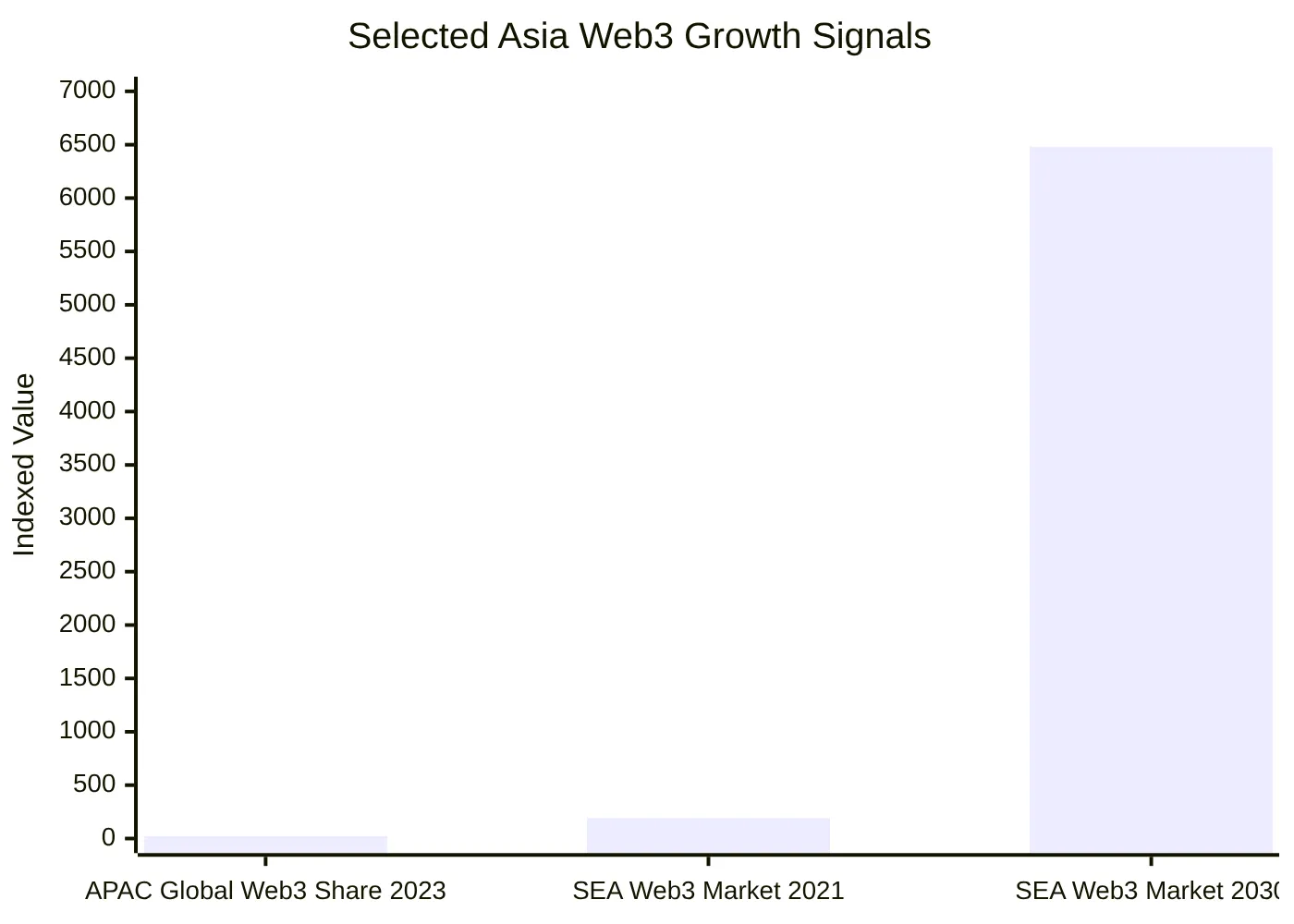
The chart above combines two different types of indicators from the research report. It is not a like-for-like market comparison, but it does illustrate the scale of regional momentum.
Blockchain Technology Adoption in Asia Also Faces Structural Risks
Optimism should not hide the hard part. Blockchain Technology adoption in Asia is growing quickly, but growth is uneven and often messy.
The first challenge is regulation. Singapore offers relatively clear frameworks for digital token services through the Monetary Authority of Singapore. Hong Kong has moved toward a more formal virtual asset regime through the SFC. Japan is also developing policy support for Web3 via the Cabinet Secretariat's Web3 policy portal. But other markets remain less predictable, and Mainland China still maintains strict restrictions on public crypto activity.
The second challenge is fragmentation. A user may hold Bitcoin, trade tokens on Ethereum, use cheaper networks for DeFi, and collect NFTs elsewhere. That sounds flexible, but it also creates confusion around network selection, asset visibility, and transaction risk.
The third challenge is security. Hacks, phishing, and malicious approvals remain serious issues. Cross-chain activity can be especially complex, which is why user protection at the wallet level matters. FoxWallet has written in detail about these issues in its guide to cross-chain swap risks, emphasizing route transparency, approval awareness, and pre-transaction caution. That focus is especially relevant in Asia, where large numbers of newer users are entering Web3 through mobile devices and fast-moving communities.
Why Blockchain Technology Needs Better Wallet Infrastructure in Web3
If Blockchain Technology is the engine of Web3, the wallet is the driver interface. In Asia, that interface needs to do more than store tokens. It has to reduce complexity without compromising self-custody.
That is exactly why non-custodial, multi-chain wallets are becoming foundational infrastructure. A user needs one place to manage assets across networks, connect securely to DApps, review transaction details, and keep control of private keys.
From FoxWallet's perspective, the case is straightforward. FoxWallet is built as a multi-chain decentralized wallet with non-custodial security, local encryption of private keys and mnemonic data, broad chain support, deep DApp and DeFi integration, and both mobile and browser extension access. This aligns closely with how Web3 is actually being used in Asia.
Here is why that matters:
| User need in Asia | Wallet capability that helps |
|---|---|
| Managing assets on multiple chains | Unified multi-chain asset view |
| Safer self-custody | Local encryption and user-controlled keys |
| Accessing DeFi and DApps | Built-in DApp browser and seamless connectivity |
| Moving between ecosystems | Integrated cross-chain swap aggregation |
| Avoiding common scams | Risk alerts, phishing protection, contract recognition |
| Switching between mobile and desktop | Consistent mobile and browser extension support |
This is not just a feature checklist. It reflects a broader shift in Web3. Users increasingly need wallets that work as an entry point, a control panel, and a risk filter all at once.
If you are comparing options, the practical advantage of FoxWallet's download access is that it supports users across iOS, Android, and browser extension environments, which fits the mobile-plus-desktop behavior common among both newer users and more advanced DeFi participants.
The Future of Web3 in Asia Will Be Multi-Chain, Mobile, and User-Controlled
My opinion is simple: Asia will help define the next internet, but it will not look like a single-platform internet. It will look like a multi-chain, wallet-centric, mobile-first network of value and applications.
Blockchain Technology is making that possible by turning ownership, identity, finance, and digital participation into portable, programmable experiences. Web3 is giving users direct access to those experiences, but only if the tools are secure and usable enough to support real adoption.
That is why wallet design matters so much. In a region where adoption is accelerating but user needs vary widely, the strongest products will be the ones that combine self-custody, security, multi-chain simplicity, and direct access to DApps without forcing users into unnecessary complexity.
For beginners, that means guided onboarding and cleaner interfaces. For advanced users, it means real multi-chain asset management and efficient on-chain execution. For active participants in DeFi and digital ecosystems, it means reliable infrastructure that helps them stay in control.
FoxWallet's positioning fits that future well: non-custodial by design, security-first in architecture, built for multi-chain and cross-chain activity, and available across mobile and browser environments. As Asia continues to lead in Web3 experimentation and adoption, that kind of wallet infrastructure will likely become less of a convenience and more of a necessity.
If you want to explore a wallet built around secure self-custody and multi-chain Web3 access, take a look at FoxWallet and review its practical guidance on safer cross-chain workflows. In a fast-moving Web3 environment, control and clarity are becoming just as important as access itself.