


FoxWallet: The Top Multi-Chain USDC Wallet

FoxWallet is a self-custody USDC wallet for people who need to manage stablecoins across more than one blockchain. FoxWallet mobile provides the broader multi-chain experience covered in this guide, including multi-network asset management, supported swaps, supported bridge routes, and access to compatible DApps. The FoxWallet browser extension has a narrower scope and should not be treated as a full substitute for the mobile app.
USDC is a digital dollar issued by Circle. Circle says USDC is fully backed by highly liquid cash and cash-equivalent assets and is redeemable 1:1 for U.S. dollars through eligible Circle services. The important wallet detail is that USDC is network-specific: USDC on one blockchain is not the same on-chain balance as USDC on another, even when both use the same ticker.
Why a USDC Wallet Needs to Be Multi-Chain
USDC is available across a growing range of blockchain networks, each with its own token contract, transaction fees, applications, and liquidity. A user may receive USDC on one network, need it for a DApp on another, or hold balances across several ecosystems.
That makes chain clarity as important as token storage. A useful multi-chain USDC wallet should show which network each balance belongs to, make the selected network obvious, and help users review the route when moving assets. Changing the network selector only changes the blockchain view; it does not transfer USDC between chains.
Self-custody also changes the user's responsibility. FoxWallet does not custody user funds or recovery credentials. Users control their keys, but they must still verify the receiving network, token contract, transaction details, and recovery backup. If you are new to wallet credentials, FoxWallet's guide to private keys vs seed phrases explains the difference.
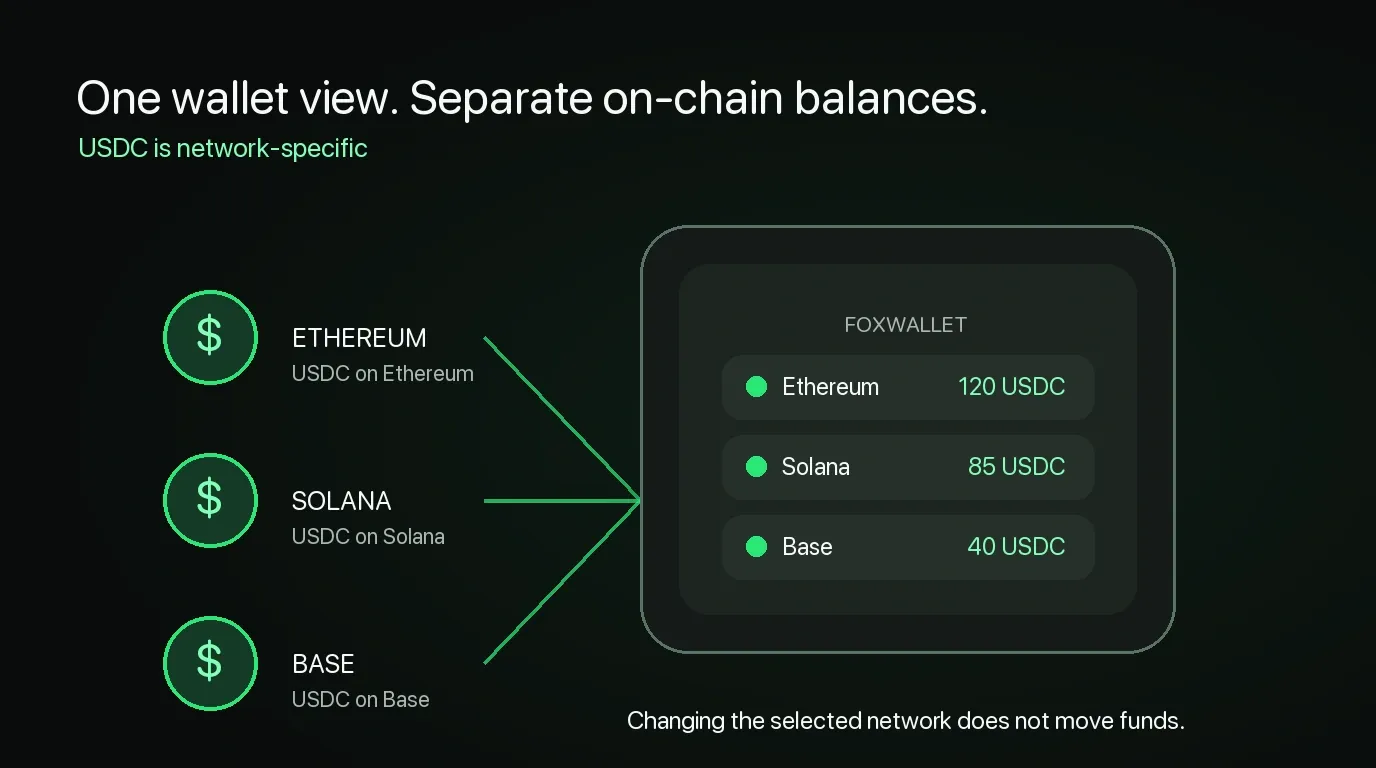
One wallet can display USDC across several networks, but the balances remain separate on-chain.
What Makes FoxWallet a Strong USDC Wallet
A strong USDC wallet starts with self-custody and clear network handling. FoxWallet stores encrypted wallet credentials locally and uses sandbox isolation. Its mobile app is designed for managing assets across a broad range of blockchain networks from one interface.
Other criteria matter once USDC is used rather than simply held:
| What to check | Why it matters for USDC |
|---|---|
| Network and token support | A wallet must support the specific network and USDC contract you intend to use. |
| Clear chain selection | The same ticker can appear on different networks or represent different contracts. |
| Gas awareness | Sending USDC usually requires the network's native fee asset. |
| Swap availability | A swap exchanges one asset for another and is usually performed within the same network. |
| Bridge availability | A bridge or cross-chain route moves value between networks; route support varies. |
| DApp access | Compatible DApps may use USDC for trading, lending, payments, or other on-chain activity. |
| Security controls | Warnings and authorization checks can reduce risk, but they do not guarantee a safe transaction. |
FoxWallet mobile combines multi-network asset visibility with Swap, Bridge, and Discover features where supported. Feature availability is not identical across every network, and supporting a blockchain does not mean that every token or route is available on it.
To install the appropriate product, use the official FoxWallet download page.
Native USDC vs Bridged USDC
The name or logo shown in a wallet is not enough to prove that a token is official USDC. Token identity comes from the network and contract address.
Circle distinguishes between native USDC, which Circle issues directly on a supported blockchain, and bridged USDC, which a third party creates after locking native USDC on another network. Bridged versions can be useful, but they depend on the relevant bridge and may not have the same support or interoperability as native USDC.
| Native USDC | Bridged or wrapped USDC | |
|---|---|---|
| Issuance | Issued by Circle on the network | Created by a third-party bridge or protocol |
| Backing path | Part of Circle's official USDC issuance | Commonly backed by USDC locked on another chain |
| Token contract | Listed in Circle's official network documentation | Defined by the bridge or protocol |
| Interoperability | Eligible for Circle-supported infrastructure where available | Depends on the bridge and destination ecosystem |
| Main user check | Verify network and Circle-listed contract | Verify network, contract, bridge, and redemption path |
Before receiving or swapping a token labelled USDC, check the selected network and compare the contract with Circle's current supported-blockchain documentation. Circle also provides a concise native vs bridged USDC explanation.
Do not assume that a token is native USDC because a DApp uses the USDC ticker or familiar artwork. Fake tokens can copy both.
How FoxWallet Supports USDC Wallet Use Across Chains
FoxWallet mobile gives users a unified place to view supported assets across several networks. That reduces the need to maintain separate wallet apps, but it does not merge network balances. The network label remains essential when copying an address, receiving USDC, or preparing a transaction.
On supported networks, FoxWallet mobile provides separate tools for different jobs:
- Swap uses 1inch on confirmed supported networks and is primarily for exchanging assets within a network.
- Bridge uses LI.FI on confirmed supported networks and can surface cross-chain routes.
- Discover lets users access and connect to compatible DApps in supported environments.
These capabilities are not universal. A network can be available for basic wallet actions without having a supported Swap or Bridge route. A route may also involve a bridge, a swap, or both, and the destination asset is not automatically guaranteed to be native USDC.
FoxWallet provides access to third-party DApps and routing services; it does not provide or guarantee their underlying lending, trading, yield, or bridge services. Review the protocol, transaction request, and approvals before signing.
Moving USDC Between Networks: Swap vs Bridge
A network switch inside the wallet does not move funds. If you have USDC on a source network and need it on a destination network, first identify what type of transaction is required.
- Use a swap when you need to exchange USDC for another supported asset on the same network.
- Use a bridge or cross-chain route when value needs to move from one blockchain to another.
- A complex route may combine both actions, for example swapping the source token, bridging, and receiving another token on the destination network.
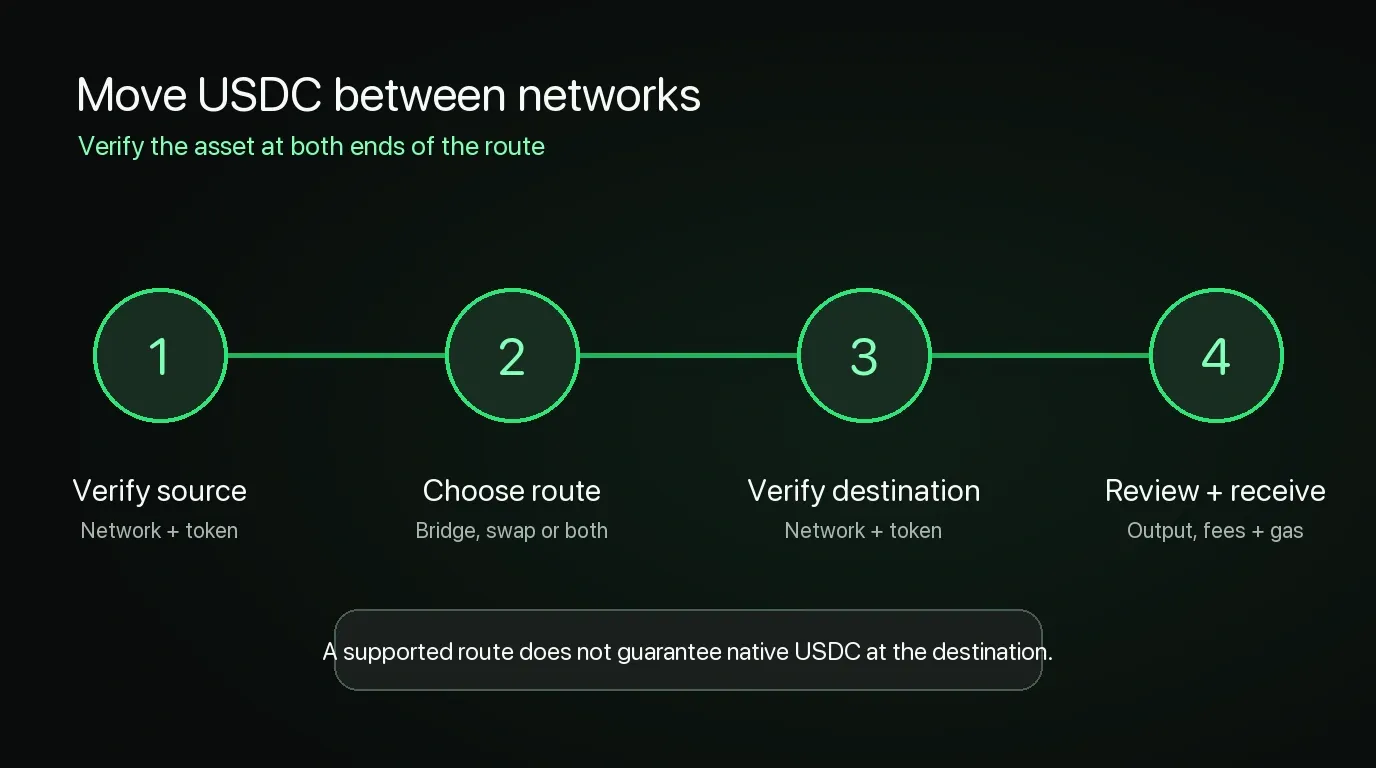
Review the entire route before signing. Availability, fees, slippage, and the destination token can change.
Before confirming a route, check:
- The source network and exact source token.
- The destination network and exact token you expect to receive.
- Whether the route uses a bridge, swap, or both.
- Estimated output, provider fees, network costs, and slippage where applicable.
- Whether you will have the destination network's gas asset after arrival.
- The receiving address and route permissions.
For more detail on routing trade-offs, see FoxWallet's guides to cross-chain swap risks and DEX aggregators for cross-chain swaps. If the transaction is a same-chain stablecoin exchange, the comparison of DEX aggregators for stablecoin swaps is the more relevant starting point.
USDC Gas Requirements
Holding USDC does not necessarily mean you can send it. Most networks require fees to be paid in their native gas asset.
For example, Ethereum-family transactions typically require the native asset used for gas on that network, while Solana transactions require SOL. Other networks have their own fee mechanics. If a destination receives USDC but no usable gas asset, the balance may be visible yet temporarily unable to move.
Before withdrawing USDC from an exchange or using a bridge, check both the destination network and the fee asset you will need there. Circle's bridge guidance also notes the need for a native gas token on the source chain.
Why FoxWallet USDC Wallet Security Matters
Self-custody removes custodial account dependence, but it does not remove transaction risk. USDC users still face phishing sites, malicious approvals, fake tokens, wrong-network transfers, risky contracts, and bridge failures.
FoxWallet's current security controls include local encrypted credential storage, sandbox isolation, phishing protections, warnings for high-risk signatures, malicious authorization checks, and Connected Sites management. These controls can make risk more visible; they cannot prevent every loss or prove that a token, DApp, smart contract, or bridge is safe.
Use a practical signing routine:
- Confirm the active network before copying or pasting an address.
- Verify the token contract through Circle or another authoritative source.
- Read the amount, recipient, token, spender, and approval scope shown in the wallet.
- Avoid unlimited token approvals unless the use case requires them and the contract is trusted.
- Disconnect sites you no longer use and review existing authorizations periodically.
- Test a new route with a small amount when practical.
- Keep the recovery phrase offline and never enter it into a website or unsolicited support form.
Remember that self-custody does not control Circle's issuer policies, smart-contract behavior, or the risks introduced by third-party protocols.
How FoxWallet USDC Wallet Features Help Beginners and Advanced Users
Beginners generally need obvious network labels, straightforward receiving flows, and clear transaction review. Experienced users may care more about switching among ecosystems, evaluating routes, connecting to DApps, and managing approvals. The same multi-chain USDC wallet can support both groups when it makes the network context visible instead of hiding it.
FoxWallet mobile is the stronger fit for the multi-chain workflows discussed here. Users can monitor supported balances, use Swap or Bridge where a route is available, and connect to compatible DApps through Discover. Advanced activity still requires independent review of the DApp, contract, fees, and destination token.
USDC is not the only multi-network stablecoin. Readers comparing the practical differences between stablecoin networks may also find FoxWallet's guide to the best USDT wallets and network options useful.
FoxWallet Mobile vs Browser Extension
FoxWallet mobile and the browser extension are different products with different capability scopes.
| Capability | FoxWallet mobile | FoxWallet browser extension |
|---|---|---|
| Multi-network asset management | Broad mobile network coverage | EVM and Aleo scope |
| Basic send and receive | Yes, on supported networks and assets | Yes, within supported extension environments |
| Swap | Available on confirmed supported mobile networks via 1inch | Not available |
| Bridge | Available on confirmed supported mobile networks via LI.FI | Not available |
| DApp access | Discover and compatible DApp connections | Basic extension wallet connection in supported environments |
| Staking | Only on confirmed supported mobile networks | Not available |
If your goal is to manage USDC across several chains or review supported cross-chain routes, use FoxWallet mobile. The extension is suitable for narrower EVM and Aleo wallet interactions, not full mobile feature parity.
Where FoxWallet Fits as a Multi-Chain USDC Wallet
FoxWallet is a strong option for users who want self-custody and a mobile interface for managing USDC across supported networks. Its main value is not that every feature works everywhere; it is that asset management, supported swaps, supported bridge routes, DApp access, and transaction-risk controls can be reached from one mobile wallet.
No wallet eliminates the need to verify the network and token. The right choice depends on the chains you use, whether you need cross-chain routing, and how you prefer to manage self-custody. If FoxWallet's supported environments match your workflow, download it only through the official FoxWallet download page.
FAQ
Can one wallet hold USDC on multiple networks?
Yes. A multi-chain wallet can display and manage supported USDC tokens across several networks. Each balance remains on its own blockchain, and switching the wallet's selected network does not move the tokens.
Is USDC the same on every blockchain?
No. USDC contracts are network-specific. Circle-issued native USDC should also be distinguished from bridged or wrapped versions created by third parties. Verify the network and contract rather than relying on the ticker or logo.
What is the difference between native and bridged USDC?
Native USDC is issued directly by Circle on a supported network. Bridged USDC is issued by a third-party bridge or protocol and is commonly backed by native USDC locked on another chain. The bridge, contract, and conversion path add separate dependencies.
Can I move USDC between networks inside FoxWallet?
FoxWallet mobile offers Bridge through LI.FI on confirmed supported networks, but not every network pair or token has a route. Review the source token, destination token, route, output, fees, slippage, and destination gas requirements before confirming.
Do I need a native gas token to send USDC?
Usually, yes. Transactions generally require the network's native fee asset, such as ETH in relevant Ethereum environments or SOL on Solana. The required asset depends on the selected blockchain.
Does FoxWallet support USDC in its browser extension?
The extension supports basic wallet actions in its EVM and Aleo scope, but it does not have FoxWallet mobile's Swap, Bridge, or staking capabilities. For the broader multi-chain USDC workflow described in this guide, use the mobile app.
Is USDC safe in a self-custody wallet?
Self-custody gives you control of the wallet keys, but it does not remove token, issuer, smart-contract, DApp, bridge, phishing, or transaction risks. Verify contracts and networks, protect the recovery phrase, and review every approval before signing.