


Best DeFi Apps 2026: FoxWallet’s Top Picks

The best DeFi apps in 2026 depend on what you want to do. Uniswap is a strong starting point for direct on-chain swaps, Jupiter specializes in routing Solana trades, Aave and Morpho cover lending, Lido provides liquid staking, Pendle separates principal from future yield, and Hyperliquid focuses on on-chain trading. No single protocol is best for every task. Compare the activity, network, custody model, liquidity, fees, smart-contract exposure and position risks before connecting a wallet.
This guide compares seven established DeFi applications by function, without ranking them by temporary APY, TVL or token price.
Best DeFi Apps in 2026 at a Glance
| DeFi app | Main use | Ecosystem | Best suited to | Important limitation |
|---|---|---|---|---|
| Uniswap | Token swaps and liquidity provision | Ethereum and supported EVM networks | Users who want direct access to automated market maker pools | Price impact, pool selection and liquidity-provider losses require attention |
| Jupiter | DEX aggregation and swap routing | Solana | Users comparing routes across Solana liquidity sources | Route quality and token risk still need to be reviewed before signing |
| Aave | Supplying and overcollateralized borrowing | Ethereum and supported EVM networks | Users who want established pooled lending markets | Borrowers face variable rates and liquidation risk |
| Morpho | Permissionless lending markets and vaults | EVM networks | Users comparing isolated lending markets or curated vault strategies | Market, oracle, collateral and curator choices vary by position |
| Lido | Liquid staking | Primarily Ethereum for stETH/wstETH | ETH holders who want a liquid representation of staked assets | Adds protocol, validator, oracle and token-liquidity risks to native staking risk |
| Pendle | Trading principal and future yield | Supported DeFi networks | Experienced users managing fixed-yield or yield-exposure strategies | Maturity, underlying-asset and yield-token mechanics add complexity |
| Hyperliquid | Spot and perpetual trading | Hyperliquid | Active traders who understand margin, funding and liquidation | Leveraged perpetual positions can be liquidated and may incur funding costs |
The list is category-based. A DEX, lending market and liquid-staking protocol solve different problems, so start with the activity you need and compare risks within that category.
How to Choose a DeFi App
Start with the transaction, not the headline yield.
Choose the activity first. A swap exchanges tokens. Supplying assets makes liquidity available to borrowers, while borrowing creates collateral-backed debt. Liquid staking creates a transferable token representing staked assets. Yield trading separates principal from future yield. Perpetual trading creates a leveraged derivative position.
Confirm the chain and asset. A protocol name may operate on several networks, but the available markets, liquidity and supported assets can differ between deployments. Check the selected network in both the app and wallet before approving anything.
Understand custody and signing. Most DeFi protocols execute through smart contracts. A self-custody wallet holds the keys and presents requests for approval or signature; it does not remove smart-contract risk or make the protocol responsible for wallet recovery. Readers comparing access tools can use FoxWallet’s guide to the best crypto wallets for DeFi and its explanation of custodial versus non-custodial wallets.
Look past the displayed rate. Lending rates respond to utilization, trading prices depend on liquidity, and staking rewards can change. Vault and Pendle outcomes depend on allocation, underlying markets and maturity. A high APY may reflect incentives, leverage, low liquidity or added token risk.
Check execution costs. Network fees, swap fees, price impact, slippage, borrowing interest, funding payments and bridge costs are different charges. Some are paid once; others accrue while a position remains open. The cheapest-looking interface is not always the cheapest completed transaction.
Review permissions and exits. Check which contract is requesting approval, the token and amount involved, whether the approval is limited or unlimited, and how you will unwind the position. A strategy is harder to manage if you understand how to enter it but not how to withdraw, repay, redeem or close it.
1. Uniswap: Direct AMM Swaps and Liquidity Pools
Best for: direct token swaps and users who want to provide liquidity to automated market maker pools.
Uniswap is a decentralized exchange protocol. Its smart contracts allow users to swap tokens against liquidity pools rather than submitting orders to a traditional order book. Liquidity providers deposit assets into pools, while traders exchange against those reserves.
That makes Uniswap a useful reference point for understanding a DEX. The protocol supplies the market mechanism itself. This is different from a DEX aggregator, which searches across multiple liquidity sources and chooses a route.
The main advantage is direct, self-custodial market access. Users can inspect the pool, quoted output, fee tier and price impact before signing. Liquidity providers can also choose pools and, in some protocol versions, specific price ranges.
The main limitation is that a familiar protocol name does not remove transaction-level risk. Thin pools can produce high price impact, and tokens can be fraudulent or restrictive. Liquidity providers face market-making risks; range-based positions may also move out of range and stop earning fees.
Uniswap suits users who understand the pair and network they are using and want direct access to an AMM. It is not automatically the best route for every swap; comparing an aggregator quote can still be worthwhile.
2. Jupiter: Solana Swap Routing Across Liquidity Sources
Best for: Solana users who want an aggregator to compare routes rather than checking individual venues one by one.
Jupiter is a Solana-focused swap-routing platform. Its current swap system can compare routing engines and liquidity sources, assemble a transaction and return it for signing. This makes Jupiter an aggregator rather than a single liquidity pool.
That distinction matters. A DEX executes against its own pool or order book. An aggregator searches possible paths, which may include several venues or split routes, to find a suitable quoted result. FoxWallet’s DEX aggregator comparison explains the category in more depth.
Jupiter’s advantage is practical route discovery inside Solana. It can reduce the work involved in comparing separate liquidity sources, especially when a direct pool is not the strongest path.
Aggregation does not guarantee a final result. Quotes can change, and multi-hop routes add moving parts. Users still need to confirm the tokens, minimum received amount, price impact and transaction details. Token quality is separate from routing quality.
Jupiter is best suited to users already operating on Solana who want route comparison. It is not a general cross-chain bridge, and using it should not be confused with moving assets between blockchains.
3. Aave: Pooled Lending and Overcollateralized Borrowing
Best for: users who want to supply assets to a lending pool or borrow against supported collateral.
Aave is a non-custodial liquidity protocol built around pooled lending markets. Suppliers provide assets to a pool and may receive interest as borrowers use that liquidity. Borrowers supply collateral and take overcollateralized loans subject to the market’s loan-to-value and liquidation parameters.
The difference between supplying and borrowing is fundamental. Supplying an asset does not necessarily create debt. Borrowing does. A borrower must monitor collateral value, accrued interest and the position’s health because adverse price moves can trigger liquidation.
Aave’s strength is a clear lending-market model with documented collateral and risk parameters. It can suit users who understand variable rates and want to supply, borrow or use supplied assets as collateral where supported.
Its main limitation is that a dashboard can make a complex position look simple. Supply and borrow rates change, available liquidity affects withdrawals, and oracle prices and governance parameters affect collateral positions.
Before using Aave, check the exact market, network, reserve status, collateral setting and health factor. A conservative buffer matters more than borrowing the maximum displayed amount.
4. Morpho: Permissionless Lending Markets and Curated Vaults
Best for: users who want to compare isolated lending markets or use a vault that allocates capital across selected markets.
Morpho provides decentralized, non-custodial lending infrastructure on EVM networks. Its variable-rate markets allow overcollateralized lending and borrowing, while its vault layer can allocate supplied assets across markets according to a defined strategy.
Morpho differs from a conventional pooled lending app because individual markets can be defined by a loan asset, collateral asset, oracle and interest-rate model. That can improve flexibility, but it shifts more attention toward market construction. Two markets using the same loan asset may not carry the same collateral or oracle risk.
Vaults can simplify the supplier experience by handling allocation, but “vault” does not mean risk-free automation. Users need to understand who curates the vault, what markets it can allocate to, its fee structure and whether the underlying positions match their risk tolerance.
Morpho’s advantage is modularity. Its limitation is that the app name alone tells you less than the specific market or vault selected.
Morpho suits users willing to evaluate the underlying market configuration. Beginners should avoid choosing a market solely because its current rate is higher than an alternative.
5. Lido: Liquid Staking With stETH and wstETH
Best for: ETH holders who want staking exposure represented by a transferable token that can also be used across supported DeFi applications.
Lido is a liquid-staking protocol. When ETH is staked through Lido, the protocol issues stETH, a token representing staked ether and the associated rewards and penalties. Wrapped stETH, or wstETH, provides a non-rebasing representation designed for easier use in DeFi integrations.
Liquid staking tokenizes the position so it can be transferred, traded or used in other protocols. That composability is the attraction, but it also adds dependencies.
Users are exposed not only to Ethereum staking conditions but also to Lido’s smart contracts, validator performance, oracle and withdrawal mechanisms, and the market liquidity of stETH or wstETH. If an LST is then deposited into another DeFi protocol, the risks of that second protocol are added rather than replaced.
Lido is useful for users who specifically want liquid staking and understand the difference between stETH and wstETH. It is not the same as holding native ETH, and a displayed staking rate should not be compared directly with unrelated lending or vault yields.
For a broader decision framework, see FoxWallet’s comparison of crypto wallets for staking.
6. Pendle: Principal and Yield Trading
Best for: experienced DeFi users who want to separate the principal value of a yield-bearing asset from its future yield.
Pendle tokenizes yield-bearing assets into Principal Tokens (PT) and Yield Tokens (YT). PT represents the principal component and is redeemable according to the market’s maturity mechanics. YT represents the right to yield generated until maturity. Both can be traded through Pendle’s markets.
This makes Pendle a yield-trading protocol, not a basic staking app or ordinary yield vault. A PT position may be used to target a known redemption relationship at maturity, while a YT position provides exposure to future yield. The outcome depends on purchase price, maturity, underlying yield and market conditions.
Pendle turns yield into a separately tradable component, enabling strategies that are difficult to reproduce in a standard lending market.
The same mechanism is its main limitation. Users must understand the underlying yield-bearing asset, the PT/YT relationship, maturity, liquidity and the protocol producing the original yield. YT value generally declines toward maturity as the remaining claim on future yield shortens. A “fixed yield” position still depends on the underlying asset and relevant smart contracts; fixed does not mean free of risk.
Pendle is appropriate for users who can explain how the position settles before they open it. It is a poor choice for someone selecting solely on the largest APY shown in the interface.
7. Hyperliquid: On-Chain Spot and Perpetual Trading
Best for: active traders who understand perpetual contracts, margin, funding and liquidation.
Hyperliquid is an on-chain trading environment known for spot markets and perpetual contracts. Perpetuals do not have an expiry date; traders use collateral to take long or short exposure, and funding payments help keep contract prices aligned with the underlying market.
This places Hyperliquid in a different category from a DEX such as Uniswap. A spot swap exchanges assets. A perpetual position is a derivative with margin requirements, funding and liquidation mechanics. The user can gain directional exposure without buying the underlying token, but leverage amplifies losses as well as gains.
Hyperliquid’s advantage is a trading-focused interface and on-chain market structure suited to active users. Its limitation is that the product category is inherently less forgiving. Funding can add ongoing cost, volatile markets can move through liquidation levels quickly, and order settings matter.
Hyperliquid is best suited to users who already understand limit and market orders, cross versus isolated margin, position sizing and stop management. It should not be chosen simply because it offers more advanced trading features than a swap interface.
DeFi Risks to Check Before Connecting a Wallet
Different DeFi apps create different risk combinations.
| Risk | Where it appears | What to check |
|---|---|---|
| Smart-contract risk | Every protocol using on-chain contracts | Official domain, contract addresses, audits, upgrade controls and current incident notices |
| Token-approval risk | Swaps, lending, vaults and staking integrations | Spender contract, token, amount and whether approval is limited |
| Liquidity and price-impact risk | DEXs, aggregators and market exits | Pool depth, route, minimum received and exit liquidity |
| Liquidation risk | Lending and leveraged derivatives | Collateral ratio, health factor, maintenance margin and price volatility |
| Oracle risk | Lending, vaults, derivatives and some staking integrations | Price source, market parameters and what happens if an oracle fails or diverges |
| LST and underlying-asset risk | Liquid staking and protocols using LSTs | Redemption mechanics, validator exposure, token liquidity and added protocol layers |
| Maturity and yield risk | Pendle and other yield markets | Expiry, PT/YT mechanics, underlying yield source and exit conditions |
| Bridge and cross-chain risk | Moving assets between networks | Route, bridge provider, destination chain, token representation and recovery process |
| Front-end and phishing risk | Every web or mobile interface | Exact domain, bookmarked official links and transaction details shown by the wallet |
Audits do not prove a protocol cannot fail, and a long operating history does not make every new market or token equally safe. Assess risk at the position level: protocol, chain, market, asset, approval and route.
Cross-chain actions deserve a separate check because they add bridge and destination-chain dependencies. Readers comparing those tools can use FoxWallet’s guide to DEX aggregators for cross-chain swaps.
Using DeFi Apps With FoxWallet
FoxWallet is a self-custody wallet and signing layer, not the DeFi protocol behind a swap, loan, staking position or derivatives trade. Where a compatible DApp is available through FoxWallet mobile, users can open it, connect the relevant account and review transaction requests before signing.
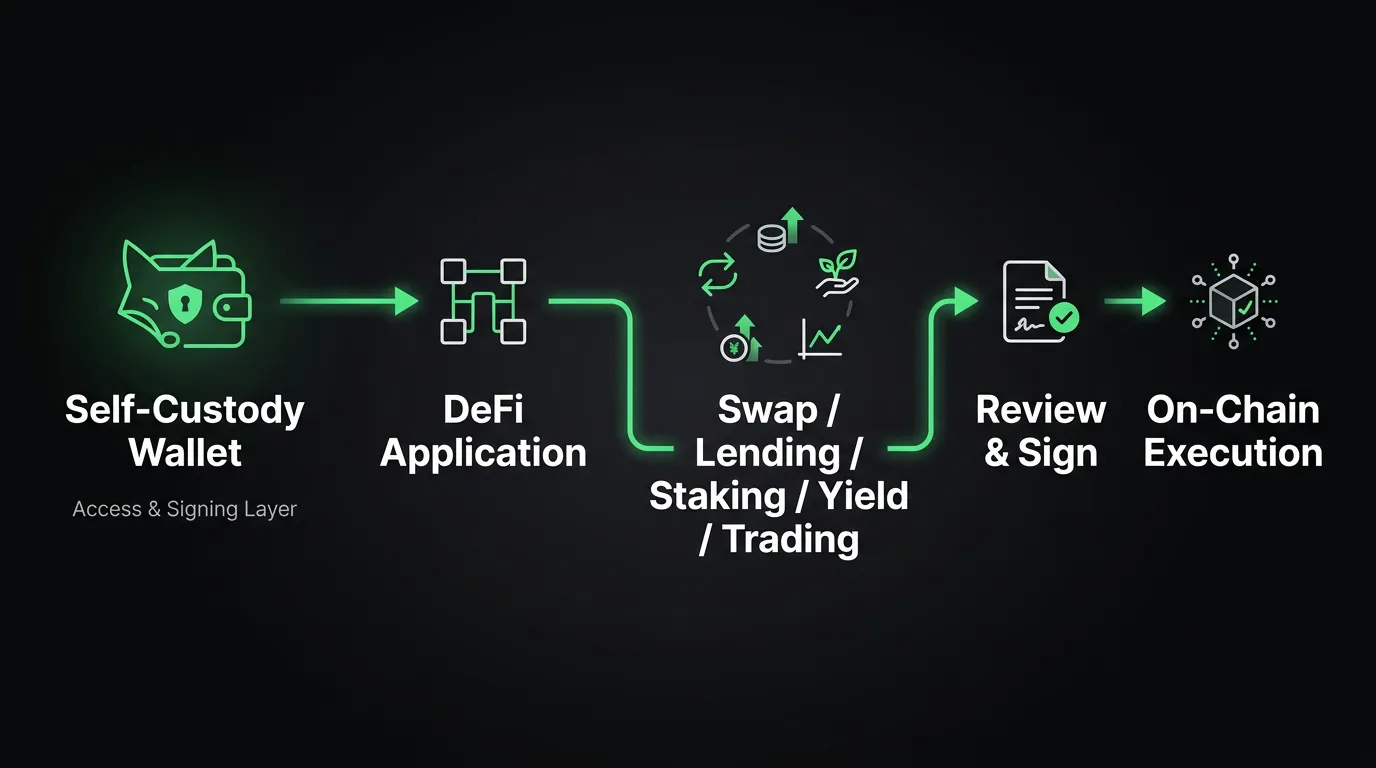
The protocol determines the market mechanics. The wallet controls the account keys and presents requests for review. Neither layer should be confused with the other.
FoxWallet mobile also has built-in Swap and Bridge features on confirmed supported networks. Swap uses 1inch as its provider on supported networks; Bridge uses LI.FI on supported networks. These are separate capabilities. Network support does not by itself establish Swap, Bridge or staking support, and a DApp appearing in Discover does not imply a partnership or endorsement.
Before signing a DeFi transaction in FoxWallet or any other self-custody wallet:
- Verify the DApp domain and selected network.
- Confirm the token contract, especially for unfamiliar assets.
- Read the approval request and avoid granting more access than needed.
- Check the quoted output, minimum received, fees and route.
- For borrowing or derivatives, confirm liquidation thresholds and ongoing costs.
- Keep enough of the network’s native token to pay transaction fees and exit the position.
If the intended activity is a simple swap, a routing comparison may be more useful than opening several DEXs separately. If the activity is lending, staking or yield trading, the position mechanics matter more than the wallet’s swap feature.
Which DeFi App Is Best for You?
Choose by task:
- For a direct AMM swap: start with Uniswap and compare pool depth and price impact.
- For Solana route aggregation: use Jupiter to compare available swap paths.
- For pooled lending and borrowing: review Aave’s market parameters and liquidation rules.
- For modular lending markets or curated vaults: examine Morpho’s specific market or vault configuration.
- For liquid ETH staking: compare Lido’s stETH/wstETH mechanics with native staking and other staking routes.
- For principal and yield strategies: use Pendle only after understanding PT, YT and maturity.
- For spot and perpetual trading: consider Hyperliquid if you understand margin, funding and liquidation.
The best DeFi app is the one whose mechanics match your transaction and whose risks you understand. Inspect the exact market and treat every approval as permission granted to a specific contract.
Frequently Asked Questions
What is a DeFi app?
A DeFi app is an interface to blockchain-based financial smart contracts. Depending on the protocol, it may support swaps, lending, borrowing, staking, liquidity provision, yield trading or derivatives. The interface helps construct transactions, while the protocol’s contracts execute them on-chain.
What are the best DeFi apps in 2026?
Strong options by category include Uniswap for AMM swaps, Jupiter for Solana aggregation, Aave and Morpho for lending, Lido for liquid staking, Pendle for yield trading and Hyperliquid for spot and perpetual trading. The right choice depends on the activity, chain, asset and risk profile.
Do I need a self-custody wallet to use DeFi?
Many DeFi apps are designed for self-custody wallets, although access methods vary. A self-custody wallet lets the user control the keys and approve transactions directly. It does not protect against every smart-contract, token or market risk.
What is the difference between a DEX and a lending protocol?
A DEX facilitates token trading through pools, order books or other market mechanisms. A lending protocol connects suppliers and borrowers through smart contracts. Borrowing normally requires collateral and can create liquidation risk; a simple spot swap does not create a loan.
Can I use DeFi without giving up custody?
Yes. Many DeFi protocols let users connect a self-custody wallet and sign transactions without transferring control of the wallet’s private keys. Assets committed to a smart contract are still exposed to that contract’s rules and risks.
What risks should I check before using a DeFi protocol?
Check smart-contract, approval, liquidity, oracle, liquidation, token, bridge and front-end risks as relevant to the activity. Also confirm the network, market, asset, fees and exit process. Different protocol types have different risk profiles.
Can I access DeFi apps through FoxWallet?
Compatible DApps can be accessed through FoxWallet mobile where supported, and transaction requests can be reviewed and signed in the wallet. FoxWallet is the wallet layer, not the underlying DeFi protocol, and a Discover listing does not imply endorsement or partnership.
DeFi involves smart-contract, market and asset risks. Rates, liquidity and protocol parameters can change. This guide is educational and does not recommend a particular transaction or investment.
