


Why AI Agents Need Non-Custodial Wallets, Not API Keys to an Exchange

Non-custodial wallets give AI agents a more transparent and controllable path for on-chain activity than broadly permissioned exchange API keys, but only when authority is constrained outside the model itself.
An AI agent can analyze data, prepare payments, monitor balances, or submit a transaction proposal in seconds. That speed can be useful, yet it also magnifies the consequences of faulty data, compromised tools, or manipulated instructions. The core question is not whether an agent uses an API or a wallet. It is whether the agent receives broad, reusable authority or narrowly defined, reviewable, and revocable authority.
For exchange-only trading and reporting, a carefully scoped API key can still be appropriate. For direct DeFi activity, wallet-to-wallet settlement, and multi-chain operations, non-custodial wallets for AI agents offer a stronger control model because users retain control of assets and can place policy checks around each proposed action.
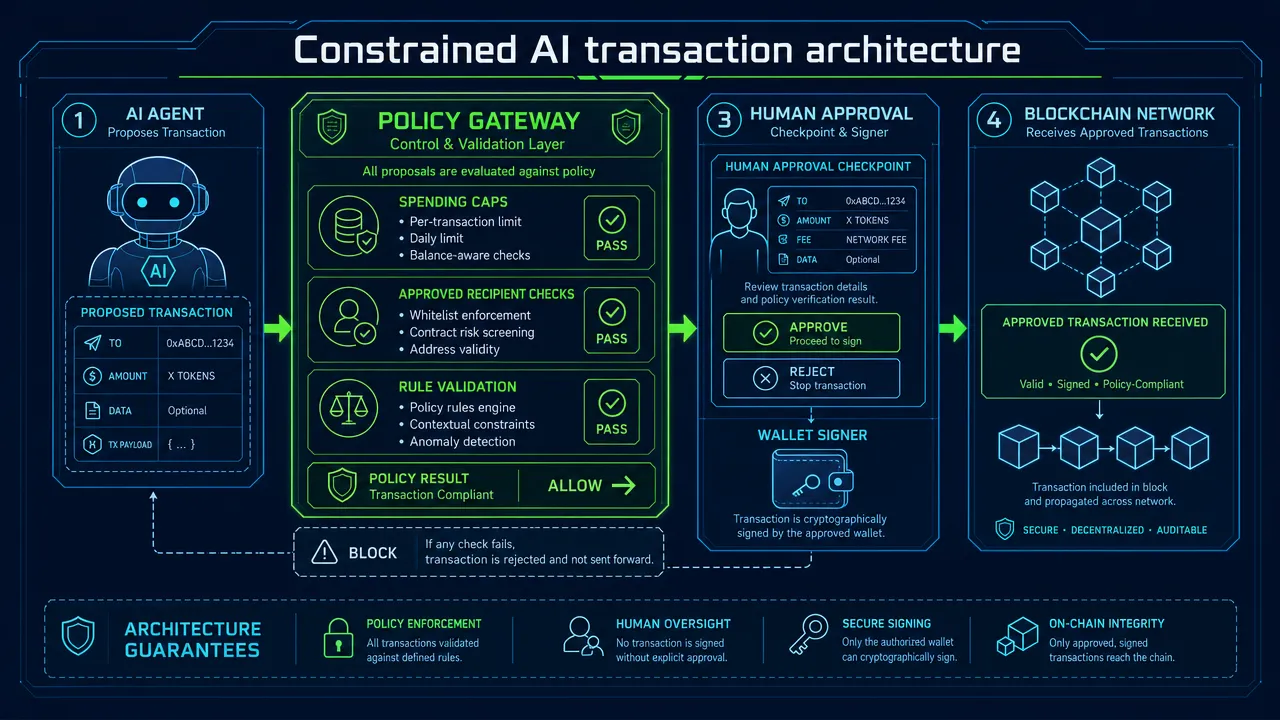
Why non-custodial wallets for AI agents create a better authorization boundary
AI agents should not receive unlimited financial authority simply because they can automate a task. A model can misinterpret an instruction, rely on bad market data, call an unsafe tool, or follow malicious content embedded in a webpage, message, or data feed. Financial controls must therefore exist independently of the agent's reasoning process.
This is where non-custodial wallets for AI agents change the design. A non-custodial crypto wallet gives the user control of the private keys or recovery phrase used to authorize transactions. Instead of handing an agent access to an entire exchange account through a reusable credential, a wallet-based design can require the agent to prepare a specific action that is checked against rules before signing.
That does not mean an agent should hold a wallet's master private key. A safer AI agent wallet arrangement separates the roles involved in a transaction:
| Role | Recommended responsibility | What it should not control alone |
|---|---|---|
| AI agent | Analyze inputs, prepare transaction proposals, explain rationale | Master private keys or unrestricted treasury funds |
| Policy layer | Check limits, recipients, contracts, networks, and timing | Strategy decisions without external governance |
| Human or multisig approver | Approve exceptions and high-risk actions | Every routine low-risk action, if defined policies exist |
| Controlled signer | Sign only permitted transactions | Policy creation and unrestricted execution |
| Monitoring system | Record actions, alert on anomalies, support incident response | Final approval authority |
This approach supports self-custody for AI agents without treating the agent as a trusted treasury owner. The user or organization remains responsible for defining what is allowed, protecting recovery information, and reviewing exceptions.
A practical example is autonomous agent payments for routine on-chain invoices. An agent could prepare a payment only when the recipient is allowlisted, the token and network are approved, the amount falls below a daily cap, and the wallet has a limited operational balance. A payment outside those boundaries should stop for human review.
Why non-custodial wallets for AI agents can reduce the API key blast radius
Exchange API keys are not inherently unsafe. They are useful tools for centralized exchange reporting, market data, and order execution. The risk appears when a broad credential is connected to an agent that may receive untrusted inputs or run in infrastructure that can be compromised.
Coinbase, for example, documents distinct API permission levels for View, Trade, and Transfer. Transfer permissions can include deposits and withdrawals, making that scope particularly sensitive. See Coinbase's guidance on API key permissions and its developer reference for checking API key permissions.
An exchange API key alternative is not necessarily a wallet in every situation. If the action must happen inside a centralized exchange order book, a tightly restricted API key may be the right operational tool. However, an API key generally authenticates a software process to an account-level environment. That can create a larger blast radius than a constrained on-chain workflow.
| Control dimension | Exchange API key | Non-custodial wallet workflow |
|---|---|---|
| Authorization method | Reusable credential authenticated by the exchange | Cryptographic signature for a specific transaction or delegated action |
| Scope | Often account or portfolio oriented | Can be tied to wallets, contracts, recipients, limits, and time periods |
| Custody model | Assets are held through the exchange's custodial arrangement | User controls the signing credentials |
| Auditability | Platform logs are generally private and exchange controlled | Confirmed transactions can be independently reviewed on-chain |
| Main compromise risk | Leaked key can remain usable until revoked | Compromised key or unsafe signature can move funds |
| Best fit | Exchange-native trading, reporting, and analytics | Direct DApp use, on-chain settlement, and multi-chain asset workflows |
A trade-only API key still has meaningful risk. An attacker or manipulated agent might place harmful orders, create excessive turnover, or alter a portfolio's exposure. Transfer-enabled access can increase the potential impact further. Coinbase also notes that certain automated trading integrations limit transfer functions, which demonstrates an important principle: limiting permissions can reduce, but not eliminate, damage from compromise. Read Coinbase's automated trading platform guidance for that context.
The right conclusion is balanced:
- Use read-only API keys for reporting whenever possible.
- Use trade-only permissions only for defined exchange execution workflows.
- Avoid transfer permissions for ordinary automation.
- Keep dedicated, low-balance operational accounts separate from broader reserves.
- Use a wallet-based model when the workflow requires direct on-chain interaction rather than exchange-account access.
How non-custodial wallets for AI agents support controlled on-chain execution
A wallet signature is powerful. Once a transaction is finalized on a blockchain, it is generally irreversible. That is why secure crypto transactions for AI agents require more than a wallet interface and a good prompt.
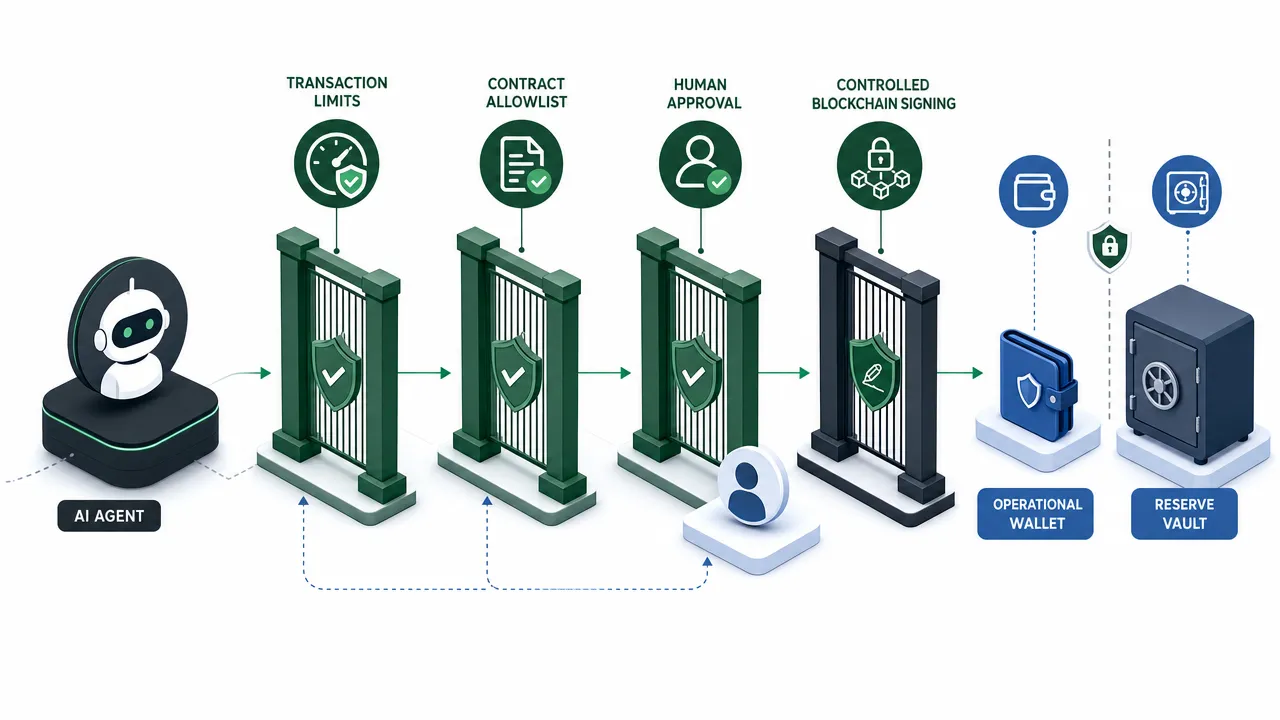
A strong wallet-based agent automation architecture places controls between the agent and the final signing path. The agent can propose an action, but an external policy system determines whether that action is permitted.

The architecture can include the following safeguards.
| Safeguard | Purpose for AI agent treasury management |
|---|---|
| Separate operational wallet | Limits exposure by keeping only task-specific funds available |
| Spending caps | Restricts maximum value per transaction, day, asset, or recipient |
| Recipient allowlists | Prevents payments to unknown or unapproved addresses |
| Contract allowlists | Restricts agent interactions to reviewed smart contracts |
| Time-limited authority | Automatically expires an agent's permission after a defined period |
| Network restrictions | Limits actions to approved chains and assets |
| Human approval thresholds | Escalates large, unusual, or out-of-policy transactions |
| Transaction simulation | Previews expected outcomes before signing, while not guaranteeing safety |
| Monitoring and alerts | Detects unexpected balances, approvals, recipients, or transaction frequency |
| Emergency revocation | Supports rapid suspension of delegated access or operational activity |
Emerging Ethereum work points toward this kind of policy-bound architecture. ERC-8196 describes an AI Agent Authenticated Wallet concept that uses policy-bound transaction execution and verifiable delegation. It is an emerging proposal, not a universal production standard or a verified FoxWallet feature.
The most important rule is simple: do not let the agent write the policy and enforce the policy by itself. The agent may propose a transaction, but an independently protected control layer should evaluate its chain, token, amount, recipient, smart contract, rate, and expiration conditions.
Where non-custodial wallets for AI agents still require caution
Self-custody provides control, portability, and direct access to on-chain protocols. It does not remove risk. In fact, it shifts substantial responsibility to the wallet owner and the organization operating the workflow.
The biggest mistake is assuming a non-custodial crypto wallet is automatically safe because no centralized platform holds the funds. A compromised seed phrase, a malicious approval, or a wrongly signed transaction can be just as consequential as a leaked exchange credential.
Key self-custody risks include:
- Private-key and recovery-phrase exposure.
- Phishing pages that imitate wallet interfaces or support channels.
- Malicious token approvals that grant a contract excessive spending authority.
- Smart-contract weaknesses in protocols, routers, bridges, or tokens.
- Incorrect recipients, unsupported token formats, or wrong network selections.
- Malware on a desktop or mobile device.
- Poorly configured delegated keys or policy rules.
- False confidence in risk alerts or transaction simulations.
Transaction alerts and contract-recognition tools can support better decisions, but they cannot guarantee that every transaction is safe. A user must still inspect the destination, understand the requested approval, verify the active network, and assess the protocol being connected.
Cross-chain workflows deserve separate attention. Moving assets across networks can add route, liquidity, token representation, bridge, and destination-chain risks. Before confirming any cross-chain swap, users should verify the source and destination networks, token details, expected output, fees, and approvals. FoxWallet's cross-chain swap risk guide offers additional educational context on reviewing these distinct risks.
For AI agent treasury management, segregation is essential. Long-term reserves, operational payment funds, DApp testing funds, and exchange trading capital should not sit in one unrestricted wallet. Separation creates a clearer audit trail and reduces the impact of a mistake within a single workflow.
How FoxWallet fits non-custodial wallets for AI agents in user-controlled workflows
FoxWallet is relevant as a non-custodial, multi-chain wallet foundation for user-controlled and agent-assisted on-chain workflows. FoxWallet does not access or hold user funds, and users retain control over their private keys and assets.
That foundation matters because agent-related workflows should begin with user control, not with unrestricted automation. FoxWallet supports locally encrypted mnemonic phrases and private keys, multi-chain asset visibility, real-time on-chain synchronization, DApp access, and mobile plus browser-extension usage. Its risk-aware features, including pre-transaction alerts and smart-contract recognition, can help users evaluate actions before they sign.
For a fuller view of the wallet's security and multi-chain positioning, see FoxWallet's overview of secure multi-chain management. Readers comparing custody models can also review the guide to custodial and non-custodial wallets.
FoxWallet may be useful in a broader architecture for:
-
Operational wallet separation: Users can organize assets so that routine on-chain activity is separated from long-term holdings.
-
Multi-chain oversight: A unified asset view can help users inspect balances and transaction status across supported networks before approving an agent-assisted action.
-
User-controlled DApp access: The built-in DApp browser can provide an entry point for direct interaction with DeFi and other Web3 applications.
-
Risk-aware transaction review: Pre-transaction warnings can offer decision-support signals before a user confirms an action.
-
Cross-chain activity: Built-in cross-chain swap functionality can support user-controlled multi-chain operations, provided users carefully assess route and approval risks.
These points should not be interpreted as a claim that FoxWallet is a dedicated AI-agent wallet, an autonomous trading platform, a policy engine, a session-key system, or an institutional custody service. Those capabilities have not been verified here. The wallet's value is its user-controlled, security-first foundation for managing assets and interacting with on-chain applications.
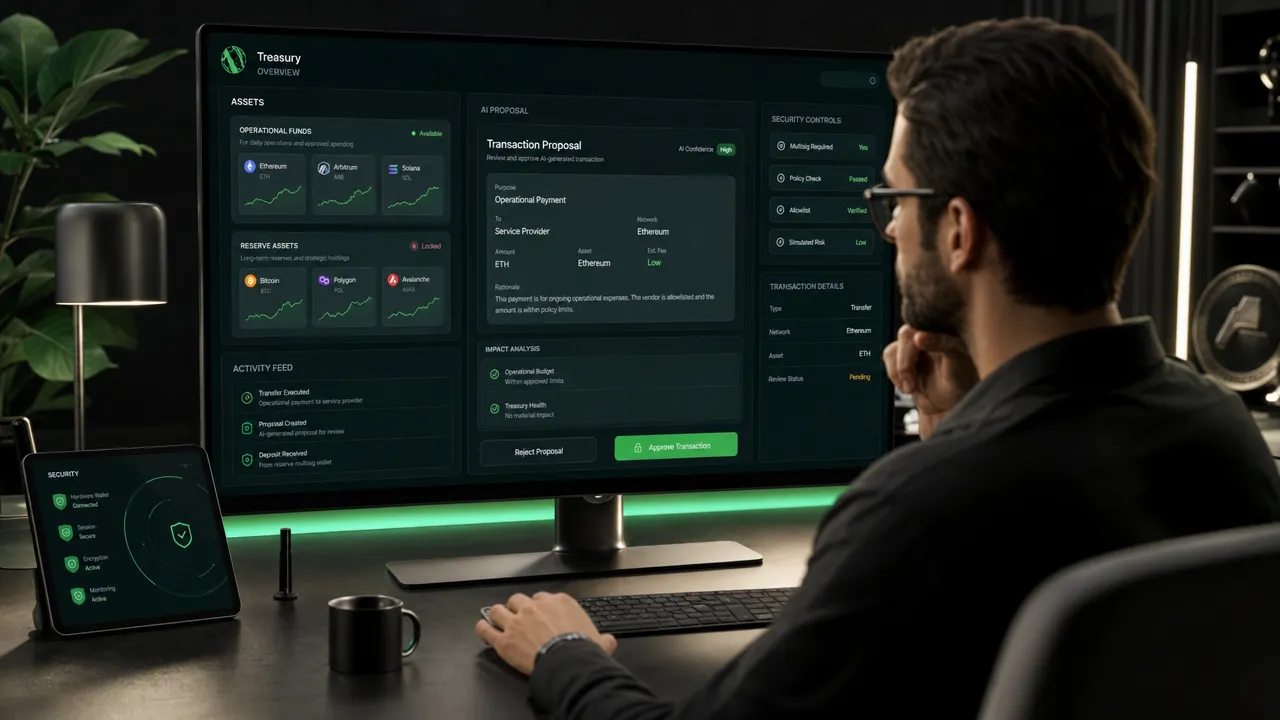
A practical checklist for non-custodial wallets for AI agents
Before connecting any AI system to crypto-related actions, use this checklist to reduce avoidable exposure.
| Question | Safer answer |
|---|---|
| Does the agent have a master seed phrase? | No. Keep recovery information outside the agent environment. |
| Can the agent spend from long-term reserves? | No. Use a capped operational wallet. |
| Can the agent send to any address? | No. Use recipient allowlists and escalation rules. |
| Can the agent call unknown contracts? | No. Limit activity to reviewed contracts and functions. |
| Are permissions indefinite? | No. Use expiry dates and revoke access when a task ends. |
| Is every transaction automatically approved? | No. Escalate high-value, unusual, or out-of-policy actions. |
| Are approvals monitored separately from transfers? | Yes. Review token approvals as their own security decision. |
| Is there an emergency response plan? | Yes. Define how to pause agents, revoke permissions, and move operational funds. |
| Is there a transaction record? | Yes. Retain logs of agent intent, policy results, approval decisions, and transaction hashes. |
Exchange API keys remain useful when the task belongs inside a centralized exchange. Non-custodial wallets for AI agents are more suitable when the task requires direct, user-controlled on-chain settlement, transparent asset management, or DApp interaction.
The safer choice is not blind automation. It is constrained authority: small operational balances, explicit limits, reviewed contracts, independent policy enforcement, and human control over meaningful exceptions.
FAQ: non-custodial wallets and AI agents
Is a non-custodial wallet automatically safer than an exchange API key for an AI agent?
Not automatically. Both are tools, and both fail the same way if authority is unconstrained. A non-custodial wallet gives a stronger control surface (recipient allowlists, spending caps, per-transaction policy checks) but only if those controls are actually enforced outside the agent's own reasoning, not left to the model to police itself.
Should an AI agent ever hold a wallet's master private key or seed phrase?
No. Recovery information should stay outside the agent's environment entirely. A safer design separates roles: the agent proposes, a policy layer checks the proposal against rules, and a human or multisig approver signs off on anything outside those rules.
What is ERC-8196, and is it something FoxWallet uses today?
ERC-8196 is a draft Ethereum proposal describing policy-bound wallet execution for AI agents, it's an emerging standard, not a finalized production spec, and not a verified FoxWallet feature. It's referenced here as context for where this space is heading, not as a claim about current capability.
Can FoxWallet act as a dedicated AI-agent wallet or policy engine today?
No, and this is worth being precise about. FoxWallet is a non-custodial, multi-chain wallet with risk-aware features like pre-transaction alerts and contract recognition. It is not a verified autonomous trading platform, session-key system, or institutional policy engine, those capabilities aren't part of what's being claimed here.
What's the single most important safeguard before connecting any AI system to on-chain funds?
A capped, isolated operational wallet, separate from long-term reserves, with recipient and contract allowlists and an expiration on any delegated permission. If that one safeguard is missing, none of the others fully compensate for it.
FoxWallet can serve as a non-custodial, multi-chain starting point for users who want to retain control of their assets while participating in on-chain workflows. Before using any wallet in an agent-assisted process, protect recovery information, separate operational funds from long-term holdings, review every transaction carefully, and assess the risks of every connected protocol.
This article is for educational purposes only and is not investment, legal, tax, or security advice. Digital-asset transactions involve risk and may be irreversible.