


BNB Smart Chain Explained: BSC, BEP-20 & Wallets

BNB Smart Chain (BSC) is the EVM-compatible smart-contract network within the broader BNB Chain ecosystem. It is where users hold and transfer BEP-20 tokens, connect wallets to compatible DApps, and sign smart-contract transactions. BNB is the network’s native asset and is used to pay gas fees, including when the asset being sent is a stablecoin or another BEP-20 token.
The names are related but not interchangeable: BNB Chain is the broader ecosystem, BNB Smart Chain is the blockchain, BEP-20 is a token standard, and BNB is the asset used for gas and other network functions.
What Is BNB Smart Chain?
BNB Smart Chain is an EVM-compatible blockchain designed to run smart contracts and decentralised applications. EVM compatibility means it uses the Ethereum Virtual Machine environment, so many concepts familiar from Ethereum—0x addresses, smart-contract calls, token approvals and wallet signatures—also appear on BSC.
BSC is the common abbreviation for BNB Smart Chain. Wallet network selectors, exchange withdrawal screens and DApp connection prompts may use either name.
BNB Smart Chain uses Proof of Staked Authority (PoSA). Validators process transactions and help secure the network, while BNB is used for gas and network-related functions. The exact validator set and network conditions can change, so fixed claims about speed, cost or confirmation time should not be treated as permanent.
BNB Chain vs BNB Smart Chain: What’s the Difference?
BNB Chain is the broader ecosystem name. BNB Smart Chain is the EVM-compatible smart-contract chain within that ecosystem. The simplest way to separate the main terms is:
| Term | Meaning | What it means in practice |
|---|---|---|
| BNB Chain | The broader ecosystem and umbrella name. | A general reference to the BNB network ecosystem. |
| BNB Smart Chain | The EVM-compatible smart-contract blockchain. | The network selected for BSC transactions, BEP-20 tokens and compatible DApps. |
| BSC | Common shorthand for BNB Smart Chain. | Usually the same network label, but the chain details should still be checked. |
| BEP-20 | A fungible-token standard used on BSC. | Defines common token functions such as transfers, balances and approvals. |
| BNB | The native asset used for gas and network functions. | Keep enough BNB on BSC to pay transaction fees. |
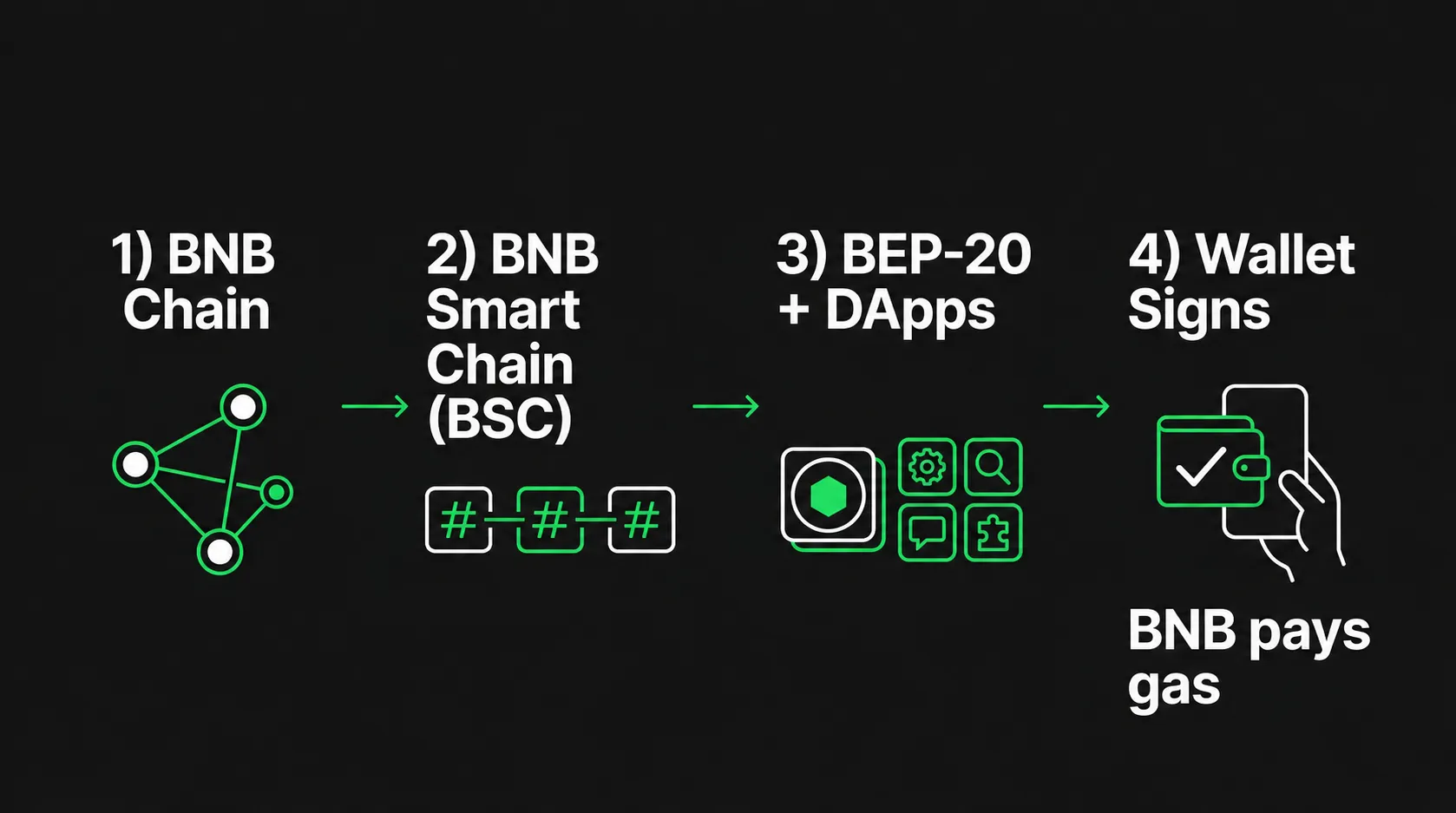
The shared terminology can make BSC feel like another name for every part of the ecosystem, but the distinction matters when choosing a network or checking a token contract. BEP-20 is not a blockchain or a wallet type, and BNB is not the same thing as every token that exists on BSC.
What Is BEP-20?
BEP-20 is a fungible-token standard used on BNB Smart Chain. It was derived from the ERC-20 model and defines common functions for token balances, transfers, allowances and approvals. The technical interface is documented in the official BEP-20 specification.
A BEP-20 token is a smart contract deployed on BSC. Your wallet does not store the token inside the app. It holds or manages the private keys used to authorise actions associated with your on-chain address, while the blockchain records balances and transactions.
Adding a token manually only tells the wallet which contract to display. It does not prove that the token is authentic, liquid or safe. Token names and symbols can be copied, so verify the full contract address through the project’s official materials and a trusted block explorer.
BEP-20 and ERC-20 use similar concepts but operate on different networks. For a deeper comparison, see BEP-20 vs ERC-20.
How BNB Smart Chain Transactions Work
At a user level, a BSC transaction follows a simple sequence:
- A wallet prepares the transaction or smart-contract request.
- The user reviews the network, destination, amount, contract action and estimated fee.
- The wallet signs the transaction with the relevant private key.
- The signed transaction is submitted to BNB Smart Chain.
- Validators process it and the network records the result.
- The user can check the transaction status and hash in a compatible block explorer.
Gas fees on BSC are paid in BNB. This remains true when the transaction sends a stablecoin or another BEP-20 token. A wallet that contains tokens but no BNB may be unable to transfer those tokens or approve a smart contract because it lacks the asset needed for gas.
Token approvals are separate from transfers. A decentralised exchange or another smart contract may first request permission to spend a specified amount of a token. Review the token, spender contract and allowance before signing. Large or unlimited allowances can remain active until they are changed or revoked, and revoking an approval is another on-chain transaction that requires BNB for gas.
Official BNB Chain wallet configuration currently identifies BSC Mainnet with chain ID 56 and BNB as the native currency. If a wallet requires manual network setup, use the current official BNB Chain configuration rather than copying settings from an unknown site.
BSC Addresses and Network Selection
BNB Smart Chain and Ethereum both use EVM-style addresses that begin with 0x. The same private key can derive the same-looking account address across EVM networks, but that does not make the networks interchangeable.
A matching address format does not prove that:
- an exchange or service accepts deposits on both networks;
- a token sent on BSC will appear as the Ethereum version of that token;
- a recipient supports the selected chain;
- an unsupported wrong-network transfer will be recoverable.
Before sending, check the network selected in the wallet and the network expected by the recipient. If an exchange deposit page offers several choices for the same asset, match the withdrawal network exactly to the deposit network.
Wrapped or bridged versions of an asset can exist on more than one chain, but each version has its own contract and on-chain balance. The ticker alone is not enough to identify the asset.
For practical network-selection steps without repeating them here, use the dedicated guide to using BNB Smart Chain in a crypto wallet.
BNB Smart Chain vs Ethereum
BNB Smart Chain and Ethereum are separate EVM-compatible networks. Their similar address style and smart-contract conventions make many wallet interactions look familiar, but transactions, token contracts and balances remain chain-specific.
| Feature | BNB Smart Chain | Ethereum |
|---|---|---|
| Native gas asset | BNB | ETH |
| Common fungible-token standard | BEP-20 | ERC-20 |
| EVM compatibility | Yes | Native EVM chain |
| Address format | 0x style | 0x style |
| Ecosystem | BNB Chain ecosystem | Ethereum ecosystem |
| Transaction history | Recorded on BSC | Recorded on Ethereum |
Network fees and transaction conditions vary over time. It is more useful to compare the current fee estimate, application availability, liquidity, token contract and recipient support for the specific transaction than to treat one chain as permanently cheaper, faster or better.
How Wallets Use BNB Smart Chain
A BSC-compatible wallet provides the interface for interacting with BNB Smart Chain. Depending on the wallet and platform, users may be able to:
- view BNB and supported BEP-20 balances;
- send and receive assets on BSC;
- add a token contract for display;
- connect to compatible DApps;
- sign token approvals and smart-contract transactions;
- review transaction details and network fees.
The wallet signs; the blockchain executes. Connecting a wallet to a DApp does not by itself transfer funds, but a subsequent signature, approval or contract call may authorise an action. Treat each prompt as a separate decision and confirm the site, network, contract and requested permission.
Self-custody also means responsibility for the recovery phrase and private keys. No legitimate wallet provider, DApp or support representative needs your recovery words. The guide to custodial vs non-custodial wallets explains the ownership trade-off in more detail.
If the goal is to compare wallet options rather than learn the network itself, see the best BEP-20 wallets and BSC address guide.
Using BNB Smart Chain With FoxWallet
FoxWallet mobile supports BNB Chain, including BNB Smart Chain and BEP-20 assets. Users can manage supported assets, connect to compatible DApps and review transaction requests within a non-custodial multi-chain wallet.
On mobile, FoxWallet also supports BNB Chain swaps through 1inch and BNB Chain bridge routes through LI.FI. These are separate capabilities:
- A swap exchanges assets according to the route and terms shown before confirmation.
- A bridge or cross-chain route moves or exchanges assets between networks.
- Neither should be confused with staking, which is a separate activity with different mechanics and risks.
FoxWallet’s browser extension supports EVM networks and basic wallet actions, but it does not have full feature parity with the mobile app. Swap, bridge and staking are not supported in the extension.
For current DApp research and interaction considerations, see BNB Chain DeFi apps. A DApp listing does not guarantee safety, suitability or permanent compatibility.
Common BSC Mistakes
Selecting the wrong network
Choose BNB Smart Chain when the sender, recipient and asset route all require BSC. An 0x address alone does not confirm the correct network.
Running out of BNB for gas
BEP-20 transactions require BNB for gas. Leave enough BNB on BSC to cover the action and any later approval change or transfer.
Trusting a token name or logo
Scam tokens can copy familiar names, tickers and artwork. Verify the complete contract address instead of relying on the display label.
Confusing ERC-20 and BEP-20 versions
The same asset may exist on Ethereum and BSC under different contracts. Match the token standard and network expected by the destination.
Signing without reviewing the request
A connection, message signature, token approval and contract transaction are different actions. Check what the request authorises before signing.
Skipping the test transfer
For a new address or route, a small test transaction can confirm the network and destination before a larger transfer. A successful test does not remove every risk, but it can catch basic configuration errors.
FAQ
What is BNB Smart Chain?
BNB Smart Chain is the EVM-compatible smart-contract blockchain within the broader BNB Chain ecosystem. It supports BEP-20 tokens, DApps and wallet-signed transactions.
Is BSC the same as BNB Chain?
Not exactly. BSC is shorthand for BNB Smart Chain. BNB Chain is the broader ecosystem name, while BNB Smart Chain is the EVM-compatible blockchain users commonly select for BEP-20 transactions.
Is BEP-20 the same as BSC?
No. BSC is the blockchain; BEP-20 is a token standard used on that blockchain.
Do I need BNB to send BEP-20 tokens?
Yes. BSC transaction fees are paid in BNB, including fees for BEP-20 transfers, token approvals and other smart-contract actions.
Is a BSC address the same as an Ethereum address?
Both networks use 0x-style addresses, and the same account can display the same-looking address on both. The networks remain separate, so the selected chain, token contract and recipient support must still match.
Is BNB Smart Chain EVM-compatible?
Yes. BNB Smart Chain is EVM-compatible, which allows Ethereum-style smart contracts, addresses and wallet interactions while maintaining its own network state, validators, fees and transaction history.
Can I use BNB Smart Chain with FoxWallet?
Yes. FoxWallet mobile supports BNB Chain, including BNB Smart Chain and BEP-20 assets. Keep enough BNB for gas and review the network, contract and transaction details before signing.
The practical rule is simple: confirm BSC, verify the token contract, keep BNB for gas and make sure the destination supports the selected network. When those details match, a BSC-compatible self-custody wallet can be used to manage BEP-20 assets and interact with supported DApps.