


How to Spot a Crypto Wallet Recovery Scam

If you are reading this after losing crypto or wallet access, pause before paying anyone who promises a fast fix. A crypto wallet recovery scam often targets people at their most stressed moment: after a stolen transfer, a compromised wallet, a lost seed phrase, or a suspicious DApp interaction.
The safest first rule is simple: never share your seed phrase, private key, wallet password, exchange login, 2FA code, or remote access with anyone claiming they can recover funds. The FTC explains that cryptocurrency payments are typically not reversible, and the CFTC warns that recovery fraud is often advance-fee fraud. That does not mean every investigation is useless, but it does mean that "guaranteed recovery" is a major warning sign.
FoxWallet is a security-first, non-custodial, multi-chain wallet. It helps users reduce risk through local key encryption, phishing protection, pre-transaction risk alerts, smart contract recognition, DApp access, multi-chain asset visibility, and mobile/browser extension support. FoxWallet is not a recovery service. It cannot reverse blockchain transactions, retrieve lost seed phrases, or recover stolen crypto.
What a crypto wallet recovery scam is
A crypto wallet recovery scam is a fake service or person claiming they can recover stolen crypto, restore a lost seed phrase, unlock a wallet, reverse a transaction, or "hack back" funds. The offer usually leads to one of three outcomes:
- You pay an upfront fee and receive excuses for more payments.
- You reveal a seed phrase, private key, or wallet login and lose remaining assets.
- You connect your wallet to a malicious DApp and approve a harmful transaction.
This is why a wallet recovery scam warning matters: recovery scammers often target people who have already been harmed. The CFTC notes that scammers may use lists of prior victims to re-victimize people with new promises of recovery.
Common fake crypto recovery service claims
| Claim | Why it is dangerous |
|---|---|
| "We guarantee 100 percent recovery." | No legitimate investigator can guarantee asset recovery. |
| "Pay a tax, gas fee, AML fee, or release fee first." | This resembles advance-fee recovery fraud. |
| "Send your seed phrase so we can verify ownership." | Anyone with your seed phrase can control your wallet. |
| "Install this remote-access app." | It may expose passwords, browser sessions, wallet files, and exchange accounts. |
| "We can reverse the blockchain transaction." | Crypto payments are generally irreversible once confirmed. |
| "We found your funds. Pay now before they disappear." | Urgency is a common manipulation tactic. |
A fraudulent wallet recovery offer often looks professional. Scammers may use cloned websites, fake testimonials, government-style seals, copied law firm names, paid ads, or social media comments that say someone successfully recovered funds. Do not treat a polished website as proof of legitimacy.
How a crypto wallet recovery scam works
Most recovery scams follow a predictable funnel. The scammer first finds a victim, builds false authority, creates urgency, then extracts money or wallet access.
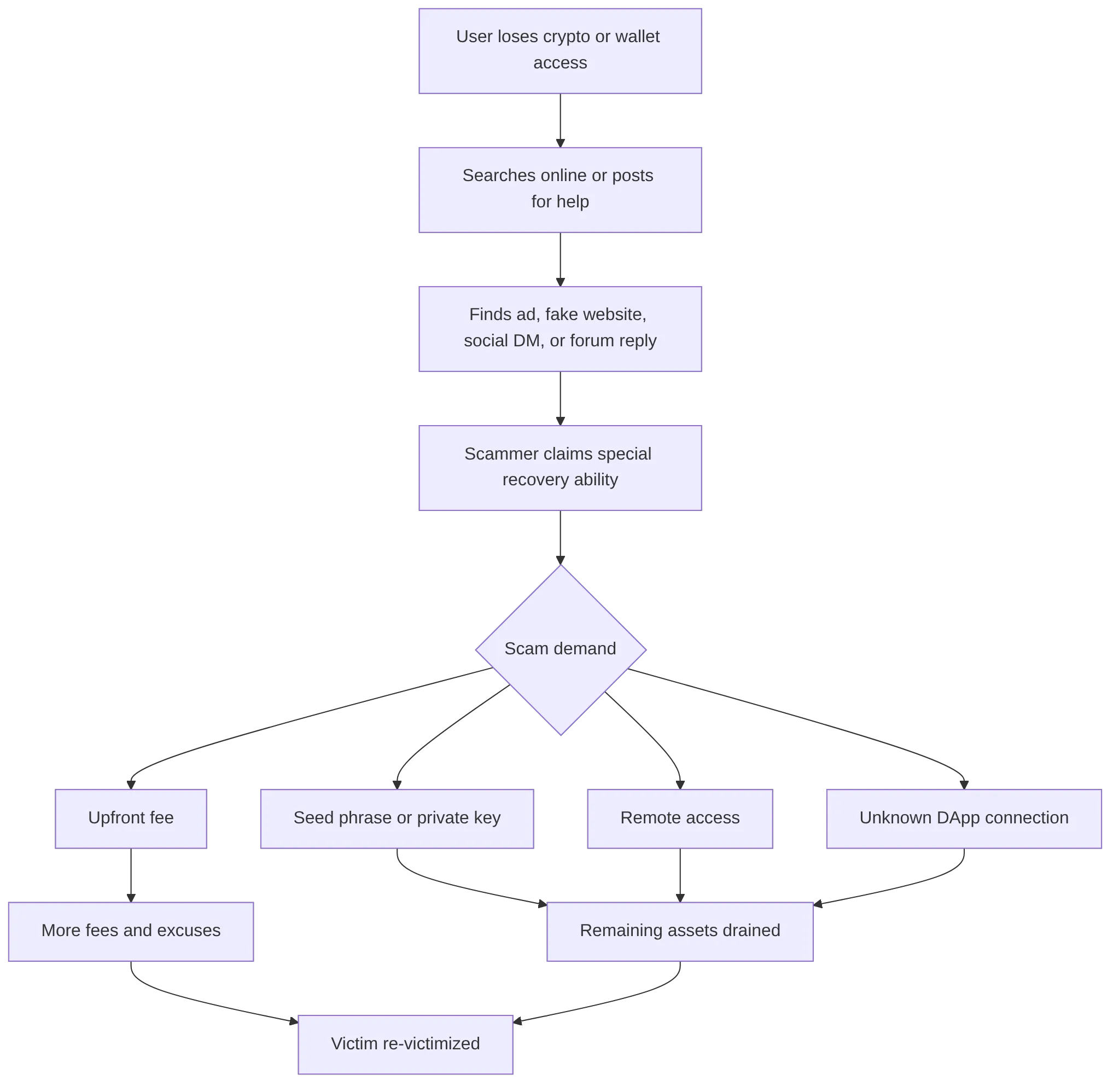
The recover stolen crypto scam pattern
A recover stolen crypto scam usually begins with a promise that sounds technical. You may hear phrases like:
- "Node synchronization"
- "Wallet validation"
- "Smart contract reversal"
- "Blockchain tax clearance"
- "Liquidity activation"
- "Private key reconstruction"
- "Cross-chain release fee"
- "AML clearance deposit"
These phrases are often technical theater. They are designed to make the scam sound credible while pushing you toward payment or credential disclosure.
Impersonated wallet support
Scammers may pretend to be wallet support and ask you to "verify" or "restore" your wallet by entering a seed phrase into a website. Legitimate non-custodial wallet support never needs your seed phrase or private key.
Because FoxWallet is non-custodial, users retain full control over private keys and assets. FoxWallet does not hold user funds or private keys, so it cannot reset a lost seed phrase, retrieve a private key, or reverse a transaction. For a deeper explanation of what is possible when a backup is missing, see FoxWallet's guide on how to recover a crypto wallet without a seed phrase.
Government and exchange impersonation
Some scammers pretend to represent the FBI, FTC, CFTC, SEC, a tax agency, an exchange, or a court. The FTC warns that scammers impersonate government agencies and that legitimate agencies will not demand that you transfer crypto to "protect" your money.
If someone contacts you first and claims to be from an official recovery department, independently verify the claim through the official agency or exchange website. Do not use links, phone numbers, or emails provided by the person contacting you.
Crypto wallet recovery scam red flags to check first
If you want to spot crypto wallet recovery scam tactics quickly, use this checklist before you respond, pay, click, or connect your wallet.
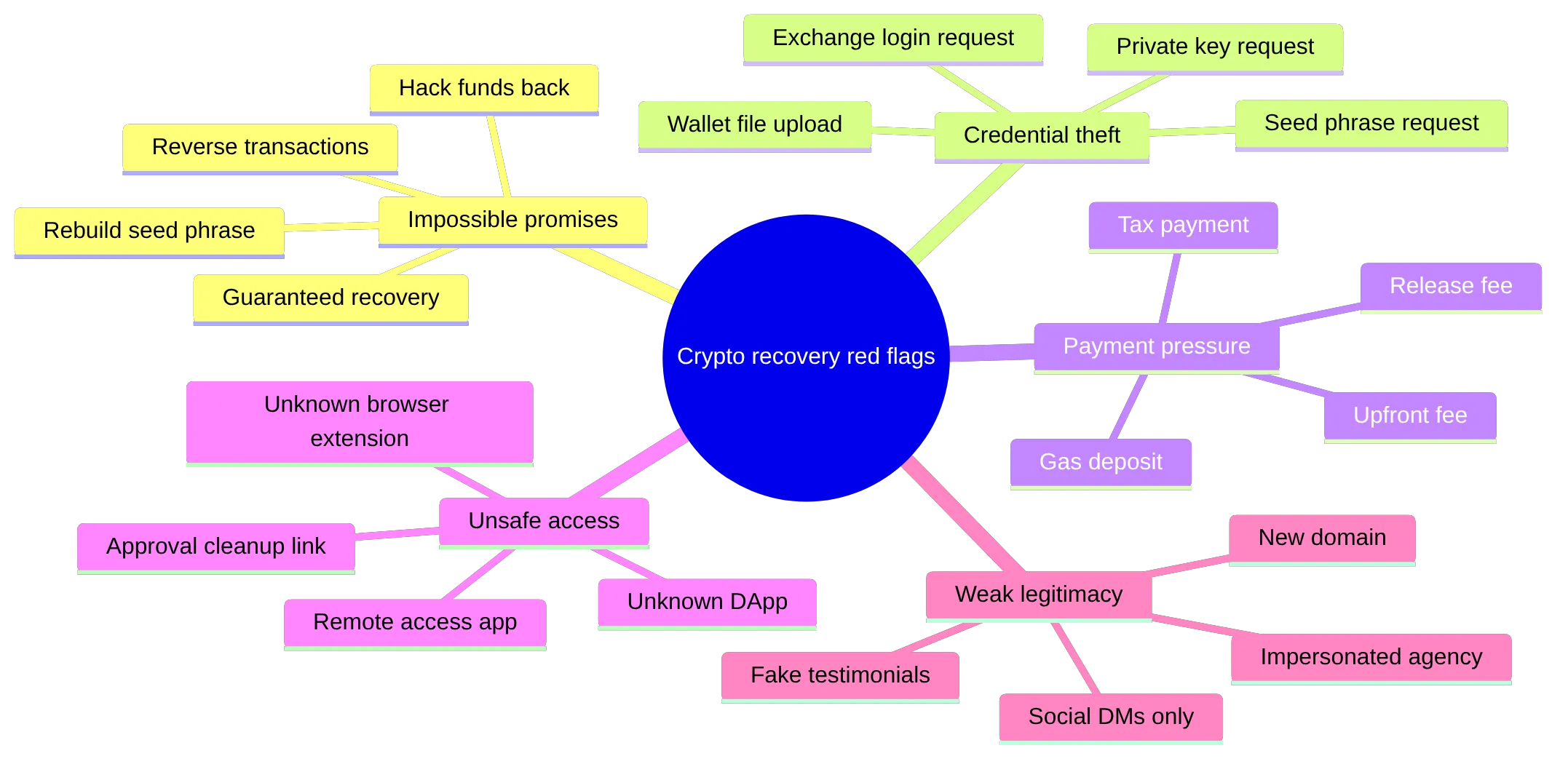
Red flag 1: Guaranteed recovery
No honest party can guarantee recovery of stolen crypto. Blockchain tracing may show where funds moved, but tracing is not the same as retrieving funds.
Red flag 2: Seed phrase or private key requests
This is the clearest crypto recovery red flag. A seed phrase is not a support code. It is the master key to the wallet. If a person, form, website, or "agent" asks for it, assume the offer is malicious.
Red flag 3: Upfront payment pressure
The CFTC describes recovery fraud as advance-fee fraud. Be especially cautious of fees described as:
- Tax
- Gas
- Unlock fee
- Retainer
- Wallet activation
- Compliance fee
- AML clearance
- Final withdrawal fee
Red flag 4: Remote access
A fake crypto recovery service may ask you to install remote-access software so an "expert" can inspect your wallet. This can expose your browser wallet, saved passwords, exchange sessions, screenshots, files, or seed phrase backups.
Red flag 5: Social media-only communication
Telegram, WhatsApp, Discord, Instagram, X/Twitter replies, YouTube comments, and forum DMs are common scam channels. A real company or regulator should be independently verifiable outside a messaging app.
Red flag 6: Unknown DApp connection
Some scammers claim they need you to connect your wallet to a "revoke," "cleanup," or "asset rescue" tool. Unknown DApps can request dangerous approvals or signatures. If your wallet shows a risk alert, stop and investigate before signing. To learn more about common wallet mistakes, FoxWallet explains common Web3 wallet traps that often lead to phishing, approval risk, and loss.
What a crypto wallet recovery scam cannot really do
The best way to avoid crypto recovery scam pressure is to understand what is technically possible and what is not.
| Situation | What is realistic | What is suspicious |
|---|---|---|
| You sent crypto to a scammer. | Preserve evidence, report to agencies, notify exchanges if funds move there. | "We can reverse the transaction if you pay now." |
| Your seed phrase is lost. | Recovery may be possible only if you have another valid backup or device access. | "We can recreate your seed phrase from your address." |
| Your wallet was compromised. | Create a new wallet on a clean device and move remaining assets if possible. | "Give us your private key so we can secure it." |
| You approved a malicious contract. | Review and revoke risky approvals using trusted sources. | "Connect to this unknown rescue DApp." |
| Funds moved to an exchange. | Report quickly with transaction hashes and evidence. | "Pay a release fee to unlock frozen funds." |
Blockchain transactions are generally irreversible
The FTC says cryptocurrency payments are typically not reversible. In practical terms, if you willingly or unknowingly sent crypto to an address controlled by a scammer, a wallet app cannot simply undo it. The recipient would need to return the funds, or an official investigation may need to identify and pursue an entity that can cooperate.
Seed phrases cannot be reconstructed from wallet addresses
A public wallet address can show transaction history. It cannot reveal the private key or seed phrase. This is a core security property of crypto wallets. If someone claims they can rebuild your private key from a public address, treat it as a fraudulent wallet recovery claim.
Tracing can help, but it is not recovery
Blockchain analytics may trace movement of funds across addresses, networks, swaps, or exchanges. This may support a report to law enforcement or an exchange. But tracing does not guarantee that assets can be frozen or returned.
Official reporting matters
The FBI advises victims to stop sending money and report fraud through IC3. The FBI has also warned users to be wary of cryptocurrency recovery service advertisements and fake recovery businesses. NASAA similarly warns investors about crypto recovery room scams, where victims of a first fraud are targeted again.
What to do after a crypto wallet recovery scam or wallet compromise
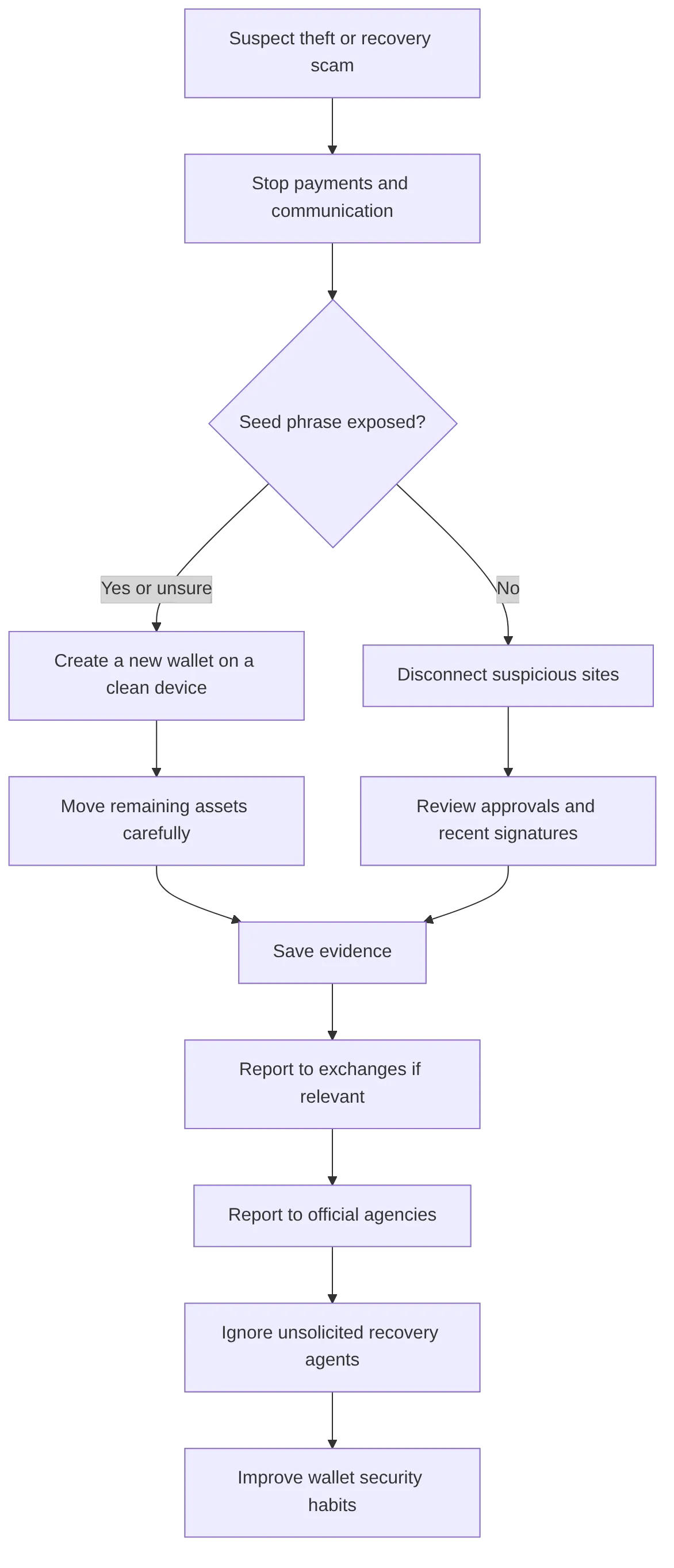
If you suspect you are already dealing with a crypto wallet recovery scam, act quickly but carefully. Do not send more money to "finish" the process.
Step 1: Stop paying
Do not pay additional taxes, gas, verification fees, compliance fees, or withdrawal charges. A scammer may keep inventing fees until you stop.
Step 2: Secure remaining assets
If your seed phrase or private key may be exposed, create a new wallet on a clean device. Move remaining assets carefully. Test with a small transfer first when possible.
FoxWallet supports self-custody with locally encrypted storage of mnemonic phrases and private keys, sandbox isolation, and a unified multi-chain asset view. That helps users manage assets across networks with more visibility, but it does not remove the need to protect backups and read every transaction prompt.
Step 3: Save evidence
Collect:
- Transaction hashes
- Wallet addresses
- Token contract addresses
- Screenshots
- Chat logs
- Email headers
- Website domains
- Social media profiles
- Payment receipts
- Any fake case numbers or documents
Do not delete messages, even if they are embarrassing or stressful. Evidence may help exchanges, law enforcement, or regulators.
Step 4: Report to official channels
Use official reporting portals, not links sent by a recovery agent:
- FBI IC3
- FTC ReportFraud
- CFTC complaint portal
- SEC tips, complaints, and referrals
- NASAA guidance on contacting securities regulators
If funds moved to a known exchange address, report the transaction hash and supporting evidence to that exchange immediately. Speed can matter, but recovery is never guaranteed.
Step 5: Clean up your device and accounts
Update your operating system, browser, and wallet apps. Remove unknown extensions. Scan for malware. Change email and exchange passwords from a clean device. Reset 2FA if needed. Avoid remote-access tools unless you are working with a verified professional you independently selected.
How FoxWallet helps reduce crypto wallet recovery scam risk
Crypto scam prevention is mostly about reducing the chance of signing a bad transaction, visiting a phishing page, losing a seed phrase, or trusting a fake support channel. A wallet cannot guarantee safety, but good wallet design can help users make better decisions before risk becomes loss.
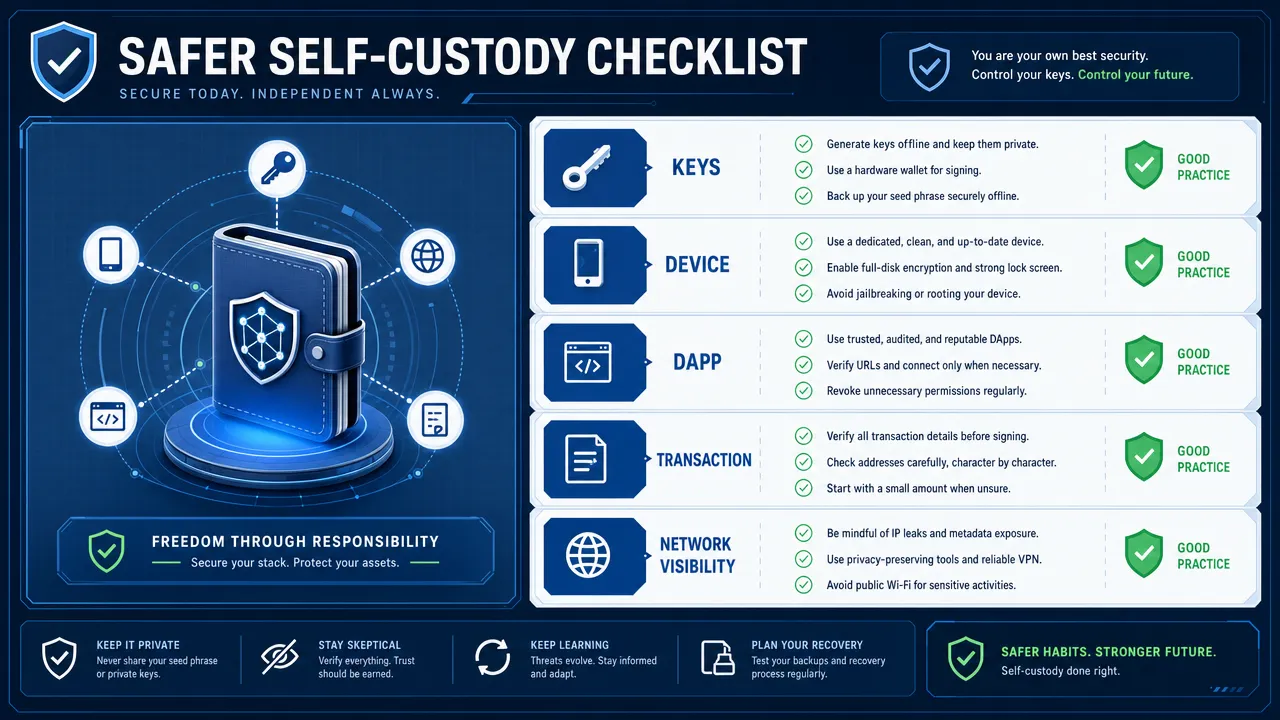
FoxWallet is designed as a multi-chain decentralized wallet for beginners, advanced users, and professional Web3 users. Users retain full control over private keys and assets, while FoxWallet provides security-oriented tools for everyday self-custody.
Use a non-custodial wallet responsibly
With a non-custodial wallet, you control your assets. That is powerful, but it also means no wallet provider can reset a lost seed phrase for you. FoxWallet never accesses or holds user funds. It supports local encryption for mnemonic phrases and private keys, helping users keep sensitive credentials on their own device.
For more on FoxWallet's security approach, see this overview of FoxWallet security features.
Manage multi-chain assets with clearer visibility
Recovery scammers often exploit confusion across networks. FoxWallet provides one-stop management of assets and token balances across multiple blockchains, automatic detection of assets and NFTs on different networks, and real-time on-chain data synchronization. A unified asset view can reduce operational mistakes when users manage assets across chains.
You can learn more about secure and fast multi-chain management with FoxWallet.
Treat cross-chain swaps and staking as separate activities
Cross-chain swaps involve exchanging assets across networks through swap routes and liquidity sources. Staking involves participating in supported network or protocol mechanisms where applicable. They are different activities with different risk profiles. Read every prompt carefully and verify the DApp or route before signing. FoxWallet supports built-in cross-chain swaps and on-chain trading through integrated multi-chain swap aggregators, while also supporting access to DApps for DeFi, staking, lending, NFTs, GameFi, and more as separate use cases.
For a deeper look at cross-chain complexity, FoxWallet explains how cross-chain swaps work.
Use risk alerts and phishing protection
FoxWallet's security architecture includes pre-transaction risk alerts, smart contract recognition, phishing link protection, sandbox isolation, and continuously updated security strategies. These features are designed to help users pause before signing something risky.
Still, no wallet can guarantee scam prevention. If a recovery agent pressures you to ignore a wallet warning, that is another red flag.
Access DApps carefully
FoxWallet provides a built-in DApp browser for secure access to Web3 use cases including Swap, DeFi, staking, lending, NFTs, and GameFi. Before connecting to any DApp, verify the source, avoid links from strangers, and read wallet prompts. If you are exploring DApps, FoxWallet's guide to the best DeFi apps with FoxWallet can help you approach the ecosystem more carefully.
Final checklist to avoid crypto recovery scam traps
| Safety habit | Why it matters |
|---|---|
| Never share seed phrases or private keys. | They control wallet access. |
| Ignore guaranteed recovery claims. | Recovery cannot be guaranteed. |
| Avoid upfront recovery fees. | Advance-fee fraud is a known pattern. |
| Verify support through official websites. | Scammers impersonate brands and agencies. |
| Do not install remote-access tools for strangers. | They can expose accounts and wallet data. |
| Use trusted DApps only. | Unknown DApps may request harmful approvals. |
| Read wallet warnings. | Risk alerts can help prevent bad signatures. |
| Keep backups offline. | Screenshots and cloud notes can be compromised. |
| Separate wallets by risk level. | Long-term holdings should not be mixed with experimental DApp use. |
| Report scams to official channels. | Reporting creates a record and may support investigations. |
A crypto wallet recovery scam succeeds when panic overrides verification. Slow down, protect your keys, preserve evidence, and distrust anyone who promises guaranteed recovery for a fee.
Start safer self-custody with FoxWallet: manage multi-chain assets in a non-custodial wallet with local key encryption, risk-aware transaction prompts, phishing protection, DApp access, and mobile/browser extension support. FoxWallet cannot recover stolen funds or reset lost seed phrases, but it can help you reduce risk before you sign.
FAQ: crypto wallet recovery scams
Can anyone actually recover stolen crypto?
Recovery is not guaranteed by anyone. Blockchain tracing can sometimes show where funds moved and support a law enforcement report, but no legitimate party can promise to reverse a confirmed transaction or get your funds back.
Is it ever safe to share a seed phrase with a "recovery expert"?
No. A seed phrase is the master key to a wallet. No legitimate recovery service, wallet support team, or government agency needs it, and sharing it typically means losing whatever assets remain.
What should I do first if I think I'm being scammed by a recovery service?
Stop paying and stop communicating immediately. Do not send any more "fees," and do not click links or install software the other party provides.
Can FoxWallet or any wallet reverse a transaction or recover a lost seed phrase?
No. Because FoxWallet is non-custodial, it never holds user funds or private keys, so it has no ability to reverse a blockchain transaction or reconstruct a lost seed phrase.
Where should I actually report a crypto recovery scam?
Use official channels only: the FBI's IC3, the FTC's ReportFraud portal, the CFTC complaint portal, the SEC's tips and complaints system, or NASAA — never a link or contact provided by the person claiming to help you recover funds.