


Best DEX Aggregators for Large Trades in 2026

The best DEX aggregators for large trades in 2026 are CoW Swap for MEV-protected same-chain execution, 1inch for broad liquidity routing and split routes, Odos for complex smart order routing, Velora (formerly ParaSwap) for mature aggregation infrastructure, and Symbiosis for cross-chain swap workflows. The right choice depends on chain, token pair, trade size, and whether MEV protection or cross-chain capability is the priority.
Large crypto trades need a different playbook from small token swaps. For a small swap, a user may focus on the quoted output and network fee. For large crypto trades, the final result depends on liquidity depth, price impact, route splitting, MEV exposure, slippage settings, gas, transaction reliability, cross-chain risk, and wallet-level security.
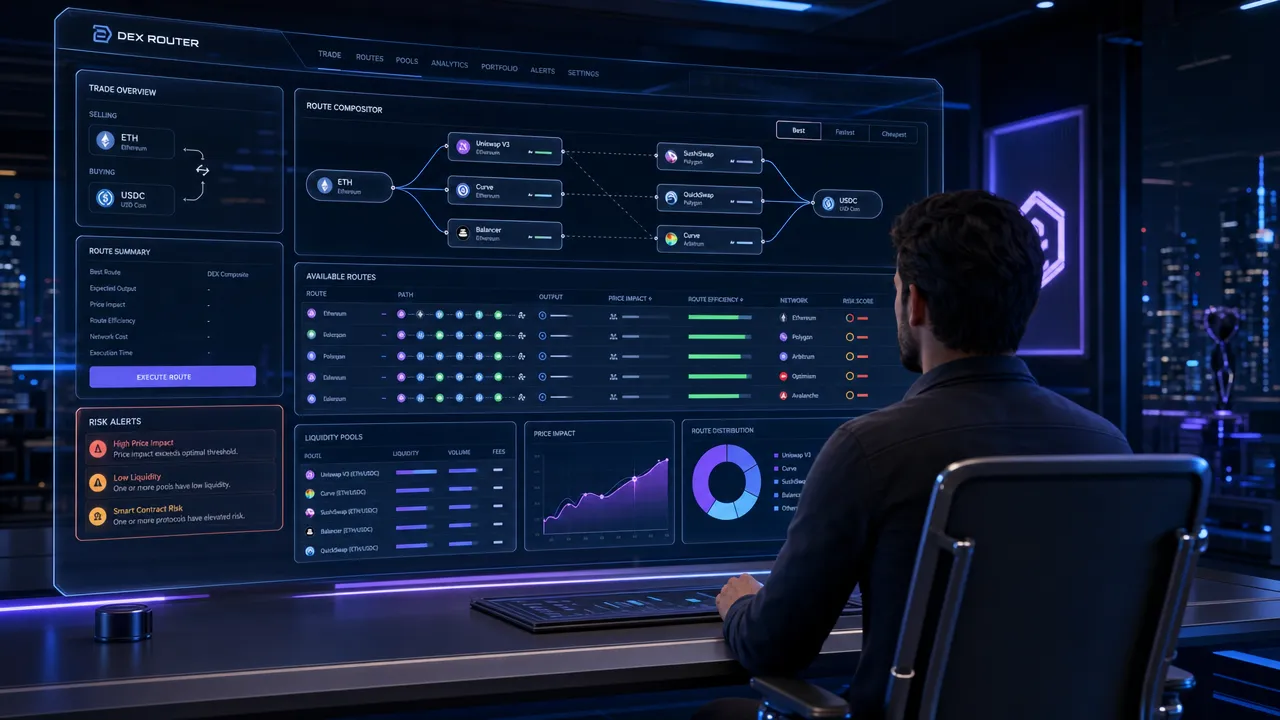
That is why comparing DEX aggregators for large trades in 2026 is not just about finding the highest displayed quote. The better question is: which platform provides the best risk-adjusted execution for a specific token pair, chain, trade size, and urgency?
In practical terms:
- CoW Swap is often best suited to MEV-sensitive same-chain trades because of its batch auction and solver-based model.
- 1inch is strong for broad liquidity routing, split routes, and intent-based execution.
- Odos is useful for complex smart order routing.
- ParaSwap, now rebranded as Velora, remains relevant for mature aggregation and intent-based models, though some MEV and cross-chain claims should be verified from official sources before execution.
- Symbiosis is more relevant when the trade requires cross-chain movement.
- FoxWallet is best understood as a secure, non-custodial, multi-chain wallet gateway that helps users manage assets, access built-in cross-chain swap functionality, connect to DeFi and DApps, and review transaction risks before signing.
Why DEX aggregators for large trades need a different execution framework
A DEX aggregator searches across decentralized exchanges, liquidity pools, market makers, and routing paths to find a better execution route than a single DEX might provide. Chainlink's educational guide explains that DEX aggregators help users access fragmented liquidity across decentralized venues rather than relying on one pool or one exchange interface. You can read more in Chainlink's overview of what a DEX aggregator is.
For large trades, this matters because liquidity is rarely concentrated in one place. A single pool may look attractive for a small swap, but a larger order can move the pool price sharply. That creates price impact, slippage, and a worse final execution price.
A strong low slippage DEX aggregator should help with:
- Scanning multiple liquidity venues.
- Splitting trades across routes.
- Comparing net output after gas.
- Showing minimum received values.
- Supporting slippage controls.
- Reducing exposure to adverse execution where possible.
- Making complex routes easier to review before signing.
Slippage and price impact are related but not identical. Slippage is the difference between the expected and actual execution price, while price impact is the effect your own trade has on the market price. MetaMask provides a useful explanation of slippage in crypto swaps, and Unizen's documentation explains the difference between price impact and price slippage.
For large crypto trades, the risk is not only paying a slightly worse price. It can include failed transactions, excessive approvals, public mempool exposure, cross-chain settlement delays, and interaction with malicious contracts or phishing links. This is where the wallet layer becomes part of the execution framework, not an afterthought.
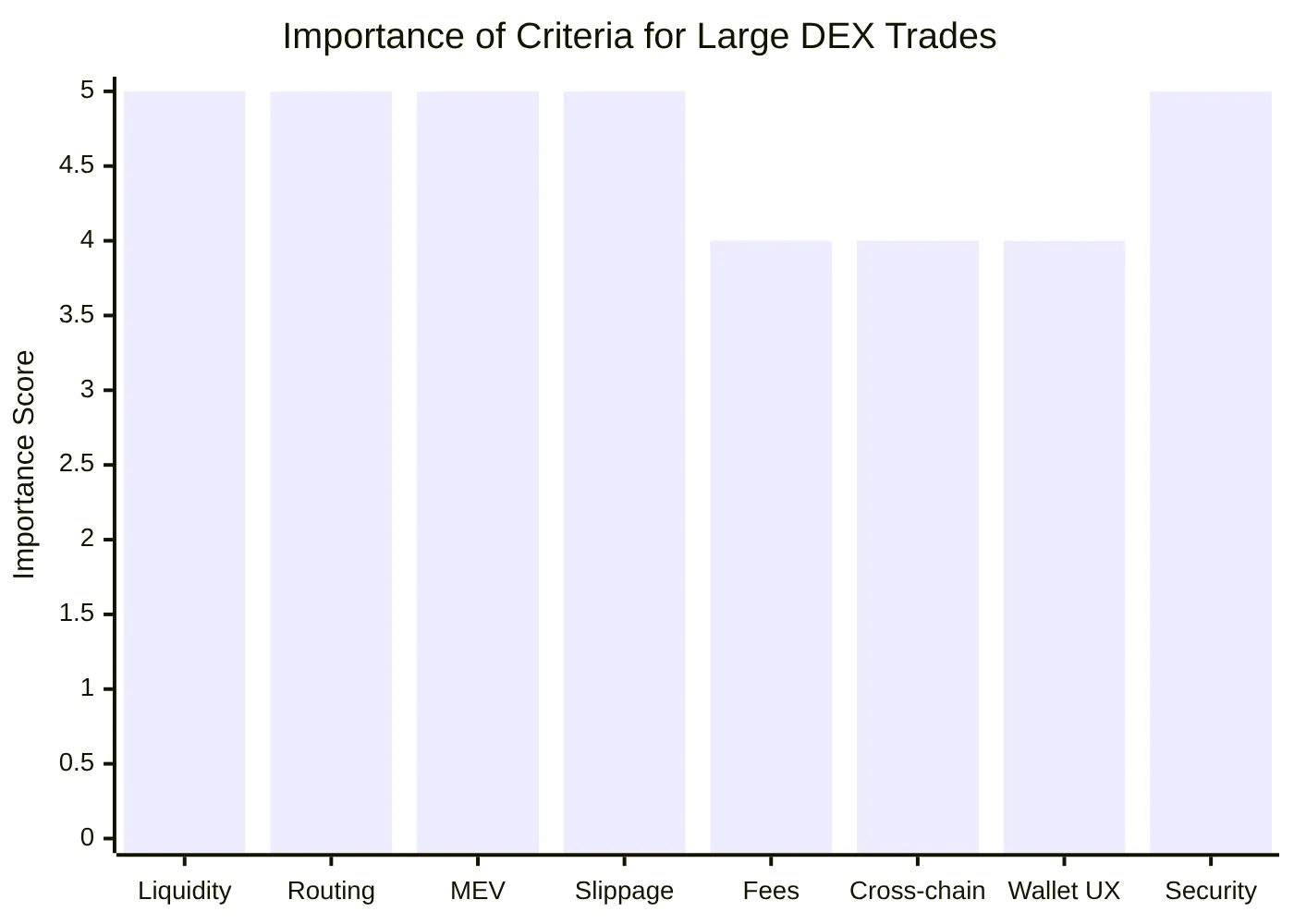
How to evaluate DEX aggregators for large trades in 2026
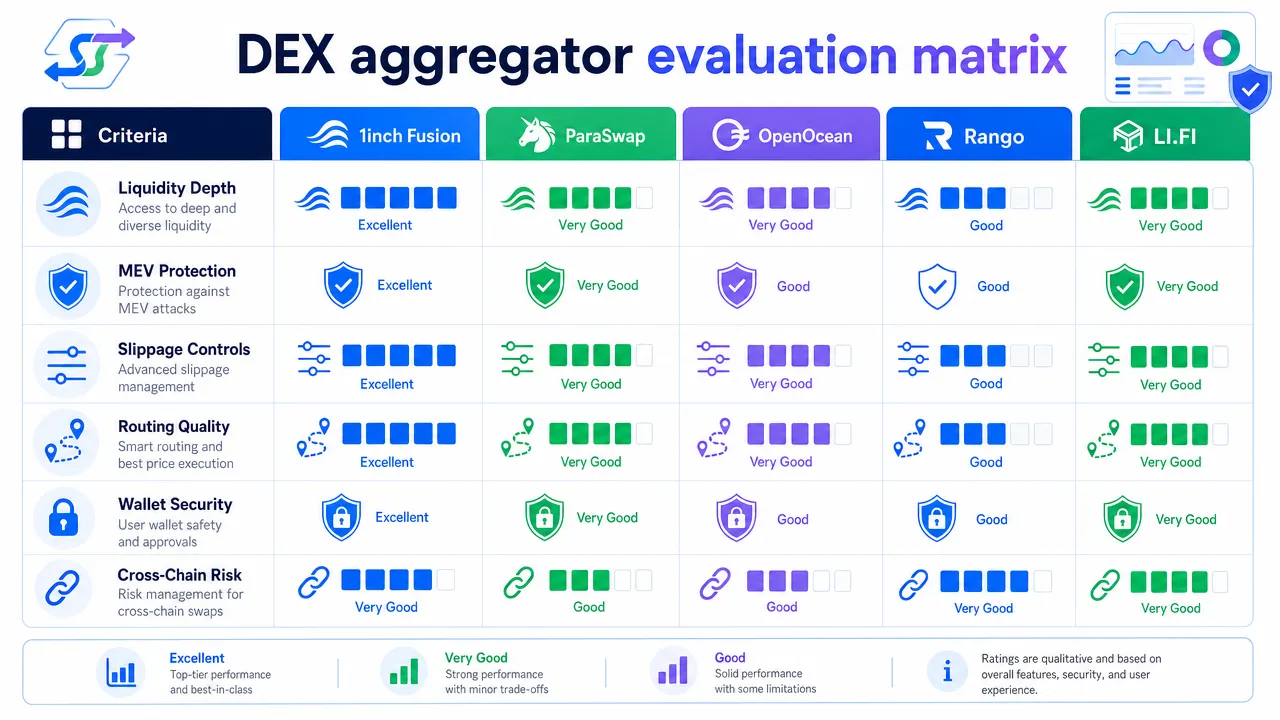
The best DEX aggregators are not always best for the same reason. One may provide stronger MEV protection swaps, another may provide deeper same-chain routing, and another may be better for cross-chain DEX aggregator workflows. For large trades, evaluate platforms across execution quality, transparency, and operational security.
| Criterion | What to check | Why it matters for large trades |
|---|---|---|
| Liquidity depth | Number and quality of liquidity sources | Deeper liquidity can reduce price impact |
| Route quality | Net output after gas and fees | A high quote may not be the best final result |
| Split routing | Ability to divide orders across venues | Helps reduce pressure on a single pool |
| MEV protection | Batch auctions, solvers, private routing, or intents | Reduces sandwich and front-running risk |
| Slippage controls | Minimum received, tolerance, quote expiry | Protects against bad fills |
| Fee transparency | Gas, route fees, bridge fees, hidden spreads | Needed for accurate net execution |
| Cross-chain support | Same-chain routing vs cross-chain swap flow | Important for multi-chain portfolios |
| Wallet integration | Clear signing prompts and risk alerts | Reduces operational mistakes |
| Security | Contract maturity, approval behavior, phishing protection | High-value trades increase approval risk |
A deep liquidity aggregator should also make the route understandable. If a route is too complex to review, the user may not know which pools, contracts, or bridge components are involved. This is especially important for institutional crypto trading, where teams may need auditability, transaction records, approval controls, and predictable minimum received values.
Before executing a large swap, ask:
- Is the displayed quote still valid?
- What is the minimum received amount?
- What is the estimated price impact?
- Is the route split across multiple venues?
- Is the route exposed to the public mempool?
- Are MEV protection swaps available for this chain and trade type?
- Are the token contracts correct?
- If cross-chain, what bridge or liquidity network is involved?
- Does the wallet show approval and risk warnings clearly?
- Is a small test transaction appropriate first?
Best DEX aggregators for large trades by use case
There is no single best answer for all users. The best price routing crypto experience depends on chain, token pair, trade size, liquidity, volatility, and risk tolerance. The table below summarizes the practical use cases.
| Platform | Best fit | Large-trade strength | Caveat |
|---|---|---|---|
| CoW Swap | MEV-sensitive same-chain trades | Batch auctions, solvers, and Coincidence of Wants model | Best fit depends on supported networks and order parameters |
| 1inch | Broad liquidity and routing | Split routes, Pathfinder-style routing, intent-based Fusion model | Execution quality varies by route, chain, and liquidity |
| Odos | Complex smart order routing | Non-linear routing and gas-aware optimization | Native MEV protection is not the primary verified positioning |
| Velora (formerly ParaSwap) | Mature aggregation and API-based routing | Aggregation infrastructure and newer intent-based execution concepts | Current MEV and cross-chain details should be verified from official docs |
| Symbiosis | Cross-chain swaps | Cross-chain bridge, swap, and liquidity routing | Large trades require careful bridge and destination-liquidity review |
| FoxWallet | Wallet gateway for multi-chain users | Self-custody, asset management, built-in swap access, risk alerts | Not positioned as a standalone DEX aggregator |
For MEV-sensitive large trades, CoW Swap is often the clearest fit because its model is built around off-chain intent aggregation, batch auctions, solver competition, and uniform clearing prices. That design helps reduce the value of transaction ordering, which is a major source of MEV risk.
For broad routing and deep liquidity, 1inch remains a leading option because of its long-standing DEX aggregation model and intent-based execution through Fusion. It is often considered by advanced DeFi users looking for best price routing crypto across many liquidity sources.
For complex routing, Odos is notable because its smart order routing approach is designed to explore non-linear paths and optimize output after gas. That can be useful when a trade benefits from more sophisticated path construction than a simple single-hop or two-hop swap.
For cross-chain movement, Symbiosis is more directly aligned with cross-chain swap workflows. However, cross-chain aggregation should be treated as a multi-leg process, not just a normal swap. A cross-chain route can involve source-chain approval, source-chain swap or lock, bridge or message-passing infrastructure, destination-chain liquidity, and final delivery.
For self-custody and usability, FoxWallet plays a different role. It should not be described as a standalone DEX aggregator. Instead, it is a security-first wallet gateway for users who want to manage assets across chains, access built-in cross-chain swap functionality, and review transaction risks from a non-custodial wallet environment.
If you want a deeper wallet-security perspective before swapping, FoxWallet's decentralized swap safety guide explains why route review, contract checks, and cross-chain risk awareness matter.
MEV protection swaps and DEX aggregators for large trades

MEV, or Maximal Extractable Value, refers to value that can be extracted by ordering, inserting, or censoring transactions within a block. For large trades, the most familiar MEV pattern is a sandwich attack.
A simplified sandwich attack works like this:
- A trader submits a large swap.
- A searcher sees it in the public mempool.
- The searcher trades before the user and moves the price.
- The user's trade executes at a worse price.
- The searcher trades after the user and captures the difference.
This is why MEV protection swaps matter more as trade size grows. A small trade may not be profitable enough to target. A large visible trade can become economically attractive.
Common MEV mitigation models include:
| Mechanism | How it helps | Limitation |
|---|---|---|
| Batch auctions | Groups orders and clears them together | Only available in protocols designed for this model |
| Solver-based execution | Solvers compete to satisfy user intents | Depends on solver competition and protocol rules |
| Private routing | Reduces public mempool visibility | Depends on relay or builder assumptions |
| Intent-based swaps | User signs a desired outcome instead of a direct route | Requires strong protocol design and clear settlement rules |
| RFQ liquidity | Market makers provide quotes | Availability and quote quality vary |
| Slippage limits | Sets a minimum acceptable output | Too tight may cause reverts, too loose may allow poor fills |
CoW Swap has one of the clearest MEV-resistant architectures among major platforms because it is designed around batch auctions and solvers. 1inch also publicly emphasizes MEV protection in connection with its Fusion model. For other aggregators, users should be cautious and verify whether MEV protection is actually active for the selected route.
The key point: MEV protection is mitigation, not magic. It does not guarantee the highest possible output, and it does not remove all execution risk. A route with strong MEV mitigation but a slightly lower displayed quote may still be better than a route with a higher quote and greater public mempool exposure.
Cross-chain DEX aggregators for large trades and wallet security
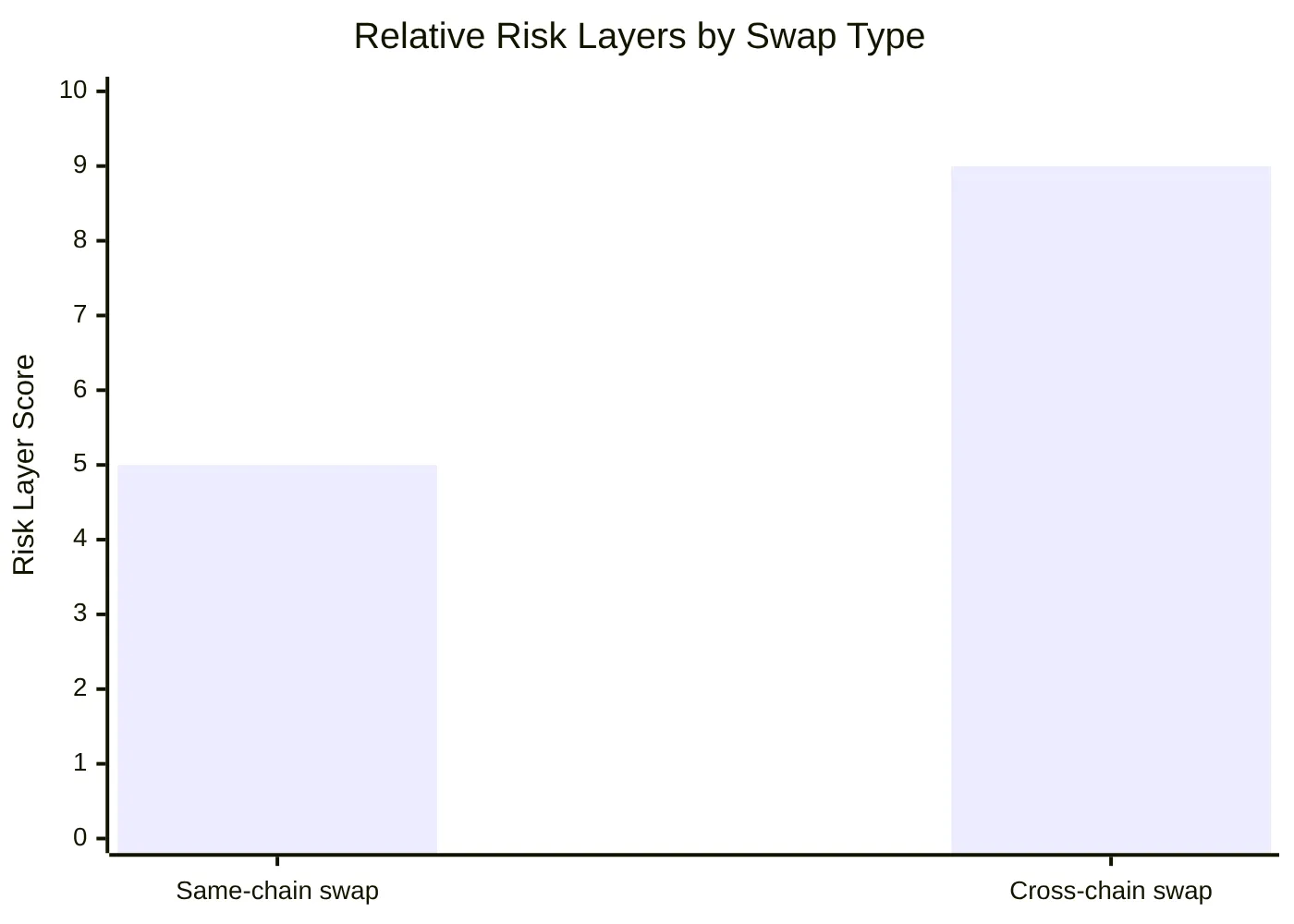
Cross-chain DEX aggregator workflows can be valuable when a user needs to move assets between ecosystems or access liquidity on another network. But cross-chain swaps are more complex than same-chain swaps.
A same-chain swap usually involves one network, one transaction path, and one settlement environment. A cross-chain swap can involve:
- Source-chain approval.
- Source-chain swap or lock.
- Bridge, message, or liquidity network.
- Destination-chain settlement.
- Destination-token verification.
- Additional fees and timing assumptions.
Starknet's educational article on DEX aggregators highlights how aggregation can improve access to fragmented liquidity, but cross-chain execution adds more layers that users must understand.
For large trades, cross-chain routes deserve extra caution. A route can look efficient on the surface but still involve bridge risk, destination-chain liquidity shortages, wrapped asset confusion, or delayed settlement. A professional or institutional crypto trading workflow should treat cross-chain execution as a multi-step transaction path.
This is where a non-custodial wallet can improve the user experience. FoxWallet supports multi-chain asset management, built-in cross-chain swap and on-chain trading access, mobile and browser extension workflows, and transaction risk review features. Users retain control of private keys and assets, while mnemonic phrases and private keys are stored locally with encryption.
FoxWallet also helps users manage multi-chain balances in one place, which matters before executing large trades. If assets are spread across networks, a unified view can reduce mistakes such as swapping on the wrong chain, approving the wrong token, or misunderstanding destination balances.
For users who want to learn more about self-custody, FoxWallet's guide to a non-custodial wallet explains why private key control is central to wallet security. For broader DApp workflows, see FoxWallet's guide to DeFi and DApp access. For multi-chain portfolio management, FoxWallet also covers multi-chain asset management.
DEX aggregators for large trades checklist and FAQs
Before signing a large swap, use this checklist:
| Check | What to verify |
|---|---|
| Token identity | Confirm token name, symbol, and contract address |
| Network | Confirm source chain and destination chain if cross-chain |
| Quote | Compare expected output with minimum received |
| Slippage | Set tolerance based on liquidity and volatility |
| Price impact | Avoid routes where your own trade heavily moves the market |
| Route | Review pools, hops, split routes, and bridge path if relevant |
| MEV | Check whether MEV protection swaps are active |
| Fees | Review gas, protocol fees, route fees, and bridge fees |
| Approval | Avoid unnecessary unlimited approvals where possible |
| Wallet alerts | Read risk warnings, contract recognition, and phishing alerts |
| Test transaction | Consider a smaller test when using unfamiliar tokens, chains, or routes |
A large trade should not be signed simply because the headline quote looks attractive. The better approach is to compare execution quality, MEV exposure, route transparency, and wallet safety together.
What is the best DEX aggregator for large trades?
There is no universal best DEX aggregator for large trades. CoW Swap is strong for MEV-sensitive same-chain execution, 1inch is strong for broad liquidity routing, Odos is strong for complex smart order routing, and Symbiosis is more relevant for cross-chain swaps. The best choice depends on token pair, chain, trade size, liquidity, urgency, and risk tolerance.
Which platform is a low slippage DEX aggregator?
The lowest slippage route changes in real time. A low slippage DEX aggregator should access deep liquidity, support route splitting, show price impact, and provide clear minimum received values. Large traders should compare multiple routes before executing.
Are MEV protection swaps necessary for large crypto trades?
They are highly recommended when available. Large public mempool swaps can be attractive targets for sandwich attacks. MEV protection swaps, batch auctions, solver-based models, private routing, and intent-based execution can reduce exposure, but they do not eliminate all risk.
What is the difference between a DEX aggregator and a cross-chain DEX aggregator?
A DEX aggregator routes swaps across liquidity sources, often on one chain. A cross-chain DEX aggregator combines swap routing with bridge or cross-chain liquidity so users can move assets between networks. Cross-chain routes add extra risk layers, including bridge assumptions, settlement timing, and destination-chain liquidity.
Is FoxWallet a DEX aggregator?
FoxWallet should be described as a non-custodial multi-chain wallet with built-in cross-chain swap and on-chain trading access, not as a standalone DEX aggregator. Its value is in self-custody, multi-chain asset management, DApp access, risk alerts, and safer transaction review before signing.
How does FoxWallet help with large crypto trades?
FoxWallet helps users keep control of private keys, manage assets across chains, access swap functionality, review transaction prompts, identify risk alerts, and interact with DeFi and DApps from mobile or browser extension workflows. For large trades, that wallet-level control can reduce operational mistakes.
What should institutional crypto trading teams consider?
Institutional crypto trading teams should evaluate liquidity depth, route transparency, MEV protection, approval controls, slippage tolerance, gas and fee accounting, smart contract risk, cross-chain exposure, transaction records, and wallet-level security policies.
The bottom line: the best DEX aggregators for large trades in 2026 will be the ones that combine deep liquidity, strong routing, transparent fees, MEV-aware execution, and clear risk controls. FoxWallet complements that process by giving users a secure, non-custodial wallet environment for managing multi-chain assets, accessing built-in swap functionality, and reviewing transaction risks before signing.