


Best DEX Aggregators For Cross-Chain Swaps

A DEX aggregator compares liquidity and routes across decentralized exchanges so a trader does not have to quote every venue manually. For a cross-chain swap, that routing problem expands to bridges, solvers and destination-chain liquidity. The best tool is therefore the one that supports the required asset pair and networks, shows the complete route and expected output clearly, and gives the user enough control to review fees, approvals and settlement risk before signing.
This guide compares six established options for cross-chain swaps: LI.FI, 1inch Fusion+, Rango, deBridge, Rubic and OpenOcean. Each approaches routing differently, so the shortlist is organized by use case rather than a single universal winner. Product details were checked against official documentation on September 17, 2026; supported routes can change, so the quote shown for a specific trade remains the deciding evidence.
Best DEX Aggregators for Cross-Chain Swaps at a Glance
| Platform | Routing model | Best suited to | Important limitation |
|---|---|---|---|
| LI.FI | Aggregates DEXs, bridges, solvers and liquidity routes | Wallets, apps and users who want broad route comparison | The experience depends partly on the wallet or app that integrates it |
| 1inch Fusion+ | Intent-based cross-chain swaps filled by resolvers | Users already comfortable with the 1inch interface and supported Fusion+ routes | Availability varies by network and token; the browser session must remain active during some swaps |
| Rango | Cross-chain and on-chain routing across DEXs, bridges and multiple ecosystems | Users moving between EVM and non-EVM environments | Complex routes can require multiple steps or signatures |
| deBridge | Solver-based cross-chain execution through the deBridge Liquidity Network | Users who value a defined destination outcome and non-custodial execution | It is an execution network, not a traditional route marketplace covering every bridge |
| Rubic | Cross-chain and on-chain aggregation across DEXs, bridges and intent protocols | Users who want a consumer-facing interface with broad route discovery | Some routes depend on third-party providers with different execution models |
| OpenOcean | Same-chain DEX aggregation plus cross-chain swap and bridge tooling | Traders and integrators who want smart-order routing across supported ecosystems | Cross-chain coverage and the exact route depend on the widget or integration used |
There is no permanently “best” route. A quote can change with liquidity, gas, market volatility, bridge availability and the size of the trade. Use the table to choose which interfaces to compare, then make the final decision from the live route details shown before signing.
How We Compared Cross-Chain DEX Aggregators
The comparison uses criteria that affect the actual trade rather than marketing claims or raw chain counts.
| Criterion | What to check before signing |
|---|---|
| Route relevance | Does the platform support the exact source asset, destination asset and networks you need? |
| Expected output | What is the minimum or estimated amount expected at the destination after route costs? |
| Route composition | Which DEXs, bridges, solvers or liquidity networks are involved? |
| Fee visibility | Are network costs, protocol fees and other route charges disclosed before confirmation? |
| Price impact and slippage | How sensitive is the quote to trade size and changing liquidity? |
| Execution model | Is the trade bridge-based, solver-filled, intent-based or composed of several on-chain steps? |
| Custody and signing | Who controls the keys, which contracts receive approvals and how many signatures are required? |
| Status and recovery | Can the user monitor a pending route and understand the next step if execution stalls or fails? |
| Interface fit | Is the tool intended for direct users, developers, wallet integrations or advanced trading workflows? |
For more specialized needs, such as Solana swaps, stablecoin routes, large trades or low-slippage execution, a use-case-specific comparison can be more useful because liquidity sources and execution constraints differ.
How Cross-Chain DEX Aggregation Works
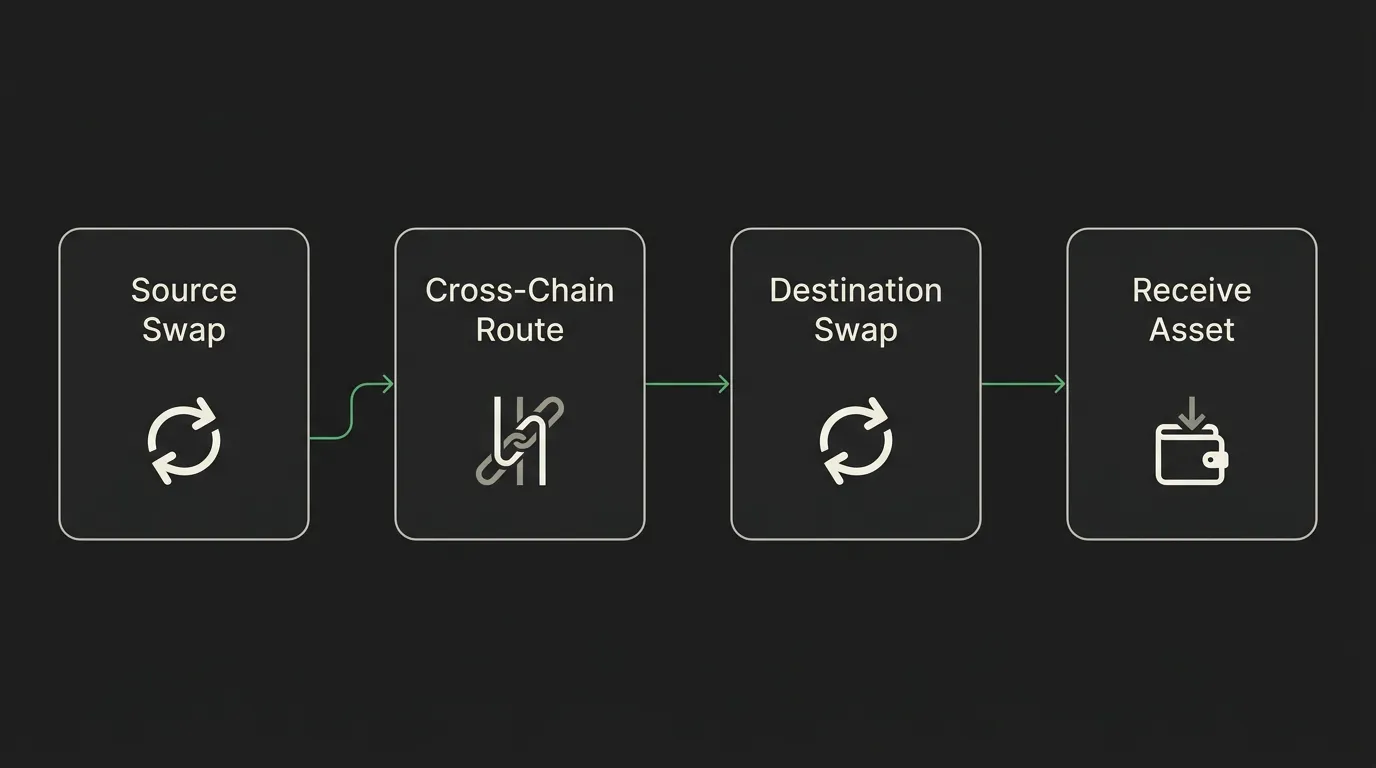
A same-chain DEX aggregator can split or route a trade across liquidity sources on one network. A cross-chain aggregator may also need to move value between networks and obtain the destination asset. A route can therefore combine four functions:
For a closer look at same-chain price discovery and route comparison, read FoxWallet's guide to how DEX aggregators help users find better swap prices.
- Swap the source asset into an asset suitable for cross-chain transfer.
- Move or settle value through a bridge, solver or liquidity network.
- Swap on the destination chain when the desired output asset differs from the settlement asset.
- Deliver the result to the destination address and expose transaction status.
The routing layer compares available paths, but it does not remove the risks of the protocols it selects. A cross-chain quote can inherit smart-contract, bridge, solver, liquidity, approval and operational risk. The user still needs to verify the destination network, token contract, receiving address, expected output and every approval request.
This distinction also explains why the products below are not identical. Some are broad routing layers used by wallets and apps. Some provide a consumer interface. Others use competitive solvers or intent-based execution instead of selecting from a conventional set of bridges.
1. LI.FI: Broad Routing Infrastructure for Wallets and Apps
LI.FI is a multi-chain routing layer that combines DEX aggregators, bridges and solvers. It can compose swaps and cross-chain transfers through one integration, which is why it often appears inside wallets and other Web3 products rather than only as a standalone destination.
Best for: users and applications that want broad route discovery across supported networks, especially when the swap experience is embedded in a wallet.
How it routes: LI.FI obtains quotes from multiple external protocols, resolves swap steps, and composes them with bridge or solver steps. Depending on the route, the source asset may be swapped before transfer and the settlement asset may be swapped again on the destination chain.
Main advantage: the routing layer is designed around fragmented multi-chain liquidity. It can compare materially different route types instead of treating cross-chain execution as one fixed bridge action.
What to watch: LI.FI is infrastructure as much as it is a user-facing route source. Route presentation, warnings and transaction monitoring can vary by the wallet or app that integrates it. A user should judge the live route, not assume every LI.FI-powered interface exposes the same controls.
FoxWallet uses LI.FI as the bridge provider in its mobile app. That gives FoxWallet users a wallet-native route into supported cross-chain transfers while they continue to control their keys. The browser extension does not support Bridge, so this capability should be understood as a mobile feature.
2. 1inch Fusion+: Intent-Based Cross-Chain Swaps
1inch Fusion+ extends the 1inch swap experience to supported cross-chain routes. The user signs an order describing the intended outcome, and resolvers compete to fill it through an escrow-based process rather than the user manually selecting and operating a bridge.
Best for: users who already use 1inch and prefer an intent-based workflow for supported cross-chain pairs.
How it routes: Fusion+ uses a Dutch-auction process in which resolvers compete to fill the order. Linked source- and destination-chain escrows coordinate the exchange. The design includes time locks and a recovery phase for an order that cannot be completed normally.
Main advantage: the user specifies the desired cross-chain outcome while resolvers handle execution. This can reduce the number of route decisions presented to the user.
What to watch: Fusion+ is not available for every possible network and asset combination. The official instructions also tell users to keep the relevant browser tab active and notifications enabled during a swap. Review the current interface instructions and pending-transaction status rather than assuming the flow matches a same-chain 1inch swap.
FoxWallet also uses 1inch as its mobile Swap provider on confirmed networks. Same-chain Swap and cross-chain Bridge are separate capabilities: 1inch supplies FoxWallet’s mobile swap routing, while LI.FI supplies its mobile bridge routes.
3. Rango: Cross-Ecosystem Routing Beyond EVM Networks
Rango describes itself as a routing and aggregation protocol for both cross-chain and on-chain swaps. Its routing model combines DEXs, bridges and cross-chain liquidity providers across different blockchain environments.
Best for: users who need to move between ecosystems that do not all share the same wallet or transaction model, including routes that cross EVM and non-EVM networks.
How it routes: Rango’s engine searches combinations of same-chain and cross-chain protocols. A path may contain several actions—for example, an initial DEX swap, a cross-chain transfer and a destination-chain swap. The available route depends on the selected assets, networks and connected wallets.
Main advantage: chain-agnostic routing is central to the product. That makes Rango relevant when a trade cannot be solved inside a single EVM-only environment.
What to watch: broader ecosystem coverage can introduce more route complexity. Some paths may need multiple transactions or signatures, and users may need an appropriate wallet or native gas asset at an intermediate or destination step. Read the route preview and prerequisites before submitting the first transaction.
Rango is most useful when its broader ecosystem reach is actually needed. For a straightforward route supported by several tools, compare the expected output, number of steps and recovery path rather than choosing by coverage alone.
4. deBridge: Solver-Based Cross-Chain Execution
deBridge provides same-chain and cross-chain swaps through the deBridge Liquidity Network. For cross-chain execution, a user creates an order on the source chain and a solver supplies the requested assets on the destination chain.
Best for: users and applications that want a defined destination outcome through a solver-based execution model.
How it routes: the source tokens enter a per-order smart-contract flow. A solver fulfills the requested destination amount, after which cross-chain messaging unlocks the source-side funds for that solver. deBridge describes the design as non-custodial and without shared liquidity pools.
Main advantage: execution is based on the output specified in the order rather than a user manually moving through several independent bridge and swap screens. The model also supports status tracking and cancellation for an unfilled order.
What to watch: deBridge is better understood as a cross-chain execution network than a neutral marketplace that always displays every available bridge. The live quote still needs to be compared with other routes, and the user should understand fees, supported assets and cancellation conditions before signing.
Avoid treating solver-based execution as automatically safer or cheaper. It changes how liquidity and settlement are coordinated; it does not eliminate smart-contract, market or operational risk.
5. Rubic: Consumer-Facing Cross-Chain Route Discovery
Rubic is a decentralized cross-chain and on-chain aggregator. Its Best Rate Finder combines DEXs, bridges, intent protocols and other route sources in a consumer-facing interface.
Best for: users who want to compare cross-chain routes directly in one interface without building or integrating routing infrastructure.
How it routes: Rubic queries available providers and can compose multi-hop paths that include both swaps and cross-chain transfer. The selected provider determines the exact execution model for a given route.
Main advantage: the interface puts heterogeneous route types behind one comparison surface. This can help users discover paths across supported EVM, non-EVM and layer-2 environments.
What to watch: aggregation introduces dependency on underlying providers. Their fees, settlement logic, approval contracts and recovery processes are not necessarily identical. Rubic’s documentation also notes that some deposit-based providers can apply their own controls, so users should inspect the named route provider rather than evaluating only the top-level Rubic interface.
The best quote is not always the simplest route. A route with more steps or an unfamiliar provider may not be the right choice for a user who values clarity and a straightforward recovery process.
6. OpenOcean: DEX Routing With Cross-Chain Tooling
OpenOcean provides DEX aggregation and a widget that supports same-chain and cross-chain swaps. Its tooling is aimed at both direct trading experiences and integrations inside wallets or dApps.
Best for: users and integrators who want DEX smart-order routing alongside cross-chain swap and bridge functionality.
How it routes: on the same chain, OpenOcean aggregates liquidity and can use split or multi-hop paths. Its cross-chain tooling adds bridge-related execution and can incorporate source- and destination-chain swaps where supported.
Main advantage: the platform connects established DEX aggregation with embeddable cross-chain functionality. It can therefore serve both trading interfaces and products that want to offer swaps without building routing logic independently.
What to watch: “multi-chain” and “cross-chain” are not interchangeable. A platform can aggregate swaps separately on many networks without supporting every route between those networks. Confirm that the live interface shows the exact source-to-destination path you need, then check the bridge or execution provider used for that quote.
OpenOcean is a useful comparison point when the trade depends heavily on source- or destination-chain liquidity. For routes where the cross-chain transfer itself is the main constraint, also compare a routing layer or solver network built specifically around cross-chain execution.
If the source or destination is Solana, use the dedicated Solana DEX aggregator comparison because its liquidity venues and execution conditions differ from a general cross-chain shortlist.
How FoxWallet Fits Into the Cross-Chain Swap Workflow
FoxWallet is a non-custodial multi-chain wallet, not a seventh entry in the aggregator ranking. Its role is to give users a controlled environment for holding assets, obtaining supported swap or bridge routes, reviewing transaction requests and monitoring the resulting balances.
On FoxWallet mobile:
- Swap is provided through 1inch on supported networks.
- Bridge is provided through LI.FI on supported networks.
- Private keys remain under the user’s control and are stored locally in encrypted form.
- The app includes Connected Sites management, phishing-site blocking, high-risk signature warnings and malicious-authorization checks.
The browser extension supports basic wallet actions on EVM networks and Aleo, but it does not support Swap or Bridge. Users who want FoxWallet’s current swap and cross-chain bridge functions should use the mobile app.
For the current in-app bridge workflow, see FoxWallet's cross-chain bridge guide.
This wallet-native model can reduce unnecessary context switching, but it does not guarantee a particular price or make cross-chain execution risk-free. The relevant decision is still the route shown for the exact trade. Compare the expected output, provider, fees, approvals and destination-chain conditions before confirming.
Download FoxWallet to access its current mobile Swap and Bridge features.
How to Choose the Right Aggregator for a Specific Swap
Start with the transaction you actually need rather than a platform leaderboard.
- Define the complete pair. Record the source network and token, destination network and token, amount, and receiving address format.
- Obtain more than one live quote. Compare expected output after visible costs, not just a headline exchange rate.
- Inspect the route. Identify every DEX, bridge, solver or liquidity network involved and the number of signatures required.
- Check approvals. Confirm the spender contract and avoid approving an unfamiliar contract merely because the surrounding interface looks legitimate.
- Review destination needs. Determine whether the output includes enough native gas for the next action or whether a separate gas top-up is required.
- Understand status and recovery. Know where pending transactions appear, whether an unfilled order can be cancelled, and which support channel belongs to the actual provider.
- Use a smaller test when appropriate. A test transaction can reveal address, wallet and destination-network issues before a larger transfer, although it creates an additional set of fees.
For a stablecoin-only route or a large order, use the dedicated comparisons for stablecoin swaps and large trades. Solana-specific swaps are covered separately above because those routes have different liquidity sources, execution constraints and risk priorities.
Cross-Chain Swap Risks That Aggregation Cannot Remove
Route comparison is useful, but it does not turn a cross-chain transaction into a risk-free action.
- Smart-contract risk: the route can touch several contracts across multiple networks.
- Approval risk: a malicious or overly broad token approval can remain dangerous after the swap.
- Bridge or solver risk: settlement depends on the infrastructure selected for the route.
- Liquidity risk: limited depth can increase price impact or make a quoted route unavailable.
- Market movement: prices and gas conditions can change between quote generation and execution.
- Operational risk: selecting the wrong network, token contract or recipient address can cause loss or difficult recovery.
- Interface risk: phishing sites can imitate legitimate aggregators and request harmful signatures.
- State and monitoring risk: a multi-stage route may remain pending while one chain or provider is delayed.
Use official URLs, verify the connected wallet and network, read every signing request, and save the source transaction hash. Never share a seed phrase or private key with an aggregator, bridge, support agent or recovery service.
FAQ
What Is a DEX Aggregator?
A DEX aggregator compares liquidity and quotes across decentralized exchanges or other route sources. It may split a trade or use several pools to improve execution. A cross-chain aggregator adds bridges, solvers or cross-chain liquidity networks so the source and destination can be on different blockchains.
Which DEX Aggregator Is Best for Cross-Chain Swaps?
There is no universal winner. LI.FI is a strong infrastructure-oriented choice for broad route aggregation; 1inch Fusion+ suits users who want supported intent-based swaps; Rango focuses on cross-ecosystem routing; deBridge uses solver-based execution; and Rubic and OpenOcean provide broader consumer or integration surfaces. Compare live routes for the exact assets, networks and amount.
Is a Cross-Chain Aggregator the Same as a Bridge?
No. A bridge is one method of transferring value or messages between networks. An aggregator may compare several bridges, combine a bridge with DEX swaps, or use a solver or intent-based network instead. The route details should identify which model is being used.
Can a Cross-Chain Aggregator Guarantee the Best Price?
No. An aggregator can compare the providers it integrates, but it cannot see every possible source of liquidity or guarantee that a quote will remain optimal. The result also depends on fees, price impact, route timing and market conditions.
Do Cross-Chain Swaps Stay Non-Custodial?
Many of the tools in this guide use non-custodial smart-contract or solver-based flows, but the exact custody and settlement model varies by route. Review the named provider and contracts before signing. Using a non-custodial wallet means the user controls the keys; it does not remove protocol risk after a transaction is authorized.
Does FoxWallet Have a Built-In DEX Aggregator?
FoxWallet mobile provides Swap through 1inch and Bridge through LI.FI on supported networks. FoxWallet itself is a non-custodial wallet rather than a standalone DEX aggregator. Its browser extension does not currently support Swap or Bridge.
The Practical Takeaway
Choose a cross-chain DEX aggregator by route quality and fit, not by a static ranking. LI.FI and Rango emphasize broad routing, 1inch Fusion+ and deBridge use intent- or solver-based execution, and Rubic and OpenOcean provide aggregation through consumer and integration surfaces. For every trade, compare the current expected output, route composition, approvals, fees and recovery path.
FoxWallet can serve as the self-custodial wallet layer around that process. Its mobile app uses 1inch for supported swaps and LI.FI for supported bridge routes, while keeping private-key control with the user. Review the final route carefully before signing and treat every cross-chain transaction as a multi-protocol operation rather than a simple transfer.
This article is educational and does not provide financial advice. Digital-asset swaps involve smart-contract, market, liquidity and operational risk.