


Which Chains Are Actually Ready for AI Agent Wallets?

Direct answer: among the FoxWallet-supported chains reviewed here, Ethereum, Sui, and TON are the only chains with meaningful native foundations for AI agent wallets today. Ethereum is the most mature choice for programmable account controls, Sui is promising for application-built workflows, and TON has a dedicated but still experimental agent-wallet standard. Tron and Aptos are not chain-native agent-wallet leaders, while the remaining supported chains are not yet meaningful choices for this use case.
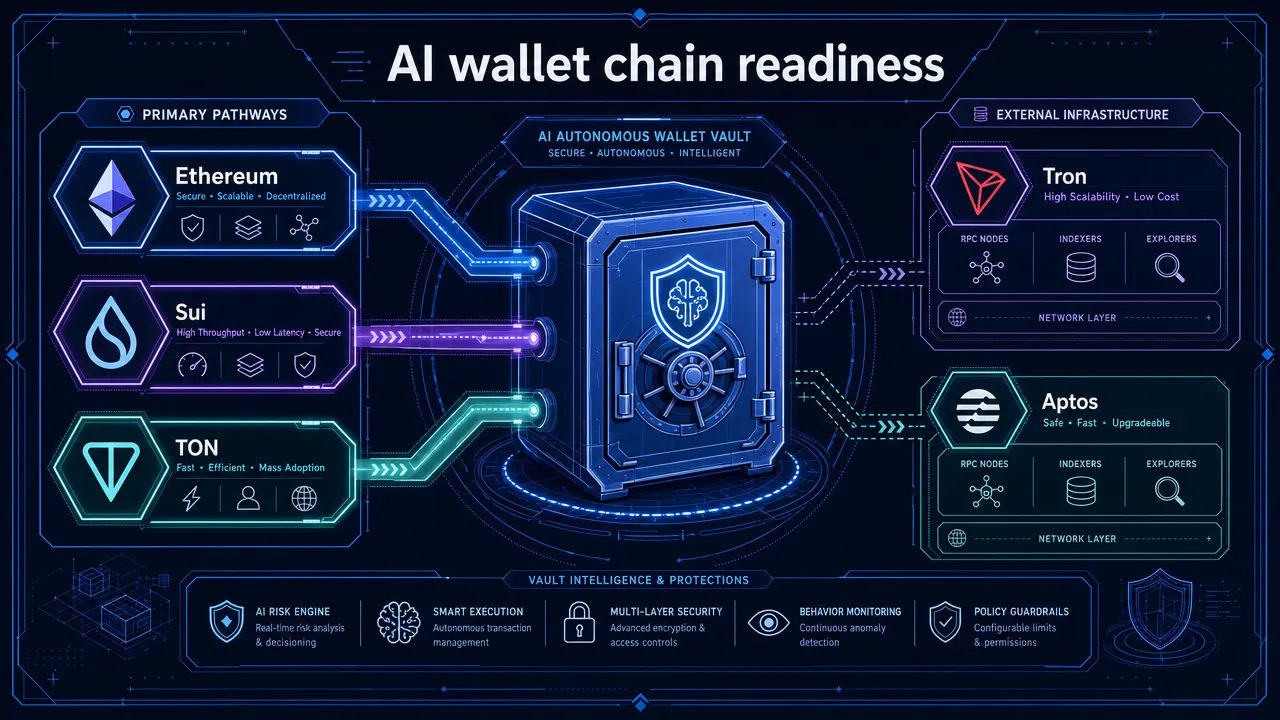
The distinction matters. A chain can be supported in a multi-chain wallet without providing the controls that autonomous agent crypto wallets need: scoped authority, limited funds, revocable access, programmable transaction rules, and a clear on-chain audit trail.
FoxWallet is a non-custodial, multi-chain wallet designed for user-controlled assets, DApp access, transaction review, and unified asset management. That does not mean FoxWallet currently provides autonomous signing, session keys, or AI-agent policy controls. This roundup evaluates the chain infrastructure beneath those possible future workflows, not unverified wallet features.
AI agent wallets: What readiness actually means
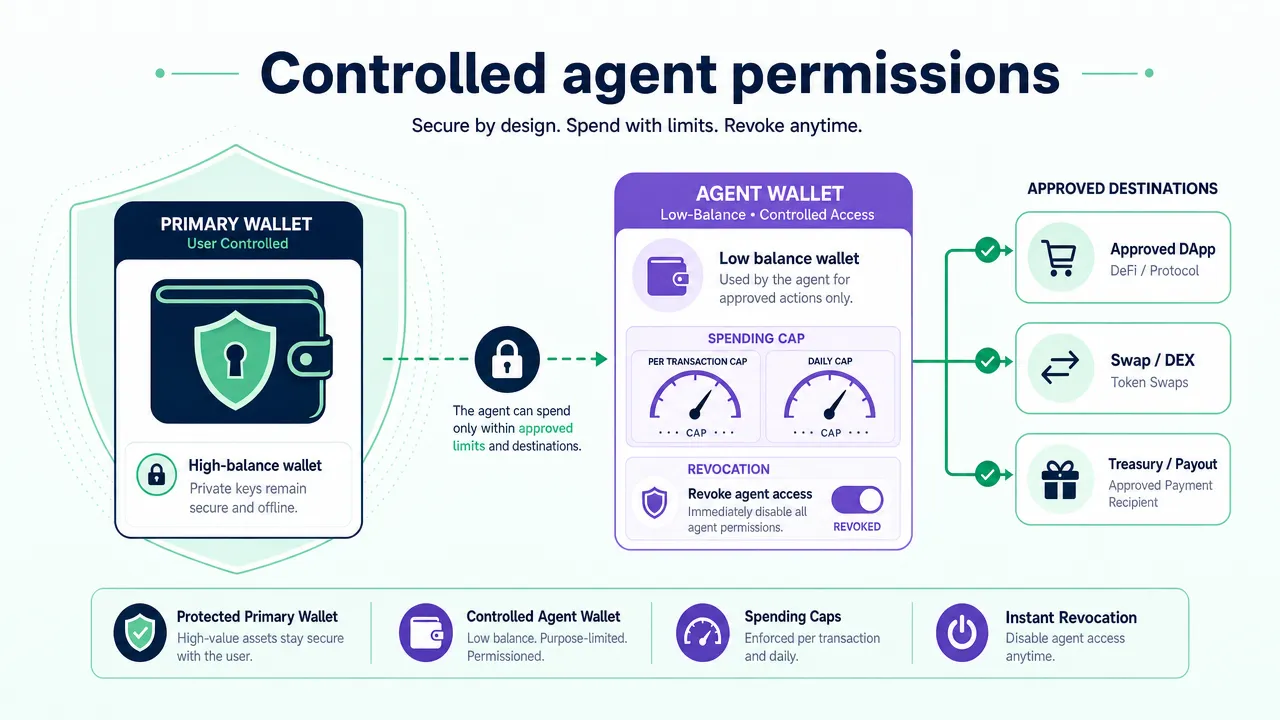
For AI agent wallets, throughput or generic smart-contract support is not enough. A useful readiness test asks whether an agent can act with enforceable boundaries instead of receiving a user's unrestricted recovery phrase or primary private key.
| Capability | Why it matters for AI agent wallets |
|---|---|
| Scoped permissions | Restricts an agent to a narrow task, account, contract, or destination list |
| Spending limits | Caps token amounts, transaction values, or frequency |
| Revocable authority | Lets the user stop or replace an agent's access quickly |
| Session keys or delegation | Enables temporary, purpose-specific authorization |
| Programmable accounts | Allows policy logic to validate transactions before execution |
| Agent identity or reputation | Helps applications identify and evaluate an agent separately from a wallet owner |
| Auditability | Makes actions, approvals, and funding visible on-chain |
| Production maturity | Separates live, documented systems from proposals or unaudited experiments |
The safest model is controlled autonomy. An agent may propose or execute an allowed action, but it should not control a primary treasury wallet or hold the recovery phrase.
For a broader foundation, FoxWallet's guide on why AI agents need non-custodial wallets rather than exchange API keys explains why self-custody still needs external policy controls. Non-custody preserves user key control. It does not automatically make automation safe.
AI agent wallets by chain: The readiness roundup
The following list covers chains identified in FoxWallet documentation and official product listings. FoxWallet's Help Center describes support for more than 50 networks, while its provider documentation and chain pages provide evidence for the specific networks assessed here. Platform availability can vary by chain.
| Chain | Readiness tier | What exists today | Practical verdict |
|---|---|---|---|
| Ethereum | Tier 1: mature programmable-account foundation | ERC-4337, EIP-7702, expanding agent-identity work | Best starting point for controlled designs |
| Sui | Tier 1: strong native execution primitives | Object model, parallel execution, PTBs, sponsored transactions, zkLogin | Strong for purpose-built application experiments |
| TON | Tier 1: dedicated but experimental standard | Agentic Wallet contracts and agent-specific wallet model | Monitor closely, test only with limited funds |
| Tron | Tier 2: third-party route, not native | Potential provider-layer agent infrastructure, no verified native standard | Do not describe as agent-native |
| Aptos | Tier 2: useful primitives, no native agent standard | Keyless Accounts and wallet ecosystem tooling | Monitor, but do not oversell |
| Bitcoin | Tier 3: not meaningfully ready | No documented agent-wallet controls identified | Wait for dedicated infrastructure |
| Aleo | Tier 3: not meaningfully ready | No documented agent-wallet controls identified | Wait for dedicated infrastructure |
| Cosmos | Tier 3: not meaningfully ready | No chain-wide standard identified | Wait for dedicated infrastructure |
| Filecoin | Tier 3: not meaningfully ready | No documented agent-wallet controls identified | Wait for dedicated infrastructure |
| IronFish | Tier 3: not meaningfully ready | No documented agent-wallet controls identified | Wait for dedicated infrastructure |
| Qtum | Tier 3: not meaningfully ready | No documented agent-wallet controls identified | Wait for dedicated infrastructure |
| Spacemesh | Tier 3: not meaningfully ready | No documented agent-wallet controls identified | Wait for dedicated infrastructure |
Ethereum: The strongest foundation for controlled agent execution
Ethereum is the best blockchain for AI agent wallets in this FoxWallet-supported audit when the priority is mature programmable-account infrastructure.
ERC-4337 account abstraction makes smart-account behavior possible through UserOperations, bundlers, and paymasters. In practice, a smart account can validate rules such as asset limits, allowlisted destinations, time windows, multi-party approvals, and session-key constraints.
EIP-7702 adds an EOA delegation mechanism that can let a conventional externally owned account use delegated smart-contract code. That can reduce friction when users need more programmable behavior without changing every part of their account workflow.
Ethereum's agent ecosystem also includes newer work around on-chain agent identity and reputation, including ERC-8004. That identity layer should be kept separate from execution controls: identity can help an application recognize an agent, but it does not itself establish spending caps or safe permissions.
The important caveat is that standards are not policies. ERC-4337 and EIP-7702 can support secure designs, but a weak implementation can still give an agent too much authority. Users should look for clear rules, simulation, withdrawal controls, contract allowlists, and fast revocation.
FoxWallet documents Ethereum support through its Ethereum wallet resources. Its role remains self-custodied asset management and transaction access, rather than a claim that it currently exposes Ethereum smart-account or agent-policy features.
Sui: Strong building blocks, not a universal agent-wallet standard
Sui earns its Tier 1 placement for its architecture, not because it already offers a complete, universal agent-wallet standard.
Sui's object-centric model can be useful when builders want to separate application state and assets into dedicated objects. Its transaction model can execute non-conflicting actions in parallel, which may suit systems where multiple agents operate on separate resources. Programmable Transaction Blocks also let developers combine transfers, Move calls, and coin operations into a single atomic flow.
Other relevant components include sponsored transactions and zkLogin-supported application patterns. These can improve transaction composition and onboarding, but they should not be mistaken for universal agent permissions.
Sui does not currently have a verified chain-wide standard for all of the following:
- AI-agent identity and reputation.
- Universal session keys for agent execution.
- Standardized revocable delegated authority.
- A canonical agent wallet with configurable spending caps.
That makes Sui a compelling option for teams building a complete application and policy layer themselves. It is less suitable for a reader seeking a ready-made, retail-friendly autonomous agent crypto wallet framework.

FoxWallet's provider documentation identifies Sui support. Users should verify current device availability before planning a specific workflow.
TON: A direct agent-wallet model with an experimental warning
TON is especially notable because it has a dedicated Agentic Wallets standard. TON Tech announced the initiative on April 28, 2026, and its model centers on separate wallets for individual agents rather than unrestricted access to a user's primary wallet.
According to the official TON Agentic Wallet contracts documentation, the design supports self-custodied agent wallets and separates user and agent roles. The potential safety advantage is clear:
- A user can allocate a limited balance to a dedicated agent wallet.
- Exposure can be limited to the amount placed in that wallet.
- The user retains a practical path to withdraw funds or change agent access.
- Agent activity remains observable on-chain.
However, TON's own documentation includes the most important qualification in this article: the contracts are unaudited and users are advised to experiment on testnet.
So, TON is genuinely relevant to AI agent wallet infrastructure, but it is not production-hardened enough to treat as a high-value automation environment. Use small, isolated balances for any experiment. Do not equate "an agent can transact" with "an agent is safely constrained."
FoxWallet lists TON in its provider documentation, with the cited documentation noting mobile-app availability for this network.
Tron and Aptos: Infrastructure support is not chain-native support
Tron and Aptos belong in a separate tier because neither has a verified native agent-wallet standard comparable to Ethereum's programmable-account ecosystem or TON's dedicated contracts.
Tron has no verified native framework for standardized session keys, on-chain agent identity, revocable agent permissions, or chain-wide smart-account policy logic in the sources reviewed. Cobo's Agentic Wallet announcement confirms a multi-chain product with AI framework integrations and support for more than 80 blockchains. However, its reviewed official materials do not directly confirm Tron support. It is therefore more accurate to say that third-party agent-wallet infrastructure may become available around Tron, not that Tron is agent-native.
Aptos has useful account-level building blocks. AIP-61 Keyless Accounts supports identity-based account flows, and Aptos provides a wallet interoperability standard. Yet Keyless Accounts are authentication infrastructure, not a complete delegation system for AI agent wallets. No canonical Aptos standard for scoped agent permissions, agent reputation, session keys, or user-configurable spending limits was identified.
For both chains, provider-level tools can still be useful. But users should check exactly where policy enforcement happens, who controls key shares, how recovery works, whether rules are portable, and whether the provider explicitly supports the target chain.
AI agent wallets: Why multi-chain support is a different claim
"FoxWallet supports this chain" and "this chain is ready for AI agent wallets" are separate statements.
FoxWallet is designed as a multi-chain, non-custodial gateway where users retain control of private keys and assets. It offers unified asset visibility, DApp access, transaction-risk protections, and cross-chain swap functionality. These capabilities help users manage a multi-network portfolio, but they do not prove the availability of delegated agent signing or chain-native policy controls.
| Multi-chain wallet support | AI wallet chain support |
|---|---|
| Manage balances and assets on a network | Give an agent limited, enforceable authority |
| Send and receive supported tokens | Enforce limits on what, where, and when an agent can transact |
| Connect to supported DApps | Provide revocation and monitoring paths |
| Review transactions and risk alerts | Support policy-enforcing accounts or agent-specific wallets |
| Use integrated network operations | Establish a clear agent identity and audit model where needed |
This is why blockchain compatibility for AI agent wallets must be judged chain by chain. A wallet can support 12, 50, or more networks while only a small subset has meaningful infrastructure for controlled autonomy.
FoxWallet's multi-chain wallet management guide is useful for the asset-management side of that distinction. For the operational risks that can arise when moving assets between networks, see the FoxWallet guide to cross-chain swap risks. Cross-chain execution introduces its own routing, liquidity, and destination-chain considerations, separate from an agent's permission model.
AI agent wallets: Which chains to use and which to watch
For readers evaluating chains ready for AI agent wallets, the practical decision is less about finding one universal winner and more about matching the chain to the maturity of the workflow.
Start with Ethereum for the broadest policy-design options
Ethereum is the strongest starting point when a wallet or application can demonstrate policy-enforcing smart accounts, bounded session keys, transaction simulation, destination controls, and a tested revocation process. Its advantage is the depth of programmable-account infrastructure, not an automatic guarantee of safety.
Use Sui for application-specific experimentation
Sui is attractive when a builder can design the full application around objects, Move logic, and atomic transaction blocks. It is a strong substrate for custom workflows, but users should not expect a universal, turnkey agent-permission layer.
Monitor TON, but keep experiments isolated
TON's dedicated Agentic Wallets approach directly addresses agent-specific funding and separation from primary assets. Because the official contracts remain unaudited, start on testnet where possible and use only negligible funds for early experiments.
Treat Tron and Aptos as watchlist chains
Tron and Aptos may gain practical value through provider products or evolving wallet infrastructure. Today, though, they should not be positioned as equivalent to the native foundations available on Ethereum, Sui, or TON.
Wait on the remaining chains for agent-specific use
Bitcoin, Aleo, Cosmos, Filecoin, IronFish, Qtum, and Spacemesh can serve other goals, but current evidence does not support selecting them specifically for AI agent wallets. Generic transaction functionality, privacy features, storage specialization, or an ecosystem of applications do not substitute for constrained agent authorization.
Before experimenting on any network, use this minimum checklist:
- Keep long-term funds separate from the agent's operational balance.
- Do not share a seed phrase or master private key with an AI system.
- Fund only the amount required for the task.
- Use asset, destination, and contract allowlists where the infrastructure supports them.
- Apply value caps, frequency caps, and expiry times.
- Avoid unlimited token approvals.
- Test the full flow with a negligible amount.
- Confirm that a manual revocation or withdrawal path works before relying on automation.
- Review every transaction and connected DApp carefully.
For users who want to begin with a security-first self-custody setup, FoxWallet's non-custodial wallet guide outlines core practices for local key control, multi-wallet separation, and safer DApp activity. FoxWallet can help users manage assets across supported networks while they assess emerging infrastructure, but it should not be represented as a verified AI-agent signing platform.
FAQ: AI agent wallets
Which chains are actually ready for AI agent wallets?
Ethereum is the most mature option for programmable accounts and policy-based transaction design. Sui has strong native execution and transaction-composition primitives, but no universal agent-wallet standard. TON has a dedicated Agentic Wallets model, although its official documentation says the contracts are unaudited. Tron and Aptos are better described as third-party infrastructure opportunities rather than native leaders.
What is the best blockchain for AI agent wallets?
Ethereum is the strongest overall answer for users and builders who prioritize mature account abstraction and programmable authorization. Sui can be a better fit for custom applications built around object-level state. TON is compelling for its agent-specific wallet design, but its experimental status requires caution.
Does FoxWallet currently provide AI agent wallet functionality?
No verified documentation in this audit confirms that FoxWallet offers autonomous agent signing, session keys, delegated execution, AI-agent identity, or agent spending controls. FoxWallet is accurately described as a non-custodial, multi-chain wallet for user-controlled asset management, DApps, and on-chain transactions.
Is account abstraction the same as an AI agent wallet?
No. Account abstraction is infrastructure that makes wallet behavior programmable. An AI agent wallet is a use case in which an agent receives constrained authority to act through a policy layer. Account abstraction can enable safer designs, but it does not automatically provide limits, monitoring, approval thresholds, or a secure agent identity.
Why are spending limits and revocation important for autonomous agent crypto wallets?
An agent can make flawed decisions, interact with an incorrect contract, or be influenced by malicious inputs. Spending limits contain the possible loss. Revocation lets a user stop the agent without abandoning the primary wallet or moving every asset. Together, these controls are essential for avoiding unrestricted delegation.
Are Bitcoin and Cosmos good choices for AI agent wallets today?
Not based on the evidence reviewed for this roundup. FoxWallet supports both networks, but no credible, chain-wide infrastructure for scoped agent permissions, standardized session keys, agent identity, programmable accounts, and revocable delegated authority was identified.