


Top Enterprise Payment Infrastructure 2026

Why Enterprise Payment Infrastructure Looks Different in 2026
By 2026, enterprise payment infrastructure is no longer just about card acquiring, bank transfers, and payment gateways. It is becoming a hybrid stack that combines traditional rails, real-time payment systems, embedded finance, and Web3-native settlement options. In my view, that shift is not a niche experiment anymore. It is the practical direction of global payments.
Research from Deloitte, J.P. Morgan, and Checkout.com points to the same pattern: enterprises want API-first systems, faster settlement, richer payment data, and more flexibility across regions and payment methods. At the same time, Web3 payment infrastructure is expanding quickly, with Global Market Insights projecting strong long-term growth in Web3 payment solutions.
That is why enterprise payment infrastructure now includes more than PSPs and banks. It increasingly includes stablecoin rails, on-chain treasury workflows, and multi-chain wallet access for organizations that need direct interaction with digital assets.
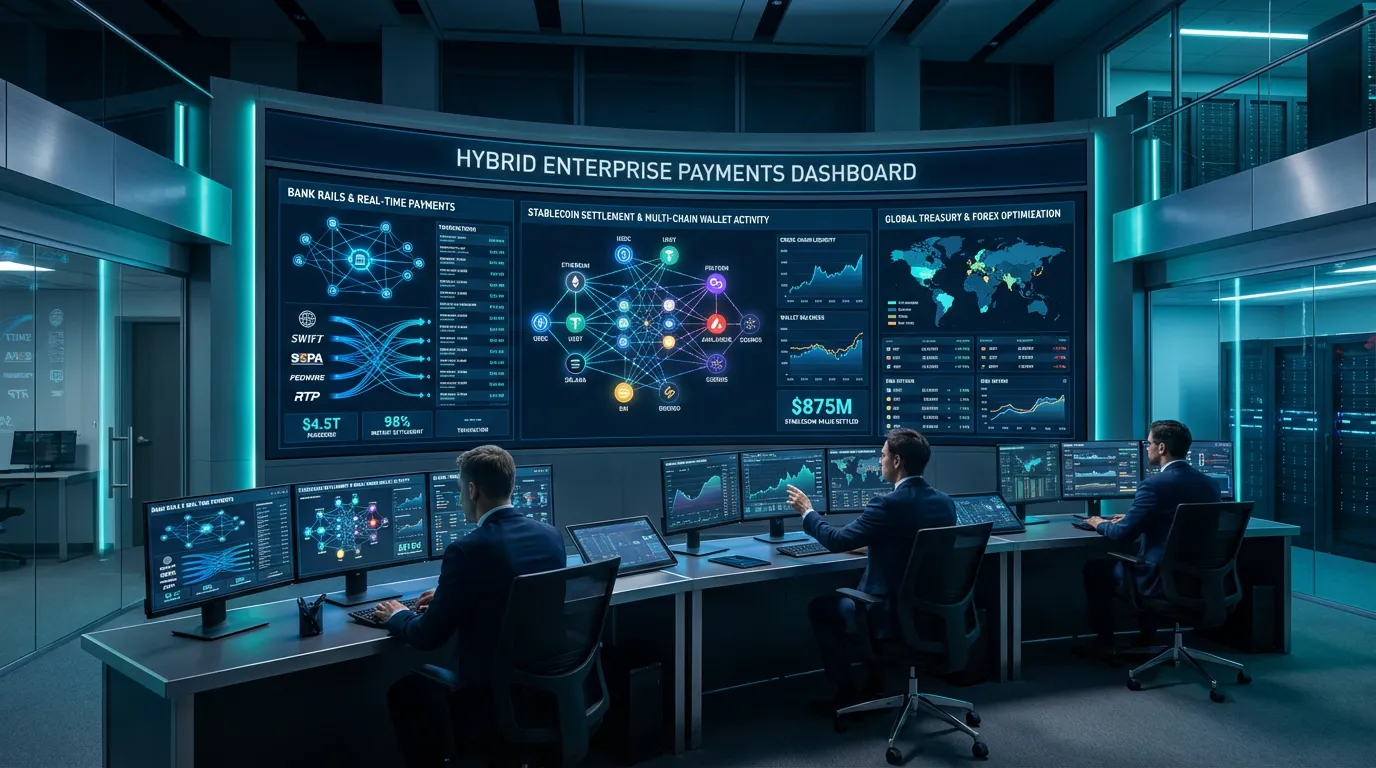
For FoxWallet, this matters because the company sits at the Web3 edge of enterprise payment infrastructure. As a multi-chain decentralized wallet, FoxWallet is not a bank or PSP. Instead, it acts as a non-custodial interaction layer for secure asset control, multi-chain visibility, on-chain execution, and DApp connectivity across mobile and browser environments.
Core Enterprise Payment Infrastructure Trends in 2026
The biggest change in enterprise payment infrastructure is convergence. Traditional and digital rails are no longer developing in isolation.
First, real-time and API-based treasury models are becoming standard. Enterprises increasingly expect always-on visibility into balances, settlement status, and liquidity movement. Second, stablecoins and tokenized money are moving from pilot projects toward production use cases, especially for cross-border settlement and treasury operations. The World Economic Forum and Deloitte both describe 2026 as a key inflection point for digital asset infrastructure.
Third, enterprise payment infrastructure now has to account for fragmentation across chains. Liquidity, assets, and applications are spread across multiple networks, which creates operational complexity for businesses working with digital assets.
Here is a simple view of where strategic emphasis is heading by 2026:
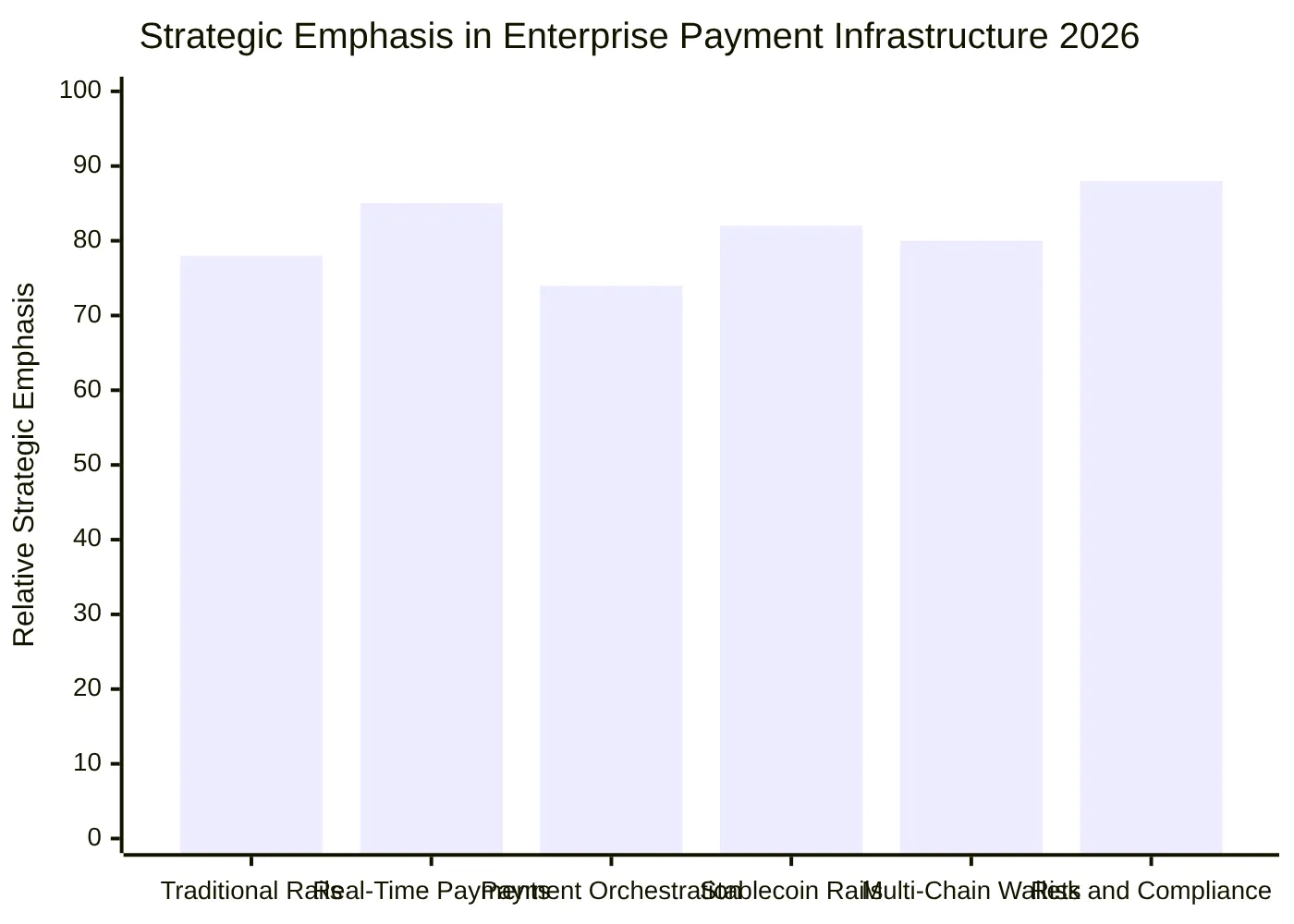
| Infrastructure layer | Why it matters in 2026 | Enterprise takeaway |
|---|---|---|
| Traditional rails | Still essential for cards, ACH, SEPA, and global banking flows | Must coexist with newer rails |
| Real-time payments | Faster settlement and richer automation | Important for treasury modernization |
| Payment orchestration | Helps optimize routing, cost, and resiliency | Critical for global payment operations |
| Stablecoin rails | Lower friction for some cross-border and treasury flows | Growing enterprise interest |
| Multi-chain wallets | Secure access point for on-chain assets and applications | Increasingly part of enterprise payment infrastructure |
| Risk and compliance | Required across both fiat and on-chain environments | Non-negotiable for scale |
Enterprise Payment Infrastructure Needs a Web3 Edge
This is where many opinion pieces miss the point. They treat wallets as consumer tools, but in 2026, wallets are increasingly part of enterprise payment infrastructure when an organization operates on-chain.
A multi-chain wallet can serve as the execution layer for treasury teams, Web3 operations staff, loyalty program managers, and professional users who need to move assets, review balances, and interact with protocols directly. That is especially true when the wallet is non-custodial and security-focused.
FoxWallet fits this role well. The FoxWallet official website highlights full user control, local private key encryption, support for more than 100 popular blockchain networks, NFT visibility, and security features such as phishing blocking, high-risk signature verification, and token authorization monitoring. That makes FoxWallet relevant as a secure edge component within enterprise payment infrastructure rather than a replacement for banking infrastructure.

This role becomes even more valuable when enterprises need all of the following at once:
- Self-custody instead of handing assets to a third party.
- Unified visibility across multiple chains.
- Fast access to DApps and DeFi tools.
- Lower-friction on-chain trading and cross-chain asset movement.
- Better security prompts before users sign transactions.
For organizations exploring Web3 payment operations, a wallet like FoxWallet becomes the interface that connects strategy to execution.
How FoxWallet Strengthens Enterprise Payment Infrastructure Workflows
The strongest case for FoxWallet in enterprise payment infrastructure is not that it tries to be everything. It is that it focuses on the part of the stack where user control, multi-chain access, and operational safety matter most.
The table below shows how that translates into practical value.
| FoxWallet capability | Relevance to enterprise payment infrastructure | Why it matters |
|---|---|---|
| Non-custodial architecture | Self-custody for operators and organizations | Users keep control of keys and assets |
| Multi-chain asset management | Unified view of balances and NFTs across networks | Reduces fragmentation and manual tracking |
| Real-time on-chain sync | Up-to-date visibility into asset status | Helps with transparency and operational awareness |
| Built-in cross-chain swap aggregation | Access to liquidity across major chains | Supports cost-aware execution and treasury rebalancing |
| DApp browser and DeFi integration | Secure access to on-chain applications | Useful for lending, swaps, NFTs, and broader Web3 activity |
| Mobile and browser extension support | Flexible access for teams and users | Consistent experience across devices |
| Risk alerts and phishing protection | Safer transaction review | Helps reduce human error and malicious approvals |
An especially important differentiator is FoxWallet's focus on security UX. The Cross-Chain Swap Risks 2026 guide explains that cross-chain activity is layered risk. Users are not just accepting a quoted price. They are accepting a route, a set of contracts, operational assumptions, and possible liquidity tradeoffs. That is why wallet-level warnings, contract recognition, and route transparency are so important.
This is also where enterprises should think carefully. Enterprise payment infrastructure is not only about backend systems. It is also about the decisions users make at the moment of transaction signing.
If you want a broader perspective on wallet positioning in 2026, FoxWallet also provides its own market comparison in The 5 Best Crypto Wallets of 2026, which discusses differences in multi-chain support, trading experience, and security features.
Choosing Enterprise Payment Infrastructure for a Hybrid Future
The top enterprise payment infrastructure in 2026 will not come from a single vendor. It will come from well-composed systems.
In practice, that means enterprises will continue to rely on gateways, orchestration platforms, banks, and treasury systems for fiat workflows, while also adding stablecoin rails, on-chain settlement options, and non-custodial wallet access where digital asset activity makes sense. The hybrid model is becoming the real model.
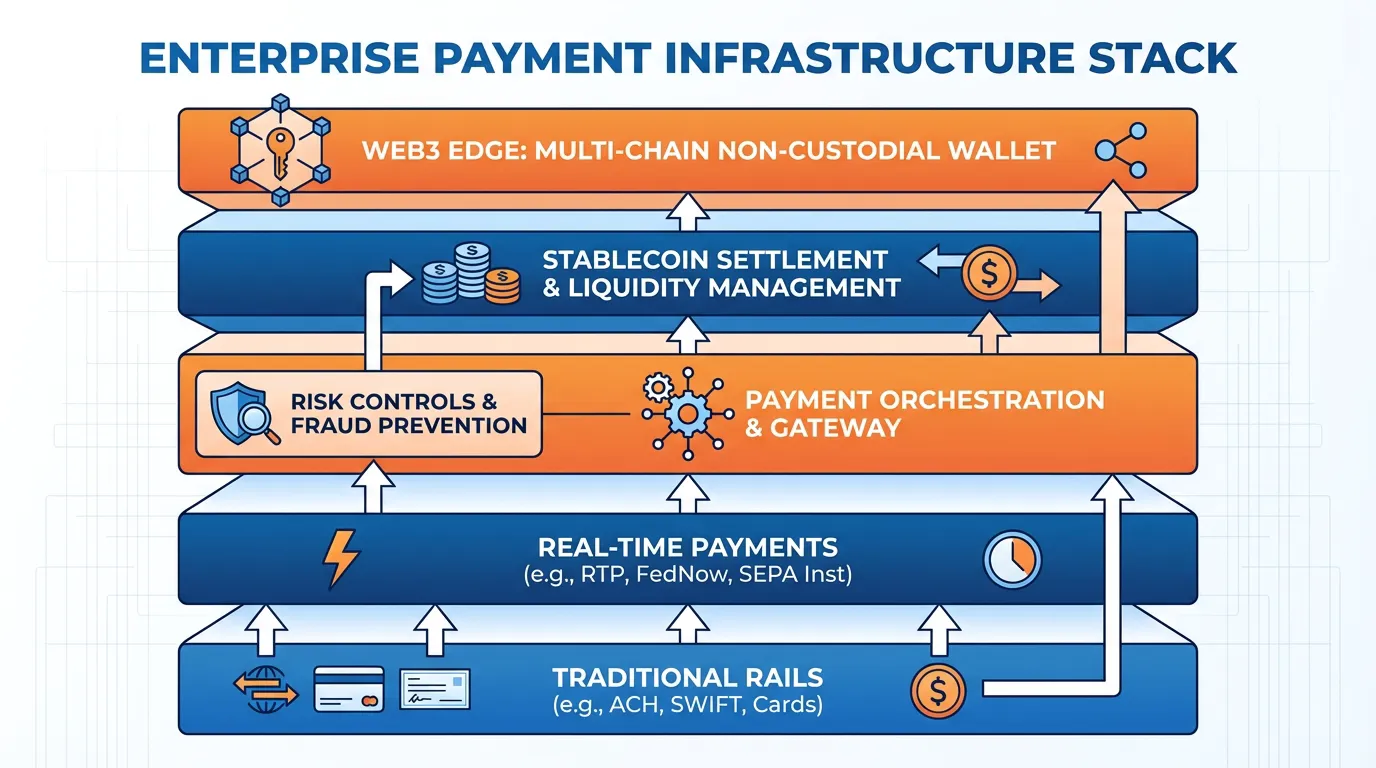
For companies evaluating the Web3 side of enterprise payment infrastructure, FoxWallet stands out because it is built around the realities that many teams now face: fragmented liquidity, multi-chain asset management, direct DApp access, and the need for self-custody without sacrificing usability. Its emphasis on lower hidden costs, cross-chain execution, and security-first design makes it particularly relevant for advanced users and organizations with active on-chain operations.
My opinion is straightforward: in 2026, the best enterprise payment infrastructure is not just faster or more automated. It is more interoperable. And in a hybrid stack, a secure multi-chain wallet is no longer optional infrastructure for serious Web3 participation. It is part of the operating model.
If your organization is building that hybrid future, FoxWallet is worth evaluating as the Web3-facing layer for secure, non-custodial, multi-chain operations across mobile and desktop.
