


How do AI agent wallets handle safe auto-payments?

AI Integration in Wallets is redefining safe auto-payments
AI Integration in Wallets is moving quickly from simple chat-style assistance to real payment execution. In 2026, the question is no longer whether software agents can use wallets. The real question is how those wallets can support autonomous transactions without exposing users to runaway spending, malicious contracts, or silent policy drift.
That is why the latest wallet conversation is split between two forces. On one side, the market is building AI agent wallets and machine-native payment rails. On the other, security leaders are pushing for strict spend caps, approval thresholds, and revocation controls before broader automation becomes normal. For users, developers, and wallet providers, safe auto-payments now depend on balancing speed with guardrails.
For FoxWallet, this shift is highly relevant. As a non-custodial, multi-chain wallet built around local key control, risk alerts, and secure DApp access, FoxWallet already reflects many of the trust principles that agentic finance will need next. If you are new to self-custody, FoxWallet's guide to secure multi-chain management offers a useful foundation before exploring AI-driven payment workflows.
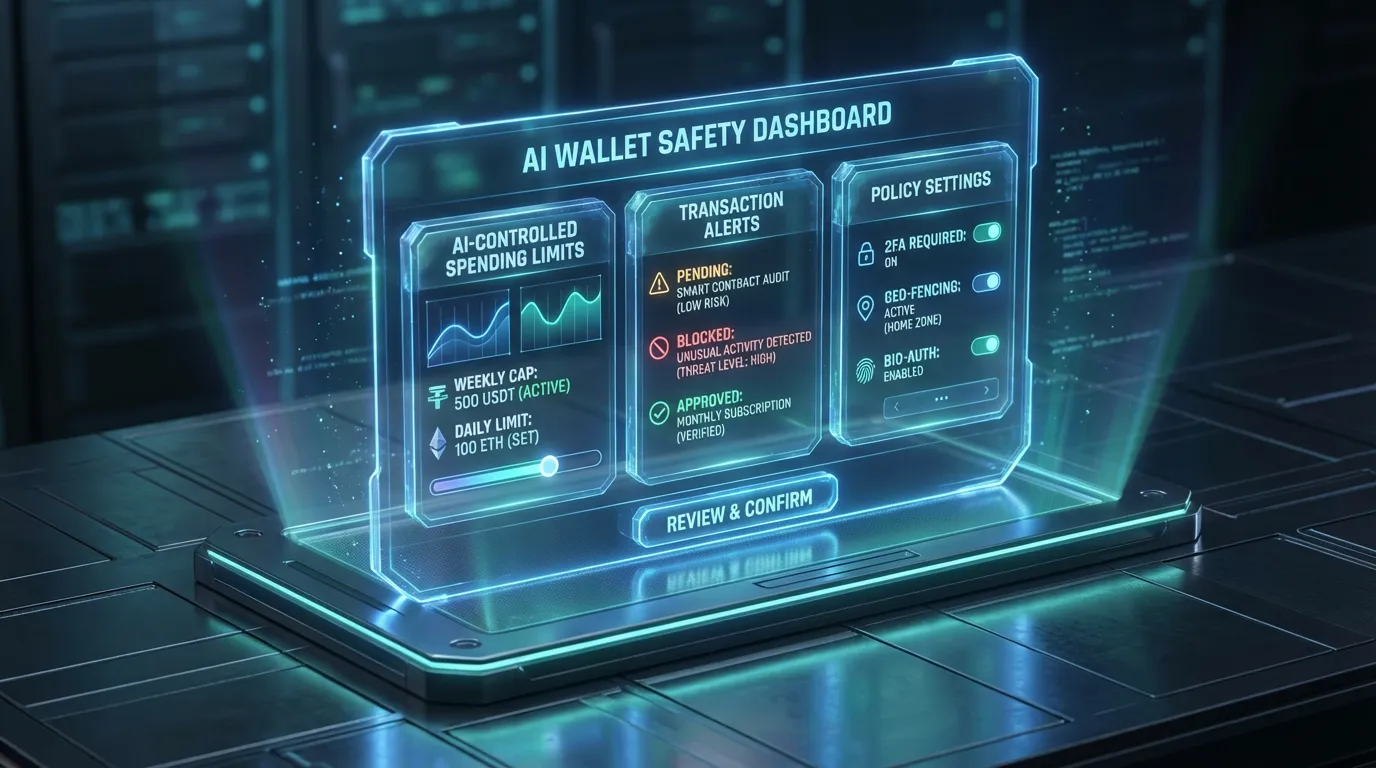
What AI Integration in Wallets means for AI agent wallets
AI Integration in Wallets can describe several different product layers. At the simplest level, AI helps explain transactions, summarize activity, or flag suspicious behavior. At a more advanced level, AI agent wallets can initiate bounded actions, such as paying for API access, completing recurring onchain tasks, or handling small machine-to-machine purchases under preset rules.
That difference matters because AI agent wallets are not just traditional wallets with a chatbot attached. They are wallet systems where software can act within predefined permissions. In practice, that means autonomous transactions should only happen inside a controlled framework, not with unrestricted access to all user assets.
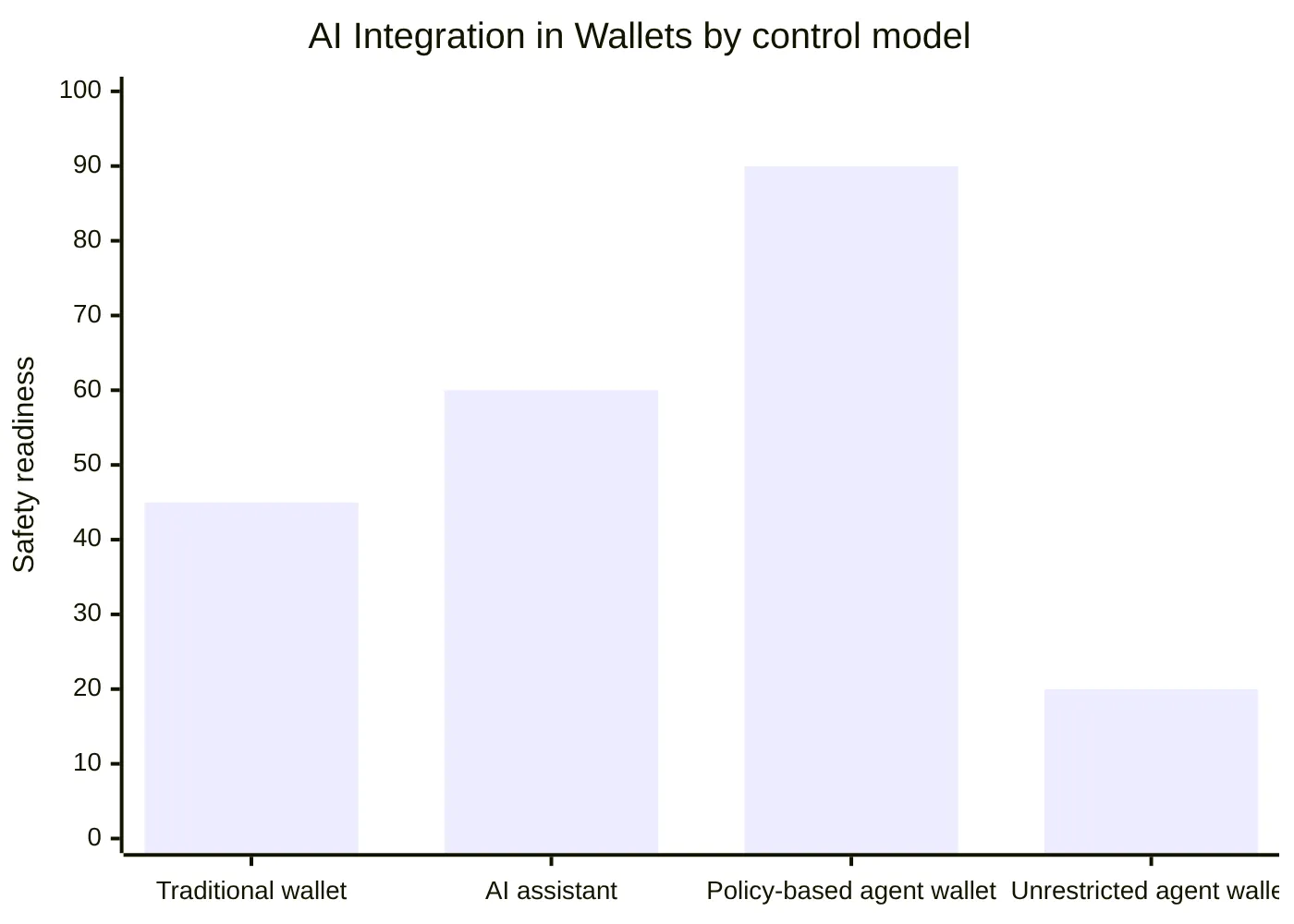
| Wallet model | Who acts | Risk level | Best control |
|---|---|---|---|
| Traditional non-custodial wallet | Human user | Lower | Manual review and signing |
| AI-assisted wallet | Human user with AI guidance | Moderate | Risk alerts and readable signing |
| AI agent wallets | Software agent under user rules | Higher | Policy engine, spend caps, approval thresholds |
Research cited in the report shows this category expanding fast. Coinbase has launched agent-focused wallet infrastructure, while MetaMask has published tutorials around AI agent flows. At the same time, the strongest product direction is not unrestricted automation. It is controlled automation.
A practical takeaway is that agentic finance should work like delegated authority, not full surrender of control. FoxWallet's non-custodial architecture is important here because users retain control over private keys, while security features such as local encryption, phishing protection, and contract recognition create a stronger base for future policy-driven automation. Readers interested in everyday wallet hygiene can also review FoxWallet's article on common Web3 wallet traps.
Why AI Integration in Wallets now depends on the x402 foundation
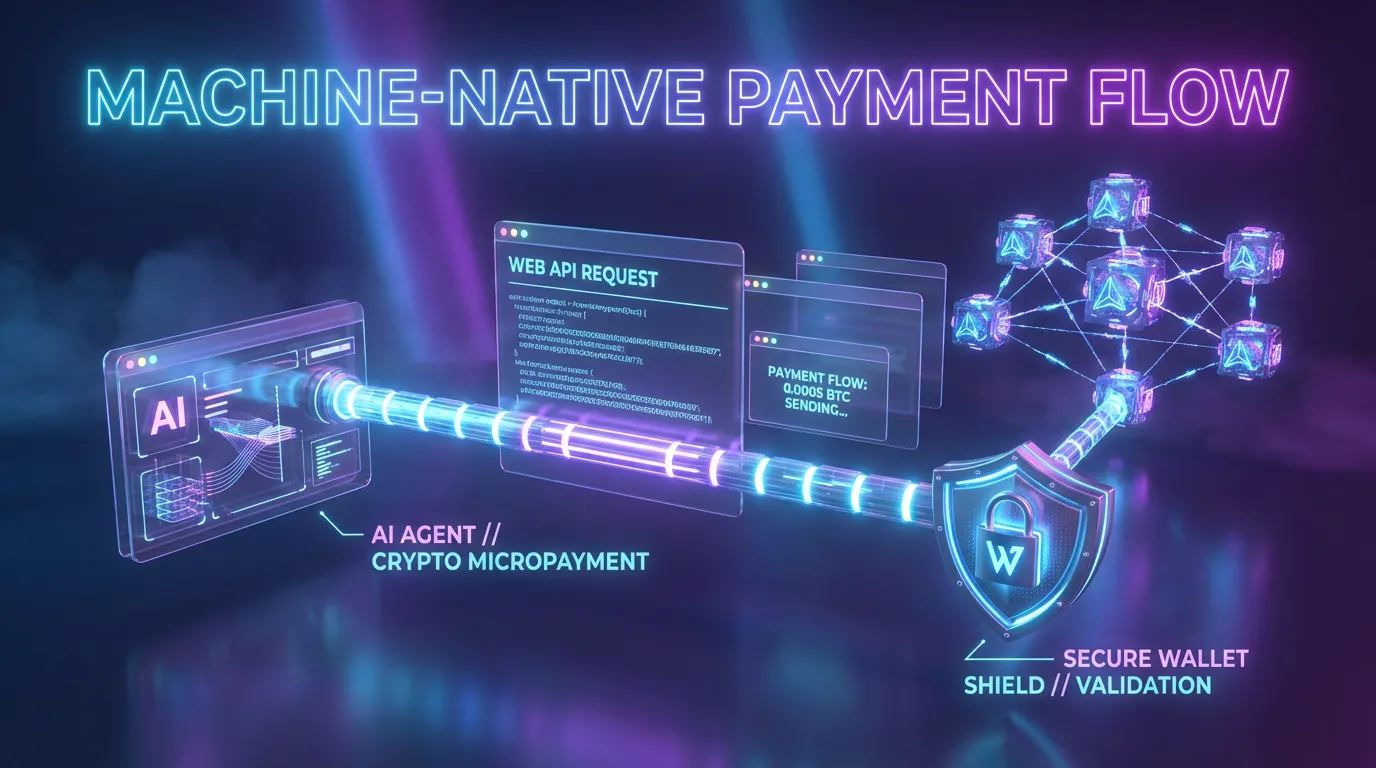
One of the biggest reasons AI Integration in Wallets is accelerating is the rise of machine-native internet payments. The most important verified signal in the research is the launch of the x402 Foundation under the Linux Foundation, with Coinbase contributing the x402 protocol. The point of x402 is to make payments part of the HTTP flow itself, so software agents can pay for services such as APIs, data, or compute without stopping for manual billing steps.
This is a major shift because it aligns well with the needs of AI agent wallets. If an AI system needs to access paid services repeatedly, autonomous transactions become more useful than manual signatures for every low-value request. That is also why x402 foundation matters beyond crypto news headlines. It represents a broader move toward an internet where machine actors can transact directly.
Still, infrastructure alone does not make these flows safe. If x402 lowers the friction for payments, wallet controls must lower the risk. That is where non-custodial wallets with visible policy settings can stand out. A wallet should not just let an AI spend. It should let the user define what can be spent, where, how often, and under what conditions.
FoxWallet is well positioned to take part in that direction because it already focuses on user control, multi-chain asset visibility, and safer transaction review. Its security features overview is especially relevant to the AI era, since many existing protections can evolve into auto-payment guardrails.
How AI Integration in Wallets stays safe with spend caps and autonomous transactions controls
The biggest challenge in AI Integration in Wallets is not just theft. It is misaligned execution. An agent can be tricked by prompt injection, pay the wrong destination, interact with a malicious contract, or keep spending within a flawed instruction loop. Because these actions happen at machine speed, the damage can scale much faster than in a manual wallet flow.
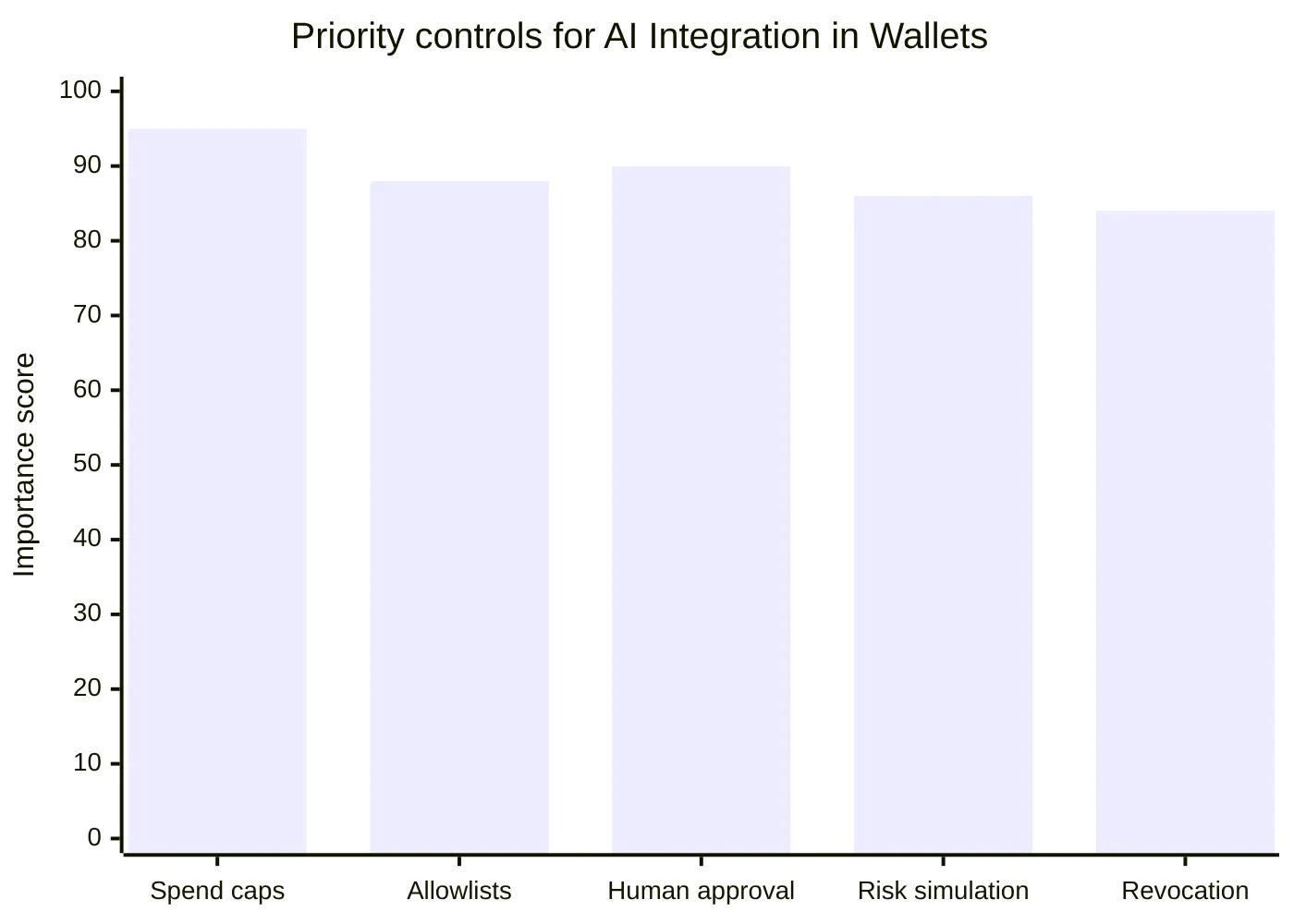
That is why spend caps have become one of the clearest safety recommendations in this space. Secondary reporting cited in the research says Vitalik Buterin recommended limiting AI-connected wallets to around $100 per day unless a human approves more. Whether the exact amount changes by use case, the principle is clear: contain downside first.
Safe AI agent wallets should combine several controls:
| Safety control | What it does | Why it matters for autonomous transactions |
|---|---|---|
| Spend caps | Limits total automated spending per day or session | Contains losses if an agent misbehaves |
| Per-transaction limits | Restricts the size of each payment | Prevents one oversized mistake |
| Allowlists | Restricts approved destinations, contracts, or domains | Reduces exposure to malicious endpoints |
| Human approval thresholds | Escalates unusual actions to the user | Keeps oversight for higher-risk activity |
| Risk alerts and simulation | Checks transactions before execution | Helps detect harmful contract interactions |
| Revocation controls | Pauses or removes delegated permissions | Lets users stop automation quickly |
For FoxWallet, these controls fit naturally with its current product strengths. The wallet already emphasizes local private key encryption, secure sandbox isolation, contract recognition, phishing defense, and pre-transaction warnings. Those are exactly the kinds of protections that should be extended into AI-connected workflows. Users looking to tighten their self-custody setup can also read FoxWallet's step-by-step secure wallet guide.
Why AI Integration in Wallets fits FoxWallet's non-custodial direction
FoxWallet does not need to promise reckless automation to stay relevant in agentic finance. In fact, its strongest position is the opposite: helping users adopt AI-enabled payments without giving up self-custody.
That message fits FoxWallet's current design. Users keep full control of their private keys. Assets are managed across multiple chains in one place. DApps and DeFi access are built in. Risk protection already includes phishing defense and malicious contract detection. Mobile and browser support also matter, because AI-connected wallet usage will not be limited to one device format or one kind of user.
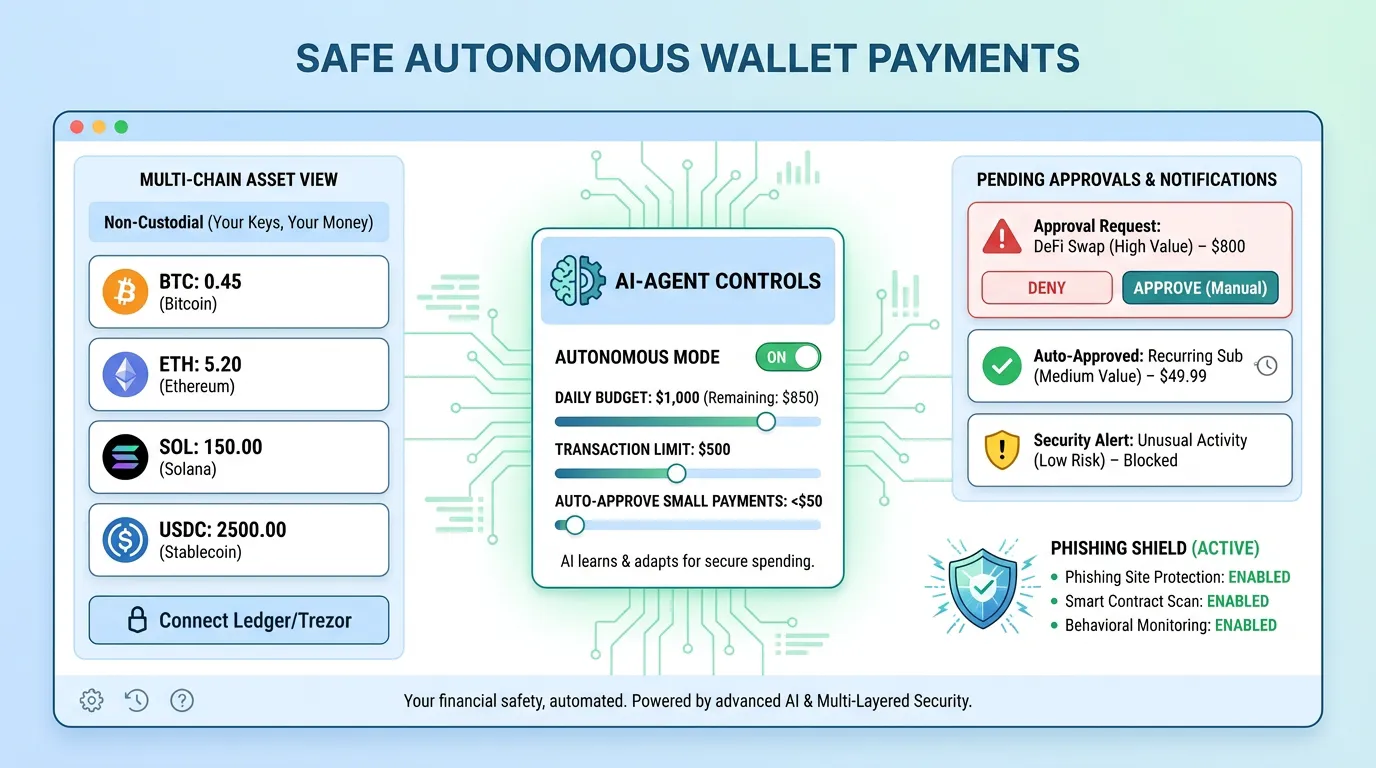
A realistic FoxWallet-aligned model would look like this:
- A user keeps primary funds in a standard self-custody wallet.
- The user creates a limited AI spending profile or budget.
- The AI can propose or trigger low-risk payments inside that budget.
- FoxWallet checks policy rules, risk signals, and destination constraints.
- Any unusual transaction gets routed back for explicit approval.
This approach supports AI Integration in Wallets while respecting the core promise of a non-custodial wallet: the provider does not hold user funds, and the user remains in control. It also matches the market direction suggested by the research, where policy-based automation looks more scalable than unrestricted agent spending.
What AI Integration in Wallets should look like next
The next stage of AI Integration in Wallets will likely reward products that make auto-payments understandable, limited, and reversible. AI agent wallets will become more useful as machine-native payments grow, especially around API access and repetitive digital services. But usefulness alone will not build trust. Users need visible controls around autonomous transactions, especially spend caps, allowlists, review thresholds, and instant revocation.
For FoxWallet, that creates a clear opportunity. The wallet already has the architecture of a security-first, non-custodial, multi-chain product. Extending those strengths into AI-safe payment policies would be a logical next step, not a brand break. In other words, FoxWallet does not need to be the loudest wallet in agentic finance. It needs to be one of the safest and most credible.
If you want a wallet experience built around self-custody, multi-chain asset management, and risk-aware onchain activity, explore FoxWallet's existing security and product resources, including its guide to secure multi-chain wallet management and its overview of wallet protection features. That is the right place to start before AI-driven payments become part of everyday Web3 usage.
