


Best Crypto On-Ramps in 2026: No Hidden Fees

A crypto on-ramp "no fees" claim usually means zero visible platform fee — not zero total cost. The best choice in 2026 is the provider that delivers the most usable crypto after spread, payment costs, FX, network fees, and post-purchase wallet steps.
For users, the real win is not just finding a no-fee crypto on-ramp. It is buying crypto with a clear final quote, choosing the right payment rail, receiving assets on the right chain, and managing them safely in a non-custodial wallet like FoxWallet, where users keep control of their private keys and assets.
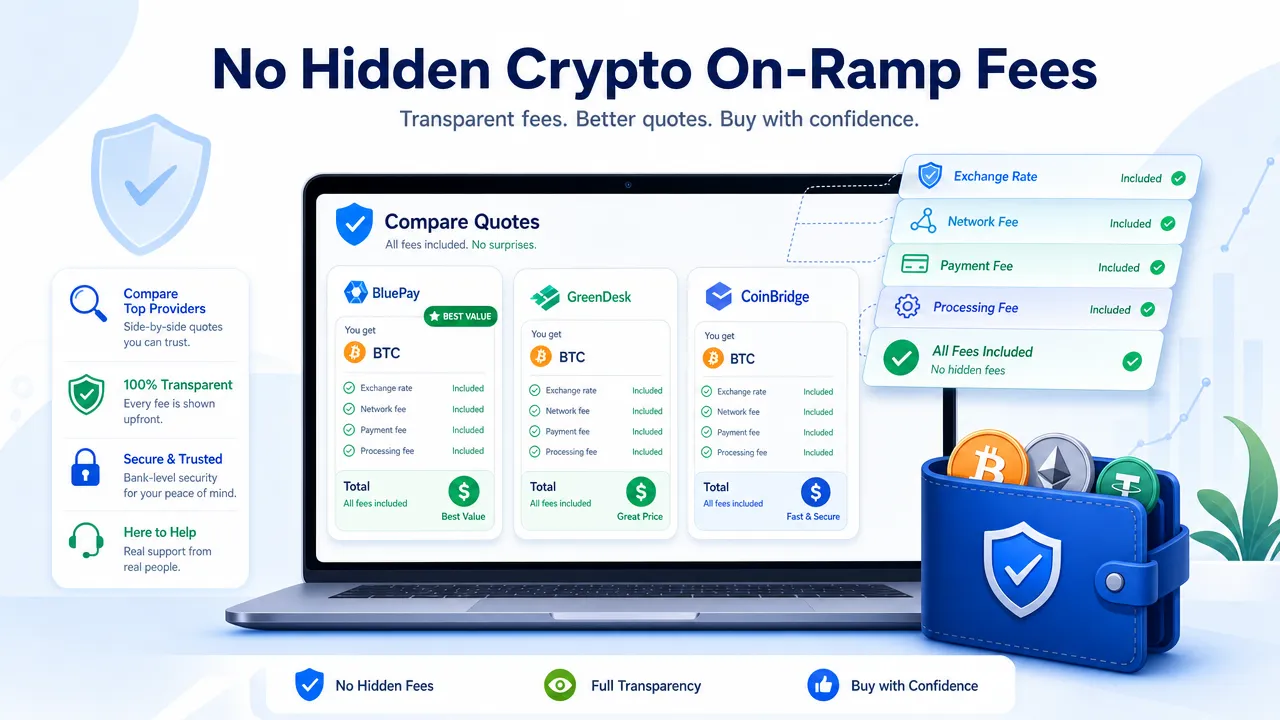
What is the best crypto on-ramp in 2026?
The best crypto on-ramp depends on your country, payment method, asset, chain, purchase size, and custody preference. Compare the final delivered crypto amount rather than relying on the advertised fee.
Here are three of the most widely used options:
1. Mercuryo
Mercuryo is a fiat-to-crypto payment platform that supports multiple payment methods, operates in more than 150 countries, and is integrated with hundreds of wallets, exchanges, and Web3 applications. It focuses on making crypto purchases simple while offering transparent pricing and a range of local payment options.
Best for: Users looking for broad global coverage and embedded crypto purchases across Web3 apps.
2. MoonPay
One of the most widely integrated crypto on-ramp providers, allowing users to buy digital assets using debit cards, credit cards, bank transfers, Apple Pay, Google Pay, and other local payment methods. Its simple checkout experience makes it a popular choice for beginners.
Best for: First-time crypto buyers who want a fast and familiar checkout experience.
3. Coinbase
Combines a crypto exchange with fiat on-ramp services, allowing users to purchase cryptocurrencies through bank transfers, cards, and regional payment methods. For users who already have a Coinbase account, it can provide a straightforward route into the crypto ecosystem before transferring assets to a self-custody wallet if desired.
Best for: Users who are comfortable buying crypto through a centralized exchange with integrated payment options.
Why crypto on-ramp no fees rarely means zero total cost
A crypto fiat on-ramp is a service or flow that converts fiat currency into cryptocurrency. It may be embedded inside a wallet, exchange, DApp, fintech app, or checkout widget. According to educational resources from Stripe and Mastercard, these flows typically involve payment processing, compliance checks, liquidity providers, and crypto delivery to an account or wallet.
The phrase crypto on-ramp no fees is usually narrower than users expect. It may mean the provider is not charging an explicit service fee, but the transaction can still include other costs. A purchase may look free at the headline level while the final amount reflects spread, payment processing, FX conversion, network fees, or partner markups.
A better way to evaluate a no-fee crypto on-ramp is to compare the final crypto delivered, not just the visible fee line.
| Cost layer | What it means | Why it matters |
|---|---|---|
| Explicit platform fee | A visible fee shown by the provider | Often the easiest fee to notice |
| Spread | The gap between the market price and quoted price | Can make a "0 fee" quote more expensive |
| Payment method cost | Card, Apple Pay, Google Pay, bank transfer, or local rail cost | Cards are often faster but can cost more |
| FX conversion | Currency conversion cost when fiat currencies differ | Important for cross-border purchases |
| Network fee | Blockchain transaction cost | Varies by chain and congestion |
| Partner markup | Fee added by an app or integration partner | May not be controlled by the ramp provider |
| Post-purchase transfer cost | Cost to move assets after purchase | Can appear when funds arrive in the wrong account or chain |
| Slippage | Price movement during a later swap | Relevant after the initial purchase |
Several reputable education sources, including Lisk and ChangeHero, highlight that fees in on-ramp flows can appear in more than one place. That is why the best crypto on-ramp is not always the one with the lowest advertised fee.
A practical formula is:
Total cost of purchase = visible provider fee + spread + payment method fee + FX fee + network fee + partner fee + post-purchase transfer or swap cost
Platform fees tend to be the most visible cost to users, while spread, FX conversion, and post-purchase transfer costs are typically the hardest to detect before confirming a purchase.
Best crypto on-ramp no fees options to compare in 2026
The best crypto on-ramp in 2026 depends on region, payment method, asset, chain, purchase size, and whether the user wants self-custody. No single provider is the cheapest in every situation.
Below is a practical list of major on-ramp models users commonly compare. Competitor links are intentionally omitted; users should always check live quotes directly before purchase.
1. Aggregator-style on-ramp platforms
Aggregator-style platforms route users across multiple third-party ramp providers. The main advantage is quote comparison. Instead of relying on one provider, an aggregator can surface different payment methods, providers, and asset routes.
Best for: Users who want to compare several providers from one interface.
Potential advantage: Better chance of finding a lower-cost route for a specific asset, region, or payment method.
Watch out for: An aggregator may not add its own fee, but the underlying provider can still include spread, network costs, KYC requirements, and payment fees.
Example provider category: Onramper-style aggregator platforms.
2. Infrastructure-first on-ramp providers
Infrastructure-first providers are designed for wallets, exchanges, fintech apps, DApps, and Web3 platforms that want embedded fiat-to-crypto checkout. These providers often handle KYC, fraud controls, payment processing, and crypto delivery.
Best for: Users buying inside a partner app or developers evaluating a crypto onboarding platform.
Potential advantage: Embedded checkout can reduce friction, especially for beginners.
Watch out for: Pricing may vary by partner, country, payment method, token, and network.
Example provider category: Mercuryo, Banxa, Ramp Network, and Transak-style infrastructure providers.
3. Consumer-friendly checkout ramps
Consumer-facing on-ramp providers focus on simple card, bank transfer, Apple Pay, Google Pay, or wallet-based purchase experiences. They are often easy for beginners and widely integrated into wallets, marketplaces, and apps.
Best for: Users who prioritize convenience and speed.
Potential advantage: Simple purchase flow and familiar payment methods.
Watch out for: Convenience can come with higher payment costs, especially for card-based transactions.
Example provider category: MoonPay-style consumer checkout ramps.
4. Exchange-based fiat on-ramps
Centralized exchanges often support bank transfers, cards, and local payment methods. They may offer competitive pricing for some users, especially larger purchases or bank-transfer routes.
Best for: Users comfortable with exchange accounts and KYC.
Potential advantage: Deep liquidity and multiple trading pairs.
Watch out for: Assets may start in a custodial exchange account, and withdrawing to a non-custodial wallet can add extra network fees, delays, and address-management risk.
5. Wallet-connected on-ramp flows
Some wallets integrate one or more fiat on-ramp providers. This can make onboarding easier because users can buy crypto and send it directly to a wallet address.
Best for: Users who want a smoother path from purchase to self-custody.
Potential advantage: Better alignment between purchase destination, chain selection, and asset management.
Watch out for: The wallet interface may rely on third-party fiat on-ramp providers, so final fees are still determined by the provider quote, payment method, and network.
| On-ramp model | Strength | Common cost risk | Best user fit |
|---|---|---|---|
| Aggregator | Compares multiple providers | Underlying provider fees still apply | Quote shoppers |
| Infrastructure provider | Embedded app checkout | Partner-specific pricing | Wallet and DApp users |
| Consumer checkout | Easy purchase flow | Higher card or spread cost | Beginners |
| Exchange-based ramp | Liquidity and trading depth | Withdrawal costs and custody tradeoffs | Active traders |
| Wallet-connected flow | Direct route to wallet address | Third-party quote still applies | Self-custody users |
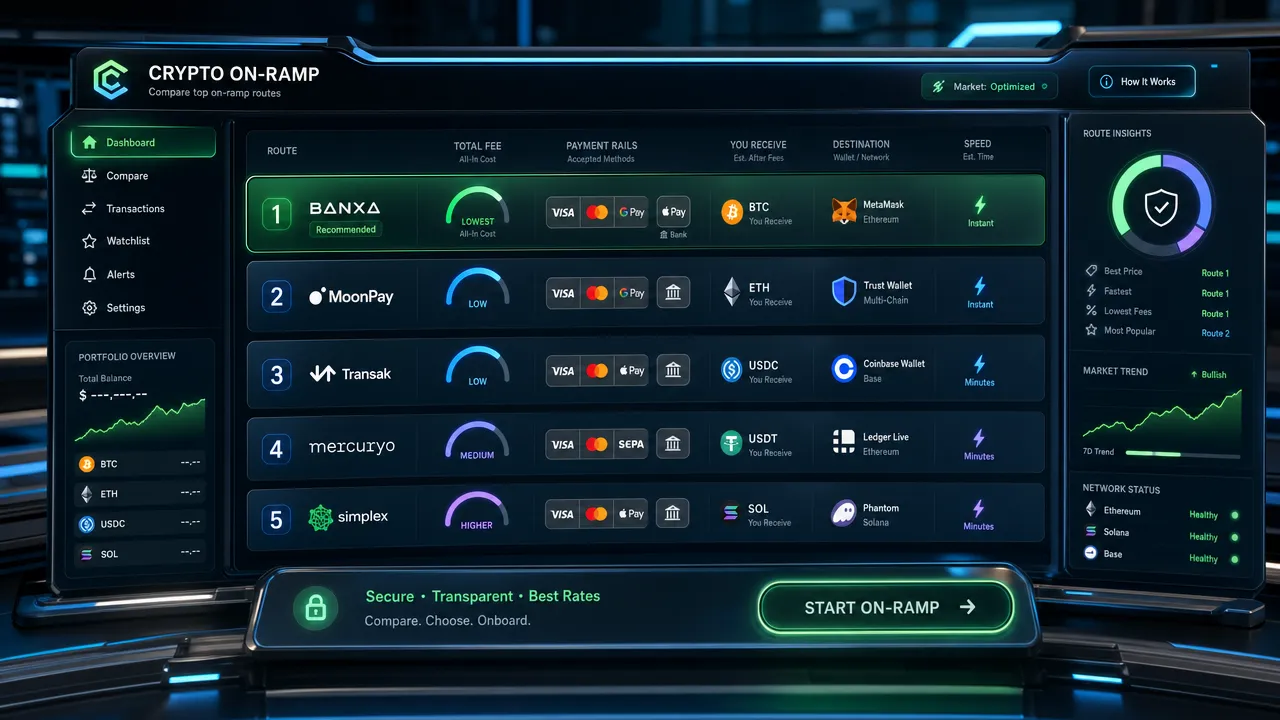
How to find a cheap crypto on-ramp no fees route
A cheap crypto on-ramp is not always the one labeled free. The cheapest route is the one that gives the best final delivered amount for the fiat paid and puts the asset where the user actually needs it.
Use this list before confirming any low-cost crypto purchase.
1. Compare the final delivered amount
The final delivered amount matters more than a fee label. Two providers can both show "0 service fee" while delivering different crypto amounts because their spreads differ.
Check:
- Fiat amount entered.
- Crypto amount delivered.
- Asset and chain.
- Quote expiration time.
- Whether network fee is included or separate.
2. Compare card, bank transfer, and local rails
Card payments are fast and familiar, but they can carry higher processing and fraud-risk costs. Bank transfers may be cheaper, though slower. Local payment rails can be efficient in supported regions, but availability varies.
For US users, ACH-style bank transfer options may sometimes be more cost-efficient than card purchases, depending on provider and purchase size. For other regions, local rails such as SEPA, Faster Payments, PIX, UPI, or PayID may matter more. Always check the provider's live quote.
3. Check spread against a market reference
Spread is one of the most common reasons a buy crypto without fees offer may still feel expensive. A provider can charge no visible platform fee while quoting a less favorable asset price.
A quick check:
- Look at a broad market reference price.
- Compare it with the on-ramp quote.
- Calculate whether the delivered amount is competitive.
- Recheck before confirming because crypto prices move quickly.
4. Avoid destination-chain mistakes
Buying the right asset on the wrong chain can create downstream costs. Users may need to transfer, bridge, or swap after purchase, each of which can add network fees, slippage, or operational complexity.
Before buying, confirm:
- The asset is supported on the chain you need.
- Your wallet supports that chain.
- You understand the gas token required.
- You will not need an immediate transfer just to use the asset.
5. Start with a small test purchase
For a new provider, payment method, asset, or wallet address, a small test purchase can reduce risk. It may add one extra transaction, but it can help confirm that the destination address and network are correct.
6. Read refund and failed-transaction rules
On-ramp failures can happen because of KYC delays, payment declines, quote expiration, network congestion, or unsupported regions. Refund timing and cancellation rules vary. Review them before sending funds.
flowchart TD
    A["Choose asset and chain"] --> B["Collect live quotes"]
    B --> C["Compare final delivered crypto"]
    C --> D["Check spread and payment fee"]
    D --> E["Check FX and network fee"]
    E --> F{"Does crypto arrive where needed?"}
    F -->|Yes| G["Confirm small purchase if new route"]
    F -->|No| H["Estimate transfer or swap cost"]
    H --> B
    G --> I["Manage assets in self-custody wallet"]
The best 2026 crypto on-ramp process is quote-first, chain-aware, and wallet-aware. Users should not stop at the checkout fee line.
Crypto on-ramp no fees and the wallet layer after purchase
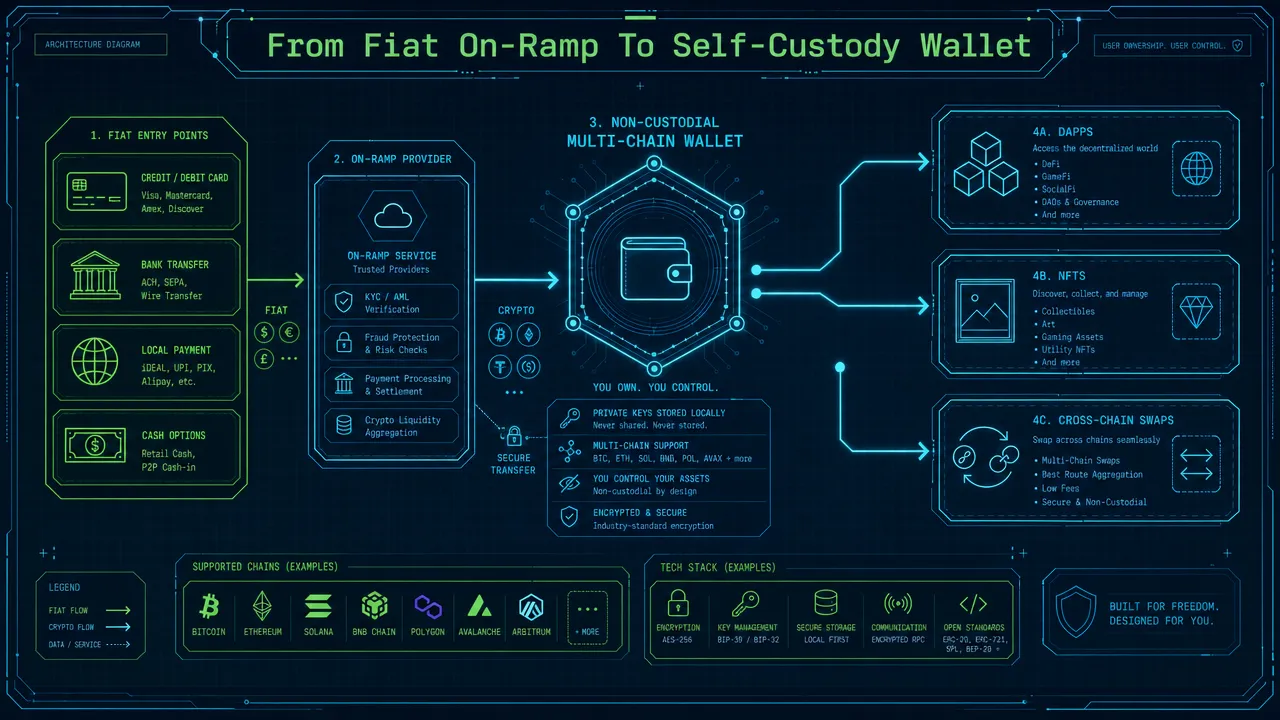
The on-ramp is only the entry point. After the purchase, users still need to store assets, track balances, interact with DApps, swap across chains, and avoid risky transactions.
That is where wallet choice matters.
FoxWallet should not be treated as a regulated fiat payment processor unless a specific integration or approval confirms that role. FoxWallet's core role is the wallet layer: secure self-custody, multi-chain asset management, built-in cross-chain swaps, DApp access, and transaction risk awareness.
Users can learn more from the FoxWallet secure multi-chain management guide, which explains how FoxWallet supports non-custodial asset control, multi-chain visibility, DApp access, and built-in swap capabilities.
Why self-custody matters after a fiat on-ramp
A non-custodial wallet lets users control their private keys and assets. FoxWallet is built around this principle: users retain control, and FoxWallet does not hold user funds.
This matters because crypto purchased through a custodial account may require withdrawal before the user can access DeFi, NFTs, GameFi, or other on-chain apps. That withdrawal can involve extra fees, waiting times, address risk, and chain-selection mistakes.
With a self-custody wallet, users can receive, track, and manage assets directly across supported networks.
Why multi-chain visibility matters
A growing number of users hold assets across multiple chains. Without a unified view, it is easy to lose track of balances, NFTs, gas tokens, and transaction status.
FoxWallet supports multi-chain asset management, including unified asset visibility, automatic detection of assets and NFTs, and real-time on-chain data synchronization. For users who buy crypto on multiple networks, that reduces confusion after the on-ramp step.
The secure multi-chain BTC wallet guide also explains how self-custody and multi-chain support can help users manage assets across ecosystems without relying on fragmented tools.
Why built-in cross-chain swaps matter
A user may buy one asset and later need another asset on a different chain. Built-in cross-chain swaps can reduce the need to jump between multiple external tools. FoxWallet integrates multi-chain swap aggregators and can route transactions for pricing and liquidity while helping users stay aware of slippage and route details.
Cross-chain swaps are not staking, and they should not be described as staking. A cross-chain swap is an asset exchange across blockchain networks. Staking is a separate activity with different mechanics and risks.
For deeper technical context, FoxWallet's article on multi-chain wallet bottlenecks and cross-chain design explains why routing, gas, slippage, and chain coordination matter for users moving across ecosystems.
Why security warnings matter
Hidden costs are not only financial. A phishing link, malicious contract, or unsafe approval can create far larger losses than a checkout fee.
FoxWallet emphasizes local private key encryption, secure sandbox isolation, pre-transaction risk alerts, smart contract recognition, phishing protection, and malicious contract risk protection. Its 2026 wallet security features guide provides more detail on how transaction warnings and safer DApp access can help users reduce risk.
2026 crypto on-ramp no fees buyer checklist
A 2026 crypto on-ramp decision should balance cost, speed, payment method, custody, security, and post-purchase usability. Use this checklist before confirming a transaction.
| Checklist item | Why it matters |
|---|---|
| Final delivered crypto amount | Shows real purchase value |
| Spread | Can hide cost inside the quote |
| Payment method | Card, bank, and local rails can differ greatly |
| FX conversion | Cross-currency purchases may include markup |
| Network fee | Affects delivery and later movement |
| Minimum order size | Small purchases can have higher effective costs |
| Supported chain | Wrong-chain purchases can create extra costs |
| Destination wallet | Self-custody users should confirm the correct address |
| KYC requirements | Verification can affect speed and success |
| Refund rules | Failed purchases may take time to resolve |
| Post-purchase needs | Swaps and transfers can add costs |
| Security warnings | Protects against phishing and malicious approvals |
Quick ranking criteria for the best crypto on-ramp
Use this simple ranking method when comparing providers:
- Delivered value: Which quote delivers the most crypto?
- Transparency: Are spread, fees, and network costs clearly shown?
- Payment fit: Is the cheapest supported payment rail available?
- Chain fit: Does the crypto arrive on the correct network?
- Custody fit: Does it arrive in a wallet or account you control?
- Speed: Does the route match your urgency?
- Security: Does the flow reduce phishing, address, and signing risks?
- Post-purchase cost: Will you need another transfer or swap immediately?
Best crypto on-ramp use cases by user type
| User type | Best-fit approach | Key caution |
|---|---|---|
| Beginner | Simple checkout with clear final quote | Do not ignore spread or network fees |
| Cost-sensitive buyer | Compare bank or local rail routes | Fast card checkout may cost more |
| Self-custody user | Buy directly to a non-custodial wallet address when supported | Confirm chain and address carefully |
| Multi-chain user | Choose the asset and chain before buying | Avoid extra transfers after purchase |
| DApp user | Receive assets in a wallet that supports DApps | Review permissions before signing |
| Frequent user | Optimize payment rails, routes, and wallet workflow | Small hidden costs compound over time |
FoxWallet is especially relevant after the on-ramp because it gives users a unified place to receive, view, and manage assets across chains. It supports mobile use and a browser extension, making it suitable for beginners who want guided onboarding and advanced users who need multi-chain, cross-chain, and DeFi-native workflows. For a broader wallet comparison, see FoxWallet's guide to the best crypto wallets of 2026.
Crypto on-ramp no fees FAQs
Can I really buy crypto without fees?
Sometimes a provider may waive the explicit platform fee, but true zero-cost buying is uncommon. Users should still check spread, payment method fees, FX costs, network fees, and partner markups.
What is the best crypto on-ramp in 2026?
The best crypto on-ramp depends on your country, payment method, asset, chain, purchase size, and custody preference. Compare the final delivered crypto amount rather than relying on the advertised fee.
Is a no-fee crypto on-ramp always cheaper?
No. A no-fee crypto on-ramp can still be more expensive if the spread is wider, card processing costs are higher, or the asset arrives somewhere that requires another transfer.
What is the cheapest way to buy crypto?
The cheapest method often depends on live conditions. Bank transfers or local payment rails may be cheaper than cards, but availability, speed, and limits vary. Always compare live quotes.
Is a card purchase more expensive than a bank transfer?
Often, yes. Cards are usually faster and more convenient, but they can include higher processing and risk costs. Bank transfers may be cheaper but slower.
What hidden fees should I look for?
Look for spread, payment processing fees, FX conversion, network fees, partner markups, minimum-order effects, withdrawal costs, and post-purchase swap costs.
Why does the destination chain matter?
If crypto arrives on the wrong chain, you may need to transfer, bridge, or swap before using it. That can add network fees, slippage, delays, and operational risk.
Should I use a non-custodial wallet after buying crypto?
A non-custodial wallet is useful for users who want direct control of private keys and on-chain assets. FoxWallet is built for self-custody, multi-chain asset management, DApp access, and security-first transaction awareness.
Does FoxWallet remove fiat on-ramp fees?
FoxWallet should not be described as eliminating fiat on-ramp fees. Fiat on-ramp providers determine the initial purchase quote. FoxWallet helps users after or alongside onboarding by supporting self-custody, multi-chain visibility, built-in cross-chain swaps, and safer on-chain interaction.
How can FoxWallet help reduce downstream hidden costs?
FoxWallet can help users reduce cost confusion by showing assets across chains, supporting route-aware cross-chain swaps, reducing unnecessary external redirects, and helping users review transaction risks before signing.
A crypto on-ramp no fees search should end with a total-cost mindset: compare the quote, choose the right payment method, confirm the destination chain, and manage the purchased crypto in a secure self-custody wallet built for multi-chain use.