


Cold Wallet vs Hot Wallet: Which Is Better?

The choice between cold wallet vs hot wallet depends on the value you intend to protect, the frequency of use, and the level of interaction with networks, DApps, and on-chain transactions. A cold wallet tends to reduce the direct exposure of private keys to connected environments, while a hot wallet prioritizes speed for moving assets and accessing the Web3 ecosystem.
There is no universally "better" option. The most consistent decision usually separates long-term assets, operational balance, and experimental activities. It's also important to understand that a wallet doesn't literally store coins: assets remain recorded on the blockchain, and the wallet manages the keys and signatures that authorize transactions.
Warning: This content is educational and does not constitute financial, legal, tax, or investment advice.
Cold wallet vs hot wallet: Which Model Fits Your Use Case?
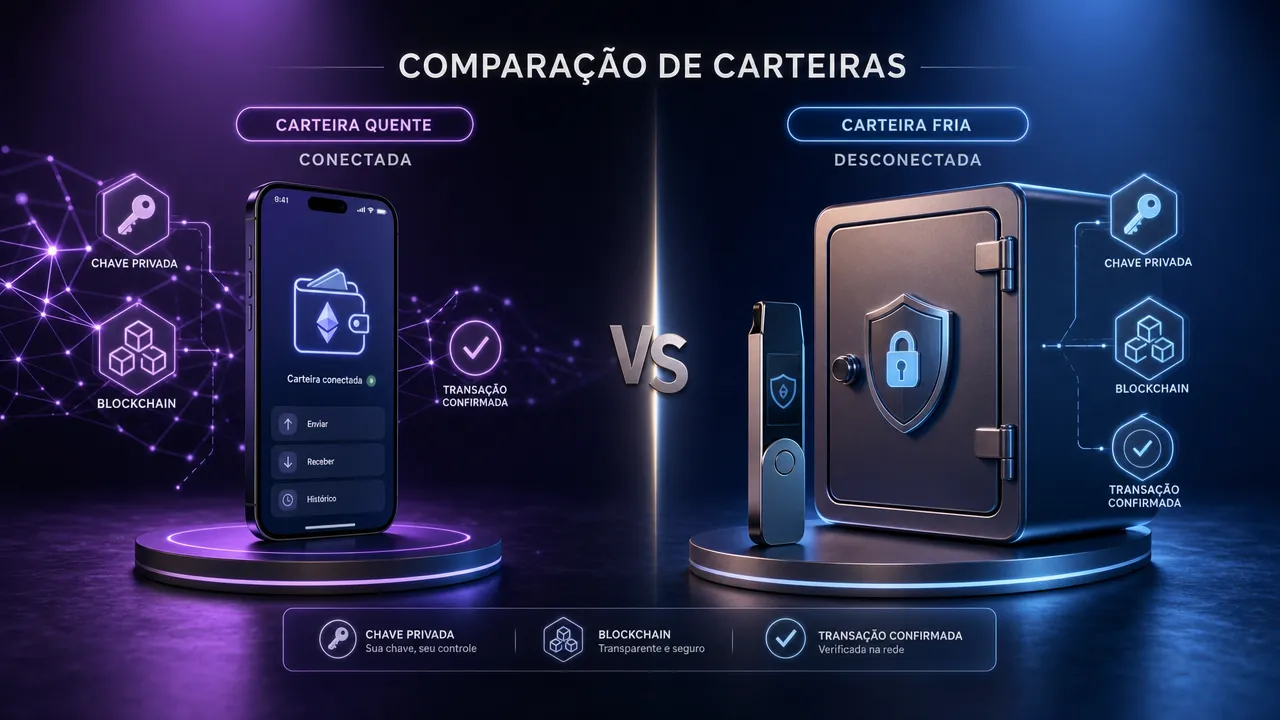
The core difference between cold wallet vs hot wallet lies in the connectivity associated with private keys and the transaction signing process.
A hot wallet operates in an internet-connected environment, such as a mobile app, desktop software, or browser extension. Therefore, it tends to be more practical for recurring transfers, swaps, NFTs, DeFi, and DApps.
A cold wallet, on the other hand, keeps private keys offline or isolated from everyday connectivity. The most well-known example is a hardware wallet — devices like Ledger or Trezor are common examples in this category — which can sign a transaction on the device itself without directly exposing the private key to the connected computer or mobile phone.
| Criteria | Hot wallet |
|---|---|
| Usage environment | Connected mobile, desktop, or browser |
| Convenience | High for daily use |
| Online attack exposure | Larger attack surface |
| Typical best use | Operational balance, DApps, NFTs, and swaps |
| Physical risk | Loss of phone or computer |
| Seed phrase | Still essential |
| Phishing protection | Limited; requires user attention |
| Criteria | Cold wallet |
|---|---|
| Usage environment | Physical device or isolated key configuration |
| Convenience | Lower, with additional confirmation steps |
| Online attack exposure | Lower direct key exposure to remote attacks |
| Typical best use | Long-term reserve and rarely moved assets |
| Physical risk | Loss, theft, or damage to device and backup |
| Seed phrase | Still essential |
| Phishing protection | Limited; malicious actions can still be approved |
The expression wallet offline vs online helps visualize the difference, but doesn't fully explain everything. A hardware wallet can use a connected interface to assemble and broadcast a transaction without the private key leaving the device. The most important factor is where the key is stored and where the signing happens.
You should also not confuse connectivity with crypto custody. A wallet can be non-custodial and still be a hot wallet. In a non-custodial solution, the user controls the private keys and assumes responsibility for backup and protection of the recovery phrase.
The guidance from Investor.gov on crypto custody reinforces an essential point: whoever holds the private key or seed phrase typically controls the ability to move assets.
Cold wallet vs hot wallet: What Does Your Wallet Actually Control?
In cryptocurrency storage, the wallet doesn't contain assets like a physical wallet holds cash. Balance records remain on the respective blockchain. The wallet provides the means to query addresses, view assets, and, most importantly, sign transactions.
Three elements deserve attention:
- Private key: The cryptographic secret used to authorize movements.
- Public address: The shared identifier to receive assets on a network.
- Seed phrase or recovery phrase: The sequence of words used to restore a compatible wallet.
The seed phrase is not a conventional password. If it's lost and you also lose access to the wallet, there may be no way to recover the assets. If it's copied or shared, someone else can restore the wallet on another device and move the funds.
Therefore, the most important rule of cryptocurrency security is simple: never share the seed phrase or private key, never send it via message, and never type it on supposed support sites, validation forms, or airdrop pages.
The official FoxWallet security tips recommend keeping the recovery phrase offline and avoiding screenshots, photos, or storage on connected devices.
Crypto custody adds another dimension to the decision:
| Custody model | Key control | Main benefit | Main trade-off |
|---|---|---|---|
| Custodial | A third party controls the keys | Account recovery and support may be simpler | Dependence on provider's policies, availability, and security |
| Non-custodial | The user controls the keys | Direct control of assets and signatures | Full responsibility for backup and operational security |
The difference between custody and connectivity is decisive. An account on a centralized platform can be custodial and online. A mobile wallet can be non-custodial but remains a hot wallet because it operates on a connected device.
FoxWallet fits as a non-custodial hot wallet for active use on mobile and browser extension. This means the user maintains control of the keys and assets while using an interface focused on multichain management and Web3 interaction. To better understand this model, refer to FoxWallet's content on custody and self-custody.
Cold wallet vs hot wallet: Security, Convenience, and Cost Comparison
A useful cold wallet hot wallet comparison doesn't seek to declare an absolute winner. It evaluates which model better reduces the relevant risks for each situation.
A cold wallet generally reduces the exposure of the private key to malware and remote attacks on the computer or mobile phone. However, it doesn't eliminate risks related to user behavior, such as leaked seed phrases, phishing, social engineering, or approval of malicious contracts.
A hot wallet, on the other hand, offers faster access to the on-chain environment. This is useful for those who need to switch networks, send assets, use DApps, trade NFTs, or perform swaps. In contrast, it requires more attention to the browser, installed extensions, accessed sites, and signature requests.
| Aspect | Hot wallet | Cold wallet |
|---|---|---|
| Transaction speed | High | Moderate or low |
| DApp usage | Generally smoother | Possible, but may require integration and more confirmations |
| Transaction signing | Performed in connected environment | Can occur on isolated device |
| Malware protection | Depends on device security | Can reduce private key exposure |
| Phishing protection | Does not eliminate risk | Does not eliminate risk |
| Acquisition cost | Generally no hardware cost | Usually requires a physical device |
| Network fees | Applicable per blockchain | Applicable per blockchain |
| Recovery | Depends on seed phrase or backup | Also depends on seed phrase or backup |
Costs should not be automatically attributed to the wallet. An operation may involve:
- Blockchain fee to process the transaction.
- Protocol or routing fees in swaps.
- Slippage, which represents the possible difference between the expected price and execution.
- Operational costs, such as time, need for gas on different networks, and risk of error.
A cold wallet doesn't make transactions free. Similarly, a hot wallet isn't necessarily more expensive just because it's connected. The actual cost depends on the network, protocol, route, and action executed.
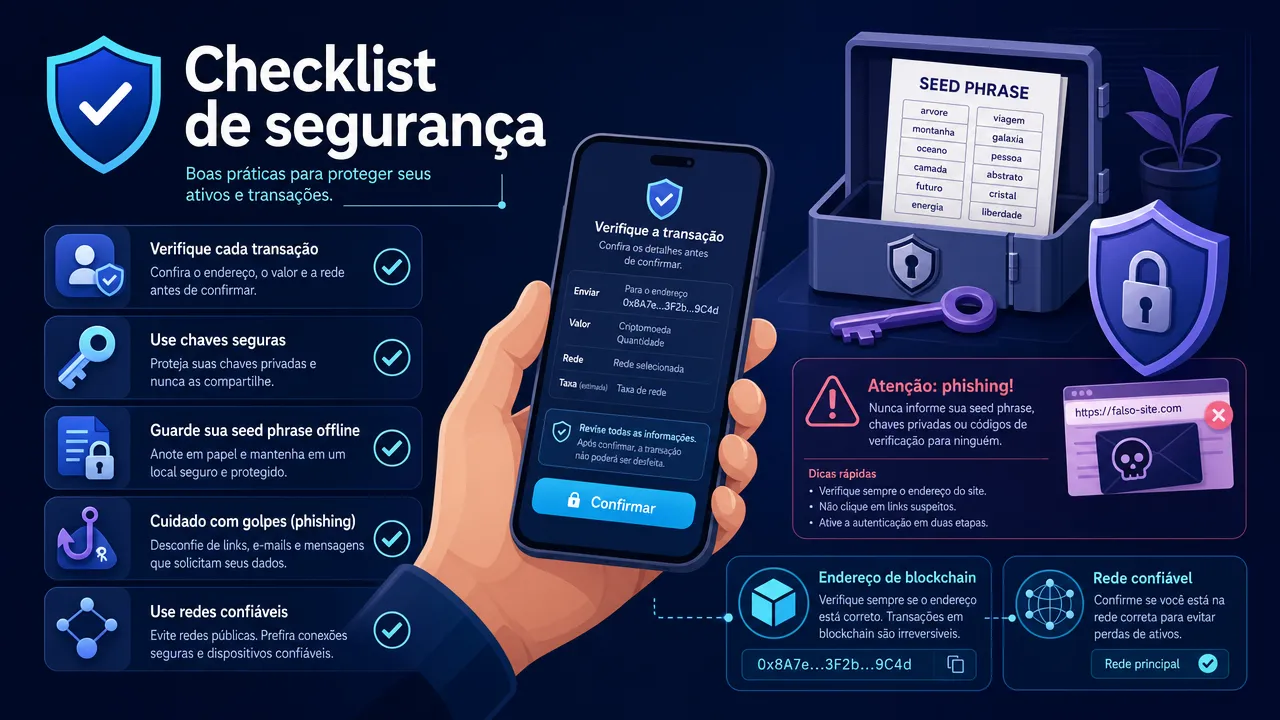
A hardware wallet reduces certain risks but doesn't prevent a harmful transaction from being confirmed by the user itself. Before approving any action, check what is being requested, which network is selected, which token will be used, and whether the DApp domain is legitimate.
Cold wallet vs hot wallet: Risks That Both Models Still Require Controlling
Cryptocurrency security doesn't depend solely on choosing between a cold wallet and a hot wallet. It results from the combination of wallet architecture, device protection, backup, browsing habits, and review of each signature.
The main risks continue to be present, to a greater or lesser extent, in both models.
Seed phrase leak
A compromised seed phrase can put assets at risk even when stored through a cold wallet. No hardware wallet can protect a recovery phrase that has been photographed, stored in the cloud, or shared with a scammer.
Keep the seed phrase offline, in a private location protected against unauthorized access, fire, water, and physical loss. Avoid photos, screenshots, emails, notes apps, and messages.
Phishing and fake sites
Phishing scams can appear as ads, emails, social media profiles, QR codes, direct messages, and fake support pages. The goal may be to steal the seed phrase, induce a signature, or lead the user to install a malicious extension.
Download apps, extensions, and updates only through FoxWallet's official channels. When opening a DApp, verify the complete domain before connecting the wallet.
Token approvals and messages to sign
On networks with smart contracts, approving a token may allow a specific contract to move assets up to the authorized limit. A broad or old approval may remain active even after you stop using that protocol.
Also, don't treat a message signature as harmless. Depending on the context, it can create sessions, confirm permissions, or facilitate unwanted interactions.
FoxWallet provides token approval control features, allowing you to review permissions and revoke or reduce authorizations when necessary.
Network, token, or address error
Sending an asset to the wrong network can create a difficult recovery process or, in certain cases, result in loss of access. Before confirming a transfer, review:
- Origin network and destination network.
- Complete recipient address.
- Correct token and contract.
- Amount sent.
- Network fee.
- Need to maintain native token for gas.
- Recipient compatibility with the chosen asset and blockchain.
For a new operation, a small-value test transfer can reduce the impact of an error.
Cold wallet vs hot wallet: How to Choose the Best Cryptocurrency Wallet?
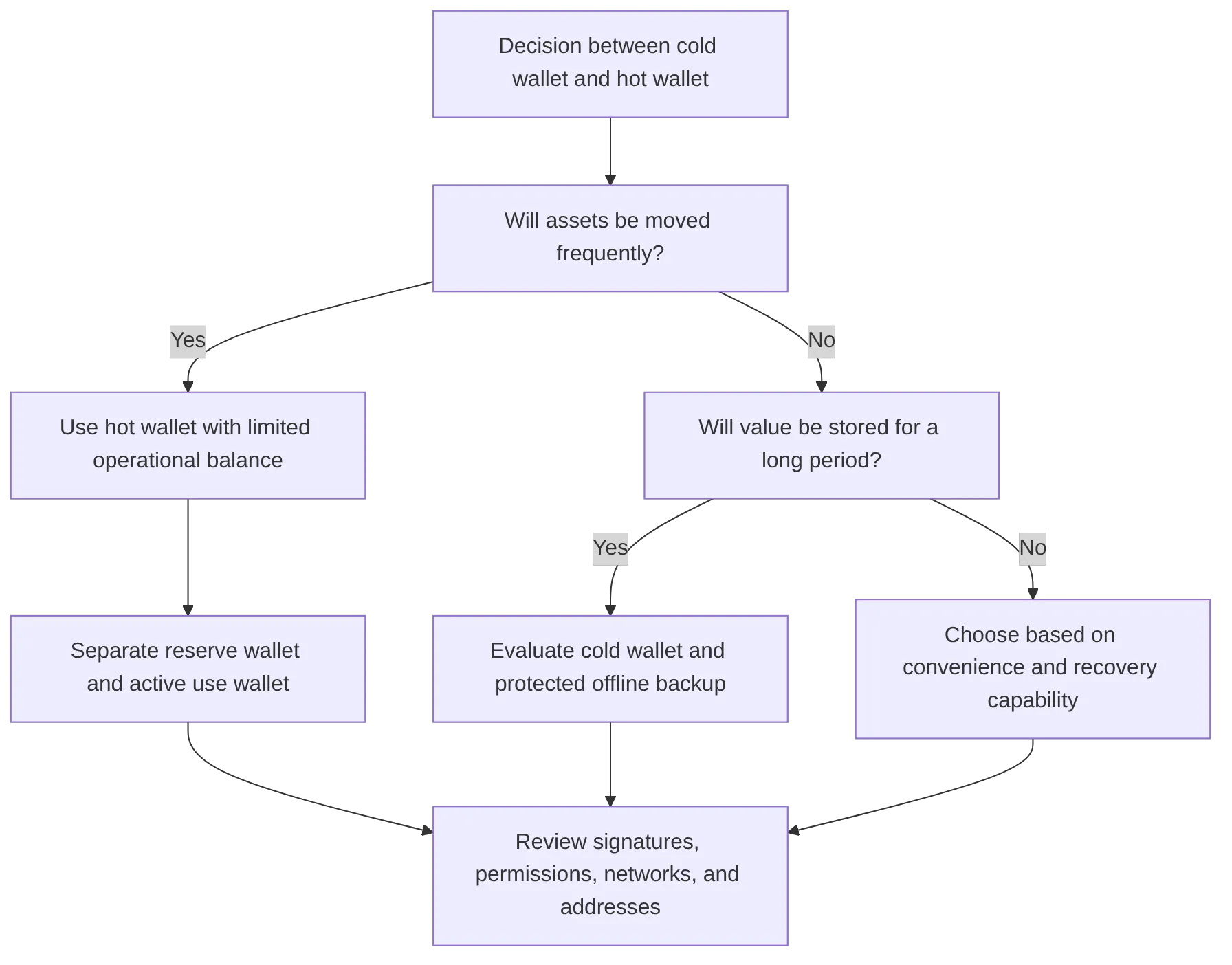
The best cryptocurrency wallet isn't defined only by the product name or device type. It depends on your routine, protected value, backup capability, and degree of exposure to on-chain activities.
For beginners, a non-custodial hot wallet with a small balance can be a practical way to learn fundamentals like networks, fees, addresses, and seed phrases. The critical point is not starting with significant values or connecting the wallet to unknown DApps without understanding the request.
For long-term holders, a cold wallet may make sense for the reserve portion that won't be moved frequently. The user needs to maintain a well-structured recovery plan and avoid using the reserve wallet for mints, airdrops, experimental sites, or applications that require many signatures.
For active traders, a hot wallet usually better serves recurring operations. Good practice is to define an operational balance, keep most of the reserve in another structure, and not concentrate all assets in the daily-use wallet.
For DeFi, NFT, and multichain application users, segmentation is especially useful:
| Profile | Structure that may make sense | Priority precautions |
|---|---|---|
| Beginner | Hot wallet with reduced value for learning | Offline seed phrase, small tests, and official sources |
| Long-term holder | Cold wallet for reserve and separate hot wallet for occasional use | Physical backup, tested recovery, and low DApp exposure |
| Active trader | Hot wallet with defined operational balance | Balance separation, contract and domain verification |
| DeFi and DApp user | Wallet dedicated to on-chain interactions | Signature and permission review |
| NFT collector | Separate wallet for mints and marketplaces | Attention to cloned sites and message signatures |
| Multichain user | Hot wallet with visibility of assets across networks | Network, gas, token, and route confirmation |
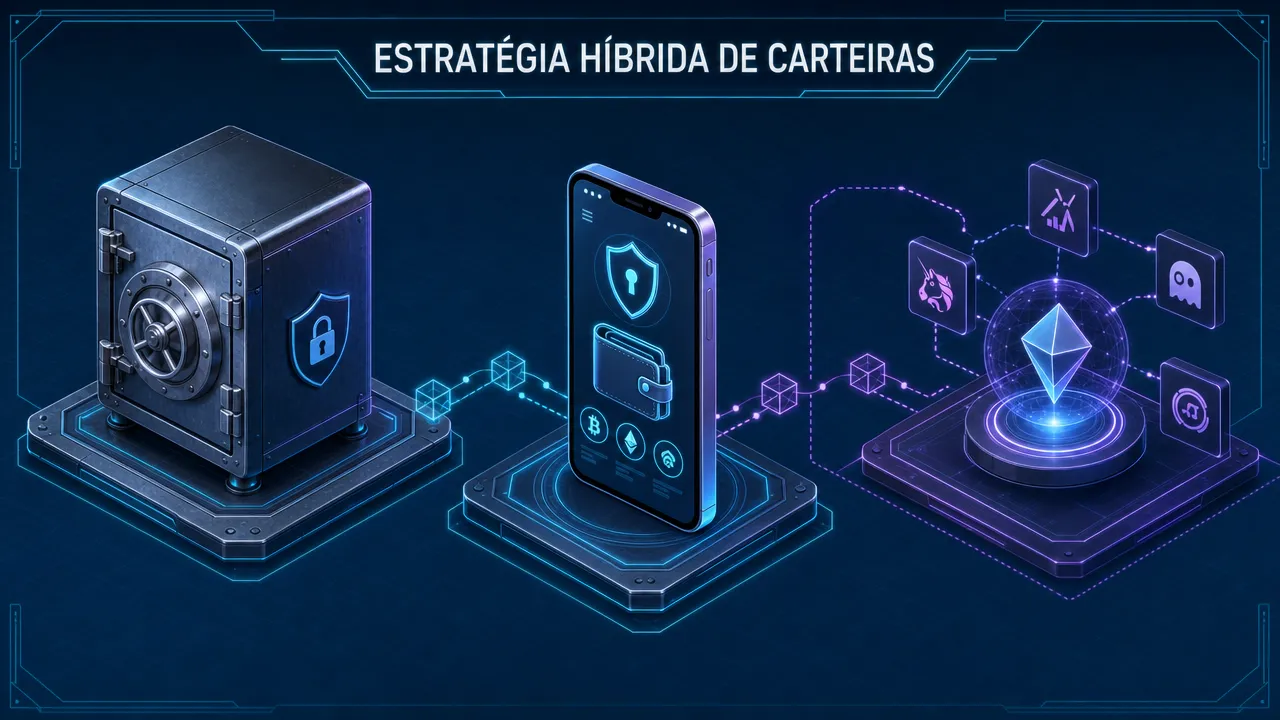
A hybrid strategy usually balances convenience and isolation:
- Cold wallet: Reserve and long-term assets.
- Primary hot wallet: Known transactions and operational balance.
- Experimental hot wallet: Tests, new DApps, mints, or operations with higher uncertainty.
This separation doesn't guarantee absolute protection but can limit the impact of improper approval or connection to a malicious site.
FoxWallet can fit the active use layer as a non-custodial multichain wallet. It was designed to help users manage assets and interact with Web3 on mobile devices and browser extensions while maintaining local key control by the user.
For cross-network operations, increased attention is necessary. A cross-chain swap may involve fees, liquidity, settlement time, slippage, and route risks. Before executing this type of action, review cross-chain swap risks and carefully confirm each step.
Cold wallet vs hot wallet: Frequently Asked Questions and Final Protection Checklist
Is a cold wallet more secure than a hot wallet?
In general, a cold wallet reduces the direct exposure of the private key to connected environments and may decrease risks of remote extraction by malware. It doesn't automatically protect against phishing, leaked seed phrases, physical loss, social engineering, or malicious approvals.
Is a non-custodial wallet automatically a cold wallet?
No. "Non-custodial" indicates that the user controls the keys. "Cold" describes the level of key isolation in relation to connectivity. A non-custodial mobile wallet is typically a hot wallet.
Can a hot wallet be secure?
A hot wallet can adopt local encryption, password, biometrics, risk alerts, and phishing blocks. Still, because it operates in a connected environment, it requires greater operational discipline.
Does a hardware wallet protect against all scams?
No. It may hinder remote extraction of the private key but doesn't prevent the user from revealing their seed phrase or approving an deceptive transaction.
Can I use hot wallet and cold wallet at the same time?
Yes. For many people, keeping the reserve in cold storage and using a hot wallet with a limited balance for on-chain activities is a balanced approach.
Which wallet is better for DeFi and DApps?
A non-custodial hot wallet tends to be more practical for frequent connections and signatures. To reduce exposure, use a dedicated wallet for these activities and don't reuse the reserve wallet.
Before any operation, confirm this checklist:
- Install apps, extensions, and updates only from official sources.
- Store the seed phrase offline and never share it.
- Don't take photos or screenshots of the recovery phrase.
- Verify the complete domain before connecting a wallet to a DApp.
- Review network, token, amount, fee, and complete address before sending assets.
- Test with small amounts on new networks, routes, or recipients.
- Read signature and approval requests before confirming.
- Revoke token permissions that are no longer needed.
- Separate reserve, operational balance, and experimental wallet.
- Stop the operation when a request seems urgent, confusing, or incompatible with your intention.
The cold wallet vs hot wallet comparison ends with a practical conclusion: cold storage tends to be more suitable for reserve and lower frequency of use, while a non-custodial hot wallet offers more agility for multichain activity. The most prudent configuration is one that combines technical protection, reliable backups, and consistent security habits.
Want to manage your operational balance with a non-custodial hot wallet? Learn about FoxWallet and configure your wallet through official channels.