


Multi-Signature Wallets for AI Agents: Adding a Human Checkpoint Without Killing Automation

AI agents can analyze information, prepare transaction details, and monitor execution faster than any human operator. But speed should not be confused with unlimited authority. The moment an agent can move assets, approve token spending, or interact with unfamiliar smart contracts, the design needs a clear boundary between what the agent proposes and what the wallet is permitted to execute.
That is the central case for multi-signature wallets for AI agents: a well-designed workflow can preserve useful automation for repetitive, low-risk actions while requiring independent human confirmation when an action introduces material financial, technical, or governance risk.
This is an educational opinion piece, not investment, legal, tax, or security advice. On-chain transactions and token approvals can be difficult or impossible to reverse.

Why multi-signature wallets for AI agents need a clear authority boundary
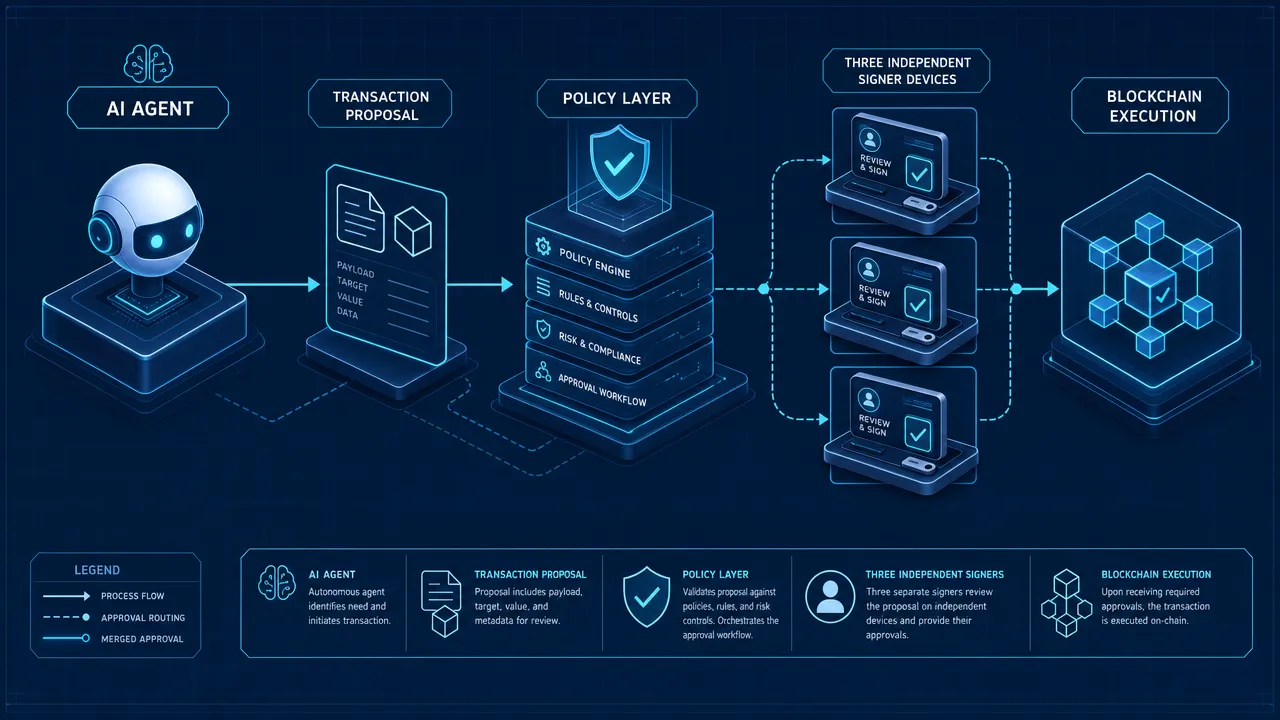
An AI agent can be useful in a wallet workflow without becoming a root signer. It may interpret an instruction, compare information, construct a transaction proposal, and monitor whether the transaction confirmed. What it should not receive by default is unrestricted access to a long-lived private key or the ability to approve every action on its own.
This distinction is foundational to AI agent wallet security. The workflow should separate five stages:
- Intent: A user or organization defines a goal, such as paying an approved vendor or rebalancing a limited operating balance.
- Proposal: The agent prepares structured transaction details, including the chain, asset, amount, recipient, contract, and method.
- Policy validation: Deterministic rules evaluate whether the proposal fits explicit limits.
- Approval: A designated signer, or several signers, accept or reject the transaction.
- Execution: The wallet signs, broadcasts, and records the on-chain outcome.
OWASP guidance on AI agent security highlights risks such as prompt injection and excessive agency. An agent can ingest untrusted content from webpages, APIs, token metadata, messages, or DApps. If that content manipulates the agent's tool use, a normal research or support task could become an attempted transfer, token approval, or malicious contract interaction.
The answer is not to abandon secure autonomous payments entirely. It is to grant narrow authority that is independently enforced outside the model's reasoning process.
A useful rule is simple: the agent can recommend and prepare, but a policy engine, signing system, or human signer determines whether the action can become irreversible.
Multi-signature wallets for AI agents create a meaningful human checkpoint
A multi-sig crypto wallet requires a threshold of independent approvals before a transaction can execute. In a 2-of-3 setup, for example, two authorized signers must approve. An AI agent could submit a well-formed proposal, but it could not unilaterally move assets if at least one human-controlled signer remains required.
This is the practical value of a human checkpoint for AI transactions. It does not force a person to manually build every transaction. Instead, it places human judgment at the highest-consequence moment: approval of an irreversible action.
Safe's smart account documentation describes multi-signature functionality as a core element of its smart-account design. The broader lesson applies beyond any one implementation: distributing authority can reduce the risk that a single compromised credential, misconfigured agent, or manipulated prompt becomes a completed transaction.
| Architecture | How it works | Human checkpoint strength | Important limitation |
|---|---|---|---|
| Single-key wallet | One key signs and broadcasts | Low unless an external review process exists | A compromised key or runtime may have broad authority |
| Multi-sig smart account | Multiple independent signers meet an on-chain threshold | Strong when a human signer is required | Signer coordination can slow urgent actions |
| MPC or threshold signing | Key shares cooperate to create one signature | Strong if a human-operated share is mandatory | It is not the same architecture as on-chain multi-sig |
| Programmable smart account | Contract logic validates transactions against custom conditions | Can be very strong | Security depends on the implementation and configuration |
| Restricted delegated authority | A limited key performs defined actions for a limited time | Good for low-risk automation | Permission scope can be misconfigured |
It is important not to treat these models as interchangeable. Multi-sig generally uses visible on-chain approval rules. MPC distributes key shares to produce one resulting signature. Smart accounts can enforce programmable validation rules. ERC-4337 provides a standard framework for smart-account transaction flows, while EIP-7579 addresses modular smart-account interfaces.
Each approach can support AI agent transaction oversight, but none makes automation inherently safe. Security depends on the actual approval threshold, signer independence, delegated permissions, recovery design, contract code, and human review quality.
A risk-based automated wallet approval workflow preserves speed
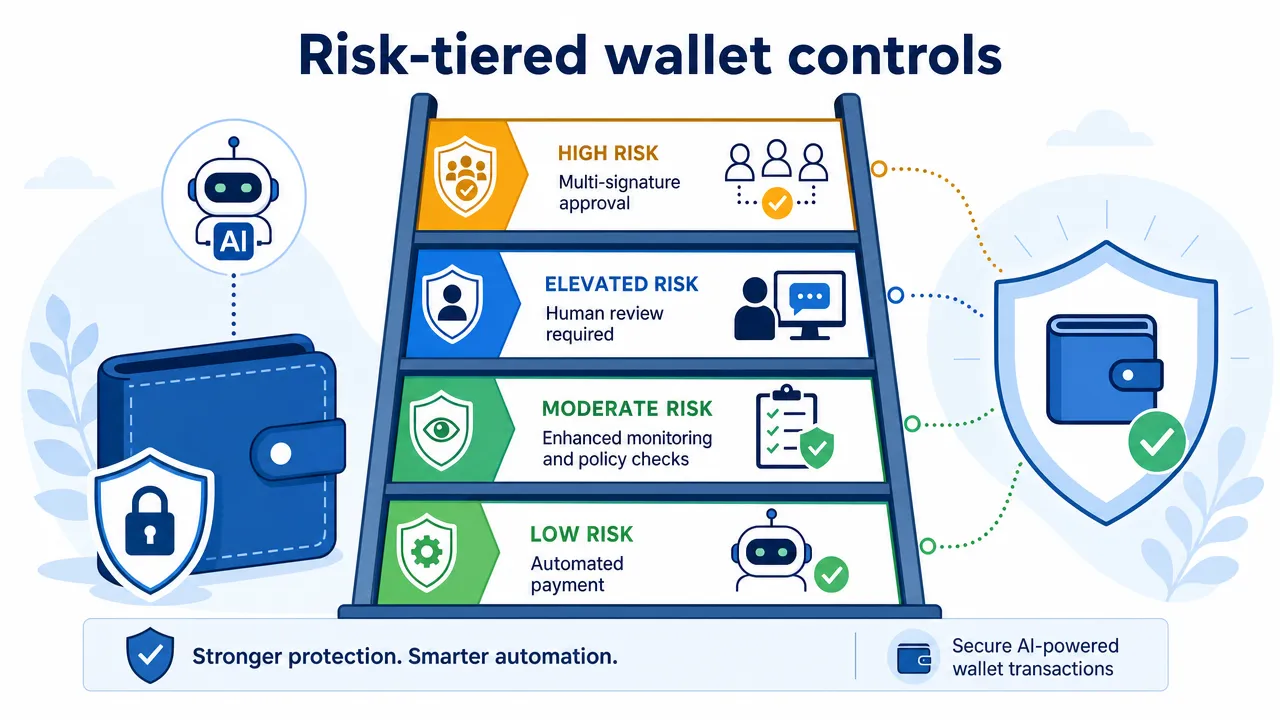
The best automated wallet approval workflow is not one rule for every transaction. It is a tiered system that gives the agent more freedom only when the action is known, bounded, and low impact.
For example, a recurring payment to an allowlisted address under a strict daily limit may justify a narrow delegated permission. A high-value transfer to a new address should not receive the same treatment.
| Risk tier | Example action | Suggested authority | Human involvement |
|---|---|---|---|
| Low | Repetitive transfer to a verified recipient below a preset cap | Restricted, revocable delegated authority | Notification and review of exceptions |
| Medium | Trade within approved assets, amount caps, and defined price conditions | One designated human approval | Review route, amount, fees, and expected outcome |
| High | New recipient, unknown contract, token approval, or cross-chain route | Multi-sig threshold | Mandatory approval by one or more humans |
| Critical | Changing signers, recovery settings, modules, or approval thresholds | Higher threshold plus a delay where appropriate | Multiple independent human approvals and out-of-band confirmation |
The following workflow is a recommendation, not a universal protocol rule:
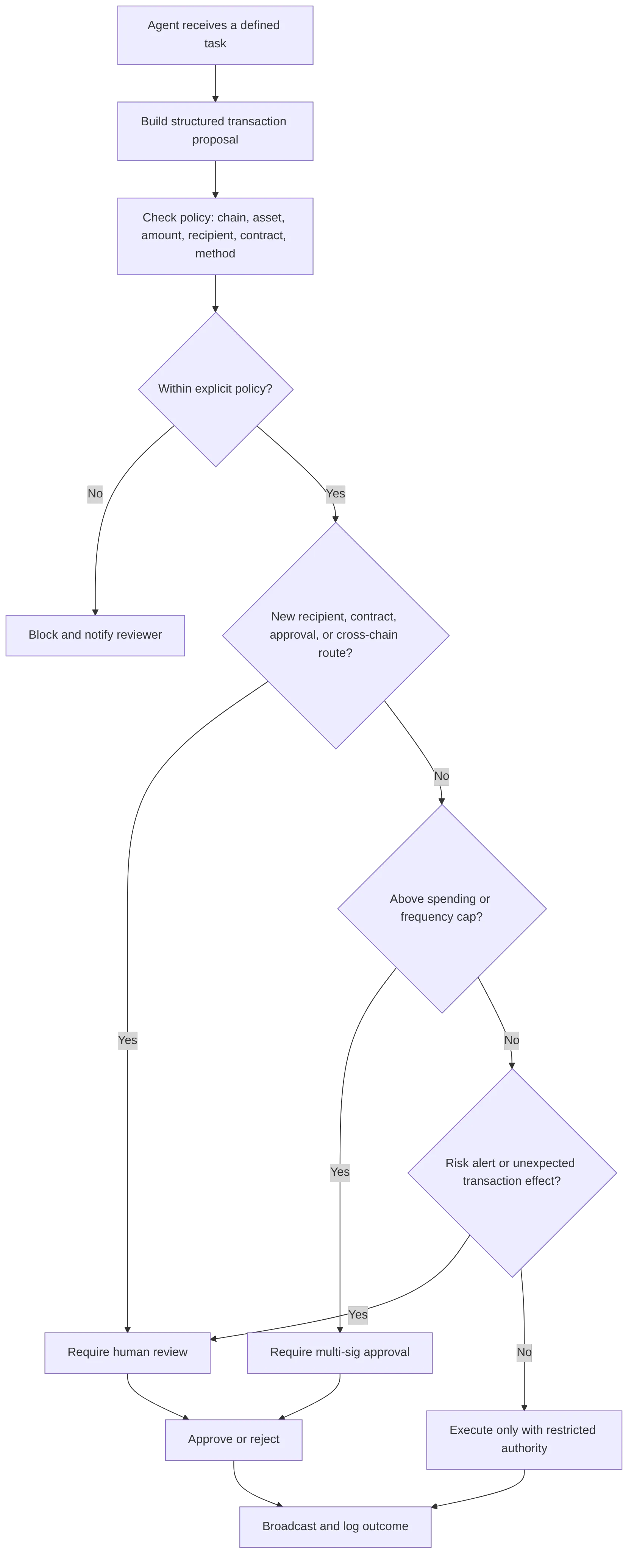
This model protects automation without killing it. The agent can still perform the time-consuming work: gathering inputs, formatting a transaction, applying known rules, and flagging exceptions. Human decision-makers spend their time where they add the most value: evaluating unfamiliar, high-value, or policy-changing actions.
A human-in-the-loop wallet control model should escalate at least the following actions:
- New recipient addresses.
- New DApp or smart-contract interactions.
- Token approvals, especially broad or unlimited allowances.
- Amounts above per-transaction, daily, or asset-specific caps.
- Changes to signer roles, thresholds, permissions, or recovery settings.
- New cross-chain routes or destination assets.
- Actions proposed after the agent processed untrusted external content.
- Transactions with unclear simulation results or unexpected effects.
Cross-chain actions deserve particular scrutiny because they can involve multiple contracts, liquidity conditions, bridges, relayers, wrapped assets, and distinct failure points. Before approving one, users should review the route, expected asset, network, fees, and timing assumptions. FoxWallet's guide to cross-chain swap risks offers useful context on why route review matters.
AI agent wallet security depends on controls beyond multi-sig
Multi-sig is an important safeguard, but it is only one layer. A human signer can still make a poor decision if the request is unclear, misleading, or rushed. Effective AI agent wallet security needs controls before, during, and after the approval event.
Use deterministic policies, not natural-language instructions
A prompt such as "never spend too much" is not a security policy. A real policy should define measurable boundaries:
- Approved chains and assets.
- Maximum value per transaction.
- Daily and weekly spending limits.
- Approved recipient addresses.
- Approved contracts and contract methods.
- Permitted transaction frequency.
- Time limits for delegated authority.
- Required approvers for each risk tier.
The agent should not be able to rewrite these constraints through reasoning or tool calls. MetaMask's discussion of agentic wallet security similarly emphasizes separating agent intent from the systems that authorize and execute financial actions.
Treat token approvals as high-risk actions
A token approval can create future withdrawal authority for a third-party contract. That makes it fundamentally different from a one-time transfer. Exact-amount approvals, where feasible, are generally easier to reason about than unlimited allowances.
Before approval, a reviewer should confirm:
- Which token is being approved.
- Which contract receives the allowance.
- The allowance amount.
- Whether the contract is recognized and expected.
- Whether the approval is necessary for the intended action.
Risk alerts and contract recognition can help users inspect these requests. FoxWallet describes high-risk signature warnings and phishing protection as part of its transaction-safety approach. Such alerts support better review, but they are not a guarantee that a transaction is safe.
Simulate, summarize, and log
A readable approval request should show more than a cryptic contract call. It should identify the recipient, chain, token, amount, gas cost, approval scope, contract address, and expected changes.
Simulation can help reveal likely effects before a signature is produced. However, it cannot guarantee safety. Blockchain state can change, contract behavior can be complex, and market or bridge conditions can shift between review and execution.
Finally, log the full decision trail:
- The agent task and proposal.
- Policy checks and their results.
- Any risk alerts.
- The approver identities.
- The final signed transaction.
- Broadcast and confirmation status.
- Revocation, pause, or emergency events.
Logs do not stop a harmful action, but they improve accountability and help teams investigate anomalies.
Where FoxWallet fits in multi-signature wallets for AI agents today
FoxWallet should be viewed today as a self-custody wallet layer for users who want direct control of their assets while operating across multiple chains. It should not be described as a native AI-agent wallet, a built-in multi-sig wallet, an MPC custody service, an ERC-4337 smart account, or an automated approval policy engine unless future official documentation verifies those capabilities.
That boundary matters. Credible security content should explain what a wallet does today rather than implying features that have not been confirmed.
For users managing Web3 activity manually, FoxWallet provides a non-custodial model in which users retain control of private keys and assets. Its multi-chain asset visibility can help users understand where funds are held before they authorize an action. Its mobile and browser-extension support can also serve users who need consistent access across common Web3 environments.
FoxWallet's security positioning is especially relevant to the human-control principle:
- Local protection of private keys supports the separation between user-controlled credentials and untrusted automation environments. Learn more about locally encrypted private keys.
- Smart-contract recognition, phishing protections, and transaction warnings can help users scrutinize DApp interactions before confirming them.
- A unified view of multi-chain assets can reduce operational confusion when reviewing balances and network context.
- Built-in DApp access can make Web3 interactions more convenient, but users should still independently verify DApps, addresses, and authorization requests.
A prudent operational pattern is to separate core holdings from active DApp and automation capital. Rather than exposing a primary wallet balance to experimental workflows, users can isolate smaller balances for specific activities. This does not eliminate risk, but it limits the potential impact of an error, harmful approval, or compromised environment.
The practical takeaway for multi-signature wallets for AI agents
The goal is not to make an AI agent behave like a human wallet owner. The goal is to let software handle repeatable preparation while keeping meaningful financial authority with people and independently enforced policies.
Multi-signature wallets for AI agents are compelling because they can convert a single point of failure into a deliberate approval process. The agent may identify an opportunity or prepare a payment, but it cannot complete high-risk execution without the people responsible for the assets.
The strongest model is risk-tiered:
- Automate only narrow, pre-approved, low-risk actions.
- Require a human decision when a transaction is new, unusual, high-value, or policy-sensitive.
- Require multiple human approvals for governance changes and critical transfers.
- Keep primary keys out of agent runtimes.
- Treat prompts, webpages, DApps, APIs, and token metadata as potentially untrusted inputs.
- Use alerts, clear transaction summaries, limits, and revocation as complementary controls.
For users who want to retain direct control while managing assets across multiple chains, FoxWallet offers a non-custodial experience with local key protection, multi-chain visibility, DApp access, and risk-aware transaction review. Start with small test amounts when exploring unfamiliar on-chain workflows, and verify every transaction detail before approving it.
FAQs about multi-signature wallets for AI agents
Can an AI agent use a crypto wallet safely?
Potentially, but only with constrained authority. An agent should operate within explicit rules, with independent policy checks and human approval for sensitive actions. No wallet or AI setup can eliminate smart-contract, phishing, market, or operational risk.
What is a multi-sig crypto wallet for an AI agent?
It is a wallet arrangement that requires a threshold of independent approvals before a transaction can execute. The agent can prepare a proposal, but designated human signers remain part of the execution requirement.
Should an AI agent have access to a private key?
As a general security principle, an AI runtime should not directly hold an unrestricted, long-lived primary private key. Restricted, time-bounded, and revocable authority is more defensible for narrowly defined tasks.
What should trigger AI agent transaction oversight?
New recipients, unknown contracts, token approvals, elevated transaction amounts, cross-chain actions, permission changes, and unexpected simulation results should all trigger closer review. These actions introduce risk that is difficult to manage through automation alone.
Can simulation guarantee secure autonomous payments?
No. Simulation can reveal likely transaction effects and make review more informed, but it cannot guarantee a safe outcome. Contract state, liquidity, network conditions, and implementation details can change.
Is MPC the same as multi-sig?
No. MPC uses distributed key shares to jointly produce one signature, while multi-sig generally requires multiple independent approvals under on-chain threshold rules. Both can support distributed authority, but their architecture and operational tradeoffs differ.