


Best DEX Aggregators for Solana in 2026

If you are searching for the best Solana DEX aggregator in 2026, the short answer is: Jupiter is still the clearest overall choice for general Solana swap aggregation, while Raydium, Orca, Meteora, and Lifinity are better understood as key liquidity venues that aggregators may route through.
But that answer is only half the story. A Solana DEX aggregator can help find a better route, but your final swap experience also depends on liquidity depth, slippage tolerance, transaction landing, priority fees, MEV awareness, token safety, and the wallet you use to review and sign the transaction.
That is where FoxWallet fits in. FoxWallet is not positioned as a Solana DEX aggregator. Instead, it is a non-custodial multi-chain wallet that helps users manage assets, access DApps, review on-chain transactions, and stay in control of their private keys while interacting with Solana swap platforms and broader Web3 apps.
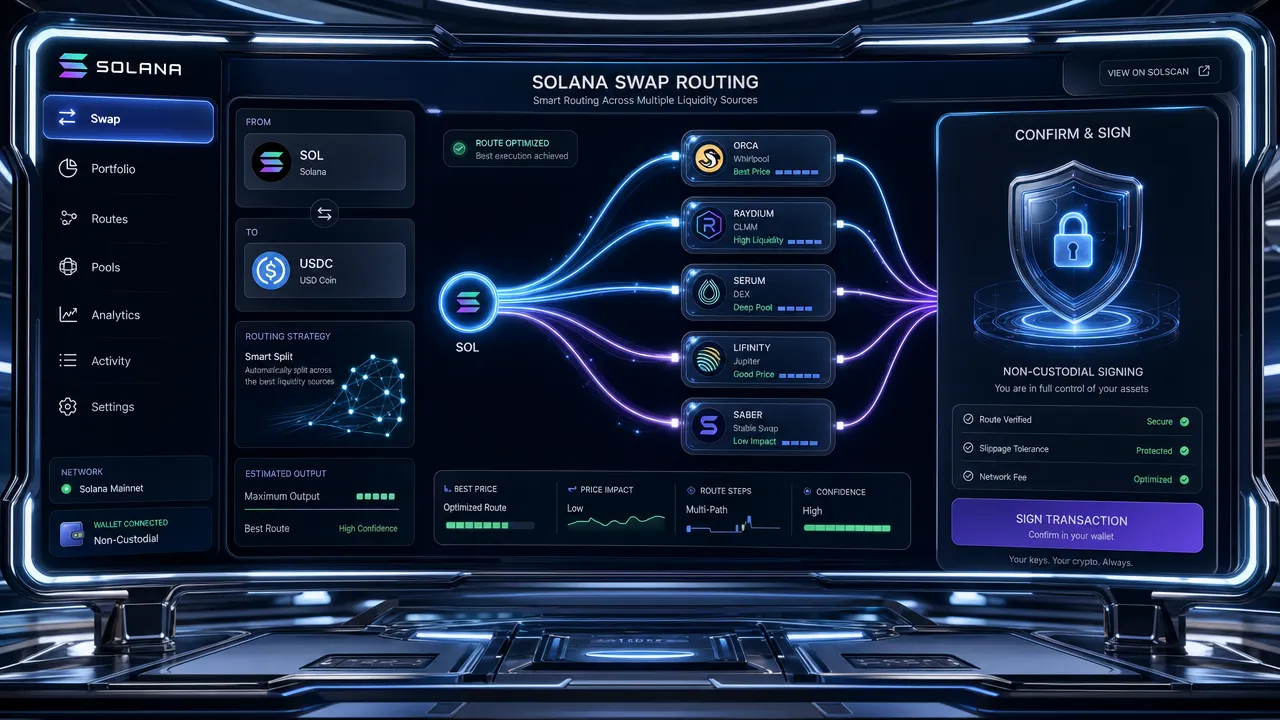
This guide compares the major Solana swap platforms, explains Solana token swap routing, and shows how to think about low slippage Solana swaps without confusing DEXs, aggregators, and wallets.
What the best Solana DEX aggregator does in 2026
A Solana DEX aggregator is a routing layer that searches across multiple Solana liquidity sources to help users find a competitive token swap path. Instead of checking individual DEXs one by one, the aggregator compares pools, routes, and possible split paths.
In 2026, the Solana swap market is less about one single DEX and more about fragmented liquidity. Liquidity can sit across AMMs, concentrated liquidity pools, dynamic liquidity pools, proactive market makers, RFQ-style sources, stablecoin venues, and other routing systems. The best Solana DEX aggregator is the tool that can search that fragmented market efficiently and return a usable route.
A typical swap aggregator on Solana works like this:
- You choose the input token, output token, and amount.
- The aggregator checks available liquidity sources.
- It compares direct routes, multi-hop routes, and split routes.
- It returns a quote with expected output, minimum received, price impact, and fees where available.
- You review the transaction in your wallet.
- You sign only if the route, token, network, and risk details look correct.
The key point: a DEX aggregator is not the same as a wallet. The aggregator finds or builds the swap route. The wallet is where you control keys, connect to DApps, review transaction details, and approve or reject the transaction.
| Layer | What it does | Examples in the Solana ecosystem | User concern |
|---|---|---|---|
| Aggregator | Searches liquidity sources and builds routes | Jupiter | Best quote, route quality, slippage, fees |
| DEX or liquidity venue | Provides pools or liquidity for execution | Raydium, Orca, Meteora, Lifinity | Pool depth, price impact, token risk |
| Wallet | Stores keys locally and signs transactions | FoxWallet | Self-custody, transaction review, DApp safety |
| Network layer | Confirms transactions and charges fees | Solana | Priority fees, compute budget, congestion |
For current market monitoring, users can review Solana DEX activity on public analytics dashboards such as DeFiLlama's Solana DEX dashboard. Keep in mind that volume, TVL, and market share change constantly, so live data should always be checked before making time-sensitive decisions.
Best Solana DEX aggregator shortlist: Jupiter, Raydium, Orca, Meteora, and Lifinity
The most useful way to compare Solana swap platforms is to separate true aggregation from liquidity provision. Many users search for "DEX aggregator Solana 2026" and expect every major swap platform to be an aggregator. In practice, only some platforms are aggregators, while others are liquidity venues that aggregators route into.
1. Jupiter: Best overall Solana DEX aggregator
Jupiter is the clearest answer for most users looking for the best decentralized exchange aggregator Solana has to offer. Its role in the ecosystem is routing and liquidity aggregation. It searches across supported Solana liquidity sources and helps users discover routes that may be better than using a single DEX directly.
Why Jupiter stands out:
- Strong Solana aggregator recognition.
- Broad routing infrastructure.
- Developer-facing APIs and routing tools.
- Support for complex route construction.
- Large ecosystem mindshare.
Jupiter is best for users who want a general-purpose Solana DEX aggregator rather than a single liquidity venue. However, users should still check the route, minimum received, fees, slippage tolerance, and wallet signing details. Aggregation can improve route discovery, but it does not guarantee the lowest possible slippage in every market condition.
2. Raydium: Major Solana liquidity venue, not a general aggregator
Raydium is one of Solana's most important DEX and liquidity platforms. It supports different pool types and liquidity programs, including AMM, CPMM, and CLMM-style infrastructure.
Raydium matters because aggregators may route through Raydium pools when those pools provide strong liquidity. For deep trading pairs, Raydium can be highly relevant to low slippage Solana swaps. But it should not be described as the same type of product as a general-purpose Solana DEX aggregator.
Best fit:
- Direct DEX users.
- Liquidity providers.
- Projects launching or managing liquidity.
- Swappers who know they want access to Raydium-specific pools.
3. Orca: User-friendly concentrated liquidity DEX
Orca is known for a clean DEX experience and its Whirlpools concentrated liquidity model. Concentrated liquidity can improve capital efficiency by allowing liquidity providers to place funds within specific price ranges.
For swappers, Orca can be a strong execution venue when active pools have deep liquidity around the current market price. For aggregators, Orca is valuable because its pools may become part of an optimized route.
Best fit:
- Users who prefer a simple DEX interface.
- Swappers using liquid Orca pairs.
- Liquidity providers comfortable with concentrated liquidity.
4. Meteora: Dynamic liquidity infrastructure
Meteora is important in Solana DeFi because of its dynamic liquidity models, including DLMM-style liquidity and volatility-aware fee mechanics. These designs can matter for routed execution, especially when market conditions change quickly.
Meteora is not best described as a generic swap aggregator on Solana. It is better understood as a liquidity protocol that can become an important part of aggregated routes.
Best fit:
- Advanced liquidity providers.
- Users exploring dynamic liquidity markets.
- Swaps that route efficiently through Meteora pools.
5. Lifinity: Specialized proactive market maker
Lifinity uses a proactive market maker model designed around capital efficiency. It is a more specialized liquidity venue and can be relevant when its liquidity provides a competitive route.
For the search query "best Solana DEX aggregator," Lifinity is not the primary answer. Its importance is in the liquidity layer, not as a broad aggregator.
Best fit:
- Advanced DeFi users comparing liquidity models.
- Swaps where Lifinity provides useful routed liquidity.
- Users interested in PMM-style market design.
| Platform | Category | Aggregator role | Liquidity role | Best use case |
|---|---|---|---|---|
| Jupiter | Aggregator | High | Routes to external liquidity | Best general Solana swap routing |
| Raydium | DEX and liquidity platform | Low | High | Direct DEX swaps and liquidity |
| Orca | Concentrated liquidity DEX | Low | High | User-friendly swaps and CLMM liquidity |
| Meteora | Dynamic liquidity protocol | Low | High | Advanced liquidity and routed execution |
| Lifinity | Proactive market maker | Low | Specialized | PMM-based liquidity exposure |
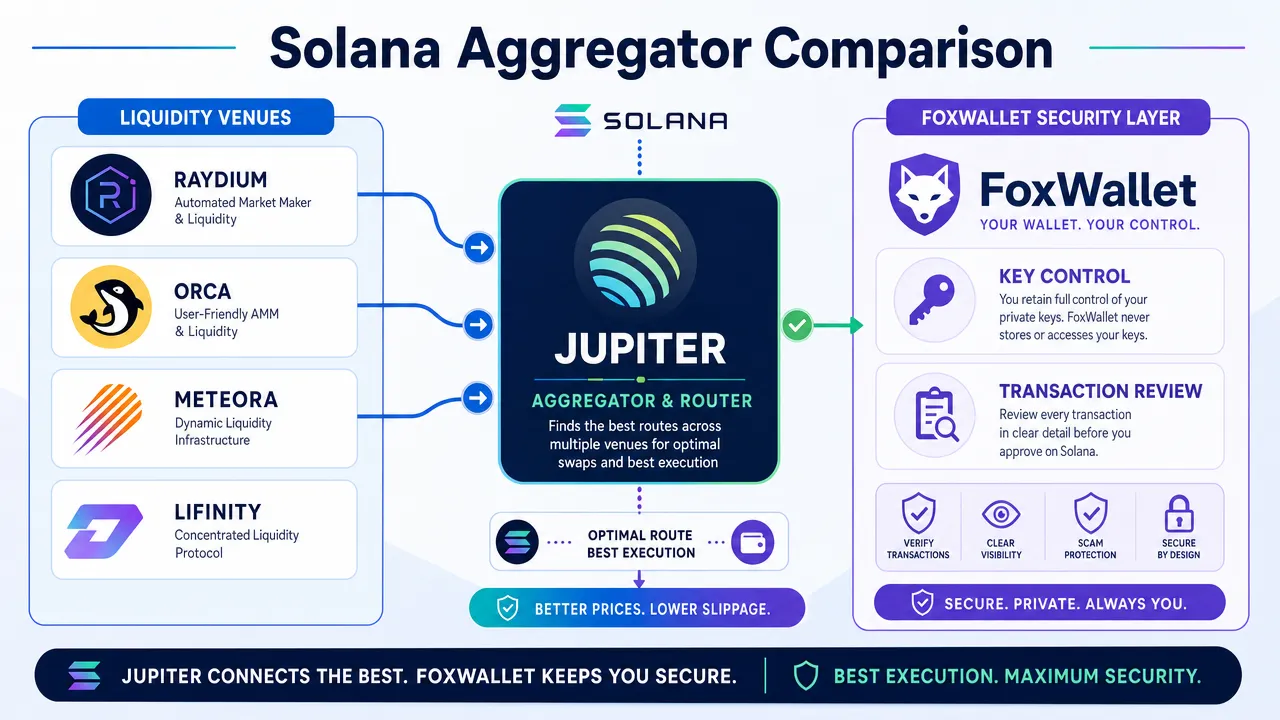
The practical takeaway is simple: Jupiter is the leading Solana DEX aggregator for most general users, while Raydium, Orca, Meteora, and Lifinity are essential because they provide liquidity that a router may use.
How the best Solana DEX aggregator reduces slippage with Solana token swap routing
Solana token swap routing is the process of finding the best available path between the token you have and the token you want. The route may be direct, multi-hop, or split across multiple venues.
For example, a SOL-to-USDC swap might be routed through one deep pool if that pool has enough liquidity. A larger or more difficult trade might be split across multiple pools to reduce price impact. A thinly traded token might require several hops, which can introduce more complexity and risk.
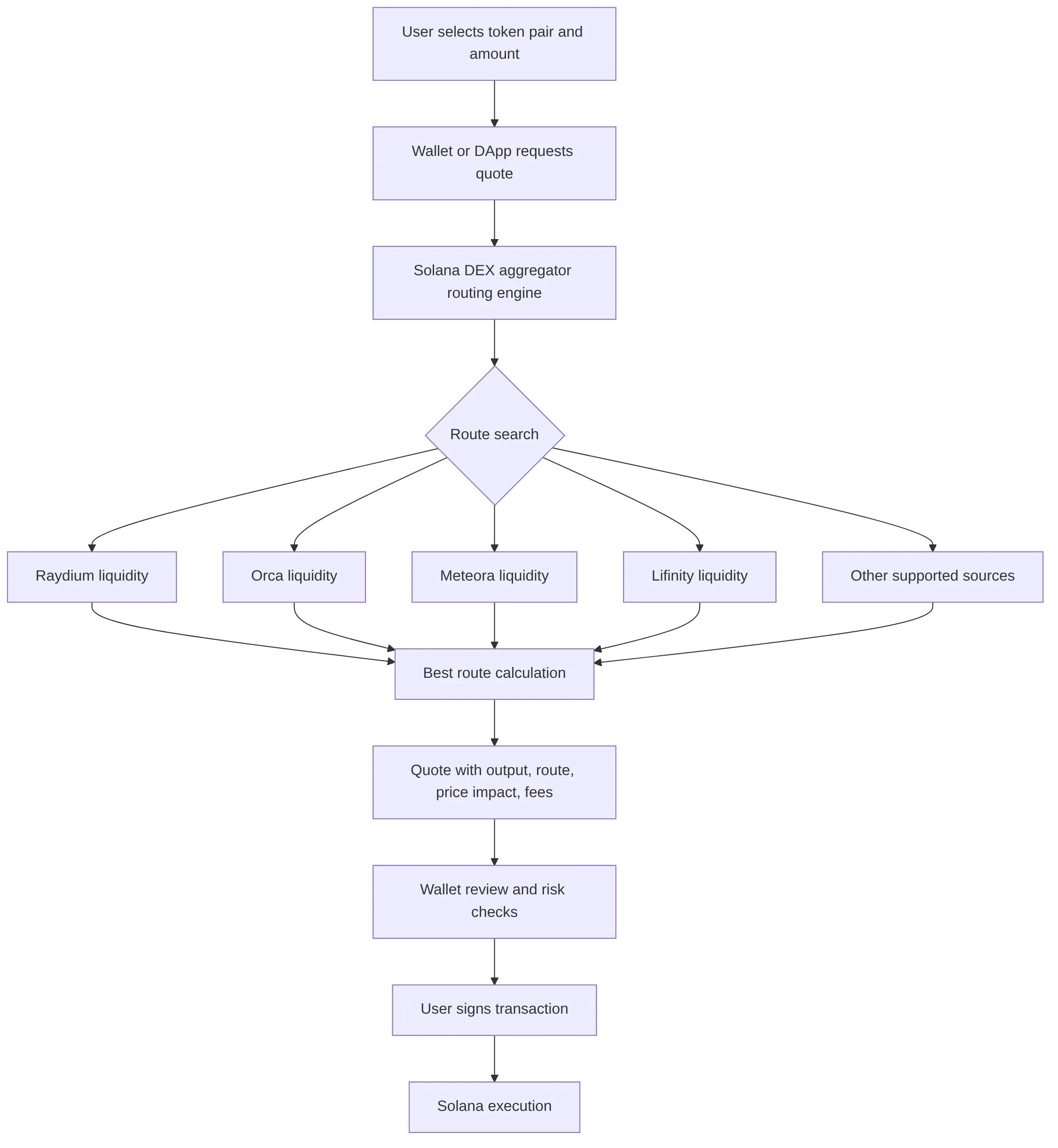
A strong Solana DEX aggregator can help reduce slippage by:
- Searching multiple liquidity venues.
- Splitting orders across pools.
- Using multi-hop routes when direct routes are inefficient.
- Comparing concentrated, dynamic, and standard liquidity pools.
- Returning a minimum received value so users understand downside risk.
- Optimizing the transaction path when possible.
However, low slippage Solana swaps are never guaranteed. Slippage can still increase because of:
- Low liquidity.
- Large trade size.
- Fast-moving markets.
- Stale quotes.
- Network congestion.
- Complex routes.
- MEV-related transaction ordering.
- Slippage settings that are too wide or too tight.
Solana transaction fees and execution mechanics also matter. According to Solana's official documentation on transaction fees, users may encounter base fees and priority fees. Solana's compute budget documentation also explains why compute units matter for transaction execution. Complex swap routes may need careful transaction construction so they land reliably.
For users, the goal is not only to find the best quote. It is to find a route that is realistic, transparent, and safe enough to sign.
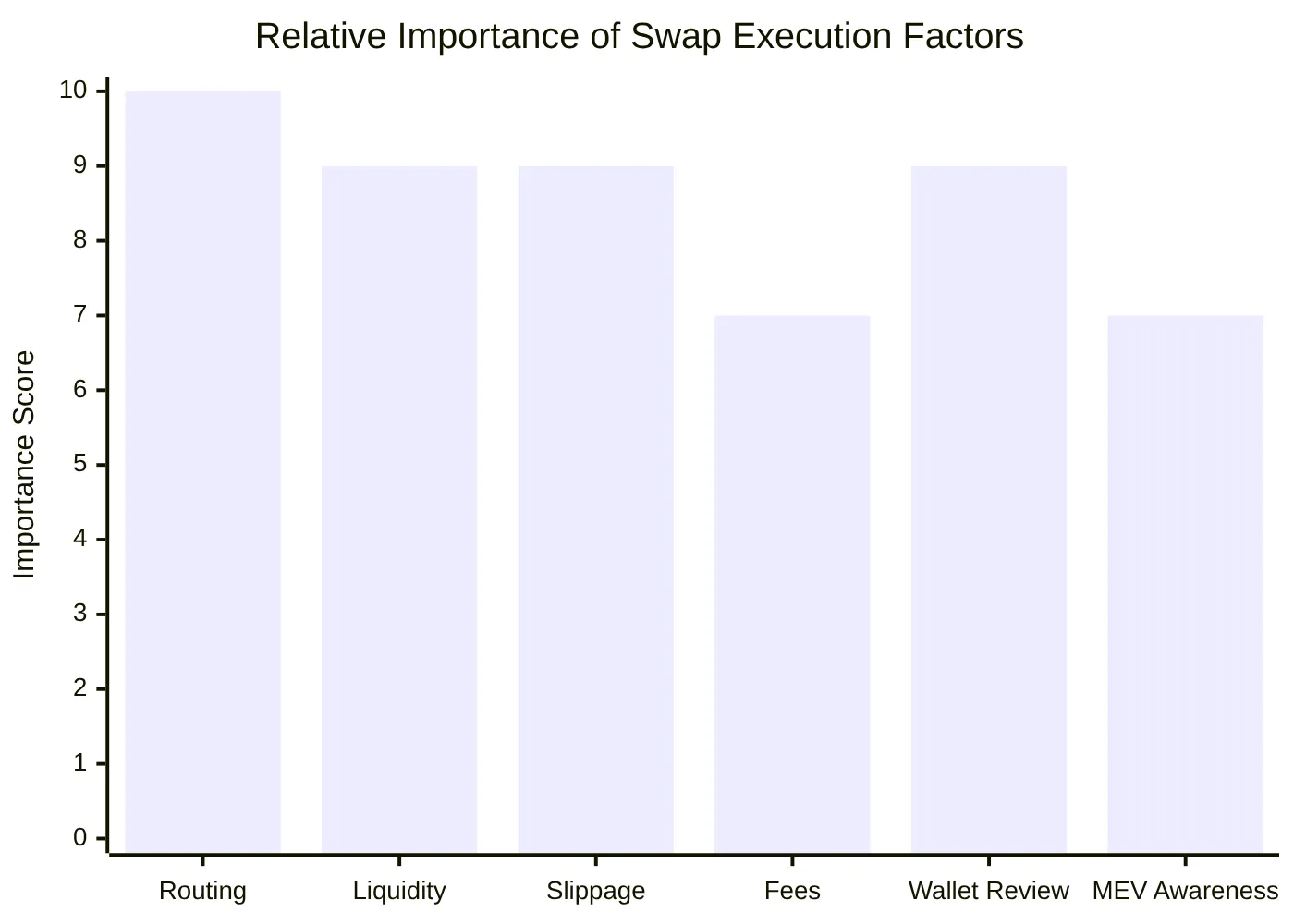
This chart is an editorial scoring model, not live market data. It shows why the best Solana DEX aggregator discussion should include both backend routing and user-facing wallet safety.
Best Solana DEX aggregator fees, reliability, and safety checklist
When comparing a DEX aggregator Solana 2026 users can rely on, do not look only at the displayed output amount. The real cost of a swap can include DEX fees, aggregator fees, spreads, priority fees, failed transaction costs, and hidden execution friction.
Fees to watch
The most important fee and cost categories include:
| Cost type | What it means | Why it matters |
|---|---|---|
| DEX pool fee | Fee charged by the liquidity pool | Varies by venue and pool type |
| Aggregator fee | Fee charged by the aggregator or route product | May depend on product path |
| Priority fee | Extra fee to improve transaction landing | Important during congestion |
| Price impact | Market movement caused by your trade size | Can be larger than visible fees |
| Failed transaction cost | Fees paid even if execution fails | Adds up for active users |
| Spread or route inefficiency | Difference between ideal and actual execution | Can appear in thin markets |
Solana's official priority fee guide is useful for understanding why transaction landing can become part of swap quality. A better quote is not very helpful if the transaction repeatedly fails, expires, or executes under worse conditions than expected.
Reliability checklist
Before signing a Solana swap, review:
- Is the token address correct?
- Is the DApp domain legitimate?
- Is the network set to Solana?
- Is the expected output reasonable?
- Is the minimum received acceptable?
- Is the price impact unusually high?
- Is slippage tolerance too wide?
- Is the route understandable?
- Are fees visible or explainable?
- Does the wallet show any risk warning?
MEV and transaction ordering
MEV awareness is increasingly relevant for Solana swaps, especially for large, volatile, or high-slippage trades. Solana's developer materials discuss MEV protection concepts, including mechanisms designed to reduce certain transaction ordering risks.
Users should be careful with absolute claims. No aggregator or wallet can eliminate every execution risk. A safer framing is that MEV-aware routing, reasonable slippage settings, priority fee logic, and cautious wallet review can help reduce certain risks.
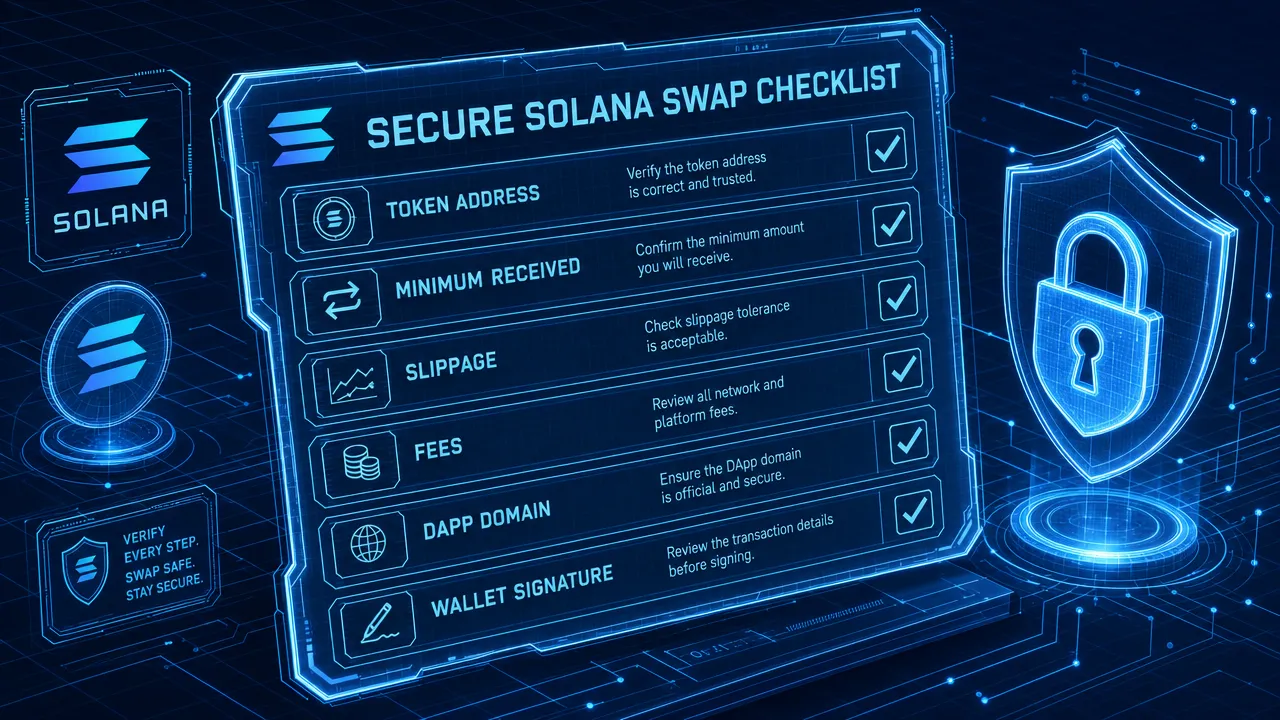
A security-first mindset is especially important because Solana swaps are non-custodial. You are not asking a centralized platform to execute on your behalf. You are signing an on-chain transaction from your own wallet.
Why FoxWallet matters when using the best Solana DEX aggregator
The aggregator helps you find a route. The liquidity venues execute the swap. But the wallet is where you make the final decision.
FoxWallet is a non-custodial multi-chain wallet built for users who want self-custody, asset visibility, DApp access, and secure transaction review. FoxWallet does not hold user funds and does not access private keys. Users remain in control of their assets.
This matters for Solana swaps because the signing screen is the last checkpoint before execution. A strong wallet workflow helps users slow down, review details, and avoid blind approvals.
FoxWallet's relevance to Solana swap workflows includes:
- Non-custodial self-custody.
- Locally encrypted storage of mnemonic phrases and private keys.
- Multi-chain asset management from a unified wallet experience.
- Built-in DApp browser for accessing Web3 applications.
- Integrated swap support across supported workflows.
- Pre-transaction risk alerts and smart contract recognition.
- Protection-focused design against malicious contracts and phishing links.
- Mobile support for iOS and Android, plus browser extension support for desktop Web3 use cases.
For users managing assets across multiple networks, FoxWallet's broader asset-management approach can reduce operational friction. You can learn more in FoxWallet's guide to secure and fast multi-chain management and its overview of mastering Web3 assets with FoxWallet.
For users focused on safety, FoxWallet's security-first design is especially relevant. The article on wallet security features for keeping crypto safe in 2026 covers practical wallet protections, while the guide to a secure non-custodial BTC wallet explains self-custody principles that also apply broadly to Web3 wallet usage.
If you often swap from a mobile device, the FoxWallet guide to fast and secure mobile swaps is also useful for understanding how wallet UX, transaction review, and safety checks affect the swap experience.
Important distinction: FoxWallet should not be described as the best Solana DEX aggregator. A more accurate statement is that FoxWallet helps users access DApps, manage multi-chain assets, and sign transactions through a non-custodial, security-first wallet experience.
Practical workflow for safer Solana swaps with FoxWallet
- Open the Solana swap DApp or aggregator you intend to use.
- Confirm you are on the legitimate domain.
- Connect your wallet only if the site appears trustworthy.
- Enter the token pair and amount.
- Review the route, expected output, minimum received, price impact, and fees.
- Check token addresses carefully.
- Review the wallet transaction prompt.
- Sign only if the details match your intent.
- Monitor confirmation and updated balances.
- Disconnect from DApps you no longer use.
This approach does not remove all risk, but it helps align the aggregator's routing power with wallet-level self-custody and user control.
Best Solana DEX aggregator FAQ
What is the best Solana DEX aggregator in 2026?
For most general users, Jupiter is the clearest overall answer because it is widely recognized as Solana's leading routing and liquidity aggregation layer. However, the best route for any specific swap depends on liquidity, token pair, trade size, slippage, fees, and transaction conditions.
Is Raydium a Solana DEX aggregator?
Raydium is better described as a Solana DEX and liquidity platform, not a general-purpose Solana DEX aggregator. It is still important because aggregators may route through Raydium pools when they offer strong liquidity.
Is Orca better than Jupiter for swaps?
They serve different roles. Jupiter is an aggregator that searches across liquidity sources. Orca is a DEX and concentrated liquidity venue. Orca can be excellent for direct swaps in liquid pools, while Jupiter may find better routes by comparing multiple venues.
What is Solana token swap routing?
Solana token swap routing is the process of finding the path between your input token and output token. A route can be direct, multi-hop, or split across multiple liquidity venues. Better routing can help reduce price impact and improve execution quality.
How do I get low slippage Solana swaps?
Use liquid pairs, compare aggregator quotes, avoid oversized trades in thin markets, check minimum received, keep slippage tolerance reasonable, and review transaction details before signing. Low slippage is easier for deep markets and harder for volatile or low-liquidity tokens.
Why do Solana swaps fail?
Swaps can fail because of stale quotes, insufficient slippage tolerance, network congestion, compute limits, route complexity, token account issues, or changing liquidity conditions. Priority fees and compute settings can also affect transaction landing.
Are Solana DEX aggregators safe?
Solana DEX aggregators can be useful, but users still face risks from malicious tokens, phishing sites, bad routes, high slippage, and transaction-signing mistakes. Always use legitimate DApps, check token addresses, and review wallet prompts carefully.
What wallet should I use for Solana DEX aggregators?
Use a non-custodial wallet that helps you control your keys, access DApps, review transaction details, and manage assets securely. FoxWallet is designed as a multi-chain, non-custodial wallet with DApp access, integrated swap support, local key encryption, and risk-aware transaction review.
Do aggregators charge fees?
Some aggregator products may charge fees, and swaps can also include DEX pool fees, priority fees, spreads, and failed transaction costs. Always review the quote and fee information before signing.
What is the final shortlist for the best Solana DEX aggregator?
A practical 2026 shortlist is:
- Jupiter: best overall Solana DEX aggregator for general routing.
- Raydium: major Solana liquidity venue.
- Orca: user-friendly concentrated liquidity DEX.
- Meteora: dynamic liquidity protocol.
- Lifinity: specialized proactive market maker.
The best result comes from understanding the full stack: aggregator routing, liquidity venue depth, Solana execution mechanics, and wallet-level safety. FoxWallet helps users approach that workflow with self-custody, DApp access, multi-chain asset management, and a security-first signing experience.