


How to Move Crypto Between Chains Without Paying Excessive Fees in 2026

How to Move Crypto Between Chains Without Paying Excessive Fees in 2026
A cross-chain transfer moves crypto value from one blockchain network to another. To move crypto between chains without excessive fees, compare the total amount received, not only the bridge fee shown on the first screen.
Crypto bridge fees can include source-chain gas, destination-chain gas, approval gas, bridge protocol fees, relayer fees, solver fees, liquidity provider fees, slippage, price impact, and failed transaction costs. By 2026, intent-based and solver-driven routes have become common, which moves more of the cost into the quoted rate rather than a visible line-item fee. Ethereum explains that gas pays for computation and transaction inclusion, and fee levels change with network demand. See the official Ethereum gas documentation for the base rule.
FoxWallet is a non-custodial, multi-chain wallet. Users keep control of private keys and assets. FoxWallet supports multi-chain asset management, built-in cross-chain swaps, local key encryption, risk alerts, smart contract recognition, and mobile plus browser extension access. For product context, see FoxWallet and its guide to secure multi-chain wallet management.
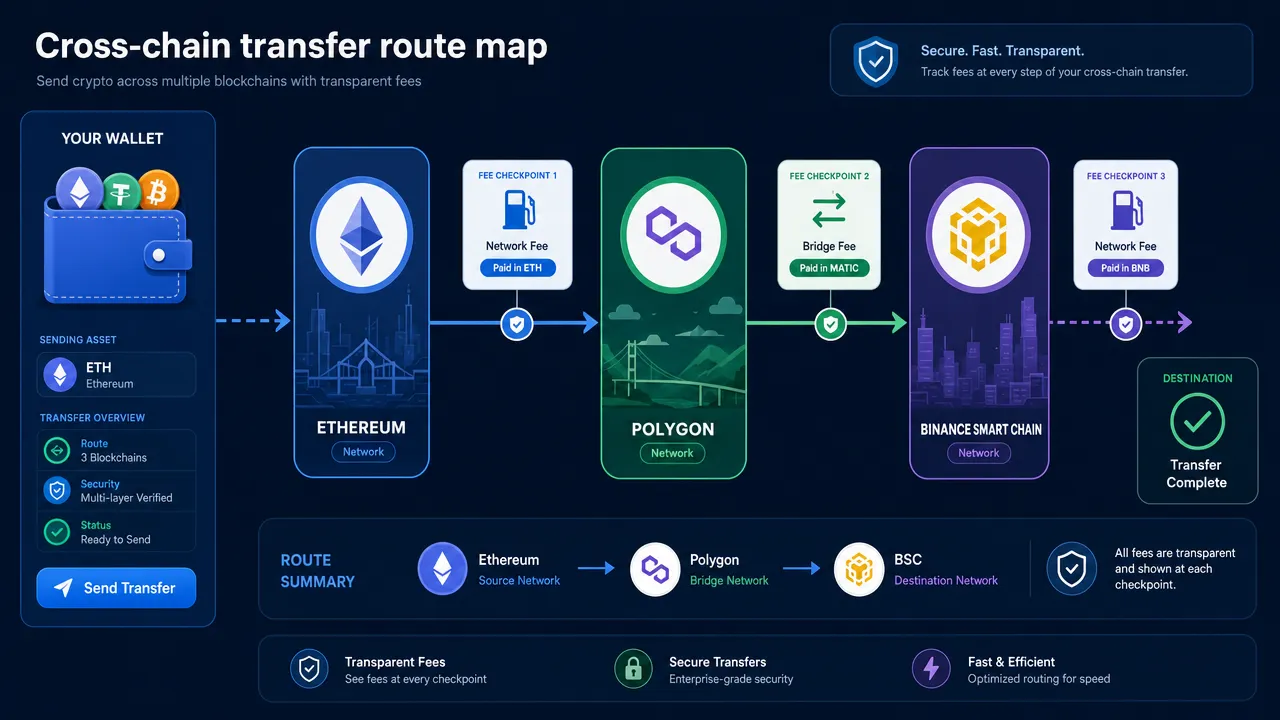
Quick rule to move crypto between chains with lower fees
Use this checklist before every cross-chain crypto transfer:
- Compare the total amount received across routes.
- Check source-chain gas and destination-chain gas.
- Review bridge, relayer, solver, or liquidity fees.
- Review slippage and price impact.
- Avoid unnecessary swaps or extra bridge hops.
- Verify the destination token type and check contract approvals before signing.
- Use a small test transfer for unfamiliar routes.
- Stop if the wallet shows a contract, phishing, or approval warning.
The cheapest way to bridge crypto is route-specific. It depends on the asset, chain pair, transfer amount, liquidity depth, congestion, and execution model. A low visible bridge fee can still produce a poor final result if gas, slippage, relayer cost, or solver spread is high. Use a low-fee route only when it is also acceptable for security, liquidity, and destination usability.
For deeper operational context on route design, see FoxWallet's article on how wallet infrastructure handles cross-chain swaps.
What it means to move crypto between chains
To move crypto between chains is to transfer value from one blockchain ledger to another. The source and destination chains do not share the same ledger, so the transfer needs a bridge, cross-chain swap, liquidity network, solver system, or routing layer.
Chainalysis describes cross-chain bridges as systems that allow blockchains to share data and assets through messaging between chains. See the Chainalysis bridge explainer for a general security and architecture overview.
A cross-chain crypto transfer can deliver the same asset, a wrapped version of the asset, or a different output token. Confirm this before signing.
| Term | Operational meaning | Fee relevance |
|---|---|---|
| Cross-chain crypto transfer | Value moves from one chain to another | May require multiple on-chain actions |
| Crypto bridge | Protocol moves or represents assets across chains | May include bridge and relayer fees |
| Cross-chain swap | Input token starts on one chain, output token arrives on another | May include swap fees and slippage |
| Bridge aggregator | Routing system compares bridge paths | Can reduce cost but adds routing complexity |
| Gas fee | Network fee paid for execution | Changes with congestion |
| Slippage | Difference between expected and actual output | Higher on thin or volatile routes |
| Price impact | Output change caused by trade size relative to liquidity | Higher for large trades or shallow pools |
| Relayer or solver fee | Payment for destination execution or order filling | Often embedded in the quote |
| Destination gas | Native token needed on the receiving chain | Required for claiming, swapping, or later use |
Common route types, with examples
Most cross-chain transfers run through one of four route types. Each has a different cost and risk profile.
- Native or canonical bridges. Official bridges operated by a chain or rollup. Often the most trust-minimized option, but can be slower and may route through mainnet gas.
- Liquidity-network bridges. Routes that fill from pooled liquidity, such as Stargate, Across, or Hop. Usually fast, with cost depending on pool depth.
- Bridge aggregators. Routing layers that compare many bridges and swaps in one quote, such as LI.FI (Jumper), Socket (Bungee), or deBridge. They can find cheaper paths but add routing complexity.
- Wallet-native cross-chain swaps. A wallet that surfaces routes inside one interface, so you do not juggle separate sites. FoxWallet's built-in cross-chain swap works this way. Verify each transaction regardless of where the route comes from.
Source-chain gas applies when you approve a token or start the transfer. Destination-chain gas applies when the route needs a claim, mint, release, swap, or later transaction. Some routes abstract destination gas, but the cost still exists — it is usually included in the quoted rate, solver spread, or relayer fee. A "gasless" transfer is not free; it usually means you do not pay gas directly at the transaction prompt.
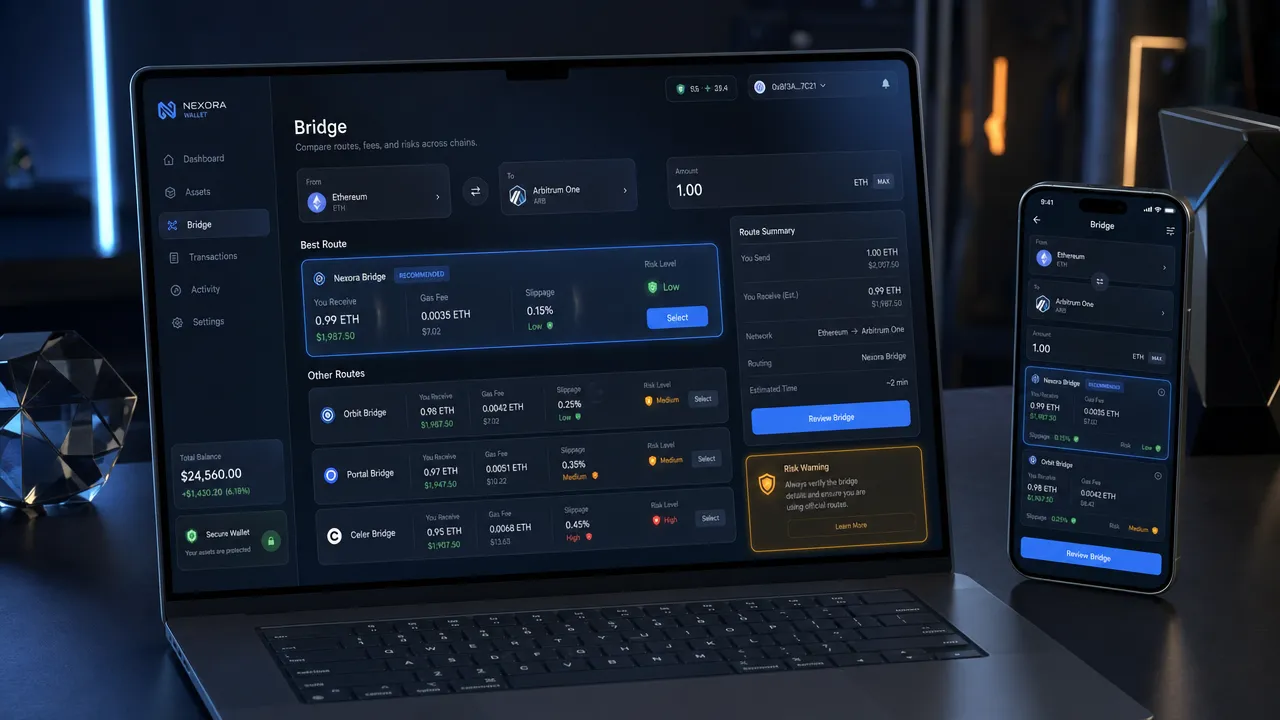
Cost checklist before you move crypto between chains
Work through these checks in order before you transfer crypto across blockchains.
Check the total received amount
Compare the final destination amount across routes and use it as the main cost metric. Do not compare only the advertised bridge fee — cross-chain costs hide in gas, slippage, liquidity fees, relayer fees, or execution spread.
Check source-chain and destination-chain gas
Check the gas fee on the chain where the transfer starts; demand for blockspace affects cost, as the Ethereum gas documentation explains. If the source chain is expensive, avoid repeated approvals and repeated small transfers.
Then confirm whether the route requires a claim, mint, release, or swap on the destination chain, and that you will have enough native gas there after arrival. If you receive a token but have no native gas, you may not be able to move or swap it. Layer 2 networks can add execution and data costs — see the Optimism fee documentation and Arbitrum gas documentation for examples.
Check approval cost and allowance
Many ERC-20-style tokens require approval before a bridge or swap contract can move them, and approval can cost gas even before the bridge transaction. Ethereum's ERC-20 documentation explains the allowance model. Use exact or limited approvals when practical, and avoid broad approvals for unfamiliar contracts.
Check slippage and price impact
Slippage is the difference between expected and actual output. Price impact is the effect of your trade size on the execution price. Uniswap's support pages explain slippage in DEX execution. Use liquid assets and a controlled tolerance, and avoid illiquid token routes unless the final received amount is acceptable.
Check failed transaction exposure
A failed transaction can still consume gas. Failures come from gas changes, slippage limits, insufficient liquidity, wrong network selection, or contract restrictions. Do not retry the same transaction repeatedly without identifying the cause.
| Cost component | When it appears | How to reduce it |
|---|---|---|
| Source-chain gas | Approval and bridge initiation | Avoid congested times and repeated small actions |
| Destination-chain gas | Claim, release, mint, swap, or later use | Keep native gas on the destination chain |
| Approval gas | First token authorization or changed allowance | Avoid repeated approvals when safe |
| Bridge protocol fee | Bridge execution | Compare routes |
| Relayer or solver fee | Fast or intent-style execution | Compare final received amount |
| Liquidity provider fee | Liquidity-network routes | Use deep-liquidity routes |
| Slippage | Swap or cross-chain swap execution | Use liquid assets and controlled tolerance |
| Price impact | Large transfer relative to pool depth | Split carefully or choose deeper routes |
| Failed transaction cost | Reverted or unsuccessful action | Verify route, gas, liquidity, and token support |
A worked example
The figures below are illustrative only, not live quotes — gas changes constantly with network demand. The point is the relationship between the costs, not the exact numbers.
Say you want to move 1,000 USDC from Ethereum mainnet to an L2 such as Base.
- A route advertises a 0.05% bridge fee — that is $0.50 on $1,000, which looks negligible.
- But starting on Ethereum mainnet, the approval plus bridge gas might run anywhere from a few dollars to $15 or more during busy periods.
- On arrival, you hold USDC on Base but little or no native gas, so you may need a small additional transfer to do anything with it.
In this case the $0.50 "fee" is the smallest cost in the transfer. The mainnet gas dominates. A route that starts from funds already on an L2 — where source gas is often cents — can deliver more USDC at the destination even if its headline bridge fee is higher. This is why total received is the only metric that matters.
| Route type | Cost complexity | Notes |
|---|---|---|
| Native / canonical bridge | Medium | Trust-minimized; may route through mainnet gas |
| Liquidity-network bridge | Medium | Cost depends on pool depth |
| Aggregator route | Higher | Compares many paths; adds routing complexity |
| Solver / intent route | Higher | Cost embedded in the quote, not shown as a fee |
For stablecoin-specific multi-chain handling, see FoxWallet's guide to a multi-chain stablecoin wallet.
Operating steps to move crypto between chains
Follow these steps for a standard cross-chain transfer. Do not skip route review.
Step 1: Confirm the exact destination asset
Identify the token you need on the destination chain, and confirm whether it will be native or wrapped. Wrapped assets can have different liquidity, contract addresses, and support conditions.
Step 2: Select the source and destination chains
Check that both chains are supported by your wallet and the route. Confirm the source chain contains the token you want to move, and that the destination chain is where you actually need to use the asset.
Step 3: Compare available routes
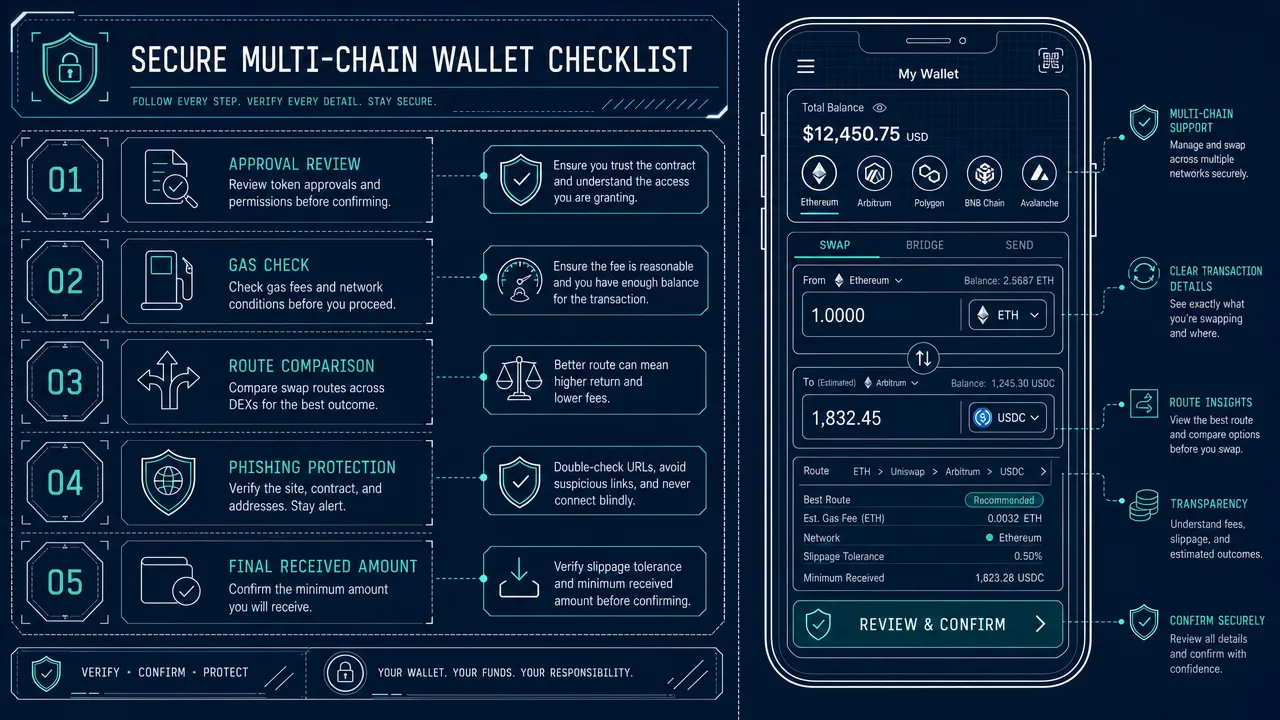
Compare at least two routes when possible, using these fields: final amount received, estimated source and destination gas, approval requirement, estimated completion time, slippage tolerance, destination token contract, route or bridge contract, and wallet risk-warning status. FoxWallet's built-in cross-chain swaps and multi-chain asset view reduce the need to switch between disconnected tools during this step, but they do not remove the need to verify every transaction.
Step 4: Review the approval transaction
If approval is required, review the spender contract and the allowance amount. Use a limited approval when practical, and do not approve a contract the wallet flags as suspicious.
Step 5: Review the bridge or swap transaction
Check the source chain, destination chain, token, amount, and minimum received. Re-check estimated fees before signing, since gas and route conditions change. Do not sign if the output token or destination chain differs from your intent.
Step 6: Send a test transfer when needed
Send a small test transfer if the route is unfamiliar, the token is new to you, or the amount is large. Wait for arrival, confirm the token contract and usability on the destination chain, and only then send the remainder.
Step 7: Confirm arrival and destination usability
After the transfer completes, check the destination balance, confirm you have native gas there, and confirm the token can be used in the intended DApp, wallet function, or transfer workflow.
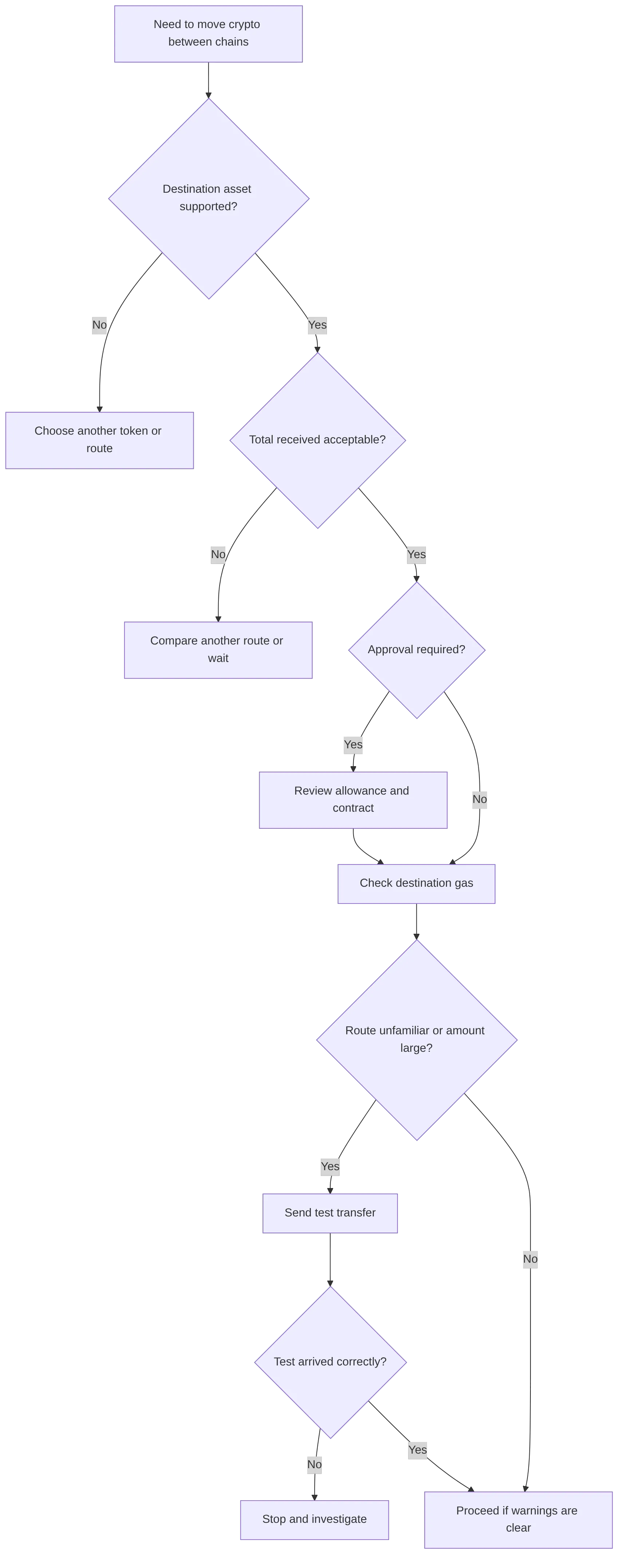
Use this decision tree before execution.
Security checks when you move crypto between chains
Cross-chain transfers use contracts, liquidity systems, relayers, solvers, or routing layers. Each layer adds execution and security risk. Chainlink's education hub explains common cross-chain bridge vulnerabilities, including smart contract, validator, and verification risks.
| Risk | Required check | Stop condition |
|---|---|---|
| Phishing site | Access the bridge or wallet from a verified source | URL is suspicious or copied from an ad |
| Malicious contract | Review wallet warnings and contract identity | Contract is flagged or unknown |
| Excessive approval | Check spender and allowance | Approval is broad and unnecessary |
| Wrong destination chain | Confirm chain name and network ID | Destination does not match intended use |
| Wrapped asset confusion | Check token contract and symbol | Asset type is not acceptable |
| Thin liquidity | Review slippage and minimum received | Output is unstable or too low |
| Failed execution | Check gas, route status, and slippage | Prior attempt failed for unknown reason |
| No destination gas | Confirm native gas availability | Asset would arrive but be unusable |
Do not enter a seed phrase into any bridge website — a legitimate bridge or DApp never needs your mnemonic phrase. Do not approve token spending from a link sent by direct message, search ad, or unknown social post. Do not continue if the destination token contract differs from the route description, and do not use the cheapest route if it requires trusting an unknown contract or ignoring wallet warnings.
FoxWallet is non-custodial: it stores mnemonic phrases and private keys locally with encryption and provides pre-transaction risk alerts, smart contract recognition, and phishing protection. It can reduce common operational mistakes by showing multi-chain balances, route context, and risk signals in one interface, but it cannot guarantee risk-free execution or the lowest possible fee on every route. For more detail, see FoxWallet's guide to wallet security features in 2026 and its decentralized swap safety guide.
FoxWallet workflow to move crypto between chains
Use FoxWallet when you want a wallet-native process for multi-chain asset management and cross-chain transfers. It supports iOS, Android, and browser extension access; use the same operational checks on every platform.
Setup requirements
- Install FoxWallet from an official source.
- Back up your mnemonic phrase offline. Do not store it in cloud notes, screenshots, chat apps, or email.
- Add or confirm the required source and destination networks.
- Confirm the source chain contains the token you want to move and the destination chain is supported for it.
- Keep native gas on the source chain for approval and transaction execution.
Route review inside the wallet
Use the wallet interface to review the source and destination chains, input and output tokens, estimated output, minimum received, slippage, route details, approval request, contract-warning status, and estimated network cost. If multiple routes are available, choose the one with the best acceptable balance of cost, output, speed, and risk. Do not select a route only because it is fastest — fast execution can carry higher relayer, solver, or liquidity costs.
Asset management after arrival
After the asset arrives, check the unified asset view, confirm the destination balance appears under the correct chain, and confirm the token can be transferred or used as intended. If the token does not appear automatically, verify the token contract before adding it manually.
Cost control for frequent users
Frequent cross-chain users should standardize a process: use common liquid assets, avoid many small transfers, keep native gas on frequently used destination chains, review approvals on a schedule, compare routes before large transfers, use wallet risk alerts before signing, and record the final received amount for cost tracking. This reduces avoidable costs over time but does not guarantee the lowest fee for every transfer.
The relative payoff of these actions is directional, not measured:
| Fee-reduction action | Practical impact |
|---|---|
| Check total received | Highest |
| Compare routes | High |
| Review approvals | High |
| Avoid extra hops | High |
| Use liquid tokens | Medium |
| Send a test transfer | Medium |
The pre-execution decision tree above covers when to proceed and when to delay: stop if source gas is unusually high, route output keeps changing, slippage exceeds tolerance, the destination token type is unclear, the wallet shows a warning, approval scope is too broad, or you lack destination gas. Proceed only when chains, token, amount, and final received are correct, fees and approval scope are acceptable, destination gas is available or included, warnings are clear, and any needed test transfer has succeeded.
Frequently asked questions
What is the cheapest way to move crypto between chains?
There is no single cheapest route. It depends on the asset, chain pair, amount, liquidity, and congestion. Compare the total amount received after all costs, not the advertised bridge fee.
Is a "gasless" bridge actually free?
No. Gasless usually means you do not pay gas directly at the prompt. The cost is embedded in the quoted rate, solver spread, or relayer fee.
Do I need gas on the destination chain?
Often yes. If a route delivers a token but no native gas, you may be unable to move or swap it. Confirm destination gas before transferring.
Why did I receive a wrapped token instead of the original asset?
Some routes deliver a wrapped or bridged version with a different contract and liquidity profile. Confirm the destination token type before signing.
How do I avoid bridge scams?
Access bridges only from verified sources, never enter your seed phrase on a bridge site, review approval scope, and stop if your wallet flags a phishing or contract warning.
Required disclaimers
This guide is not investment advice, tax advice, or legal advice. Cross-chain transfers carry smart contract, liquidity, phishing, approval, and execution risks. No wallet, bridge, or aggregator can guarantee the cheapest route or risk-free execution. Verify URLs, approvals, route details, destination tokens, and final received amounts before signing.