


Why users choose one BTC wallet for all coins

Users choose one BTC wallet for all coins because a Bitcoin-only tool often stops matching the way real portfolios grow across BTC, ETH, USDT, NFTs, DApps, and cross-chain activity. A modern wallet has to protect private keys, show assets clearly, reduce app switching, and make Web3 actions understandable without forcing users into a different interface every time their needs expand.
Why a BTC wallet now needs to support more than Bitcoin
A BTC wallet still begins with one essential job: helping users manage the keys that control Bitcoin transactions. As Bitcoin.org explains in its wallet guidance, choosing a wallet is partly about control, security, and how the user expects to transact. Educational resources such as River's Bitcoin wallet guide also make an important point: the wallet does not literally store coins inside the app. It manages cryptographic keys that let the user sign transactions on-chain.
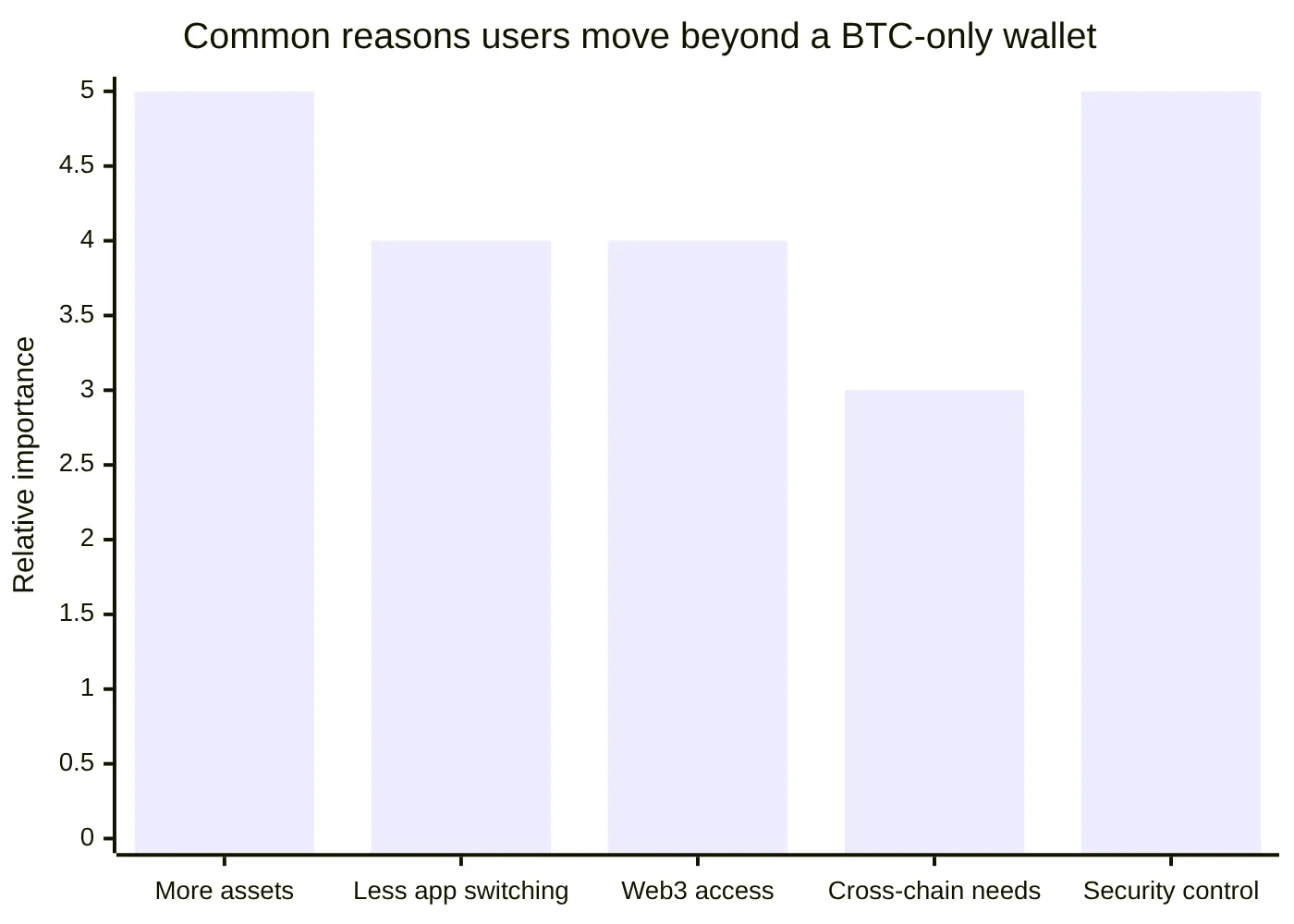
That definition matters, but it no longer describes the full user journey. Many people start with BTC, then add ETH for Ethereum transactions, USDT for stablecoin transfers, NFTs, or tokens on other networks. At that point, a BTC-only setup can create friction: one app for Bitcoin, another for Ethereum, another for a USDT wallet, and still another connection method for DApps.
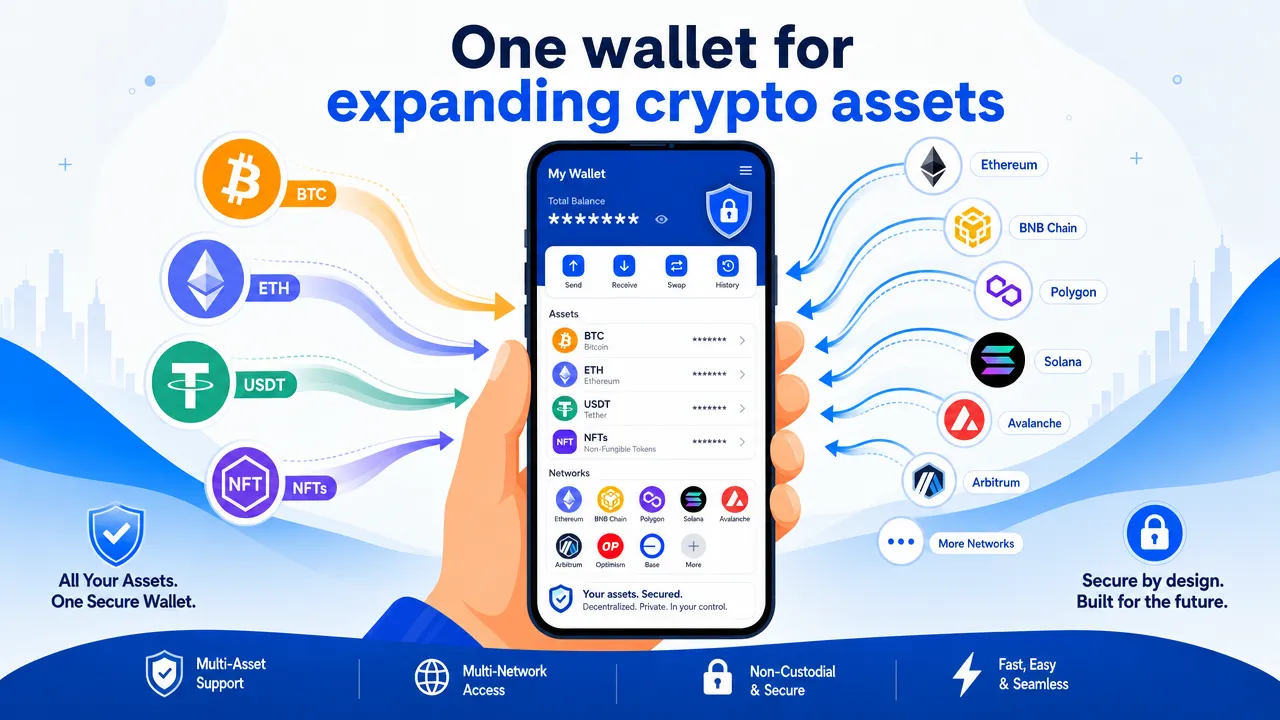
That is why the phrase "BTC wallet" often carries broader intent. In my view, many users are not asking for a wallet that only handles Bitcoin forever. They are asking for a safe starting point that will not become obsolete when they begin using ETH, USDT, DeFi, NFTs, or a web3 wallet app workflow. FoxWallet fits that direction by combining non-custodial self-custody with multi-chain asset management across mobile and browser extension use cases.
How a BTC wallet reduces app switching for ETH, USDT, and NFTs
The strongest practical argument for one BTC wallet is not novelty. It is operational simplicity. When users split assets across too many wallets, they also split security habits, recovery phrases, address books, transaction histories, and DApp permissions. That fragmentation increases the chance of wrong-network transfers, missed balances, and confusing approvals.
A multi-chain wallet helps by giving users a unified asset view. Instead of treating BTC, ETH, USDT, NFTs, and other supported assets as separate islands, the wallet becomes a single dashboard for checking balances and moving between on-chain activities. Brave's explanation of multi-chain wallets describes the core idea clearly: one wallet can support interaction across multiple blockchain ecosystems, reducing the need for separate tools.
| User need | BTC-only wallet experience | Multi-chain BTC wallet experience |
|---|---|---|
| Store and send BTC | Strong fit | Strong fit |
| Manage ETH | Usually limited or unavailable | Supported when the wallet includes Ethereum |
| Use a USDT wallet workflow | Often requires another wallet | Possible across supported USDT networks |
| View NFTs | Usually limited | Supported on compatible networks |
| Access DApps | Usually not the core use case | Built into many Web3 wallets |
| Swap across chains | Usually external and manual | Can be integrated through swap aggregators |
FoxWallet's approach is especially relevant here because it is designed as a unified asset gateway. It supports asset and NFT detection across supported networks, real-time on-chain data synchronization, and a consolidated view that helps users reduce multi-chain complexity. For readers who want a deeper dive into this angle, FoxWallet's guide to a secure multi-chain BTC wallet expands on why Bitcoin support and multi-chain access increasingly belong in the same wallet experience.
Why a non-custodial BTC wallet matters for self-custody
A BTC wallet decision is also a custody decision. A custodial wallet depends on a third party to manage access, while a non-custodial wallet gives users control of their private keys or recovery phrase. Coinbase's crypto wallet explainer summarizes the difference in accessible terms: custody changes who controls the keys and who carries the responsibility.
My opinion is simple: users who want long-term Web3 independence should understand non-custodial wallets early. Self-custody is not risk-free, and it is not a shortcut around personal responsibility. A recovery phrase must be protected offline, never shared, and never entered into suspicious sites. But non-custodial control is the foundation for using crypto without relying on a platform to hold funds.

FoxWallet is non-custodial, meaning users retain control over their private keys and assets. FoxWallet does not access or hold user funds, and it supports locally encrypted storage of mnemonic phrases and private keys. That security model is a major reason a user might choose one BTC wallet for all coins: the same self-custody discipline can apply across BTC, ETH, USDT, NFTs, and DApp interactions.
Security still requires caution. Ethereum's security guidance emphasizes wallet safety, phishing awareness, and careful key management. Tools and alerts can help reduce risk, but no wallet can guarantee protection from every scam. FoxWallet adds practical protections such as pre-transaction risk alerts, smart contract recognition, phishing protection, secure sandbox isolation, and continuously updated security strategies. These features are designed to support better decisions, not replace user judgment.
For a related self-custody perspective, FoxWallet's article on a non-custodial BTC wallet is useful for users comparing key control, asset management, and Web3 access in one wallet.
How a BTC wallet becomes a web3 wallet app for real activity
A modern BTC wallet is no longer just a send-and-receive screen. For many users, it becomes a web3 wallet app: the entry point for DApps, DeFi, NFTs, GameFi, token approvals, and on-chain identity. That shift is especially visible for users who add ETH, because Ethereum accounts, gas fees, and token standards define much of the smart contract experience. The official Ethereum documentation explains accounts, gas, and token standards in detail.
USDT adds another layer. As Tether's official resources describe, USDT is a stablecoin used across the digital asset ecosystem. But a USDT wallet experience depends heavily on network selection. Sending USDT on one network to an address or service expecting another can create costly mistakes. That is why multi-chain visibility, clear asset labeling, and network-aware transaction flows matter.
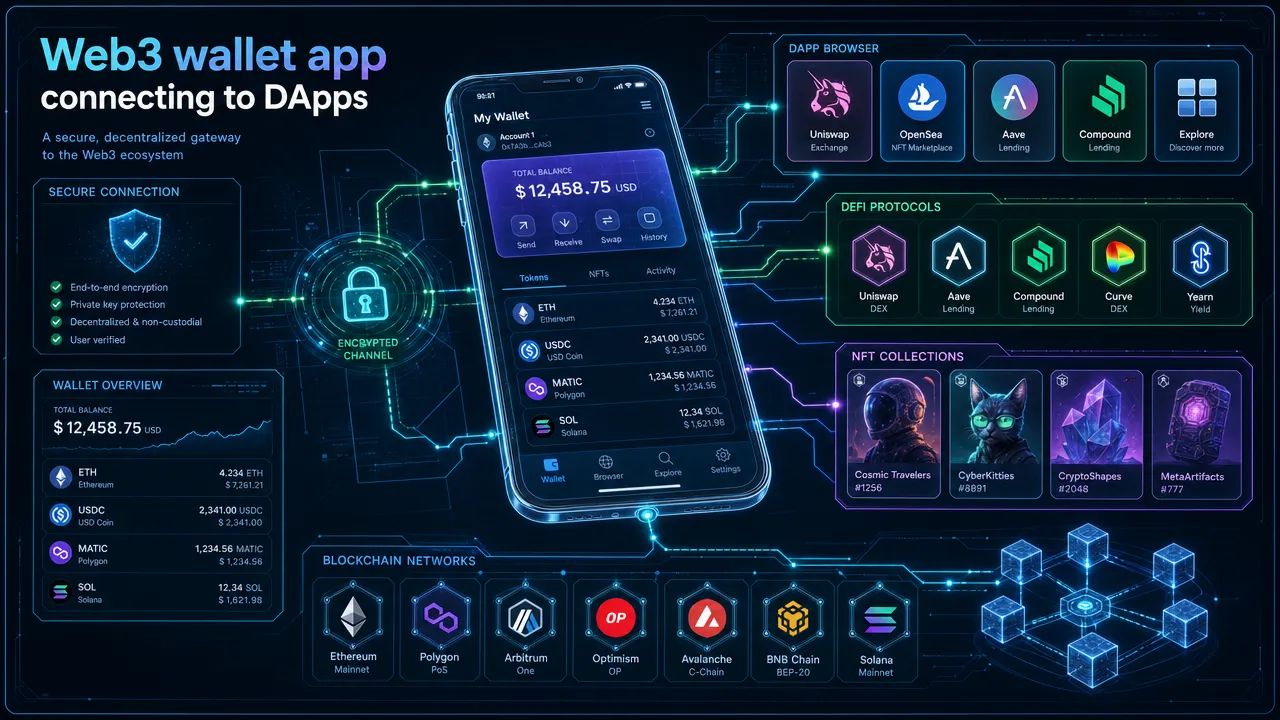
FoxWallet includes a built-in DApp browser for secure access to leading Web3 applications, including DeFi, NFTs, GameFi, and other on-chain use cases. It is available for iOS and Android through the FoxWallet download page, and it also supports browser extension use cases for desktop Web3 activity. Users should always verify downloads through FoxWallet official links to avoid fake apps, phishing pages, or impersonation attempts.
A strong web3 wallet app also needs to make transaction signing more understandable. DApp connections and token approvals are powerful, but they can create risk when users sign without reviewing permissions. Security tools such as Revoke.cash highlight why approval awareness matters: unnecessary or malicious approvals can expose assets. FoxWallet's smart contract recognition and risk alerts are designed to give users more context before they confirm transactions.
Why a BTC wallet with cross-chain swaps lowers friction
Cross-chain activity is one of the clearest reasons users outgrow isolated wallets. A user may hold BTC, use ETH for gas, keep USDT on a supported network, and want to exchange assets without manually jumping between bridge sites, swap pages, and separate wallet apps. A BTC wallet with built-in cross-chain swap support can reduce that friction by bringing route comparison and signing into one interface.
Cross-chain swaps are not staking. Cross-chain swaps exchange or move assets across networks. Staking is a separate activity related to network participation or earning mechanisms where supported. Keeping those concepts separate is important because users need clear expectations about what action they are taking and what risks apply.
FoxWallet integrates multi-chain swap aggregators and supports cross-chain asset exchanges across major blockchains. Its routing is designed to consider pricing and liquidity, helping users reduce manual route hunting and lower the barrier to cross-chain operations. That does not mean any wallet can guarantee the lowest fee, eliminate slippage, or ensure every transaction outcome. It does mean the wallet can make the workflow more transparent and efficient.
| Cross-chain pain point | Why it matters | FoxWallet approach |
|---|---|---|
| Manual bridge searching | Users may choose poor routes or unsafe sites | Built-in cross-chain swap workflow |
| Slippage uncertainty | Final received amount can change | Route and transaction review before signing |
| Liquidity fragmentation | Better routes may be spread across venues | Swap aggregator integration |
| Repeated redirects | More external pages can increase risk | Wallet-centered interaction flow |
| Hidden cost confusion | Fees and gas affect execution | Cost-aware routing and prompts |
For users who track BTC value against stablecoins or compare swap outcomes, FoxWallet's guide to a BTC to USD converter for Web3 users adds helpful context around pricing, slippage, and stablecoin conversion workflows.
Choosing one BTC wallet for all coins with FoxWallet
The right BTC wallet should secure Bitcoin today while leaving room for tomorrow's Web3 habits. That means non-custodial key control, multi-chain asset visibility, network-aware USDT wallet support, ETH wallet functionality, NFT management, DApp access, mobile availability, browser extension workflows, and security prompts that help users slow down before signing.
FoxWallet is built around that broader reality. It gives beginners a cleaner onboarding path, gives intermediate users one place to manage BTC, ETH, USDT, NFTs, and supported assets, and gives advanced users tools for DApps, cross-chain swaps, and frequent multi-chain operations. Professional users also benefit from a wallet designed to reduce operational clutter without giving up self-custody.
A practical checklist looks like this:
| What to check | Why it matters |
|---|---|
| Non-custodial design | Users control private keys and assets |
| BTC, ETH, and USDT support | The wallet can match common portfolio growth |
| Supported networks | USDT and tokens may exist on multiple chains |
| Local encryption | Helps protect key material on the device |
| DApp browser or connectivity | Enables Web3 activity from the wallet |
| Cross-chain swaps | Reduces reliance on separate tools |
| Risk alerts | Helps identify suspicious transactions |
| Official download sources | Reduces phishing and fake app risk |
Users who are still deciding where to buy Bitcoin can also read FoxWallet's guide on where can I buy Bitcoin and then consider moving assets into self-custody when appropriate. The core principle is consistent: start with Bitcoin, but choose a wallet that can grow with the rest of your on-chain life.
Download FoxWallet from the official FoxWallet download page to create a secure, non-custodial multi-chain wallet for BTC, ETH, USDT, NFTs, DApps, and supported cross-chain activity.
This content is for informational purposes only and is not financial, investment, tax, or legal advice. Always verify networks, addresses, fees, and transaction details before signing.