


ERC-20 vs TRC-20: Which USDT Network Should You Use?

Choose the USDT network your recipient or application explicitly supports. If both Ethereum and TRON are accepted, compare the current total cost, deposit requirements, and what you plan to do with the funds afterward.
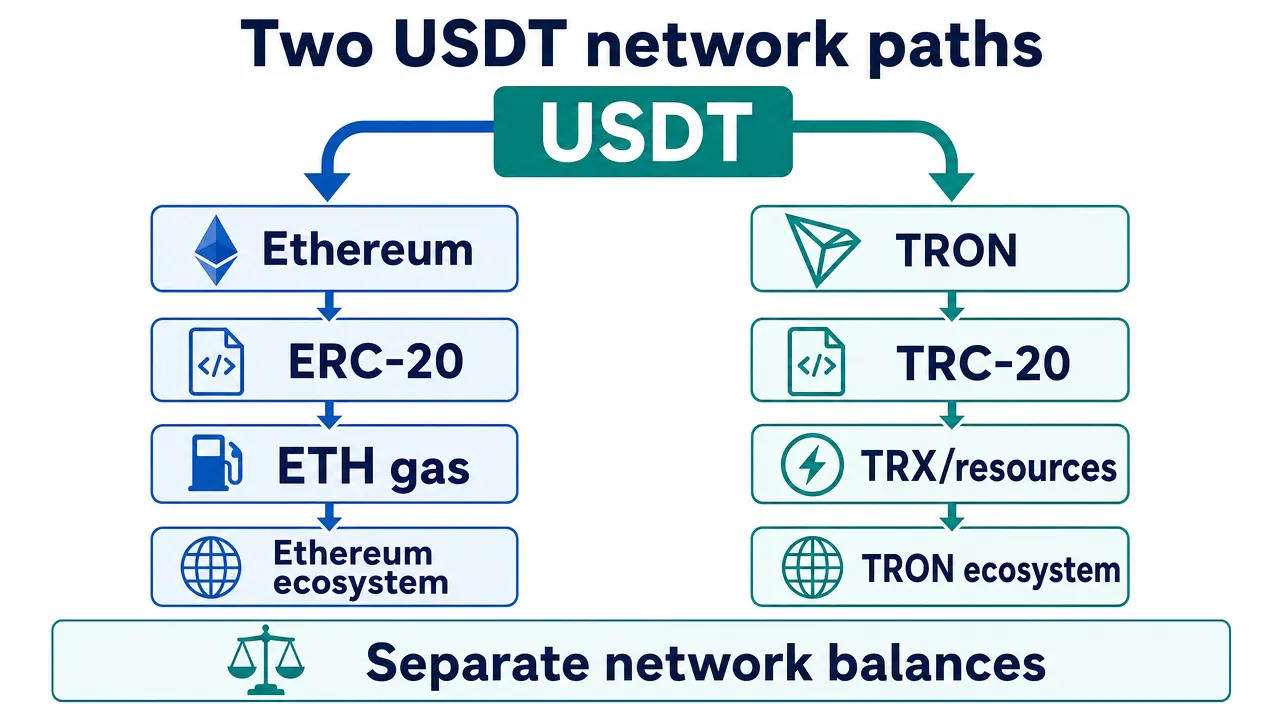
ERC-20 vs TRC-20 USDT is a comparison of USDT issued on two different blockchains, not two balances you can freely interchange. Ethereum transfers ordinarily require ETH for gas. TRON transfers use Bandwidth and Energy, with TRX consumed when applicable resources are insufficient.
The most practical choice starts with compatibility, not an advertised fee or speed.
ERC-20 vs TRC-20 USDT at a glance
This USDT network comparison covers Ethereum mainnet and TRON. Other networks, including Ethereum-compatible chains, require their own compatibility checks.
| Comparison point | ERC-20 USDT | TRC-20 USDT |
|---|---|---|
| Blockchain | Ethereum mainnet | TRON |
| Token standard | ERC-20 | TRC-20 |
| Gas token or resources | ETH for ordinary self-custodial transactions | Bandwidth and Energy, with TRX when required |
| Typical fee environment | Variable gas usage and gas prices | Variable resource requirements and availability |
| Transaction characteristics | Inclusion and execution precede finality | Execution and confirmed or solidified status are distinct |
| Ecosystem compatibility | Services accepting USDT on Ethereum | Services accepting USDT on TRON |
| Common use case | Funding an Ethereum application or compatible deposit route | Transfers through a route accepting TRON USDT |
| Main limitation | Cannot directly fund a TRON-only destination | Cannot directly fund an Ethereum-only destination |
What is ERC-20 USDT?
ERC-20 USDT is Tether-issued USDT on Ethereum. USDT is the asset, ERC-20 is the token standard, and Ethereum is the blockchain recording its balances and transactions.
Tether's supported-protocol documentation lists issuance on both Ethereum and TRON. Both represent USDT intended to track the US dollar, but each exists on its own ledger.
The Ethereum USDT network is relevant when a recipient or application specifically requires Ethereum mainnet. For example, an Ethereum lending application that accepts USDT needs the Ethereum-based token. A TRON balance in the same wallet does not fund that application.
Ordinary outgoing transactions require ETH. Sending USDT invokes a token contract, so an estimate for a simple ETH transfer is not an appropriate substitute.
What is TRC-20 USDT?
TRC-20 USDT is Tether-issued USDT on TRON. TRC-20 defines the token interface; it does not make TRON balances interchangeable with Ethereum balances.
TRON uses two resource categories:
- Bandwidth covers transaction data.
- Energy covers smart-contract execution.
A USDT transfer involves both. If available resources do not cover the transaction, applicable costs can consume TRX.
The Tron USDT network is a practical option when both parties accept that network and the current transfer requirements fit their needs. Receiving funds and sending them onward are different operations: a recipient should plan for the resources needed later.
ERC-20 vs TRC-20 USDT: Key differences
USDT transfer fees depend on the complete route
On Ethereum, the conceptual calculation is:
Network fee = gas used multiplied by the effective gas price.
Gas usage measures execution work. Gas price determines the price of that work, while the gas limit caps how much execution the transaction may use. Network demand can change the fee environment, as explained in Ethereum's gas documentation.
On TRON, the calculation starts with transaction resource demand, then considers available Bandwidth and Energy and any applicable TRX consumption. TRON's resource documentation explains these categories. Its dynamic Energy mechanism can also change execution costs for heavily used contracts.
Neither model supports a universal fixed USDT transfer price. Having resources available does not necessarily make a transfer economically free, either.
Exchange withdrawal charges are another layer. A service's displayed withdrawal fee is not necessarily the underlying blockchain cost of an equivalent self-custodial transfer.
Compare:
- The sending wallet's estimate or exchange withdrawal charge.
- Any conversion or cross-chain costs needed first.
- The net USDT the recipient will receive.
- Future gas or resource requirements.
Do not add a hypothetical blockchain fee to an exchange's withdrawal charge unless the service actually charges both separately.
USDT transaction speed is not just block time
A useful timing comparison separates four stages:
| Stage | What it tells you |
|---|---|
| Broadcast | The transaction has been submitted |
| Inclusion and execution | A block contains the transaction, and its execution result can be checked |
| Finality or solidification | The network's relevant consensus condition has been reached |
| Service crediting | An exchange or other service has updated its internal balance |
Ethereum distinguishes inclusion from checkpoint-based finality. TRON distinguishes recent blocks from solidified blocks.
A transaction can therefore appear on-chain before the recipient considers it settled. An exchange may require additional confirmations or processing.
For practical transfers, ask when the recipient will recognize the payment, not just how quickly a block is produced.
Congestion affects the networks differently
Ethereum demand can increase gas prices and make a transaction's fee settings less competitive.
On TRON, available resources and dynamic Energy requirements influence costs. A previous successful transfer is not proof that the next transfer will require the same amount.
Neither network is immune to failed transactions, delays, or infrastructure problems. Always review the current estimate and transaction status.
Wallet support and exchange support are separate
There is no universal support winner for every destination. Ethereum compatibility matters for Ethereum applications; TRON compatibility matters for TRON applications and transfer routes.
Check both layers:
- Wallet and address compatibility: Does the receiving wallet support that blockchain and token?
- Service compatibility: Does the exchange or payment service currently accept USDT deposits on that exact network?
Deposit support and withdrawal support also need separate checks. Services can suspend routes, impose minimums, or limit availability by account or jurisdiction.
A wallet supporting both networks does not prove that every integrated Swap, Bridge, or DApp feature works on both.
Addresses and network selection are not interchangeable
Ethereum addresses normally begin with 0x, followed by 40 hexadecimal characters. TRON's usual user-facing addresses begin with T and use a different encoding.
These formats provide an initial check, not proof of deposit compatibility.
One wallet application or recovery phrase can manage multiple addresses. It does not create one universal address for every blockchain.
Switching networks does not convert USDT. To move existing holdings between Ethereum and TRON, you need a separately supported route, such as a service accepting deposits on one network and withdrawals on the other, or a compatible cross-chain service.
Verify the output token as well as the destination network. A similarly named wrapped token can have additional dependencies.
Security involves more than the network
Ethereum and TRON use different consensus arrangements, but that alone does not justify calling one USDT version universally safe or unsafe.
Relevant risks include:
- Recovery phrase exposure and signing mistakes.
- Application vulnerabilities and excessive token approvals.
- Custodial service restrictions or processing issues.
- Cross-chain contract, counterparty, and liquidity risks.
- USDT issuer controls.
Tether's legal terms describe freeze-related authority. Self-custody means controlling your keys; it does not remove token issuer controls.
For transfers, compatibility checks and key protection are practical safeguards on either network.
Which USDT network should you use?
Choose based on the destination, intended use, and where your USDT already sits.
| Use case | Practical choice |
|---|---|
| Sending between exchanges | Use a network available for withdrawal at the sender and USDT deposit at the recipient |
| Sending to another person | Agree on the network before copying the receiving address |
| Holding in a wallet | Choose a supported network that fits likely future transfers or application use |
| Using Ethereum DeFi | Use Ethereum USDT if the application accepts it on Ethereum mainnet |
| Minimizing costs | Compare current total costs across compatible routes |
| Receiving payment | Specify USDT, the network, and its corresponding address |
Sending between exchanges or people
For exchange-to-exchange transfers, compare withdrawal charges, deposit minimums, route availability, and crediting requirements. The exchange generally handles its outgoing blockchain transaction; do not assume you must separately fund a personal ETH or TRX balance.
For person-to-person transfers, ask what the recipient will do next. A low-cost transfer is less useful if the recipient must then pay to move the funds elsewhere.
Holding USDT or using DeFi
Holding requires planning for the eventual exit. If your likely next step is an Ethereum application, keeping funds on Ethereum may avoid a later conversion.
If your intended recipients use TRON, a supported TRON balance may be more convenient.
For DeFi, check the exact application, chain, and token. Budget for approvals and application interactions, not just the initial transfer. Ethereum-compatible networks are not interchangeable with Ethereum mainnet.
Minimizing costs or receiving payment
Compare the route from your existing balance to the usable destination balance. Moving networks solely to obtain a lower final transfer fee can cost more overall.
For payment requests, label each network and address separately. Agree on the amount that must arrive, who bears charges, and what confirmation or crediting status counts as receipt.
There is no universal winner. The right network is the compatible route that meets the recipient's needs at an acceptable total cost.
How to send USDT without choosing the wrong network
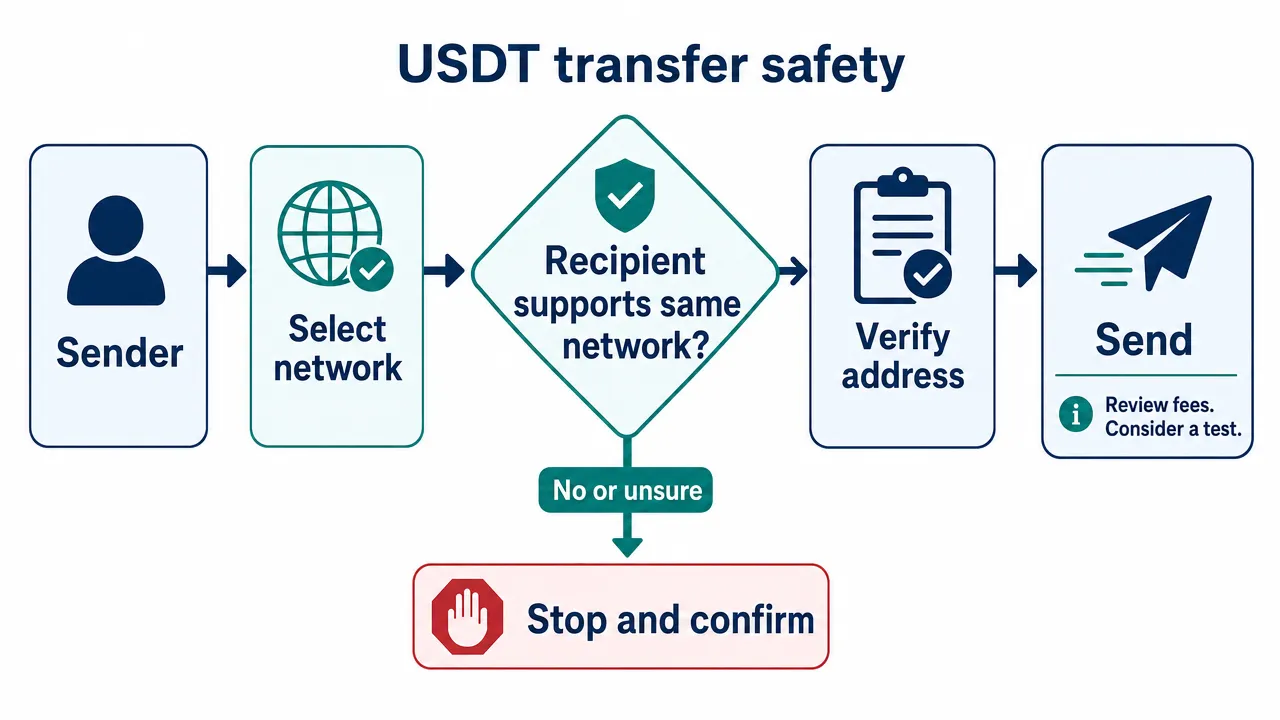
Use this checklist before signing or confirming a withdrawal.
- Confirm recipient support. Ask for the exact USDT network. For an exchange, open its current deposit instructions rather than relying on an old saved address.
- Select the same network on both sides. Ethereum must match Ethereum; TRON must match TRON. Confirm that your source balance is already on the selected network.
- Verify the address and instructions. Check the full address, deposit minimum, route status, and any service-specific requirements.
- Review fees and expected receipt. Use the current wallet estimate or withdrawal screen, including any separate service charges.
- Consider a small test for significant amounts. It must meet the deposit minimum. Wait for confirmed receipt or crediting before proceeding.
- Plan future transaction funding. Keep enough ETH or TRX/resources where required for later self-custodial transactions.
A test confirms that route at that time. Recheck the details before the larger transfer.
What happens if you choose the wrong network?
The outcome depends on what actually happened.
| Situation | Meaning and next step |
|---|---|
| The interface rejected the address | A transaction may never have been broadcast. Check status before retrying |
| A transaction was included but failed | The token transfer may not have completed, although fees or resources may have been consumed |
| Tokens reached a self-custodial address | Recovery depends on the actual address, relevant key control, network support, and account type |
| Tokens reached an unsupported custodial deposit route | The service must assess access and its recovery policy |
| Tokens reached an unintended address | Switching the sender's network does not reverse the transfer |
An incompatible address may be rejected, but do not rely on an interface to prevent every mistake.
If something goes wrong, stop sending. Preserve the network, recipient address, token, amount, and blockchain transaction hash. An exchange's internal withdrawal ID may not be the blockchain TXID.
Our transaction-tracking walkthrough explains how to inspect a TRON transfer and distinguish execution from confirmation.
Contact the recipient or official service support. Recovery is neither guaranteed nor automatically impossible. Never share a recovery phrase or private key with anyone offering assistance; follow our wallet security guidance.
Using both networks with FoxWallet
FoxWallet is a multi-chain, non-custodial wallet with documented Ethereum and TRON support on mobile. Users control their keys and assets rather than handing custody to the wallet provider.
Our documentation describes local encryption of recovery phrases and private keys using the mobile platform's Keychain or Keystore. This supports self-custody, but users still need secure backups and careful transaction review.
Network support, sending, and receiving
Select the intended network before copying a receiving address or initiating a transfer. Our TRON network guide documents mobile access, and the transaction-tracking guide covers the TRON USDT workflow.
Ethereum network support and general sending and receiving functions are documented. Before funding either network, verify the intended USDT asset and receiving details in the app.
Swap, Bridge, and DApp access
These capabilities serve different purposes:
- Sending and receiving move tokens on the selected blockchain.
- Swap exchanges assets through an available supported route.
- Bridge or cross-chain exchange requires an explicitly supported source, destination, and output token.
- DApp access connects the wallet to compatible applications, including supported DeFi services.
FoxWallet documents Swap and Bridge workflows and Ethereum and TRON provider connectivity. Network support does not guarantee every token pair, application, or cross-chain route.
Do not assume a direct Ethereum-to-TRON USDT route is available. Check the actual options, fees, destination token, and permissions before proceeding.
For your first mobile transfer, follow our funds-management guide.
FAQ
Is TRC-20 USDT the same as ERC-20 USDT?
Both are Tether-issued USDT intended to track the US dollar. Their balances exist on different blockchains, so a normal transfer does not make them interchangeable.
Is TRC-20 cheaper than ERC-20?
Not always. Ethereum costs depend on gas usage and gas prices. TRON costs depend on resource requirements and availability. Exchange withdrawal charges can differ from both. Compare current compatible routes.
Which USDT network is faster?
There is no universal end-to-end answer. Successful execution, network finality, and exchange crediting are different milestones. Check the recipient's requirements rather than relying on advertised block times.
Can I send ERC-20 USDT to a TRC-20 address?
Not as an ordinary transfer that converts Ethereum USDT into TRON USDT. An incompatible address may be rejected. Moving between networks requires a separately supported conversion route.
Can the same wallet address receive both?
Do not assume so. Ethereum usually displays 0x addresses; TRON usually displays T addresses. Use the receiving address for the exact network, even when one wallet manages both.
How do I know which USDT network an exchange supports?
Check its current USDT deposit page and, separately, its withdrawal page. Match the network names and verify minimums, route availability, and any account-specific restrictions.
Do I need ETH to send ERC-20 USDT?
For an ordinary self-custodial Ethereum transaction, yes. Custodial or explicitly sponsored services may handle fees differently, but USDT is not ordinarily the gas-payment asset.
Do I need TRX to send TRC-20 USDT?
The transfer requires Bandwidth and Energy. Insufficient resources can result in TRX consumption. Check the current estimate rather than assuming your USDT balance covers transaction costs.
Can FoxWallet hold ERC-20 and TRC-20 USDT?
FoxWallet mobile supports Ethereum and TRON, and its documentation covers TRON USDT management. For Ethereum, verify the intended USDT asset and receiving details in the app before funding; network support alone is not a token-specific guarantee.
The deciding rule is simple: match the recipient's network first, then compare cost and intended use. A lower quoted fee never overrides compatibility, and selecting a different network never converts an existing balance.