


BEP-20 vs ERC-20: What’s the Difference and Which Should You Use

BEP-20 vs ERC-20 is often described as a token comparison, but the practical choice is usually about selecting the correct blockchain network. ERC-20 is the fungible-token standard associated with Ethereum, while BEP-20 is an ERC-20-derived fungible-token standard used on BNB Smart Chain, also called BSC.
Both standards help wallets, exchanges, DApps, and smart contracts handle common token actions such as checking balances, transferring tokens, and approving a contract to spend tokens. Their similar design can make them feel interchangeable. They are not.
The most important rule is simple: use the exact network required by the receiving exchange, wallet, DApp, or smart contract.
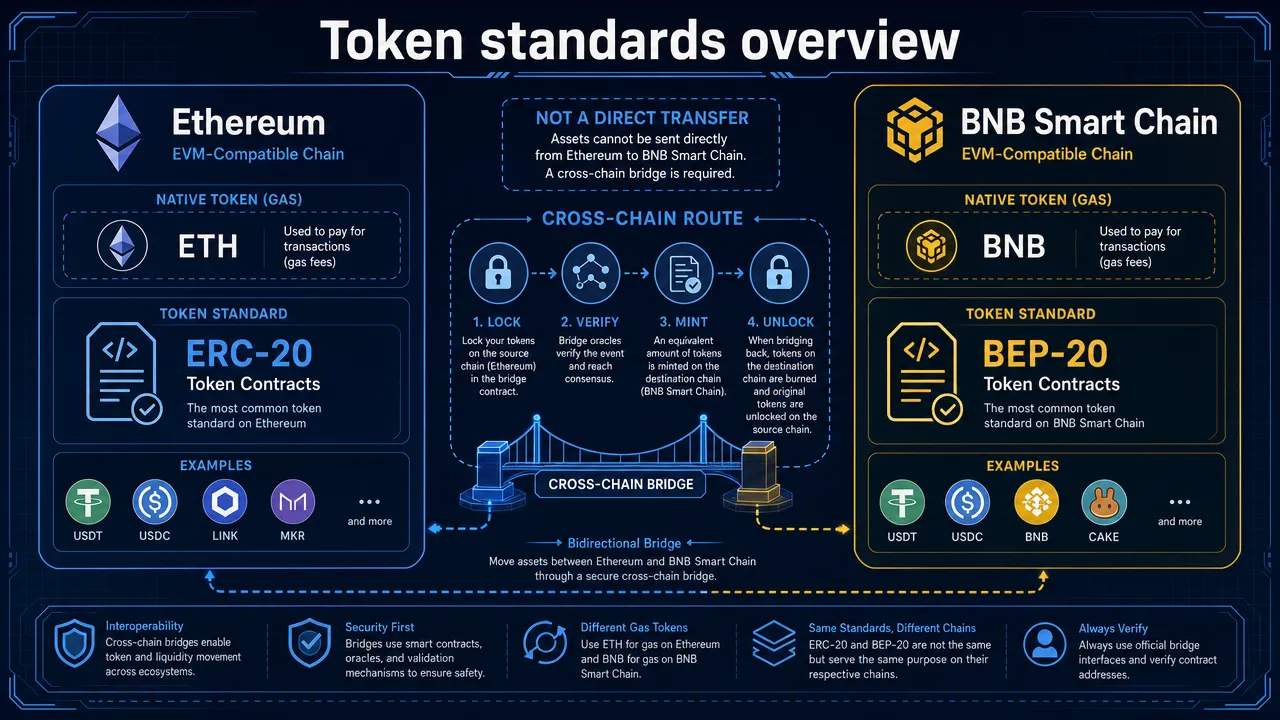
| Factor | ERC-20 | BEP-20 |
|---|---|---|
| Associated network | Ethereum | BNB Smart Chain |
| Token standard | Ethereum fungible-token interface | ERC-20-derived BSC fungible-token interface |
| Native gas asset | ETH | BNB on BSC |
| Common address format | 0x-prefixed EVM address |
0x-prefixed EVM-style address |
| Token balance and history | Recorded on Ethereum | Recorded on BNB Smart Chain |
| Best fit | Ethereum-native DApps, deposits, and contracts | BSC-native DApps, deposits, and contracts |
| Moving assets to the other network | Requires a supported bridge or cross-chain swap route | Requires a supported bridge or cross-chain swap route |
This crypto token standard comparison should not be treated as a universal ranking. Fees, transaction speed, liquidity, security assumptions, and application availability depend largely on the underlying networks and the specific route you use.
Token Standards, Networks, and Gas
The first step in understanding BEP-20 vs ERC-20 is separating the token standard from the blockchain network.
A token standard is a shared set of rules for token smart contracts. It gives wallets and applications predictable ways to interact with tokens. A blockchain network is the separate ledger where those contracts, balances, and transactions exist.
The ERC-20 token standard on Ethereum
The ERC-20 token standard is defined by Ethereum Improvement Proposal 20. It establishes common functions such as balanceOf, transfer, approve, allowance, and transferFrom. These shared functions make it easier for Ethereum wallets, exchanges, and DApps to support many fungible tokens through a familiar interface.
You can review the full technical specification in the official ERC-20 standard.
ERC-20 token activity happens on Ethereum. That means users normally need ETH in the same wallet on Ethereum to pay gas for token transfers, token approvals, swaps, and other smart-contract interactions. Ethereum gas costs are dynamic and depend on network demand and transaction complexity, as explained in Ethereum's gas and fees documentation.
Typical ERC-20 use cases include:
- Sending tokens to a deposit address that explicitly requests Ethereum or ERC-20.
- Using an Ethereum mainnet DApp or DeFi protocol.
- Interacting with a specific Ethereum token contract.
- Trading through Ethereum-based liquidity venues.
The BEP-20 token standard on BNB Smart Chain
The BEP-20 token standard is BNB Smart Chain's fungible-token standard. It was derived from ERC-20, which is why the transfer and approval experience is broadly familiar to EVM users and developers.
The official BEP-20 specification describes ERC-20-style functions for balances, transfers, allowances, and approvals. It also includes BSC-specific details such as getOwner().
BEP-20 token activity takes place on BNB Smart Chain. Users need BNB on BSC to pay gas for BEP-20 transfers and BSC smart-contract interactions. Holding a BEP-20 token without enough BNB for gas can prevent you from moving or using that token.
For a deeper guide to BSC terminology, network behavior, and wallet considerations, see FoxWallet's explanation of BNB Smart Chain and BEP-20 wallets.
Why the same 0x address can be misleading
Ethereum and BNB Smart Chain are EVM-compatible. As a result, wallet addresses on both networks commonly use the same 0x format. In many wallet setups, you may even see the same public address after switching between Ethereum and BSC.
However, an identical-looking address does not mean the networks share balances or transaction history.
For example, a wallet can have:
- USDT on Ethereum as an ERC-20 token.
- USDT on BNB Smart Chain as a BEP-20 token.
- The same public
0xaddress shown for both networks. - Two entirely separate balances and token contracts.
ETH cannot pay BSC gas. BNB on BSC cannot pay Ethereum gas. A direct transfer on one chain does not automatically create a balance on the other.
The Full Comparison
The BEP-20 vs ERC-20 difference is less about radically different token commands and more about the separate networks where those token contracts operate.
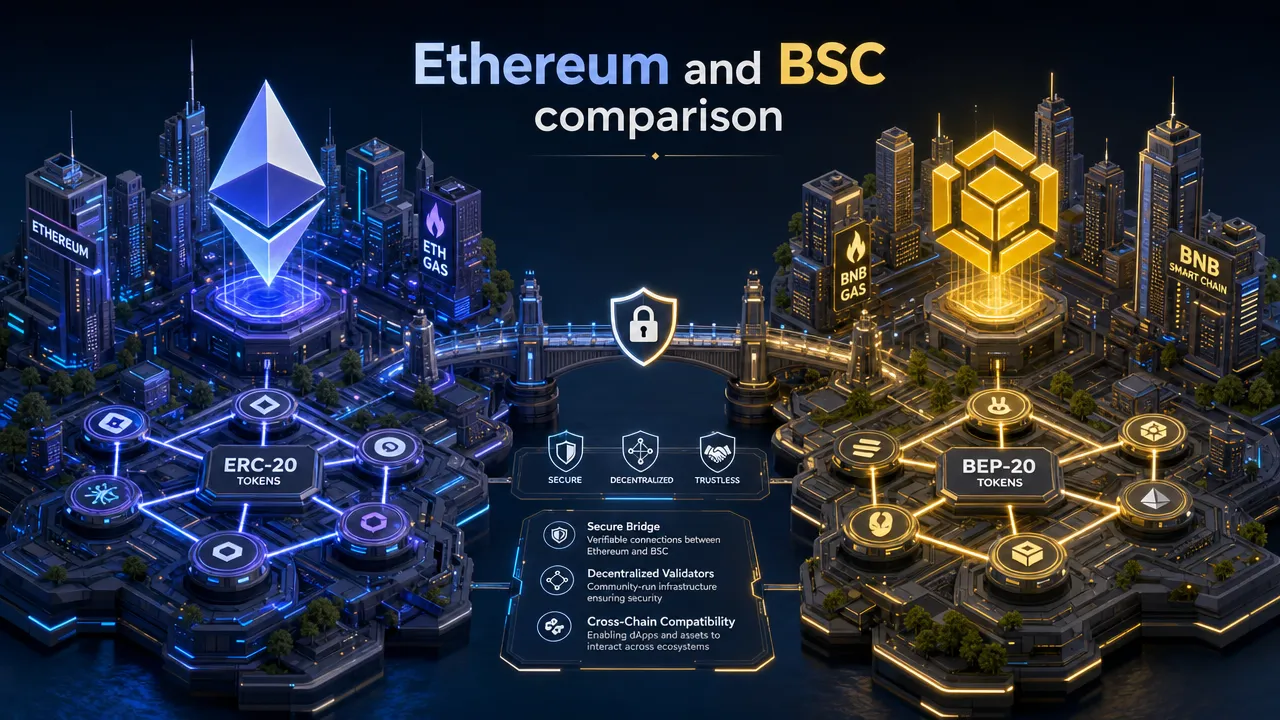
| Comparison point | ERC-20 | BEP-20 | What it means in practice |
|---|---|---|---|
| Blockchain | Ethereum | BNB Smart Chain | Balances, contracts, and transaction records are separate. |
| Gas token | ETH | BNB on BSC | Keep the correct native asset available before sending or interacting. |
| Contract design | Standardized Ethereum token interface | ERC-20-derived interface for BSC | Both use familiar transfer and approval patterns. |
| Address format | Usually starts with 0x |
Usually starts with 0x |
Similar addresses do not prove network compatibility. |
| DApp environment | Ethereum-native contracts and applications | BSC-native contracts and applications | Connect to the network required by the DApp. |
| Fee behavior | Dynamic and paid in ETH | Dynamic and paid in BNB | Compare total route costs, not just displayed network gas. |
| Consensus context | Ethereum proof of stake | BSC's documented PoSA-related design | The networks use different validator and security assumptions. |
| Cross-network movement | Needs a supported cross-chain route | Needs a supported cross-chain route | A normal send does not move funds between chains. |
Ethereum uses proof of stake, while BNB Smart Chain has its own documented validator and consensus design. These differences should not be simplified into claims that one standard is always safer, cheaper, or better. Network conditions, token contracts, DApps, bridges, liquidity, and user actions all affect outcomes.
BSC documentation describes EVM compatibility and rapid block production characteristics, while Ethereum has its own confirmation and finality model. Review the current BNB Smart Chain documentation and Ethereum's proof-of-stake overview when a workflow requires up-to-date network details.
A further distinction matters for token permissions. Both standards use approval and allowance patterns. When you approve a DApp contract, you may be giving that contract permission to move a specified amount of tokens later. Before approving, verify the DApp domain, token, spender address, and allowance size. A token standard does not guarantee that a token or smart contract is legitimate.
Can You Send Tokens Between Networks?
No, not through a standard same-chain token transfer.
If you send a BEP-20 token using BNB Smart Chain, it remains on BNB Smart Chain. If you send an ERC-20 token through Ethereum, it remains on Ethereum. The receiving address may look identical, but the transaction is recorded only on the selected blockchain.
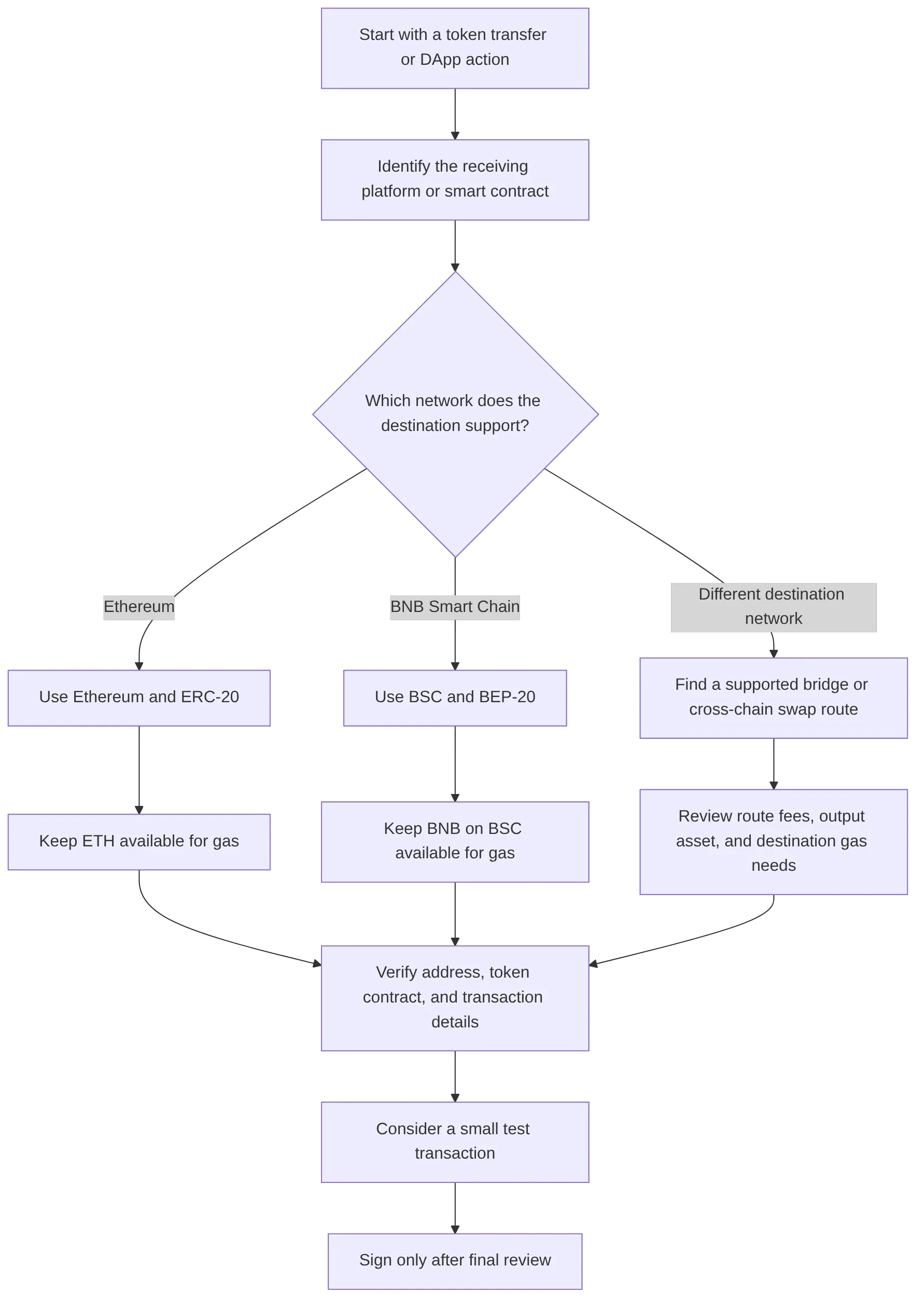
Adding a token does not move it
Adding or importing a token contract in a wallet only helps the wallet interface recognize and display that token. It does not bridge your asset, create liquidity, verify authenticity, or make the asset supported by an exchange.
Always verify the entire token contract address through official issuer information and trusted blockchain resources. Do not rely only on a token symbol, name, logo, or unsolicited wallet token.
A bridge is different from a cross-chain swap
A bridge moves value or token representations between networks. Depending on the bridge design, tokens may be locked, burned, minted, or released across the source and destination chains.
A swap exchanges one asset for another. A same-chain swap stays on one network. A cross-chain swap starts with an asset on one network and delivers an output asset on another network. It can involve several elements, including approvals, swaps, liquidity providers, bridge activity, relayers, source-chain gas, destination-chain gas, and slippage.
These actions are distinct from staking. Do not treat a bridge or cross-chain swap as a staking activity.
Before using any cross-network route, understand whether the destination asset is canonical, wrapped, bridged, or another representation. FoxWallet's guide to cross-chain swap and bridge risks explains why route design, fees, and destination-chain readiness matter.
Which Should You Use?
The answer to "BEP-20 or ERC-20 which should you use" depends on where your assets need to arrive and what you plan to do next.
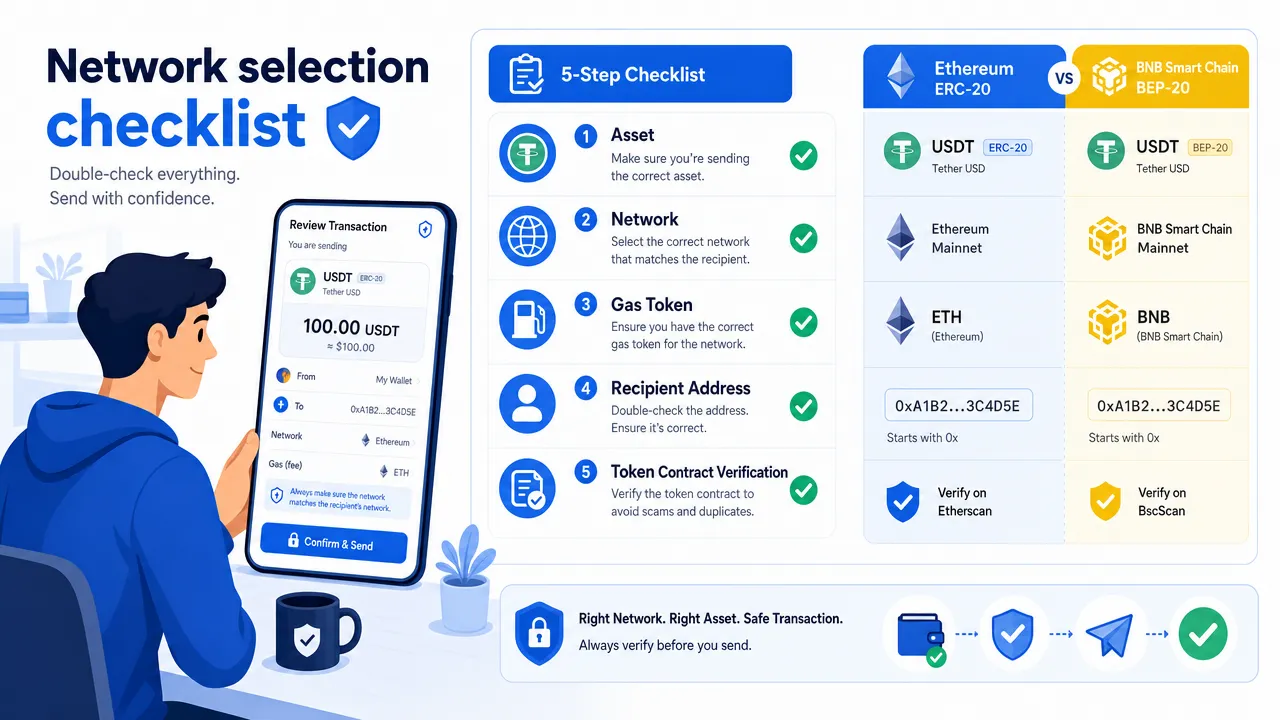
Use ERC-20 when the destination is Ethereum-native
Choose ERC-20 when:
- An exchange deposit page explicitly says Ethereum or ERC-20.
- You are connecting to an Ethereum mainnet DApp.
- A smart contract or liquidity pool is deployed on Ethereum.
- You need an Ethereum-specific token contract.
Before acting, confirm that your wallet is connected to Ethereum and that you have ETH available for gas. Token approvals, swaps, and deposits may require separate transactions.
Use BEP-20 when the destination supports BNB Smart Chain
Choose BEP-20 when:
- The recipient platform explicitly supports BSC, BNB Smart Chain, or BEP-20.
- You are interacting with a BSC-native DApp.
- You are sending a BSC-native token.
- Your intended liquidity or application workflow is on BNB Smart Chain.
Confirm that BNB Smart Chain is selected in your wallet and keep enough BNB on BSC for gas. If you are receiving assets for the first time, FoxWallet's guide on how to get a BSC wallet address provides useful network-selection and verification context.
Compare the full cost, not only gas
Binance Smart Chain vs Ethereum fee discussions often focus only on network gas. That can be misleading.
Your total route cost may include:
- Exchange withdrawal fees.
- Source-chain gas.
- Token approval costs.
- DEX fees.
- Bridge or routing fees.
- Destination-chain gas.
- Price impact and slippage.
A BSC route may be appropriate when the destination supports it and the full route is suitable. But lower gas alone is never a sufficient reason to select a network.
Use a supported cross-chain route when the asset must change networks
If your asset starts on Ethereum but must be used on BSC, or vice versa, use a supported bridge or cross-chain swap route. Do not send directly to a destination platform merely because the address begins with 0x.
For unfamiliar routes, a small test transaction can help confirm that the chosen asset, network, address, and destination instructions are correct before moving a larger amount.
Consider separate deployments if you are a developer
Developers choosing between the ERC-20 token standard and the BEP-20 token standard should begin with users and ecosystem requirements.
ERC-20 may fit projects centered on Ethereum mainnet composability and Ethereum-native integrations. BEP-20 may fit projects designed for the BSC ecosystem. A multi-chain launch requires more than copying a contract to another network. Teams should plan for separate contracts, liquidity, token representations, documentation, monitoring, support, and incident response.
Security Checklist and Multi-Chain Management
A non-custodial wallet gives users control over their private keys and assets, but it also makes careful transaction review essential. Confirmed blockchain transactions generally cannot be reversed simply because the wrong network or token was selected.
Use this checklist before sending, receiving, swapping, or bridging:
- Verify the exact asset and full token contract address.
- Confirm whether the destination requires Ethereum/ERC-20 or BNB Smart Chain/BEP-20.
- Confirm that the receiving platform explicitly supports the selected network.
- Copy the recipient address from the destination's intended receive or deposit workflow.
- Check for any memo, tag, or platform-specific instruction.
- Keep ETH for Ethereum activity and BNB on BSC for BSC activity.
- Review the complete cost of the route, including gas and third-party fees.
- Send a small test transaction when using a new address, platform, or cross-chain route.
- Review every token approval and avoid broad allowances when a limited amount is practical.
- Verify DApp domains from official sources or trusted bookmarks.
- Never share your seed phrase or private key.
- Avoid interacting with unexpected tokens, links, or signature requests.
For more guidance on phishing prevention, transaction prompts, seed phrase protection, and token safety, review the official FoxWallet security tips.
FoxWallet is a multi-chain, non-custodial wallet built to help users manage supported assets across networks while retaining control of their private keys. Its mobile and browser extension experiences support multi-chain asset management, DApp access, and risk-aware transaction review. Supported mobile swap and cross-chain routes are separate functions: swaps exchange assets, while cross-chain routes move or exchange value between networks.
When managing ERC-20 and BEP-20 holdings, treat each network as a separate environment even when the address is the same. Check the chain shown beside each balance, verify the token contract before taking action, and use a workflow that makes network selection clear before you sign. You can also review FoxWallet's manage funds guide for practical send, receive, network-switching, and transaction-history steps.
FAQ
What is BEP-20?
BEP-20 is BNB Smart Chain's fungible-token standard, derived from ERC-20. It defines the functions wallets and DApps use to check balances, transfer tokens, and manage approvals, plus a BSC-specific getOwner() method. BEP-20 tokens exist on BNB Smart Chain and require BNB on BSC for gas.
What is ERC-20?
ERC-20 is Ethereum's fungible-token standard, defined by Ethereum Improvement Proposal 20. It establishes shared functions like balanceOf, transfer, approve, allowance, and transferFrom. ERC-20 tokens exist on Ethereum and require ETH for gas.
Can I send an ERC-20 token to a BEP-20 address, or the reverse?
Not through a standard same-chain transfer. A token sent on Ethereum stays on Ethereum; a token sent on BNB Smart Chain stays on BNB Smart Chain. Moving value between the two networks requires a supported bridge or cross-chain swap route.
Do ERC-20 and BEP-20 use the same wallet address?
Often, yes — both networks are EVM-compatible, so a wallet may show the same 0x address on Ethereum and BSC. That shared address format does not mean the two networks share balances or transaction history; they remain separate.
Is BEP-20 cheaper than ERC-20?
BEP-20 transactions are often cheaper due to how BNB Smart Chain is designed, but gas cost alone should not decide which network to use. The destination platform, DApp, or contract determines which network is actually required.
Is one token standard safer than the other?
Neither standard is inherently safer. Ethereum uses proof of stake, while BNB Smart Chain uses its own documented validator design. Safety depends more on the specific contract, DApp, bridge, and how carefully approvals and transactions are reviewed than on the token standard itself.
In short, BEP-20 vs ERC-20 is not a choice between two interchangeable labels. Select ERC-20 for Ethereum-required workflows and BEP-20 for BNB Smart Chain-required workflows. If value must move between those networks, use a verified cross-chain route and review every step before confirming the transaction.