


Best Wallet Setups for AI Agents

For most users, the safest starting point is simple: keep assets in a self-custody wallet, let the agent research or prepare actions, and retain human approval for every signature. Choosing the best wallet for AI agents is not about handing an AI system unrestricted access to crypto. It is about matching the wallet architecture to the agent's real job, then limiting authority before any transaction can be signed.
More advanced automation can be useful, but only when it is separated from recovery credentials and constrained by clear rules.
This guide explains how to build an AI agent wallet setup for personal exploration, developer automation, and team-controlled funds. It also clarifies where FoxWallet fits: as a non-custodial, multi-chain wallet for user-controlled Web3 activity, rather than a dedicated autonomous signing platform.
What an AI agent wallet setup should include
An AI agent wallet setup is not one product category. It is the combination of wallet access, signing authority, transaction rules, monitoring, and recovery procedures that determines what an agent can propose or execute on-chain.
A strong setup separates five roles:
- Agent layer: Interprets a task and proposes an action.
- Authorization layer: Defines what the agent is allowed to do.
- Policy layer: Independently checks limits, recipients, contracts, and timing.
- Signing layer: Approves or signs only permitted transactions.
- Recovery layer: Lets the owner pause access, revoke permissions, or move funds if something goes wrong.
This distinction matters because self-custody and automation are different questions. A non-custodial wallet means you retain control of your keys. It does not automatically mean an agent has safe or programmable permission to transact.
For an AI agents crypto wallet workflow, never give an AI agent a seed phrase, root private key, or unrestricted recovery credential. An agent can encounter malicious DApps, compromised APIs, deceptive prompts, or phishing content. A single unsafe instruction could turn broad access into an irreversible transaction.
The ERC-4337 account abstraction standard provides a technical framework for smart accounts that can support custom validation logic. Meanwhile, delegated-signing models described in Turnkey's agentic wallet documentation show why policy evaluation should happen outside the agent before a signature is created.
For individual users, a practical first step is a dedicated, low-balance wallet where the user signs every transaction. FoxWallet can support this approach through secure multi-chain wallet management, local encryption of wallet credentials, DApp access, and transaction-risk awareness while the user keeps final control.
AI agent wallet setup options by use case
The right AI agent wallet setup depends on whether an agent only makes suggestions, executes limited repeat actions, or participates in organizational workflows.
| Use case | Suitable wallet arrangement | Who signs? | Recommended authority level |
|---|---|---|---|
| AI research and transaction suggestions | Non-custodial wallet with manual signing | User | No agent signing access |
| DApp experimentation | Separate low-value wallet | User | Manual signing only |
| Repeated low-risk app actions | Smart account with scoped permissions | Agent within defined rules | Strict caps, expiry, allowlists |
| AI agent payments | Delegated signing or smart-account policy setup | Agent within policy or user for exceptions | Limited recipients, assets, and amounts |
| Team treasury operations | Multisig wallet | Required human signers | Proposal-only agent role |
| Institutional workflows | MPC or governed signing infrastructure | Designated organizational approvers | Role-based policy controls |
A wallet setup for AI agents should always reflect the consequences of failure. If an agent makes a mistake in a test environment or small operational wallet, the loss may be contained. If it controls reserves, treasury funds, or protocol administration, a mistake can become much more serious.
Here are the six most useful architecture patterns.
1. User-controlled wallet with manual signing
This is the most practical setup for beginners and many advanced individuals. The agent can compare routes, analyze tokens, draft transaction details, or explain a DApp interaction. The user still verifies the chain, recipient, amount, contract, and approval before signing.
This approach is especially useful for people exploring AI-enabled DApps without granting an agent direct transaction authority. It keeps the agent productive while preserving meaningful human control.
FoxWallet is relevant here because it is a non-custodial wallet with multi-chain asset management, a built-in DApp browser, mobile and browser extension access, and pre-transaction risk alerts. Users can explore Web3 activity while retaining their private keys and final signing authority.
2. Isolated low-value testing wallet
A testing wallet is separate from primary holdings, reserves, and treasury funds. Fund it only with an amount you can afford to lose, and use testnet whenever possible.
This is not a complete security system, but it reduces the potential impact of a bad DApp connection, an accidental approval, or a flawed agent workflow. It is a sensible starting point for testing crypto wallet automation, transaction builders, smart contract integrations, and agent prompts.
3. Smart account with delegated permissions
For developers who need repeatable agent actions, a smart account can provide more granular controls than a conventional single-key wallet. Depending on the implementation, permissions can be restricted by:
- Recipient address.
- Contract address.
- Supported chain.
- Token type.
- Function call.
- Per-transaction spending amount.
- Daily or weekly total.
- Session expiry time.
- Approval threshold.
This is the architecture most associated with an autonomous agent wallet, but autonomy should always be bounded. The agent should never have unlimited authority simply because it can act quickly.
Biconomy documents Smart Sessions for delegated execution by agents, bots, and automated strategies, and ZeroDev offers a comparable session-key and account-abstraction toolkit built on ERC-4337. Turnkey, a wallet-as-a-service provider, takes a different approach: rather than a smart contract wallet, it offers TEE-backed key management with an off-chain policy engine that evaluates and can reject a signing request before a signature is ever produced. These tools can be useful for builders, but they are infrastructure, not a shortcut around security design. Developers still need contract allowlists, spending caps, monitoring, simulation, testing, and revocation procedures regardless of which provider they choose.
4. Multisig wallet for teams and treasuries
A multisig setup is usually more appropriate when an agent works around shared funds. Rather than signing independently, the agent can generate a transaction proposal for designated human signers to review and approve.
Safe (formerly Gnosis Safe) is the most widely used multisig standard for this pattern on EVM chains, and Squads provides the equivalent on Solana. In both cases, the agent's role is limited to proposing a transaction; it never holds enough signing weight on its own to move funds.
This approach works well for treasury disbursements, vendor payments, governance actions, and high-value transfers. It introduces coordination friction, but that friction can be an important safeguard.
5. MPC or institutional-control setup
Multi-party computation, or MPC, distributes signing operations across multiple parties or devices. It can be useful for organizations that need role separation, audit trails, identity controls, business continuity planning, and more formal approval flows.
Fireblocks and Cobo are two established providers in this space, both offering MPC-based custody with policy engines aimed at institutional and enterprise treasury operations rather than individual users. An MPC setup may be appropriate for institutional wallet infrastructure for AI agents, but the real safeguards depend on the policy design, signer configuration, custody model, and operational processes. It should not be treated as automatically safer without reviewing the implementation.
6. Agent proposes, human signs
For many users, this hybrid workflow offers the best balance. The agent can research, construct a transaction, compare options, or suggest an action. A human reviews the final request and signs it manually.
This is often a better choice than full automation for trading research, DApp exploration, AI agent payments, and cross-chain route analysis.
Secure AI agent wallet setup controls to use first
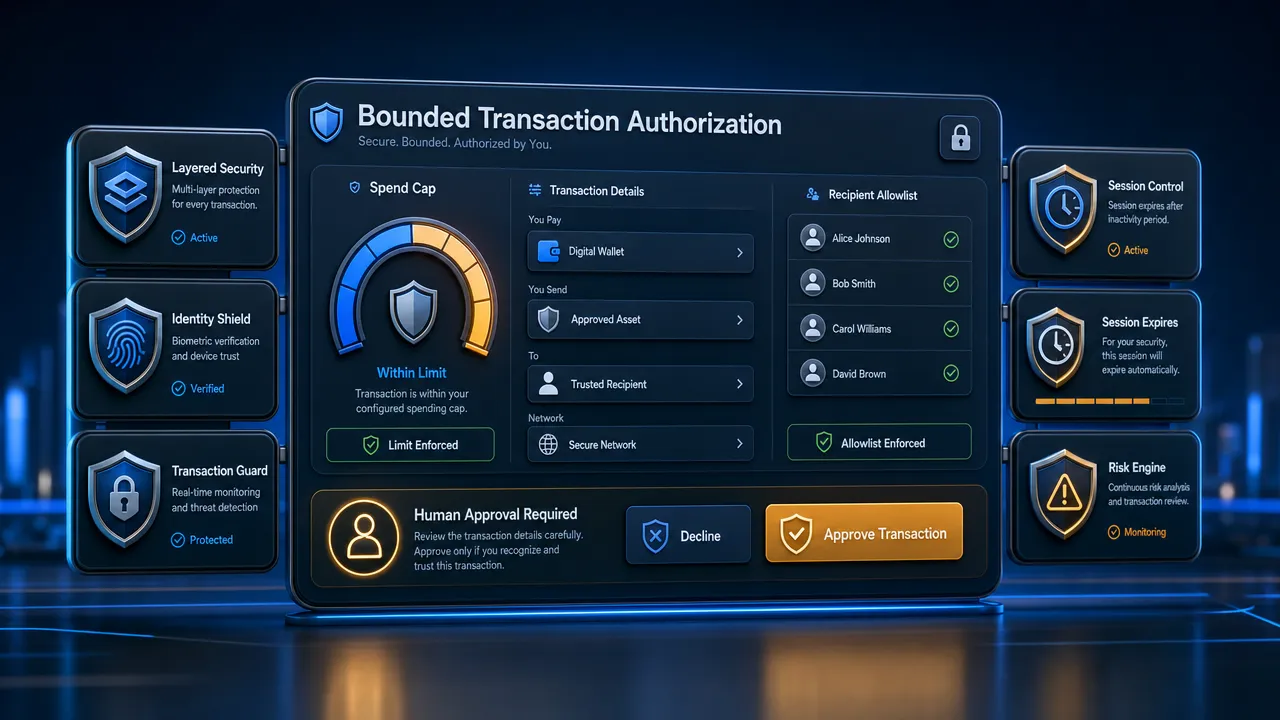
A secure wallet for AI agents should use defense in depth. No single warning, simulation, or approval screen can replace technically enforced limits.
Start with these controls before enabling any automated behavior.
| Control | Why it matters | Practical baseline |
|---|---|---|
| Separate operational wallet | Limits exposure to primary holdings | Use a dedicated wallet with a small balance |
| Spending caps | Prevents runaway or manipulated transactions | Set per-transaction and cumulative limits |
| Recipient allowlist | Blocks unapproved destinations | Permit only known addresses |
| Contract allowlist | Reduces exposure to unknown DApps | Restrict interactions to reviewed contracts |
| Exact token approvals | Limits third-party token spending authority | Avoid unlimited allowances when possible |
| Session expiry | Stops permissions from lasting indefinitely | Use short-lived delegated credentials |
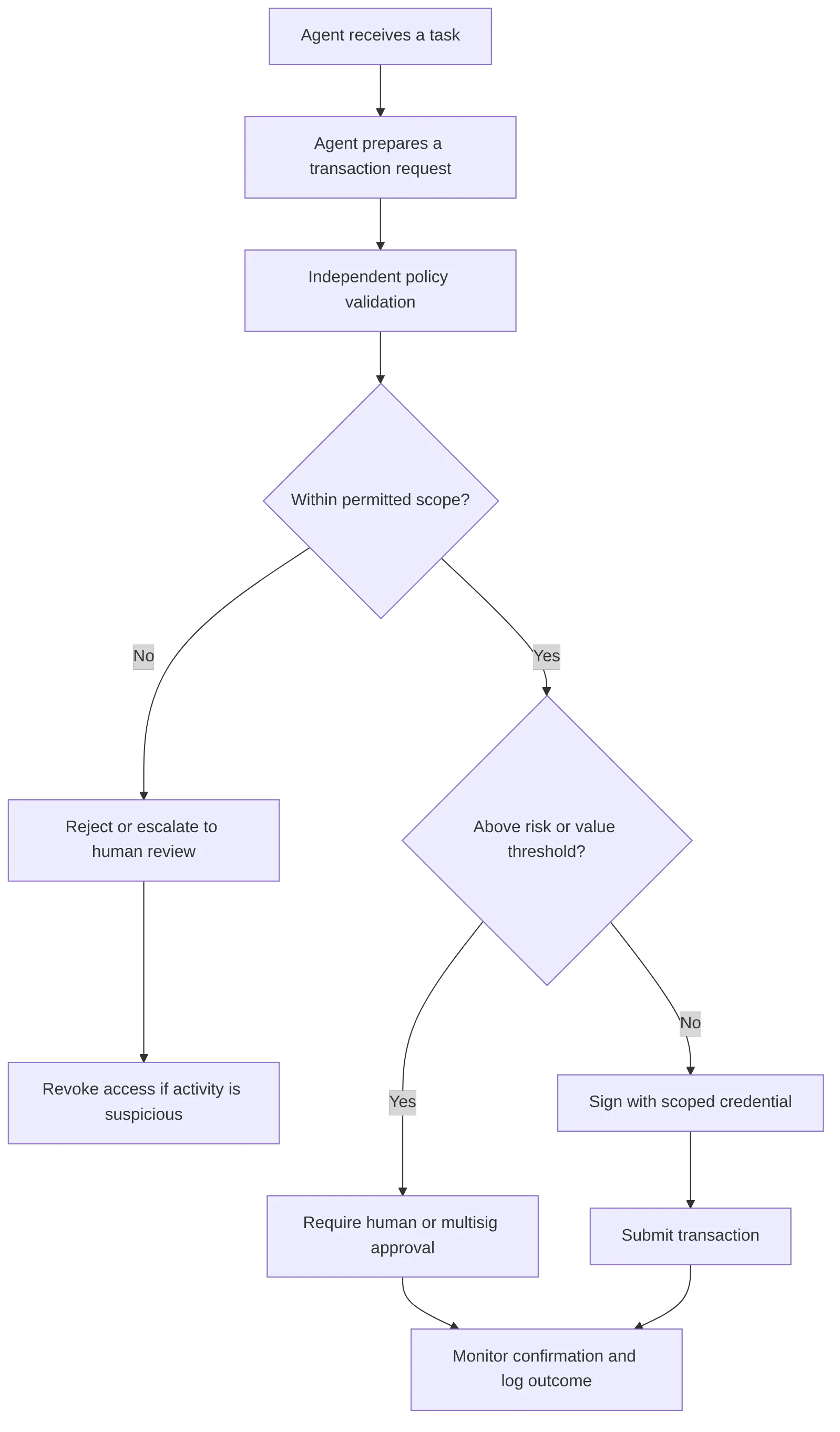
| Human escalation | Adds review for unusual actions | Require approval above a set threshold |
| Monitoring and logs | Helps identify abnormal behavior | Record agent intent, decisions, and transaction hashes |
| Revocation plan | Enables rapid response | Know how to remove access immediately |
The central principle is least privilege. Give an agent the smallest possible authority for the shortest possible period.
For example, an agent that pays a recurring service invoice should not also be able to trade assets, approve arbitrary token allowances, use new contracts, or change its own spending limit. The policy layer must enforce those rules independently of the AI model.
Prompt injection is another key risk. An agent may read a malicious webpage, DApp description, support message, social post, or API response that attempts to change its behavior. Treat every external input as untrusted. The model should be able to suggest an action, but it should not be the sole system deciding whether that action is allowed.
FoxWallet users can also benefit from wallet-level risk awareness when manually reviewing activity. Its documented protections include smart contract recognition, phishing and malicious-link protection, and pre-transaction alerts. Review FoxWallet's wallet security features before connecting to unfamiliar DApps or approving token permissions.
AI agent wallet setup comparison for common architectures
The comparison below is about fit, not a universal ranking. There is no single best wallet for AI agents because each architecture solves a different control problem.
| Architecture | Best fit | Automation potential | Key advantage | Main limitation |
|---|---|---|---|---|
| Non-custodial wallet | Individuals and manual workflows | Low | User keeps direct control | Does not provide built-in delegated automation |
| Low-value test wallet | Experiments and proofs of concept | Low to moderate | Limits financial exposure | Does not replace policy enforcement |
| Smart account | Developer-built agent workflows | High | Programmable rules and scoped permissions | Requires careful integration and monitoring |
| Multisig | Teams and treasuries | Moderate | Shared approval and governance | Can be slow for frequent actions |
| MPC setup | Organizations with formal controls | Moderate to high | Distributed signing and role separation | More complex operations and due diligence |
| Agent proposes, human signs | Most users | Moderate | Strong human oversight | Not hands-free |
FoxWallet belongs primarily in the first and sixth categories. It is suitable for users who want self-custody, multi-chain asset visibility, DApp access, and risk-aware transaction review while keeping final signature authority in their own hands.
It should not be described as an autonomous AI-agent wallet platform. Based on the available verified information, FoxWallet does not publicly claim smart accounts, agent session keys, MPC infrastructure, programmable delegated permissions, institutional policy engines, or dedicated AI-agent payment automation.
That distinction is important. A multi-chain wallet can be very useful in agent-assisted workflows without being the signing and policy infrastructure for autonomous execution.
For users evaluating cross-chain activity, keep the process separate from other on-chain actions and validate each transfer carefully. Read FoxWallet's guide to cross-chain swap risks before proceeding. Confirm the source chain, destination chain, final token, route, fees, and expected completion process with a small test amount first.
How to build your AI agent wallet setup step by step
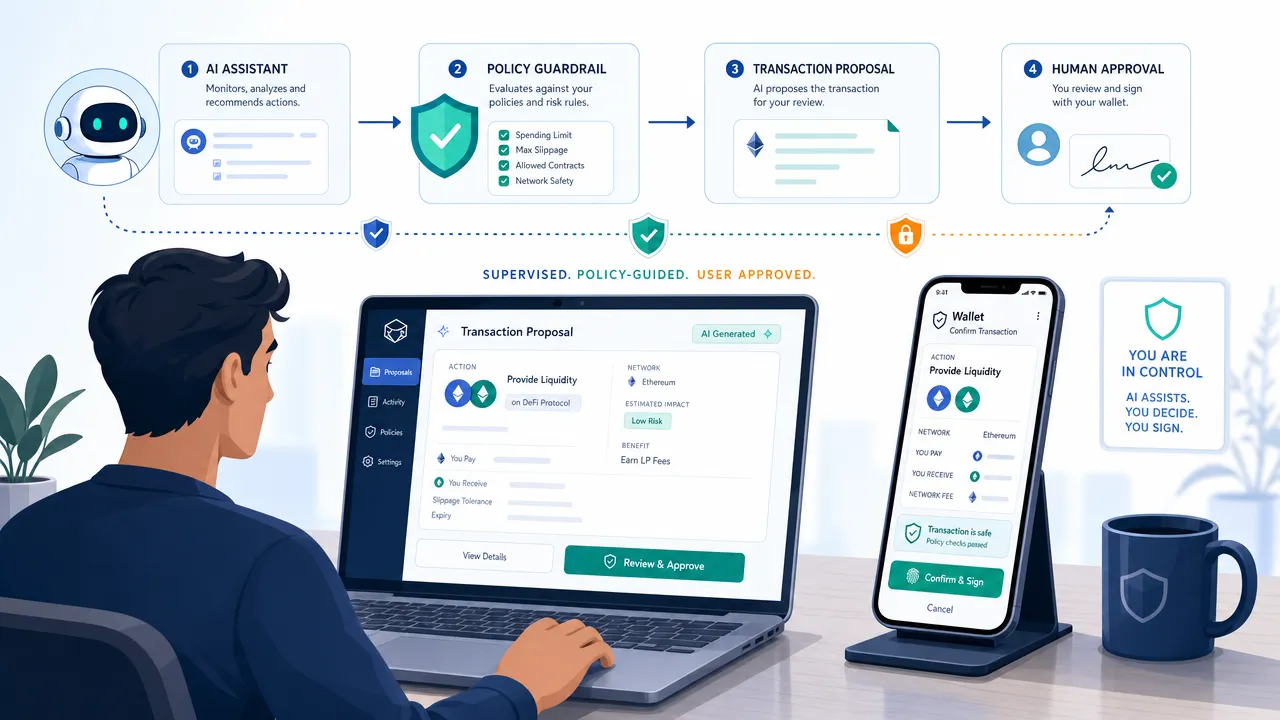
Use this process to create a safer AI agent wallet setup.
-
Define the agent's role.
Decide whether the agent will only research, prepare unsigned transactions, submit limited payments, or perform repeated app actions. Do not grant more access than the use case requires. -
Classify the risk level.
Keep test activity, operating funds, long-term holdings, and team funds in separate wallets or accounts. Never use your main holdings as an experiment environment. -
Choose a custody model.
For personal use, a non-custodial wallet and manual signing may be enough. For bounded automated execution, evaluate smart accounts or delegated-signing infrastructure. For shared funds, use a multisig or governed organizational setup. -
Set hard limits.
Define allowed chains, recipients, token types, contract addresses, transaction functions, per-action caps, and cumulative spending limits. -
Set an expiry date.
Any delegated permission should end automatically. Short-lived access reduces the risk created by forgotten credentials or changed conditions. -
Use a review threshold.
Require human approval for unfamiliar recipients, large values, unusual transactions, new contracts, or actions outside the agent's normal pattern. -
Test with the smallest viable amount.
Confirm the complete workflow before increasing limits. For cross-chain actions, verify the final asset and destination behavior, not just the first transaction. -
Prepare revocation and recovery.
Document who can pause the agent, revoke delegated access, remove token approvals, rotate credentials, and move remaining operational funds. -
Review permissions regularly.
Policies can drift as prompts, DApps, APIs, contracts, and business needs change. Remove access that is no longer essential.
For a user-controlled setup, FoxWallet provides a practical entry point for multi-chain asset management and DApp access without surrendering custody. Keep recovery information offline, never paste it into an agent tool, and treat each transaction confirmation as a final security decision.
AI agent wallet setup checklist for safer growth
Before using an agent with any wallet-connected workflow, verify the following:
- The agent has no seed phrase, private key, or master recovery credential.
- Long-term holdings are separate from experimental or operational funds.
- The wallet balance is limited to an acceptable loss amount.
- Allowed chains, contracts, recipients, and assets are clearly defined.
- Per-transaction and cumulative spending caps are enforced where automation exists.
- Token approvals are exact-value where feasible and reviewed regularly.
- Delegated access has a clear expiration date.
- A human or multisig approves high-impact actions.
- Transactions are decoded, reviewed, or simulated where available.
- Agent actions, policy decisions, and transaction hashes are logged.
- There is a tested way to pause activity and revoke permissions.
- Cross-chain transfers are tested with small amounts before larger activity.
The most responsible approach to crypto wallet automation is gradual. Start with an agent that advises. Move to an agent that prepares transactions. Only consider limited automated execution after you have clear policies, independent enforcement, monitoring, and emergency controls.
For many users, the best AI agent wallet setup remains an isolated, non-custodial wallet with a human in the signing loop. FoxWallet can support that self-custody-first approach with multi-chain visibility, DApp connectivity, and security-focused transaction review, while you remain in control of your private keys and assets.
FAQ
What's the safest wallet setup for someone just starting to experiment with AI agents?
A dedicated, low-value wallet where the user manually signs every transaction. The agent can research, compare, and draft transaction details, but it never holds signing authority. This limits potential loss to whatever is in that isolated wallet, not your primary holdings.
Is a non-custodial wallet enough to keep an AI agent's actions safe?
No. Self-custody and automation are separate questions. A non-custodial wallet means you hold your own keys; it says nothing about whether an agent has been given safe, scoped permission to transact. Those need to be designed independently.
What's the difference between a smart account and a multisig wallet for agent use?
A smart account (via providers like Biconomy or ZeroDev) enforces rules programmatically — spending caps, allowlists, session expiry — and can let an agent sign within those bounds. A multisig (like Safe or Squads) instead requires independent human signers to approve every transaction; the agent can only propose, never sign alone. Multisig suits shared treasury funds; smart accounts suit bounded, repeatable individual actions.
Should an AI agent ever hold a seed phrase or master private key?
No, under any architecture. An agent should only ever receive scoped, revocable credentials with hard limits on recipients, amounts, and duration. A leaked or manipulated seed phrase is an irreversible, unlimited loss; a leaked scoped credential is a bounded one.
Does FoxWallet offer autonomous agent-signing infrastructure?
No. Based on available information, FoxWallet does not publicly offer smart accounts, agent session keys, MPC infrastructure, or programmable delegated permissions. It is a non-custodial, multi-chain wallet suited to the "agent proposes, human signs" and manual-signing patterns described above, not autonomous execution infrastructure.