


Can an AI Agent Actually Hold Crypto? What Self-Custody Means for Autonomous Systems

An AI agent can act through a crypto account, but it does not independently "hold" or own crypto merely because it selects an action. On-chain balances belong to addresses and smart-contract accounts, while transactions are authorized by private keys, multisignature approvals, or programmed account rules. That distinction is the foundation of AI agent self-custody.
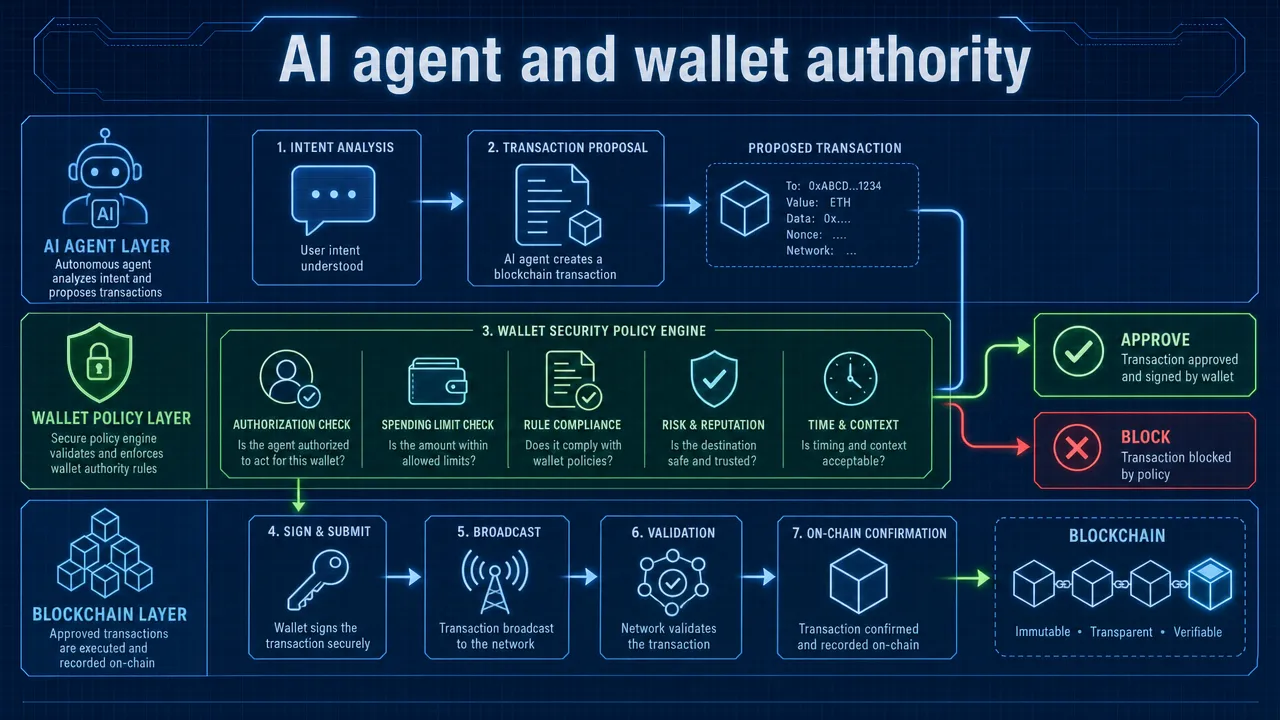
How AI agent self-custody works when an agent can act but cannot become the owner
The precise answer to "can AI agents hold crypto" is conditional. An AI system can interact with an account that holds a token balance, draft transactions, monitor on-chain conditions, and in some designs execute limited transactions. But blockchain networks do not determine whether an AI has intent, legal status, or ownership rights. They validate signatures and account rules.
Ethereum account documentation describes two core account types: externally owned accounts, which rely on private-key signatures, and contract accounts, which operate through deployed code. In both cases, the network recognizes valid authorization, not the identity of the software that suggested an action.
That creates three separate concepts that should not be conflated:
| Concept | What it means for an AI system |
|---|---|
| Operational control | The agent can propose a recipient, amount, contract interaction, or sequence of actions. |
| Technical control | The agent environment can satisfy a signing or smart-account authorization rule. |
| Legal or beneficial ownership | A person, company, DAO, or other recognized entity may hold the economic rights and responsibilities related to the assets. |
This is why crypto ownership for autonomous systems requires more than putting a wallet address into an agent workflow. An agent may be a decision-making component, but the user or organization should remain the identifiable authority behind the wallet, recovery process, and spending rules.
A useful way to frame self-custody for AI agents is this: the user or organization keeps root control over keys and recovery, while the agent receives only the smallest level of authority needed for a defined task.

The important design choice is separation. The agent can reason about a task, but the authority layer should independently check what the agent is attempting to do.
AI agent self-custody models range from human approval to restricted automation
Not every AI agent crypto wallet arrangement provides the same protection. The safest model depends on asset value, transaction frequency, the consequences of an error, and whether authority can be paused or revoked.
| Custody model | Who has final authority? | Agent autonomy | Main concern | Suitable scenario |
|---|---|---|---|---|
| AI assistance with human signing | User signs each transaction | Low | User may still miss deceptive details | Research, transaction preparation, higher-value actions |
| Scoped delegated authority | User retains root control, agent uses limited permission | Medium | Permissions may be too broad | Repetitive, low-value actions |
| Smart account with policy rules | Account code enforces owner-defined conditions | Medium to high | Contract and configuration risks | Controlled operational automation |
| Multisig approval | Multiple authorized signers approve | Low to medium | Coordination and governance friction | Treasury transfers and exceptions |
| Hosted signing environment | Provider or operator may influence key access | Medium to high | User may not have full independent recovery | Specialized institutional workflows |
| Unrestricted agent key | Agent runtime directly accesses a private key | High | Prompt injection, tool abuse, and broad loss exposure | Limited sandbox testing only |
The conservative starting point for autonomous systems crypto custody is AI assistance with human signing. In this model, the agent may explain a transaction or prepare parameters, but it cannot move funds without a user review.
A more automated option uses narrow delegated permissions. EIP-7715 outlines a proposed approach to delegated session keys, which can theoretically restrict an authorization to specific contracts, spending limits, time windows, or actions. However, an EIP proposal is not proof of universal implementation, wallet compatibility, or security.
Smart accounts can create more programmable rules. ERC-4337 explains account abstraction mechanisms that support custom validation logic. For example, a smart account could require a second approval above a certain limit or reject transactions outside an approved contract list. These controls can improve governance, but they also introduce code, configuration, and upgrade risks.
The least defensible model is unrestricted signing authority in an AI runtime. It may look like full autonomy, but it weakens practical control if the runtime, cloud environment, tool interface, or prompt context becomes compromised.

AI agent self-custody depends on independent wallet authority, not an agent prompt
An AI agent is not a secure wallet simply because it can call a blockchain tool. A real self-custody design requires credentials, policies, and recovery authority that remain outside the agent's natural-language reasoning environment.
A sound architecture separates five roles:
- Agent layer: Interprets goals, reads inputs, and proposes an action.
- Transaction layer: Converts that proposal into a structured transaction request.
- Policy layer: Checks chain, token, amount, recipient, contract, method, and time constraints.
- Authorization layer: Uses a signer, multisig process, or smart-account rule to approve permitted actions.
- Monitoring layer: Logs actions, watches for anomalies, and supports rapid revocation.
This matters because an agent can misunderstand an instruction without gaining unlimited control of assets. The policy and authorization layers should be able to reject a flawed request even when the agent is confident.
For example, an agent asked to pay a vendor should not be free to select any address, approve any token allowance, or switch to another chain. A better policy might permit only one recipient, one asset, a fixed amount range, a limited time period, and a predefined network.
This is also where a non-custodial wallet has a useful role. FoxWallet is a multi-chain, non-custodial wallet designed around user control of private keys and assets. It supports locally encrypted mnemonic phrases and private keys, unified multi-chain asset visibility, DApp access, mobile availability, and a browser extension.
FoxWallet should be viewed as a user-controlled foundation for AI-assisted Web3 activity, not as a claim that it provides autonomous agent custody, agent signing, session keys, or AI trading automation. The user still needs to understand what an external AI tool can access and what permissions a transaction requests.
For additional context on why bounded authorization matters, see FoxWallet's discussion of why AI agent wallets need policy engines to stay safe.
AI agent self-custody security must address prompts, approvals, and transaction risk
Autonomous agent wallet security combines familiar Web3 risks with AI-specific risks. A malicious contract, a misleading token approval, or a compromised key is dangerous on its own. When an agent can read webpages, process messages, call tools, and prepare transactions, an unsafe instruction can become an on-chain action.
OWASP guidance for LLM applications identifies prompt injection as a major risk. An indirect prompt injection can be hidden in a webpage, DApp interface, token description, document, email, or API response. If the agent treats external content as trusted instructions, it may attempt an unsafe tool call.
| Risk | Example | Control that reduces exposure |
|---|---|---|
| Prompt injection | A malicious page tells the agent to ignore its payment limits | Treat external content as untrusted and enforce policy outside the model |
| Private-key exposure | A seed phrase appears in an agent prompt, log, or environment variable | Keep root recovery phrases and keys outside agent environments |
| Recipient substitution | The agent proposes an address that differs from the intended recipient | Use recipient allowlists and human-readable transaction previews |
| Excessive token approval | The agent signs an unlimited allowance for an untrusted contract | Use minimal allowances and review approval scopes |
| Unapproved contract interaction | The agent calls an unfamiliar protocol or function | Restrict contracts and function selectors through allowlists |
| Incorrect chain selection | An action is prepared for the wrong network | Validate chain ID before authorization |
| Data manipulation | A false price feed or API result influences the agent | Verify inputs independently and use sanity limits |
| Runaway activity | The agent repeats actions beyond the intended budget | Set per-action, daily, and session caps |
Token approvals deserve special attention. Under the ERC-20 token standard, an approval can grant a smart contract permission to spend tokens later. That means an agent does not need to directly transfer a token to create risk. A broad approval to an unsafe spender may be enough to expose funds.
Cross-chain actions add another layer of complexity. They can involve route selection, bridges or messaging systems, token representations, liquidity, fees, destination-chain confirmation, and smart-contract approvals. Ethereum's bridge guidance explains why these workflows have their own assumptions and risks. Cross-chain activity should be assessed independently, rather than treated as equivalent to other on-chain activities.
For practical context before approving a multi-network transaction, review FoxWallet's guide to cross-chain swap risks.
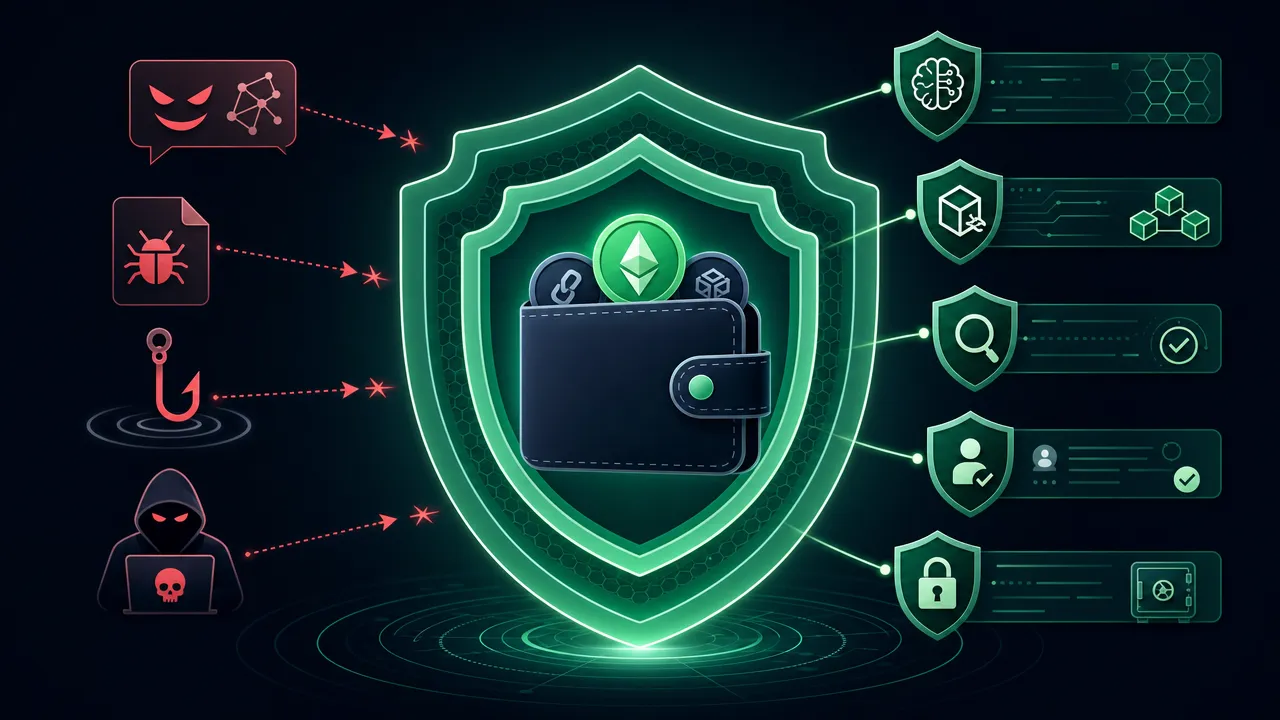
AI agent self-custody works best with limits that people can inspect and revoke
The goal is not to eliminate all automation. The goal is to ensure that autonomy remains controlled, visible, and proportionate to the risk.
Use these safeguards before allowing an AI system to participate in a crypto workflow:
-
Keep root credentials separate. Never provide a seed phrase or primary private key to an AI chatbot, browser agent, prompt, source repository, or routine cloud environment.
-
Use a dedicated operational balance. Keep long-term holdings and material reserves separate from any wallet used for AI-connected tasks.
-
Apply least privilege. Limit the assets, networks, recipients, contracts, functions, amount, and duration available to the agent.
-
Set cumulative spending limits. A cap per transaction is not enough. Add limits for a session, day, or week.
-
Require approval for exceptions. New recipients, new contracts, unusually large amounts, and unfamiliar chains should trigger human or multisig review.
-
Make permissions temporary. Expiring authority is safer than indefinite authority. Ensure that revocation or pause actions are available and clearly assigned.
-
Review approvals as carefully as transfers. A token allowance can create a durable spending right, so it needs the same scrutiny as a direct payment.
-
Monitor every action. Keep records of prompts, policy decisions, tool calls, approvals, and transaction hashes so a team can investigate anomalies quickly.
-
Test with small amounts. Before relying on an automated workflow, use a limited operational balance and verify expected results.
-
Do not let the agent edit its own limits. Policy configuration, spending caps, and emergency controls should be protected by an independent authority.
For individuals, AI agent self-custody usually means retaining direct signing control and treating the AI as an advisor. For teams, it often means separating treasury funds, operational funds, testing funds, and approval roles. For developers, it means keeping deterministic authorization checks outside the model and treating all model output as untrusted input.
FoxWallet's non-custodial approach is relevant here because users retain control of their private keys and assets while accessing multi-chain balances and DApps. Its pre-transaction risk alerts, smart-contract recognition, and local key encryption can support more deliberate on-chain decision-making. They do not guarantee that every external DApp, AI tool, contract, or cross-chain route is safe.
Readers seeking broader wallet hygiene can also explore FoxWallet's wallet security feature guide and its resource on secure multi-chain asset management.
AI agent self-custody keeps people or organizations accountable for crypto authority
AI agents can be useful participants in crypto workflows, but they should not be mistaken for independent owners. The account holds the balance. The signature or smart-account rule authorizes the transaction. The person or organization controlling recovery, policy, and governance remains accountable for how that authority is used.
The strongest form of self-custody for AI agents is controlled autonomy: user-held root authority, separate operational funds, narrow permissions, transaction review, monitoring, and a clear way to stop the system.
An autonomous system can act quickly without being granted unrestricted power. That is the practical standard for autonomous systems crypto custody: make authority visible, limited, reviewable, and revocable.
FAQ: AI agents and crypto self-custody
Can an AI agent technically own a crypto wallet?
No. Ownership and authorization are separate from an agent's ability to propose or execute an action. Blockchain networks validate signatures and account rules, not the identity or intent of whatever software suggested the transaction. A person or organization remains the accountable party behind the wallet, regardless of how much of the workflow an agent handles.
What's the safest way to let an AI agent interact with crypto today?
AI assistance with human signing, where the agent can prepare or explain a transaction but cannot broadcast it without a human reviewing and signing. Every more-automated model in this article trades some of that safety for convenience, and should only be adopted deliberately, with the operational fund kept separate from long-term holdings.
Are delegated session keys (EIP-7715) production-ready?
Not universally. It's a real, currently Draft-status Ethereum proposal, worth understanding, but a draft specification is not the same as broad wallet support or a security guarantee. Treat it as a direction the ecosystem is moving toward, not a solved problem to build production systems on today.
Does FoxWallet provide agent signing or automated trading?
No. FoxWallet is a non-custodial, multi-chain wallet built around user-controlled keys, asset visibility, and risk-aware transaction review. It is not an agent-custody platform, a session-key system, or an automated trading tool, and this article shouldn't be read as implying otherwise.
What's the single biggest risk when connecting an AI tool to a wallet?
Treating agent output as trusted by default. Whether it's a prompt injection hidden in a webpage or an overly broad token approval, the pattern is the same: the policy and authorization layers need to independently check what the agent is attempting, rather than assuming a confident-sounding request is a safe one.
Explore FoxWallet for a non-custodial, multi-chain wallet experience centered on user-controlled keys, asset visibility, DApp access, and risk-aware on-chain activity. Before connecting any AI-enabled tool to a wallet, verify exactly what it can see, what it can request, and what it can authorize.
This article is for educational purposes only and is not investment, legal, tax, or security advice. Digital-asset transactions involve risk and may be irreversible.