


Why a hardware crypto wallet beats app-only storage

A hardware crypto wallet beats app-only storage because it keeps private keys away from everyday internet-connected devices, reducing the risk that malware, phishing, fake apps, or browser threats can directly reach the credentials that control your assets.
That does not mean every app wallet is unsafe or that every user must sign every transaction from cold storage. A practical crypto wallet strategy separates roles: use hardware cold storage for long-term or high-value holdings, and use a secure non-custodial wallet for active Web3 tasks like multi-chain asset management, DApps, DeFi, NFTs, GameFi, and cross-chain swaps.
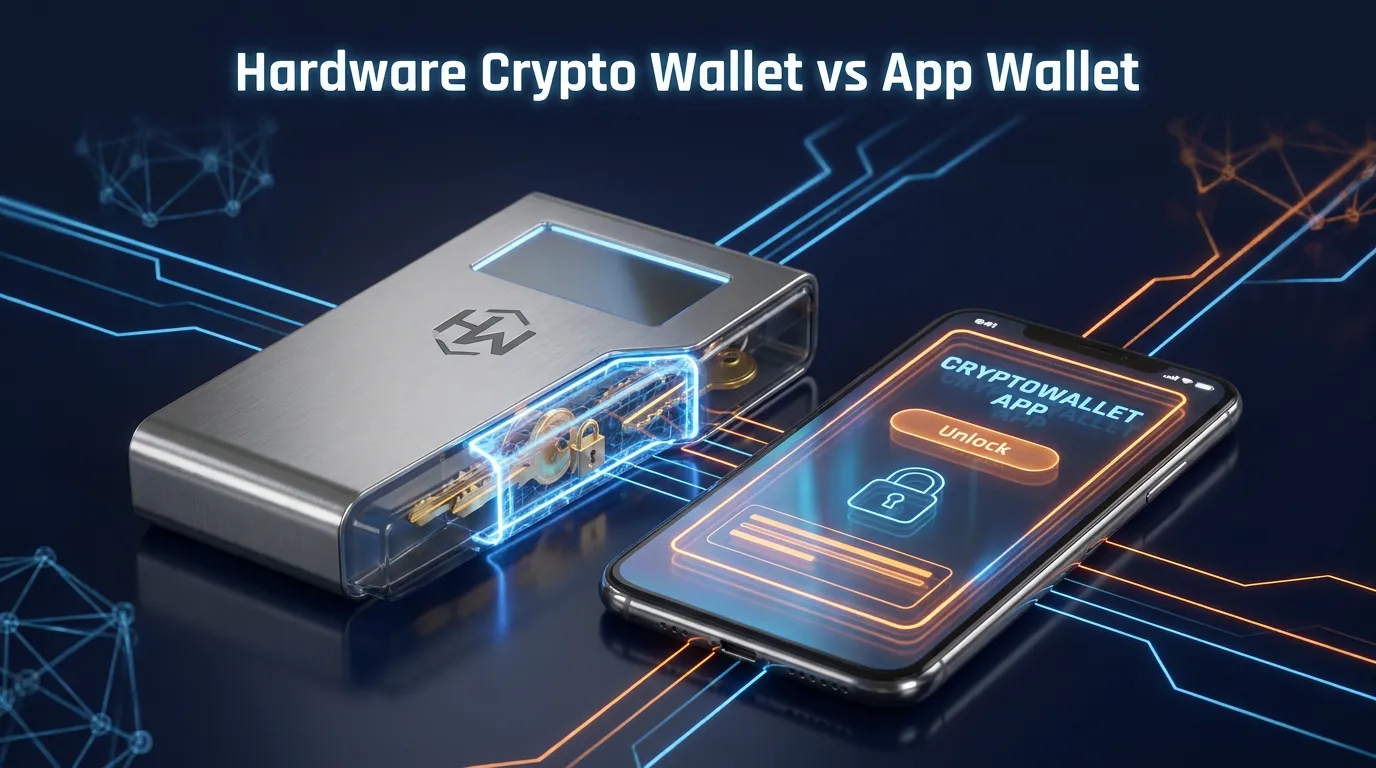
For active Web3 users, FoxWallet fits the second role: it is a non-custodial, multi-chain decentralized wallet for mobile and browser extension use. FoxWallet does not position itself as a hardware wallet. Instead, it gives users full control of their private keys while supporting local encryption, unified multi-chain asset visibility, cross-chain swaps, DApp access, and transaction risk awareness.
Why a hardware crypto wallet reduces online private-key exposure
A hardware crypto wallet is built around one simple security idea: keep the private key isolated from general-purpose devices. Your phone or computer can prepare a transaction and broadcast it to the blockchain, but the hardware device signs the transaction internally. According to Trezor's hardware wallet explanation and Kaspersky's hardware wallet guide, this separation helps reduce exposure to online threats.
In an app-only wallet, the encrypted private key or signing credential usually lives on a phone, desktop, or browser environment. Good wallets protect that data with encryption and local security controls, but the device is still online. That online convenience creates a larger attack surface.
| Wallet setup | Best use case | Main strength | Main limitation |
|---|---|---|---|
| Hardware crypto wallet | Long-term and high-value holdings | Private-key isolation and offline signing | Less convenient for frequent Web3 activity |
| App-only crypto wallet | Daily transactions, DApps, swaps, NFTs, GameFi | Fast access and strong usability | More exposure to device and browser threats |
| Non-custodial multi-chain wallet | Active self-custody across networks | User controls keys and manages assets directly | User must protect seed phrase and approvals |
| Custodial account wallet | Beginner exchange access | Simpler recovery experience | Third party controls or co-controls access |
The point is not that hardware wallets are perfect. The point is that they remove one of the biggest app-only risks: direct private-key exposure on an internet-connected device.
What a crypto wallet actually protects: keys, signatures, and recovery phrases
A crypto wallet does not literally store coins. Blockchain assets remain on-chain. The wallet manages the private keys, seed phrase, addresses, and signatures that allow you to control those assets. Educational resources such as Privy's crypto wallet security guide and Gemini's wallet security overview describe wallets as tools for accessing and authorizing blockchain activity.
That distinction matters because the real security target is not the app icon. It is the signing authority.
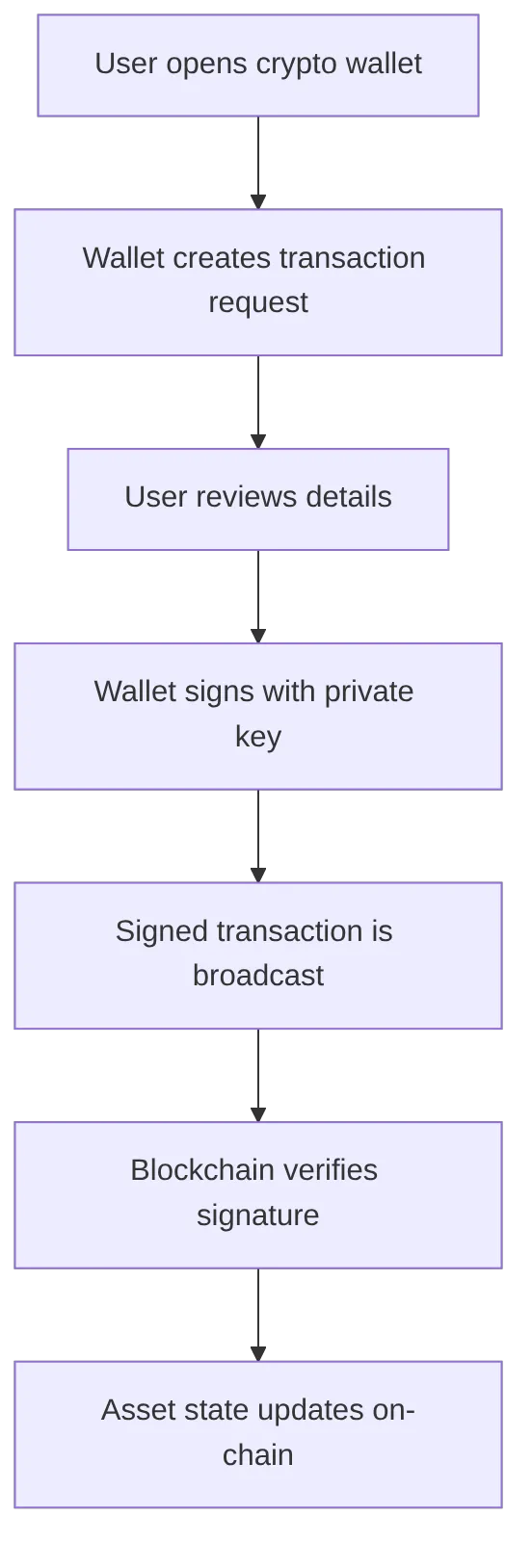
In a software wallet, signing happens inside an online environment. In a hardware crypto wallet, signing happens inside the dedicated device, and the private key normally stays there. That difference explains why hardware wallets are widely preferred for cold storage.
Seed phrase security is equally important. If someone obtains your seed phrase, they may be able to restore your wallet elsewhere and move assets without your phone, password, or hardware device. Ledger's crypto wallet security checklist emphasizes that recovery phrases must be protected from screenshots, cloud storage, phishing pages, and social engineering.
Where an app-only crypto wallet is most exposed
An app-only crypto wallet wins on convenience. It is fast, mobile, DApp-friendly, and often easier for beginners. That is why active Web3 users rely on mobile wallet apps and browser extension wallets every day. But the same features that make app wallets useful also create risks.
The most common app-only risks include malware, fake wallet apps, phishing links, malicious browser extensions, clipboard hijacking, device theft, cloud backup exposure, and harmful token approvals. Zimperium's overview of crypto wallet security threats highlights mobile and web risks around secure key management, phishing, and device compromise. Kaspersky has also reported cases of fake crypto wallet apps designed to steal recovery phrases or private keys.
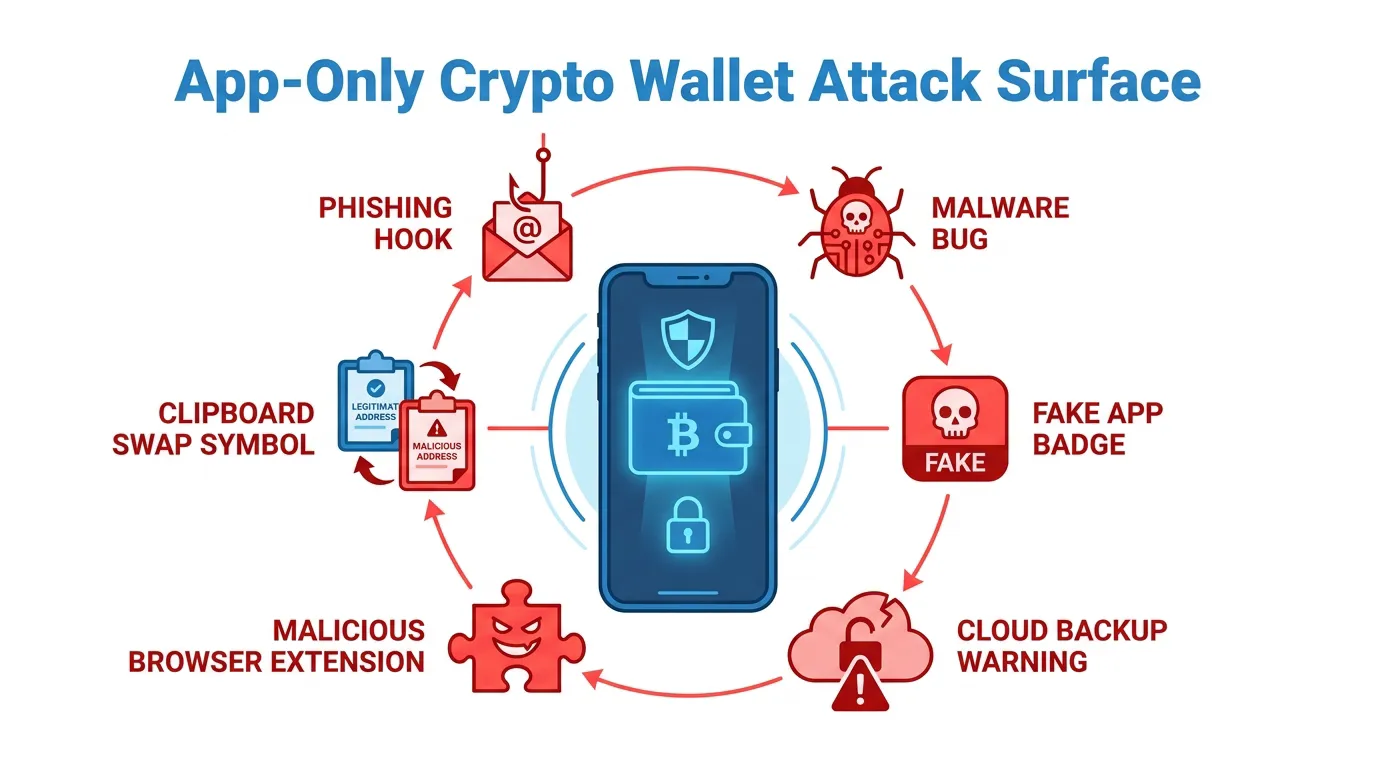
A secure app wallet should reduce these risks with local encryption, official download channels, risk alerts, phishing protection, and clear transaction details. Still, no app can fully remove user-driven risks such as entering a seed phrase into a fake website or approving a malicious smart contract.
The qualitative chart below shows why different risks feel so different in practice. It is not incident-frequency data. It simply compares how severe a risk can be for an app-only crypto wallet user.
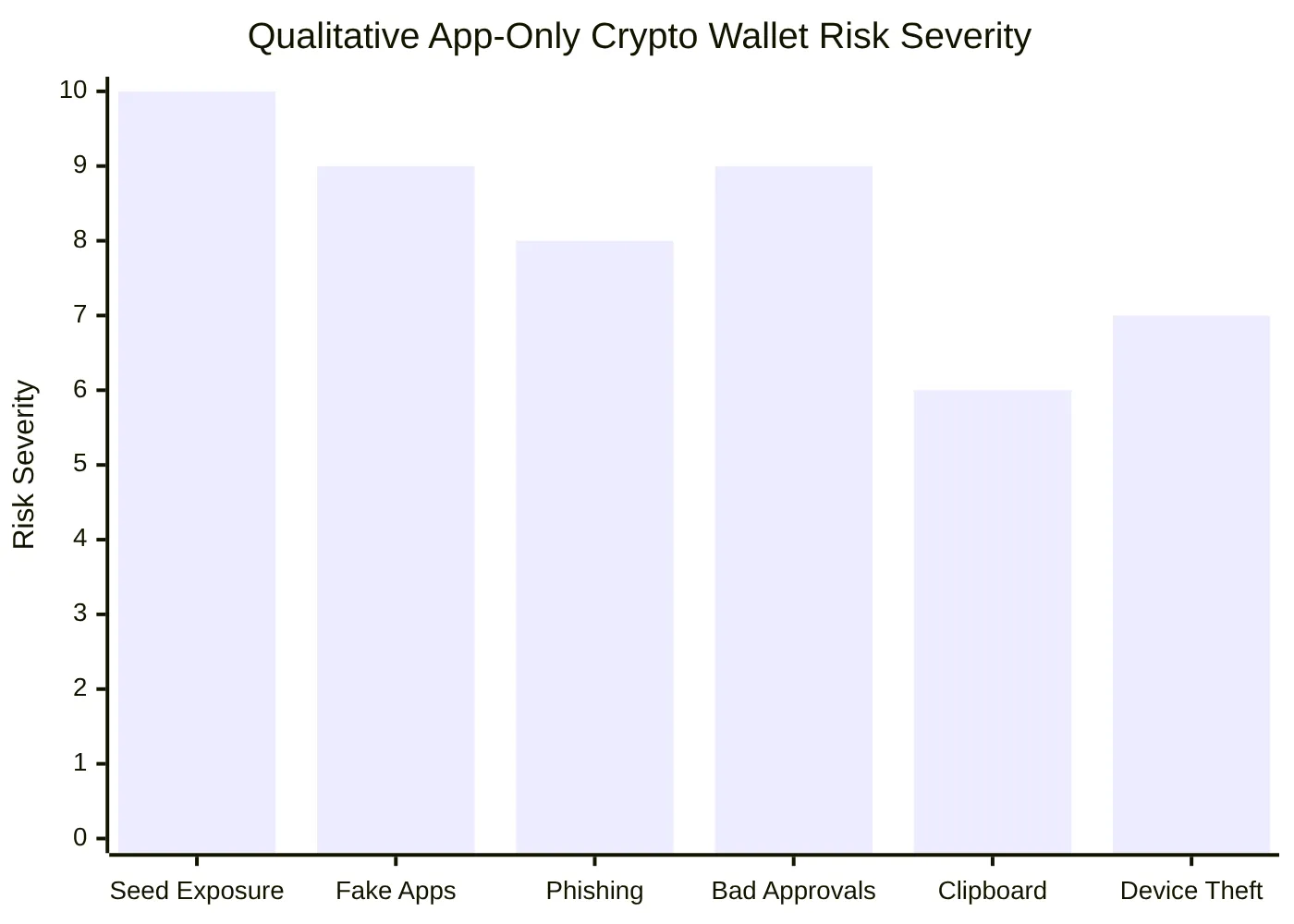
Token approvals deserve special attention. A user may think they are simply connecting to a DApp, claiming an NFT, or approving a swap, while the actual request grants ongoing spending permissions. Tools like the Etherscan token approval checker can help users review and revoke certain Ethereum approvals.
How to use a hardware crypto wallet without ignoring remaining risks
A hardware crypto wallet is a risk-reducing tool, not a magic shield. It is strongest against remote private-key extraction and malware-based key theft. It is weaker against social engineering, recovery phrase exposure, malicious approvals, and careless recovery practices.
| Remaining risk | Why it still matters | Safer habit |
|---|---|---|
| Seed phrase compromise | A seed phrase can restore the wallet elsewhere | Store it offline, never in photos or cloud notes |
| Malicious approvals | Hardware devices can still sign harmful permissions | Read requests carefully and revoke unused approvals |
| Supply-chain tampering | A tampered device may create hidden risk | Buy from official sources and verify setup steps |
| Physical theft | A stolen device can be attacked | Use strong PINs and secure storage |
| Recovery mistakes | Lost backups can mean lost access | Test recovery knowledge with small amounts first |
For long-term storage, a hardware crypto wallet is usually the better choice. For frequent DApp activity, it can be slow or inconvenient. That is why many experienced users separate their wallets by purpose: one cold-storage wallet for savings, one active wallet for on-chain interaction, and sometimes additional wallets for higher-risk activities like new mints or experimental DApps.
This separation is not paranoia. It is basic operational security. You do not need every asset exposed to every signature request.
Why FoxWallet belongs in an active crypto wallet strategy
FoxWallet belongs in the active side of a crypto wallet stack. It is designed for users who need self-custody plus practical Web3 access across multiple chains. With FoxWallet, users retain control of their private keys and assets, while the wallet supports locally encrypted storage of mnemonic phrases and private keys.
FoxWallet is especially useful when users need more than a simple hold-and-wait wallet. It supports multi-chain asset management, automatic asset and NFT detection across networks, real-time on-chain synchronization, and a unified cross-chain asset view. For users managing assets across several blockchains, this reduces the friction of switching tools and manually checking balances.
For trading and on-chain activity, FoxWallet also supports built-in cross-chain swaps through integrated swap aggregators. The goal is to help users route transactions for better pricing and liquidity while reducing slippage and operational complexity. Cross-chain swaps should still be handled carefully: always check the source chain, destination chain, token identity, route, fees, and final settlement status. FoxWallet's cross-chain swap risk guide is a useful companion for that workflow.
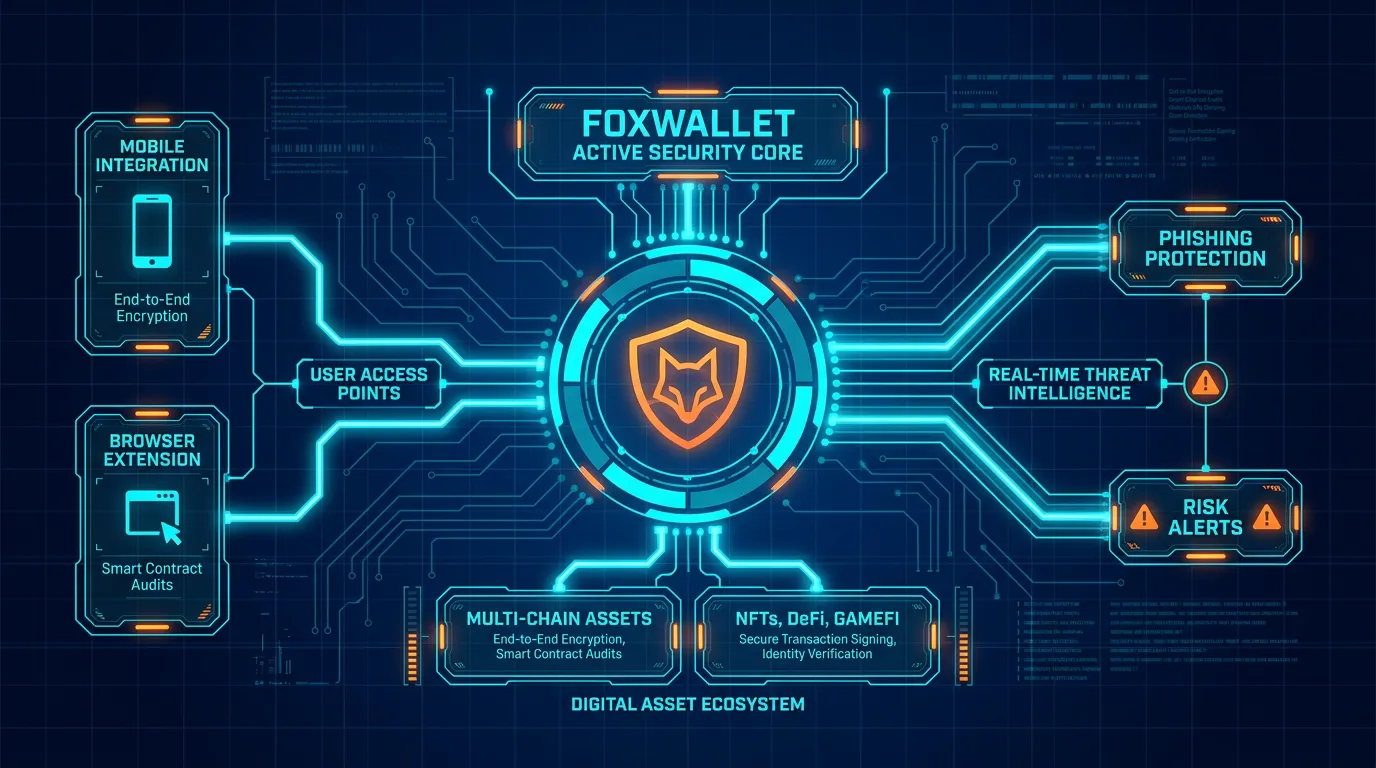
Security also matters during active use. FoxWallet provides pre-transaction risk alerts, smart contract recognition, phishing protection, and security strategies built around non-custodial self-custody. Readers who want more detail can review FoxWallet's guide to secure multi-chain wallet management and its overview of FoxWallet wallet security features.
The balanced view is simple: use hardware cold storage for long-term high-value holdings, and use FoxWallet for active Web3 interactions where mobile access, browser extension workflows, DApps, NFTs, DeFi, GameFi, and multi-chain visibility matter. For deeper active-asset workflows, FoxWallet's guide to managing Web3 assets gives practical context.
Crypto wallet security checklist for cold storage and active Web3
A better crypto wallet setup starts with wallet segmentation. Do not keep every asset in the same app-only wallet that connects to every new DApp. Do not treat hardware storage as a reason to ignore transaction details. Do not store recovery phrases in convenient but risky places.
Use this checklist as a practical baseline:
| Security action | Applies to hardware wallet | Applies to app-only wallet | Why it matters |
|---|---|---|---|
| Store seed phrase offline | Yes | Yes | Prevents cloud and device compromise |
| Avoid screenshots of recovery phrases | Yes | Yes | Reduces accidental exposure |
| Verify official download sources | Yes | Yes | Helps avoid fake apps and fake tools |
| Start with small test transactions | Yes | Yes | Limits damage from mistakes |
| Review approvals regularly | Yes | Yes | Reduces smart-contract permission risk |
| Separate active and long-term wallets | Yes | Yes | Limits blast radius |
| Keep apps and devices updated | Yes | Yes | Reduces known software vulnerabilities |
| Use risk-aware wallet tools | Helpful | Essential | Improves decision-making before signing |
For long-term holdings, a hardware crypto wallet usually offers stronger isolation. For active Web3, a secure non-custodial wallet is still necessary. FoxWallet gives users a practical way to manage multi-chain assets, access DApps, perform cross-chain swaps, and maintain self-custody across mobile and browser extension environments.
The strongest crypto wallet strategy is not hardware-only or app-only. It is purpose-built: cold storage for assets you rarely move, and FoxWallet for the active Web3 workflows where speed, visibility, risk alerts, and multi-chain control matter.