Tokenized Gold Explained: PAXG vs XAUT and How Crypto Gold Works

Tokenized gold gives investors on-chain access to a token linked to vaulted gold, but it does not place a physical bar in their wallet or remove reliance on an issuer, custodian, legal terms, and redemption process. Often called crypto gold, gold-backed cryptocurrency, or digital gold tokens, this asset category combines blockchain transferability with a layer of off-chain operational risk that buyers should understand before transacting. It is one specific form of real-world asset tokenization, not a substitute for understanding the legal structure behind the token.
PAX Gold, known as PAXG, and Tether Gold, known as XAUT, are two widely recognized examples. Both issuers state that one token represents one fine troy ounce of London Good Delivery gold. Yet their issuer structures, reserve disclosures, contract-verification processes, redemption conditions, and eligibility rules are not identical.
Tokenized gold explained: What ownership does and does not mean
Tokenized gold is a blockchain-based token designed to represent a defined interest in physical gold held outside the blockchain system. The blockchain records the token balance and transfers. The physical gold remains in a vault under an issuer and custody arrangement.
That distinction matters. Owning tokenized gold generally means controlling a token through a wallet address and private key. It does not automatically mean that you personally possess a gold bar, may select a particular bar, or can request delivery of a small amount of gold at any time.
A typical structure includes five distinct roles:
| Role | Main responsibility | What users should verify |
|---|---|---|
| Issuer | Creates and retires tokens, defines holder rights | Legal entity, terms, redemption process |
| Custodian or vault | Holds and records physical gold | Custody disclosures and reserve information |
| Attestation provider | Reviews specified reserve information | Scope, date, and limitations of the report |
| Blockchain network | Records balances and validates transfers | Token contract, network, gas requirements |
| Wallet holder | Controls the token with private keys | Recovery phrase protection and transaction accuracy |
Under the current Pax Gold terms, PAXG represents fractional ownership of allocated London Good Delivery bars held in custody. A holder with less than a full bar has a pro rata fractional interest rather than physical possession of a particular bar. See the official PAX Gold product information and legal terms for the current structure and redemption options.
Tether Gold states that each XAUT represents one fine troy ounce of gold on a London Good Delivery bar. Its legal terms describe a holder's legal title to an undivided specific interest in the gold reserves. That interest is governed by the issuer's current Tether Gold product materials and legal terms; it is not the same as taking physical possession of bullion.
Tokenized gold is also different from a fiat stablecoin. A stablecoin commonly aims to follow a currency such as the US dollar. A gold-backed cryptocurrency is designed to provide exposure to gold, so its market value can rise and fall as gold prices change. It can also trade above or below the gold spot reference price because of liquidity, spreads, trading demand, network fees, and redemption friction.
How tokenized gold works from vaulting to blockchain transfer
How crypto gold works involves both an off-chain custody process and an on-chain token process. The issuer acquires or arranges custody for gold, then mints tokens under its stated backing model and legal terms. Users can subsequently buy, receive, transfer, or trade those tokens on supported networks.
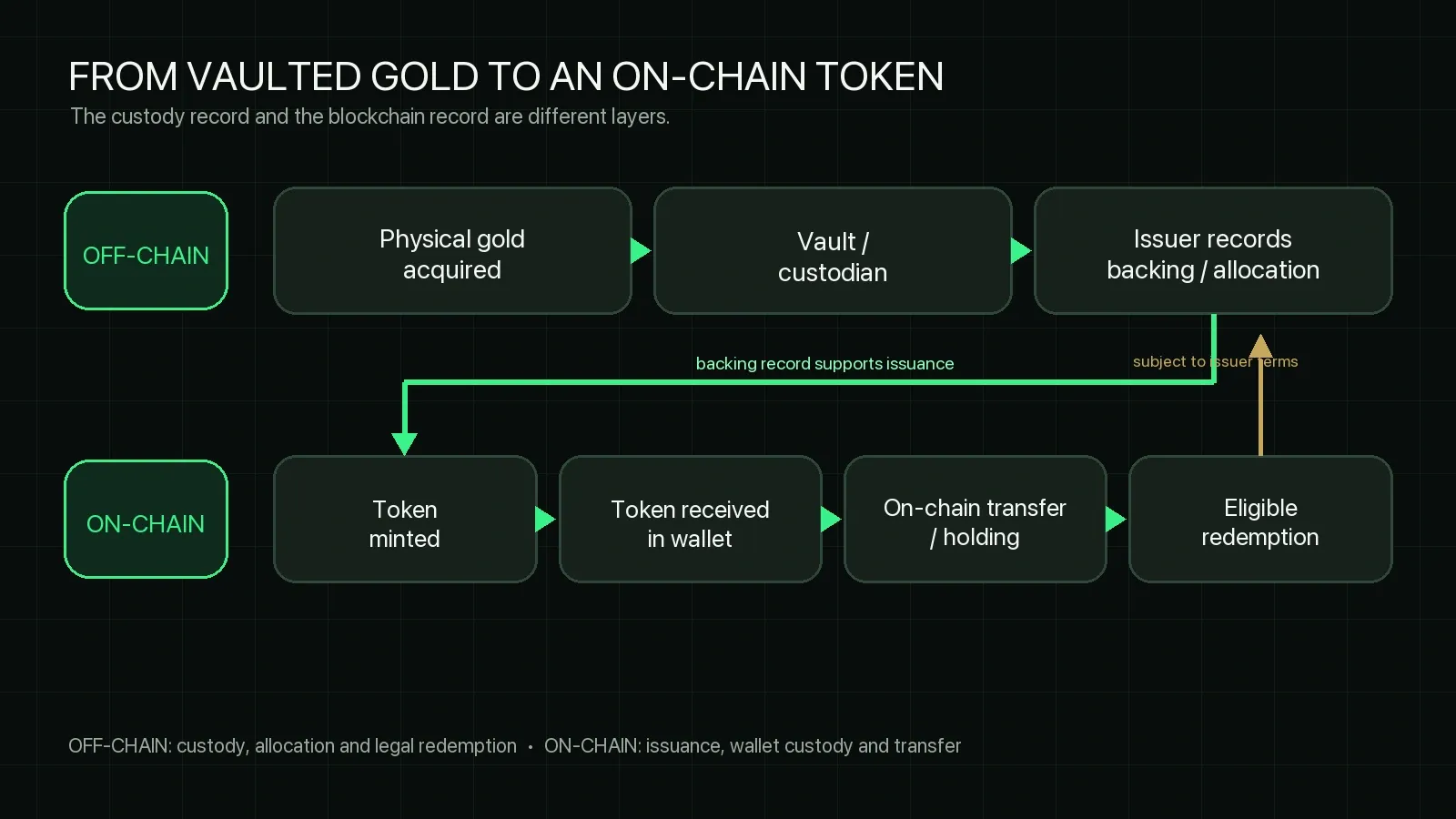
The blockchain can show that a valid token transfer occurred from one address to another. It cannot independently prove that physical gold exists in a vault, is free of claims, remains properly allocated, or will be redeemable under every circumstance. That is why issuer terms, reserve reporting, attestation scope, and redemption rules deserve as much attention as the token contract itself.
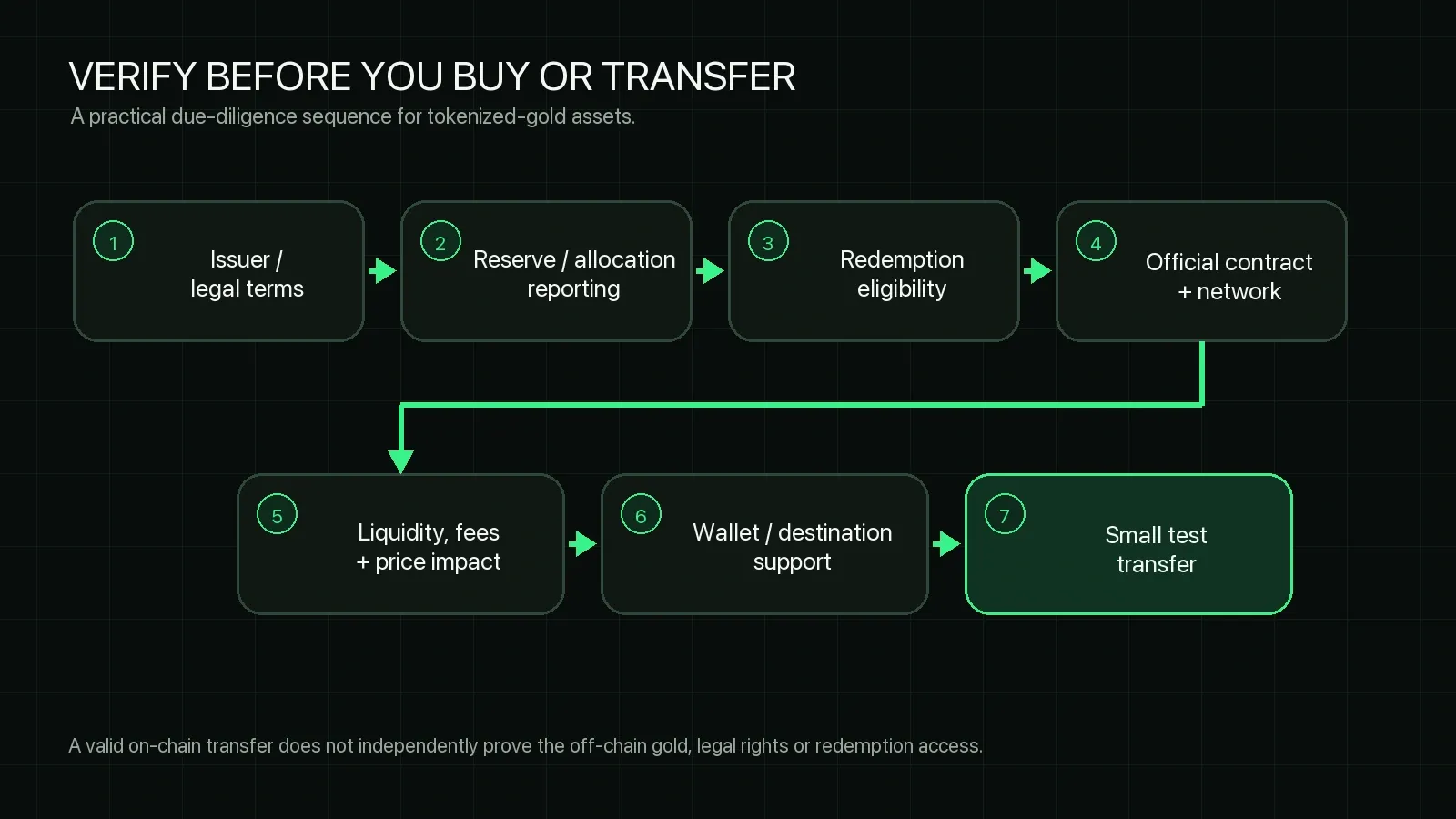
A tokenized-gold transaction generally follows this sequence:
- A user identifies the official issuer and reads the current product terms.
- The user confirms the official token contract and intended network.
- The user checks whether their wallet, exchange, or destination supports that exact asset on that exact network.
- The user sends or receives the token and pays the relevant network gas fee.
- The blockchain records the transfer after network confirmation.
- The user may hold, transfer, sell, or use the token in supported on-chain applications.
- Where issuer terms permit, an eligible holder may seek redemption through the issuer's process.
Network selection is especially important. A token with a familiar name or ticker may be an issuer-native token, a wrapped representation, a bridged asset, or a counterfeit token. Similar names, logos, and symbols do not confirm authenticity.
Paxos currently documents PAXG on Ethereum, Solana, and Base. Tether currently documents XAUT on Ethereum and BNB Smart Chain in its supported-protocols directory. These are issuer-documented networks; a wrapped or bridged representation should not be treated as an issuer-native token merely because it uses the same name or symbol.
Users should verify the exact contract address from the issuer's current documentation immediately before transacting, then compare it with the relevant verified blockchain-explorer page. Do not rely solely on a wallet token list, decentralized exchange search result, social post, or unsolicited message.
Tokenized gold comparison: PAXG vs XAUT factors that matter
A PAXG vs XAUT comparison should go beyond a simple question of which token is better. Each asset has its own issuer, disclosures, redemption terms, and operational constraints. The right question is whether the specific product's terms, transparency, availability, and risk profile suit your intended use.
| Criterion | PAXG | XAUT |
|---|---|---|
| Token name | PAX Gold | Tether Gold |
| Issuer | Paxos Trust Company, N.A. | TG Commodities, S.A. de C.V. |
| Stated relationship | One token represents one fine troy ounce of London Good Delivery gold | One token represents one fine troy ounce of gold on a London Good Delivery bar |
| Officially documented networks | Ethereum, Solana, Base | Ethereum, BNB Smart Chain |
| Reserve and allocation information | Gold Allocation Lookup; monthly KPMG attestations; annual physical inspection/audit described by Paxos | Address-based Gold Allocation Lookup plus product and legal disclosures |
| Physical redemption | A London Good Delivery bar requires approximately 430 PAXG, subject to eligibility, terms, and fees | Verified users may redeem in full-bar increments; generally around 430 XAUT, adjusted to the bar's actual size and purity |
| Other redemption routes | Paxos describes unallocated Loco London gold or USD routes, subject to current terms and eligibility | Tether Gold describes physical delivery in Switzerland or a sale process through its framework, subject to current terms and eligibility |
Paxos states that PAXG is backed by one fine troy ounce of London Good Delivery gold. It also offers a Gold Allocation Lookup and publishes PAXG transparency reports. Paxos notes that reports posted on or after February 28, 2025 are issued by KPMG LLP. Its current product materials also describe a separate annual physical inspection/audit by Bureau Veritas.
Allocation data, a reserve attestation, a physical inspection, and a full financial-statement audit are not interchangeable. Each addresses a different question and has its own scope and date. None guarantees future solvency, uninterrupted liquidity, or immediate redemption access.
Paxos states that PAXG may be redeemable for physical gold, unallocated Loco London gold, or USD at prevailing market prices, subject to applicable terms and eligibility. Its PAX Gold terms and conditions state that physical redemption for a London Good Delivery bar requires a minimum of 430 PAXG plus applicable fees. This makes direct physical delivery impractical for many small-balance holders.
Tether identifies TG Commodities, S.A. de C.V. as the issuer of XAUT. Tether Gold provides an address-based Gold Allocation Lookup and product and legal disclosures. Those materials are useful, but they are not the same as a full financial-statement audit or a PAXG-style monthly third-party reserve attestation. Tether Gold states that verified users can seek redemption in whole-bar increments, generally by depositing 430 XAUT, with the final amount adjusted to the selected bar's actual size and purity. Physical delivery operates within its Switzerland-based framework and remains subject to eligibility, fees, restrictions, and current terms.
Before choosing either product, review these questions:
- What does the token represent under the current legal terms?
- Who is the legal issuer?
- What reserve information is available, how frequently is it updated, and what is the assurance scope?
- Can you meet direct redemption minimums, verification requirements, fees, and delivery restrictions?
- Is the exact token contract supported on your intended network?
- What are the current liquidity, spread, slippage, and gas costs?
- Is the token issuer-native, wrapped, or bridged?
- Is the product available and permitted in your jurisdiction?
Neither PAXG nor XAUT should be treated as equivalent to direct possession of bullion. Both involve issuer, custodian, legal, market, smart-contract, network, and self-custody considerations.
Tokenized gold risks, benefits, and price differences
Tokenized gold can make fractional gold exposure and blockchain transfers more accessible, but convenience does not eliminate risk. A complete evaluation should consider both the potential benefits and the limitations.
Potential benefits of tokenized gold
| Potential benefit | Why it may matter | Important limitation |
|---|---|---|
| Fractional ownership | Users can hold less than a full gold bar | Physical redemption may still require whole bars or high minimums |
| On-chain transfers | Tokens can move on supported networks outside traditional market hours | Gas fees and network congestion still apply |
| Self-custody | Users can control tokens without leaving them on an exchange | Private-key loss can result in permanent loss |
| Transparent transfers | Token transfers and supply can be reviewed on-chain | On-chain data does not prove off-chain gold reserves |
| DeFi compatibility | Some supported assets may work with selected DApps | Smart-contract, approval, and liquidity risks apply |
The primary risk categories are interconnected:
| Risk category | What can go wrong | Practical mitigation |
|---|---|---|
| Issuer and custody risk | Gold backing, operations, or legal rights may not match assumptions | Read terms, review reserve reporting, understand the issuer structure |
| Redemption risk | Minimums, fees, KYC, delays, or location limits may affect access | Check redemption eligibility before buying |
| Smart-contract risk | Wrong token, malicious contract, or unsafe approval | Verify the official contract and limit approvals |
| Network risk | Wrong-chain transfers or insufficient gas can disrupt transactions | Confirm network compatibility and hold gas token |
| Market risk | Price can trade above or below spot gold | Check spread, depth, slippage, and execution cost |
| Self-custody risk | Seed phrase theft or address errors can cause irreversible loss | Store recovery information offline and test transfers |
| Legal and tax risk | Rules vary by location and transaction type | Seek qualified local advice where appropriate |
A tokenized-gold price can differ from the spot price of gold for several reasons:
- Centralized exchange order-book liquidity and bid-ask spreads.
- Decentralized liquidity pool depth and price impact.
- Network gas fees and withdrawal costs.
- Trading during weekends, holidays, or periods of limited traditional market activity.
- Changing confidence in the issuer, custody model, or redemption process.
- Constraints on token creation or direct redemption.
- Demand for the token on a specific blockchain network.
A self-custody wallet reduces dependence on an exchange to hold the token. It does not remove dependency on the issuer and custodian for the underlying gold. That two-layer model is essential: you control the token keys, while the issuer's terms govern the gold-linked claim.
Holding tokenized gold safely with FoxWallet
Holding tokenized gold safely starts with verifying the issuer, contract, network, and destination before approving any transaction. A non-custodial wallet can manage supported tokens and sign transactions, but it cannot verify physical reserves, guarantee redemption or issuer solvency, determine legal rights, guarantee token authenticity, or guarantee liquidity.
FoxWallet is a decentralized, non-custodial multi-chain wallet designed for users who want to retain control of private keys and assets. FoxWallet states that private keys and mnemonic phrases are encrypted and stored locally, rather than held by the wallet provider. Before receiving or transferring a tokenized-gold asset, confirm current support for the exact token and network.
Use this safety process:
-
Create or import your wallet securely. Follow the official wallet creation guidance, then write down the recovery phrase offline. Never take a screenshot, save it to cloud storage, or share it with anyone.
-
Verify the token contract. Obtain the contract address directly from the issuer's official product documentation. Compare each character carefully with a verified explorer page. Do not trust a token solely because its name says PAXG, XAUT, gold, or a similar label.
-
Confirm the exact network. The receiving wallet or platform must support the token on the selected chain. A token sent on the wrong network may be difficult or impossible to recover. Confirm the exact contract and network on both the sending and receiving sides.
-
Keep enough gas token. Token transfers and approval changes require native network gas. Check this before initiating a transaction, especially when moving an entire balance.
-
Start with a small test transfer. A small test transaction can help confirm the network, address, asset, and destination before moving a larger amount.
-
Inspect every approval. A token approval may allow a smart contract to spend tokens from your address. FoxWallet's approval-management guide explains why unlimited approvals can be risky and how users can review or revoke permissions.
-
Review DApp requests before signing. Use only trusted applications, confirm the domain, review transfer values, inspect the spender address, and pause if a transaction prompt is unclear. FoxWallet's security tips provide practical guidance for checking websites, contracts, signing requests, and fake-token risks.
-
Separate active and long-term holdings. Consider using different accounts for routine DApp activity and longer-term holdings. This can reduce exposure when interacting with new contracts or applications.
FoxWallet also supports multi-chain asset management and DApp access where available. Its multi-chain management guide explains the wallet's focus on unified asset visibility, transaction review, and self-custody. These wallet functions do not validate the issuer's off-chain gold, legal structure, or redemption process.
Final tokenized gold checklist
Before buying, receiving, sending, or swapping tokenized gold, confirm all of the following:
- The issuer's current product page and legal terms have been reviewed.
- The token contract comes from an issuer-controlled source.
- The selected blockchain matches the token and receiving destination.
- The wallet supports the exact asset and network.
- The asset is issuer-native, wrapped, bridged, or otherwise clearly identified.
- You understand redemption minimums, fees, verification requirements, and delivery limits.
- You have sufficient native gas token.
- The recipient address has been checked character by character.
- The transaction is tested with a small amount first.
- Any DApp approval amount and spender address are understood.
- Your recovery phrase is stored offline and never shared.
Tokenized gold can offer a flexible way to hold a blockchain-based gold-linked asset, but responsible use requires more than watching the price. Verify the issuer, confirm the contract, understand redemption reality, and protect your private keys before every transaction.