What Are Real-World Assets (RWA) in Crypto? Tokenized Assets Explained

Real-world assets in crypto are blockchain-based tokens that represent a defined interest in off-chain assets, financial instruments, or payment rights. They can bring traditional asset categories such as Treasury-focused funds, bonds, real estate interests, commodities, and private credit onto blockchain rails, but the token itself does not automatically give its holder direct ownership of the underlying asset.
That distinction matters. A wallet can show that you control a token at an address, while the issuer's legal documents determine what the token legally represents, who may hold it, how it can be transferred, and whether it can be redeemed.
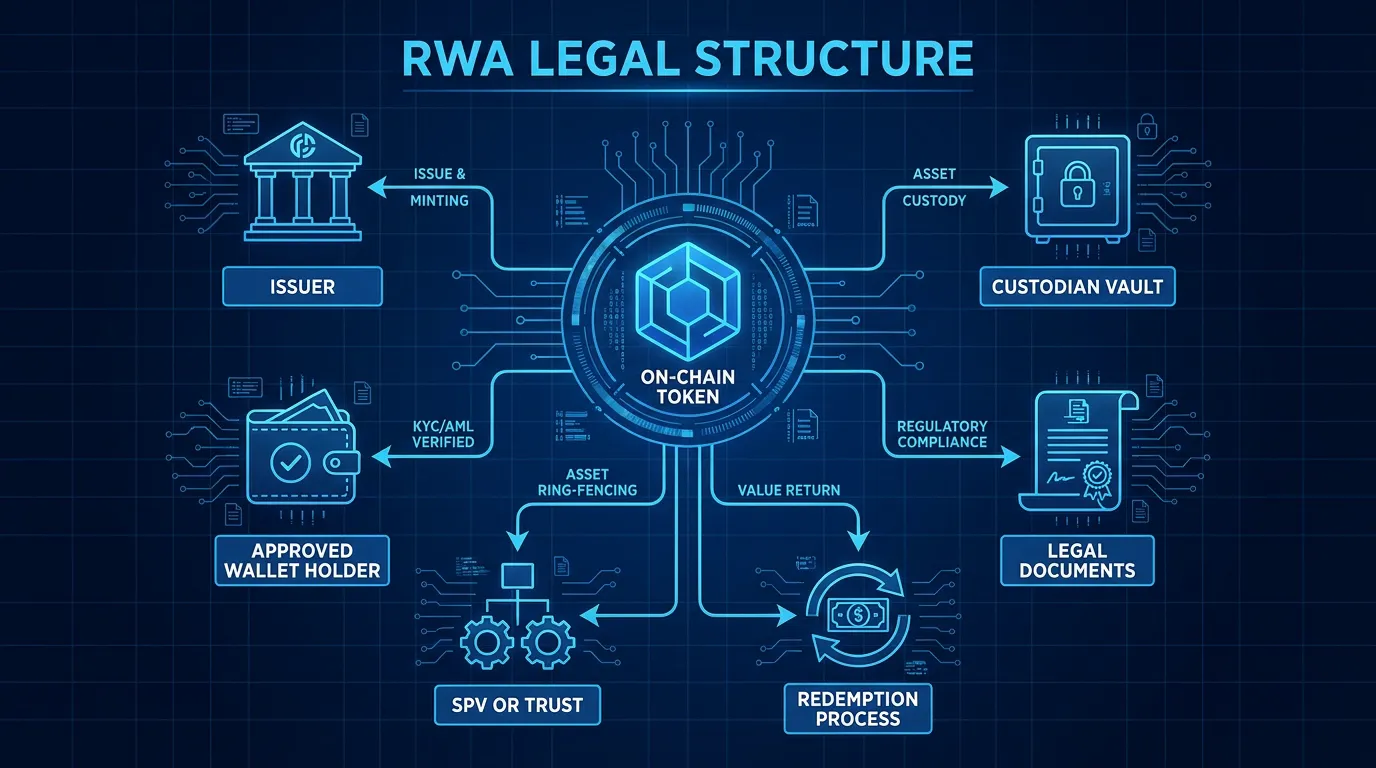
What real-world assets in crypto represent and why legal rights matter
Real-world assets in crypto, often shortened to RWAs, are on-chain representations of assets or claims that exist outside the blockchain. The category can include tokenized fund shares, debt instruments, commodity claims, property-company interests, receivables, or other contractual rights.
The phrase "tokenized assets" describes the technical format, but it does not describe the full legal structure. Before interacting with an RWA token, users should determine exactly what one token represents.
| Asset category | A token may represent | What it may not represent |
|---|---|---|
| Treasury-focused fund | A share or interest in a fund holding government debt and cash-equivalent instruments | Direct ownership of an individual Treasury bill |
| Bond | A blockchain-recorded debt claim under specified bond terms | Ownership of the blockchain or an unrestricted right to transfer |
| Real estate | An LLC interest, beneficial interest, or revenue-related contractual claim | Direct title to a building or land parcel |
| Gold | A contractual entitlement linked to vaulted gold, subject to issuer terms | Immediate delivery of a physical bar |
| Private credit | A note, loan participation, fund share, or interest in a receivables structure | A guaranteed liquid loan position |
| Equity-linked token | Shares, depositary interests, or price exposure, depending on the structure | Voting and dividend rights unless documentation expressly provides them |
The central question is not just, "What token do I hold?" It is, "What enforceable rights do I have against whom?"
The U.S. Securities and Exchange Commission explains that tokenized securities can remain securities even when ownership records or transfer activity use distributed-ledger technology. In other words, moving an instrument on-chain does not remove the laws and obligations that apply to the underlying financial product.
This also clarifies the difference between tokenized assets and crypto backed by real-world assets. A token can have economic exposure to an off-chain asset without granting direct legal title to it. Stronger disclosures should identify:
- The issuer and the entity that holds the underlying assets.
- The rights attached to each token.
- The custodian or safeguarding arrangement.
- The governing law and insolvency treatment.
- Eligibility rules and transfer restrictions.
- Redemption terms, fees, minimums, and processing timelines.
For users, the practical takeaway is simple: ownership of an on-chain token is not the same as ownership of an off-chain asset unless the issuer's legal framework makes that connection enforceable.
How real-world assets in crypto move from custody to tokenization
Understanding how real-world assets work in crypto requires looking at both the blockchain layer and the off-chain legal and operational layers. Real-world asset tokenization usually begins with a traditional structure, such as a fund, trust, special-purpose vehicle, or issuing entity.
The issuer defines the holder's rights and acquires or arranges exposure to the underlying asset. A custodian, administrator, or other service provider may safeguard the asset or maintain relevant records. After investor onboarding and eligibility checks, the issuer may mint a token that represents the defined interest.
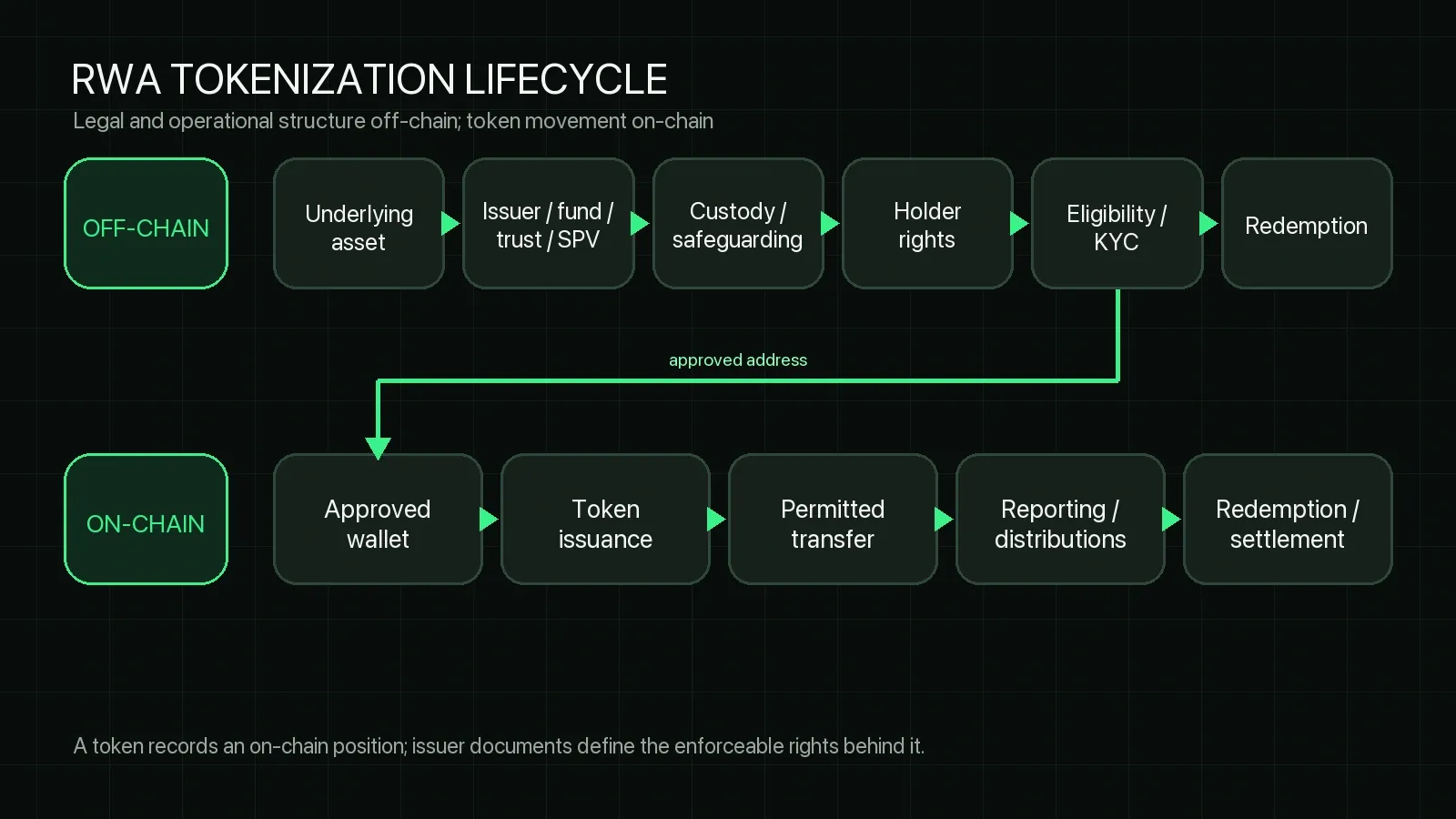
Blockchain technology can make transaction records more visible and can automate selected rules. It cannot, by itself, confirm that the issuer owns an off-chain asset, that reserves are sufficient, or that a token holder has a legal redemption right.
Several roles may be involved:
| Role | Core function |
|---|---|
| Issuer | Creates the product and defines the token holder's rights |
| Fund, trust, or SPV | Holds assets or issues the defined interest |
| Custodian | Safeguards securities, commodities, cash, or related assets |
| Transfer agent or registrar | Maintains recognized records and processes certain transfers or redemptions |
| Smart contract | Applies token-level functions, including minting, burning, and transfer controls |
| Attestation or oracle provider | Supplies off-chain information such as NAV, reserve data, or payment events |
| Wallet holder | Controls the private key for the on-chain token, subject to product restrictions |
Many RWA products are permissioned. That means a user may need to complete identity verification, meet jurisdictional requirements, or use an approved wallet address before receiving or transferring the token. A smart contract can enforce allowlists, freezes, forced transfers, or other compliance controls where its rules permit them.
This is why 24/7 token movement does not necessarily mean 24/7 redemption. The underlying fund, custodian, bank, transfer agent, and settlement rails may follow business-hour schedules, cutoff windows, and eligibility procedures.
Real-world assets in crypto across Treasuries bonds real estate and commodities
RWA crypto covers a wide range of structures. Similar token labels can hide important differences in liquidity, legal rights, risk, and investor eligibility.
Tokenized Treasury and money-market products. These products commonly represent fund shares or structured interests with exposure to U.S. government debt, repurchase agreements, cash, or money-market instruments. For example, BlackRock's USD Institutional Digital Liquidity Fund is a fund structure, rather than a token that gives direct ownership of one particular Treasury bill. RWA.xyz's Treasury dashboard tracks this fast-growing category, though product values, access rules, and market metrics should always be checked at the time of review.
Tokenized bonds crypto. A tokenized bond is generally a debt obligation recorded or administered with blockchain technology. The core risk remains the creditworthiness of the issuer and the terms of the instrument, including coupon, maturity, transfer conditions, and repayment priority. The World Bank's bond-i initiative is an early example of a bond using blockchain-related technology in its lifecycle.
Private credit. Tokenized private-credit products can represent loan notes, participations, fund interests, or interests in a structure that holds loans and receivables. Tokenization may streamline reporting or administration, but it does not make borrower default risk, valuation uncertainty, or limited exits disappear.
Tokenized real estate crypto. A tokenized real estate crypto product often represents an interest in the entity that owns or finances property, rather than direct title registered in a local land system. It can expose holders to property value, vacancy, maintenance, leverage, manager performance, local regulations, and resale limitations. The legal documents should explain whether the token represents an LLC interest, a beneficial interest, a revenue share, or another contractual arrangement.
Gold and other commodities. Commodity-linked tokens generally depend on issuer terms, vault arrangements, and redemption policies. PAX Gold terms and conditions illustrate why users should examine physical redemption requirements, identity checks, minimum quantities, fees, locations, and delivery logistics before assuming token redemption will be convenient.
Equities and equity-linked products. A tokenized stock product may be an actual share, a depositary interest, a restricted instrument, synthetic price exposure, or a contractual claim. Users should verify whether they receive voting rights, dividends, shareholder records, inspection rights, and liquidation rights. A token that follows a stock price can be materially different from owning the underlying shares.
Stablecoins. Stablecoins are related to the RWA conversation because some rely on fiat currency and reserve assets. However, they are structurally distinct from tokenized Treasury fund shares. For example, USDC is governed by Circle's contractual terms and reserve arrangements. It is not a bank deposit or direct ownership of its reserve assets.
Real-world assets in crypto offer potential benefits but retain material risks
Real-world asset tokenization can improve how certain financial interests are issued, recorded, transferred, and administered. The potential benefits are meaningful, but they are conditional on the structure and do not guarantee liquidity, redemption, or legal protection.
| Potential benefit | What it can mean in practice | Important limitation |
|---|---|---|
| Fractionalization | Smaller token units may lower entry sizes where permitted | Restrictions can still exclude many users |
| Faster settlement | Digital rails can reduce certain reconciliation steps | Off-chain settlement and redemptions may take longer |
| Programmability | Smart contracts can automate distributions and transfer rules | Contract bugs and admin controls create technical risk |
| Transparent transfers | Public blockchain data can show token activity | It does not prove off-chain reserves or legal ownership |
| Operational efficiency | Some processes may need less manual reconciliation | Traditional service providers and documentation remain necessary |
| Broader distribution | Digital access can simplify technical distribution | Laws, KYC, geography, and investor status can limit access |
Tokenized Treasury market totals change quickly and can differ depending on whether a dashboard reports market value, assets under management, total value locked, or outstanding supply. For current category data, use the live RWA.xyz Treasury dashboard, then verify each product's issuer documents, eligibility rules, and redemption terms separately.
The same features that make RWA crypto appealing can create new dependencies. A user should assess at least the following risks:
- Legal-structure risk: The token may represent a contractual claim rather than direct ownership of an asset.
- Issuer risk: An issuer may face financial distress, litigation, operational failure, or suspended redemption.
- Custody risk: Underlying assets may be subject to custodian failure, delays, freezes, or insolvency disputes.
- Liquidity risk: A transferable token may still have few buyers or no practical path to quick redemption.
- Smart-contract risk: Code vulnerabilities, upgrades, permissions, and administrative keys may affect access or transfers.
- Attestation risk: An attestation is not necessarily a full audit, and reporting may be delayed or limited.
- Compliance risk: KYC, sanctions screening, geofencing, and investor classifications can restrict holding or transfers.
- Market risk: The value of a property, bond, commodity, fund share, or loan portfolio can decline.
- Tax risk: Transfers, redemptions, distributions, and swaps can have tax consequences that vary by jurisdiction.
- Wallet-security risk: Phishing, malicious approvals, lost recovery phrases, and incorrect transaction details can cause irreversible loss.
The European Central Bank has cautioned that tokenized money-market funds can introduce familiar liquidity, operational, valuation, settlement, and run-risk channels in a new technical format. Its analysis of tokenized money-market fund risks reinforces a key principle: a blockchain wrapper does not remove the financial risks of the underlying product.
How to evaluate real-world assets in crypto before interacting
RWA investing crypto requires more diligence than checking a token name, chart, or wallet balance. The most useful approach is to start with legal rights, then work through eligibility, liquidity, technology, and personal risk.
Use this checklist before acquiring, holding, transferring, or connecting to an RWA-related DApp:
- Identify the official issuer and contract address. Use the issuer's official documentation, not a social-media post, ticker symbol, or search result alone.
- Read the offering and legal documents. Confirm what one token represents and which entity owes obligations to holders.
- Review the custody and structure. Determine whether a fund, trust, SPV, or another entity holds the underlying assets.
- Check insolvency treatment. Look for disclosure on segregation of assets, creditor claims, and what may happen if a provider fails.
- Confirm eligibility. Verify that your jurisdiction, investor status, and wallet address are permitted to participate.
- Understand transfer controls. Check for whitelisting, holding periods, geographic restrictions, freezes, or forced-transfer provisions.
- Review redemption details. Evaluate minimums, fees, settlement currency, processing times, cutoff times, and suspension rights.
- Assess liquidity independently. A token's existence does not prove that a real secondary market or prompt exit exists.
- Review reporting. Check available audits, attestations, NAV methodology, reserve reporting, and disclosure frequency.
- Examine contract controls. Consider upgrade authority, admin keys, minting permissions, burn functions, and oracle dependencies.
- Plan for taxes and currency exposure. Consult qualified tax and legal professionals for guidance based on your circumstances.
- Protect your wallet. Verify every transaction, approval, network, recipient, and DApp domain before signing.
For U.S. users, whether a product is regulated can depend on its actual rights and structure. Other jurisdictions take similarly fact-specific approaches. In the European Union, MiCA generally does not replace the established financial-markets framework for instruments that are already regulated as financial instruments.
A sound diligence process should stop when critical details are unclear. Do not treat an attractive yield, recognizable ticker, or visible wallet balance as a substitute for issuer documentation and a clear redemption pathway.
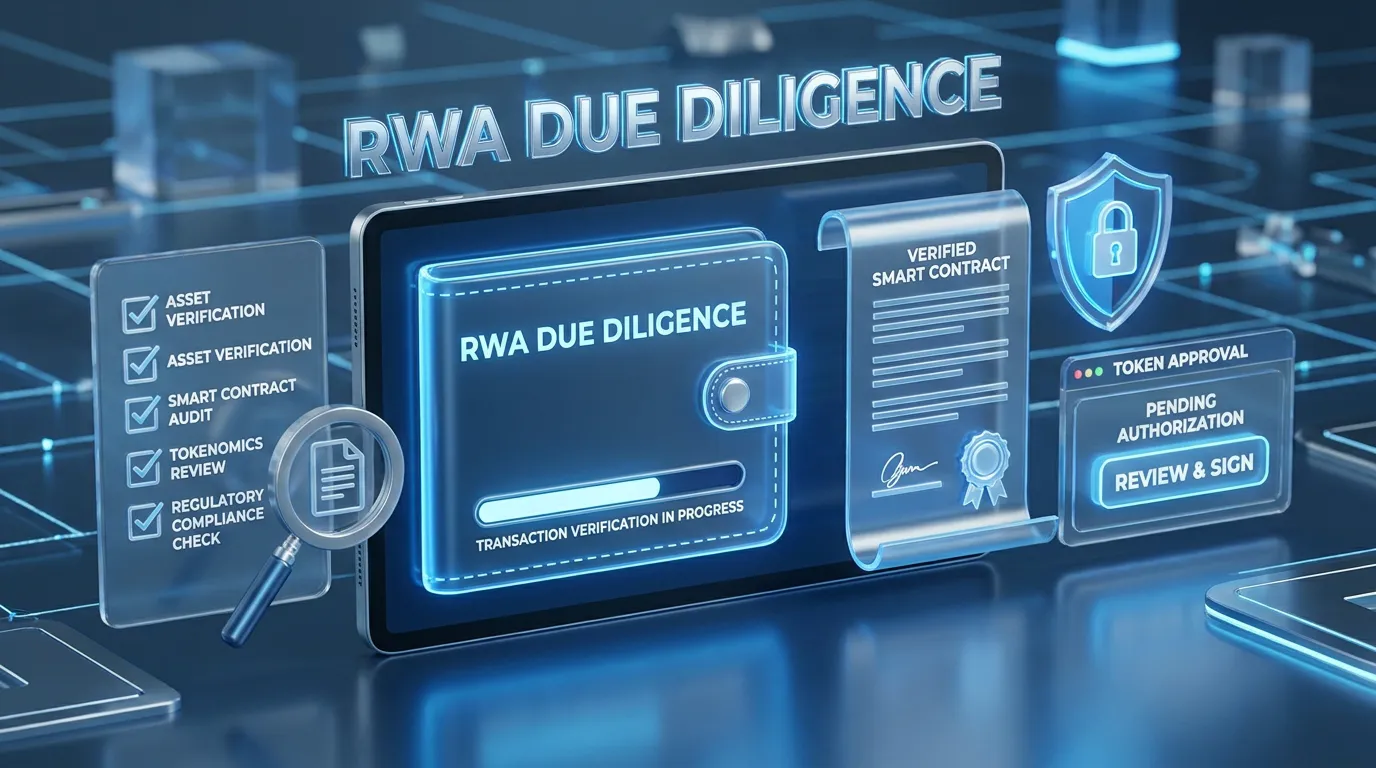
Using real-world assets in crypto with a non-custodial wallet
A non-custodial wallet can help users manage supported on-chain token balances and connect to compatible DApps, but it is not an issuer diligence service. A wallet does not verify reserves, guarantee redemption, establish legal ownership, or determine whether an RWA token is suitable, compliant, or liquid.
FoxWallet's multi-chain asset-management tools are designed to help users manage supported assets across compatible networks from a unified self-custody interface. Users retain control of their private keys and assets, while mnemonic phrases and private keys are locally encrypted rather than held by FoxWallet.
FoxWallet mobile includes a Discover/DApp browser for accessing and connecting to compatible DApps across supported networks. For RWA-related activity, this can support a more deliberate workflow:
- View supported balances across compatible networks.
- Connect to compatible DApps through the mobile Discover/DApp browser.
- Review transaction details before approving an interaction.
- Watch for suspicious operations and treat risk alerts seriously.
- Review existing token permissions and reduce unnecessary approvals.
- Keep recovery phrases offline and never submit them to websites, forms, or support chats.
Before connecting to a DApp, use FoxWallet's DApp connection guidance and confirm that the domain is the issuer's official domain. Before signing an approval, review token approval management practices so that you understand the token allowance being granted.
A small test transaction can help reduce operational mistakes when using an unfamiliar product or network. It does not validate the issuer, prove the quality of reserves, or eliminate smart-contract risk.
Users considering multi-network token movement should also understand that moving a token representation between networks can introduce separate route, smart-contract, and wrapped-asset risks. Review cross-network transaction risks before taking action, and do not assume that a technical transfer preserves every legal right or redemption option attached to the original token.
Protecting the wallet remains essential. Follow FoxWallet security guidance by checking domains, contract calls, message prompts, and transaction details carefully. Never share a recovery phrase, and never rely on a token name alone to determine authenticity.
Frequently Asked Questions
What does RWA mean in crypto? RWA means real-world asset. In crypto, it commonly refers to a tokenized representation of an off-chain asset, a financial instrument, or a contractual claim connected to one.
Do tokenized assets always mean direct ownership? No. A token may represent a fund share, note, LLC interest, beneficial interest, economic exposure, or another right defined in issuer documents.
Can anyone buy tokenized bonds or tokenized real estate? Not always. Products can require identity verification, approved wallets, jurisdictional eligibility, or a specific investor classification.
Are stablecoins the same as tokenized Treasury funds? No. Stablecoins and tokenized Treasury-focused funds can both depend on off-chain reserves, but their legal structures, return profiles, redemption terms, and holder rights can differ materially.
Can an RWA token always be redeemed? No. Redemption may depend on eligibility, minimum amounts, operating hours, settlement channels, fees, geography, and issuer discretion under the applicable terms.
Real-world assets in crypto can make traditional financial and physical-asset interests easier to represent and manage on-chain. The responsible approach is to verify the issuer, understand the holder rights, assess redemption and liquidity, and secure every wallet interaction before signing.