


The Real Technical Bottleneck of Multi-Chain Wallets Is Not Cross-Chain

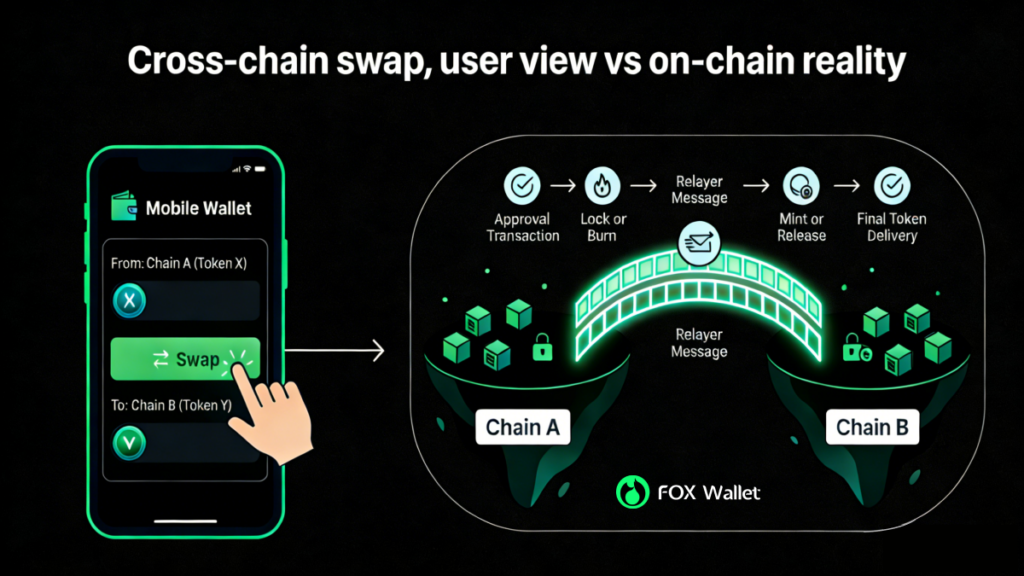
Why "how cross-chain swap works" looks simple in a wallet UI (but is not)
A cross-chain swap is an exchange where your input asset starts on one blockchain and your output asset ends on another. What makes this confusing is that most wallets compress a multi-step, multi-network process into a single confirmation screen.
What you typically see:
- Pick a "from" chain and token.
- Pick a "to" chain and token.
- Review an estimate (amount out, fees, ETA).
- Confirm once (sometimes twice if a token approval is required).
What is usually happening underneath:
- At least one transaction on the source chain (often approval + swap or bridge call).
- Some form of cross-chain coordination (relayers, proofs, or a liquidity network).
- At least one transaction on the destination chain (mint or release, and sometimes a destination swap).
- Continuous status tracking until your destination balance updates.
This gap between the simple UX and the real system behavior is why users often understand the surface of cross-chain swaps, but not the real bottlenecks that multi-chain wallets must solve.
How cross-chain swaps actually work under the hood (3 common designs)
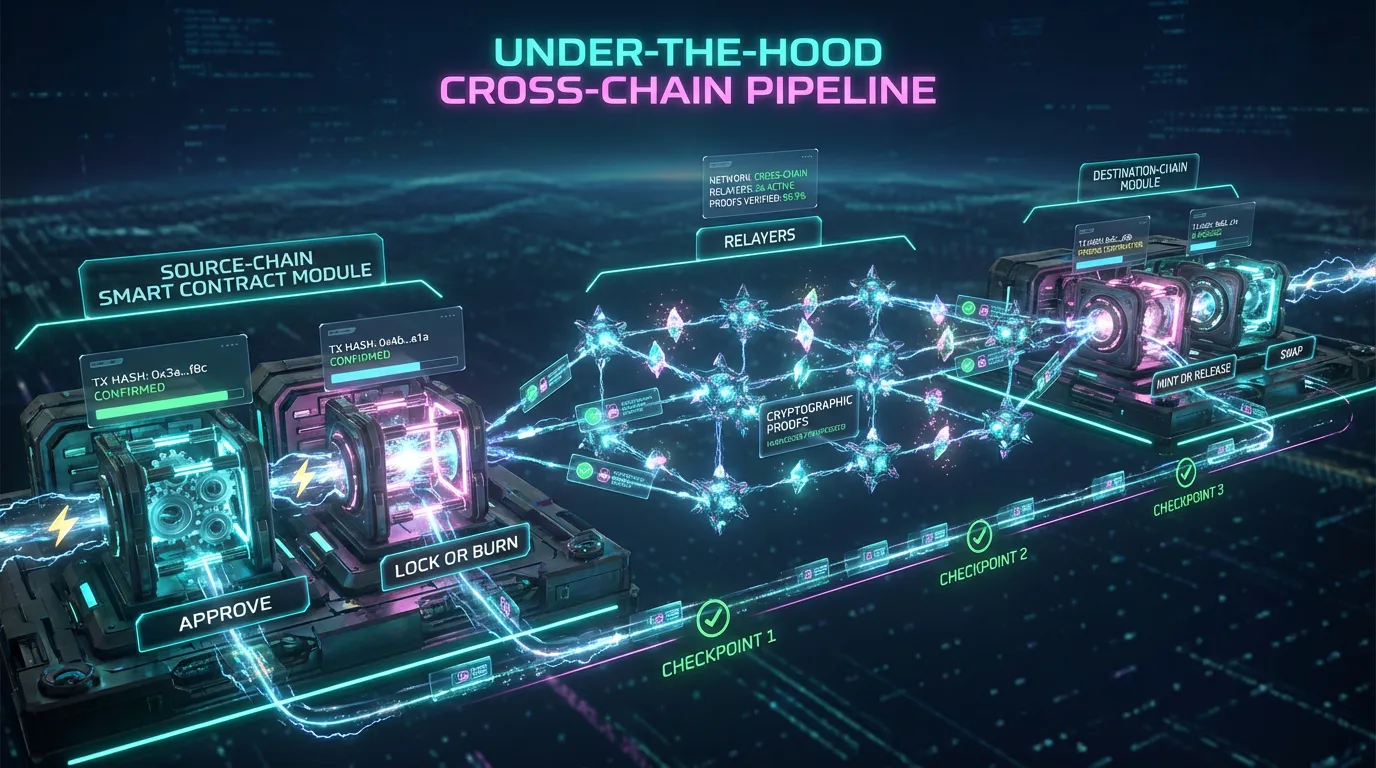
Most real-world routes are hybrids, but they usually resemble one of these three patterns.
1) Bridge-based routes (lock-and-mint, burn-and-release)
This is the dominant retail pattern today.
- Lock-and-mint: the asset is locked on the source chain, and a wrapped representation is minted on the destination chain.
- Burn-and-release (or burn-and-mint): the representation is burned on one side and released or minted on the other based on proofs.
Key implication: your security depends on the bridge's trust model (validator sets, multisigs, or more trust-minimized designs). Bridge risk has historically been a major source of losses in crypto, so wallets and users should treat route selection and risk visibility as first-class concerns. For background on bridge risk and multi-chain security pitfalls, see the analysis from Halborn on multi-chain risks and best practices.
2) Liquidity networks and intent-based routing (relayers can front liquidity)
Some protocols use liquidity pools or market makers to deliver the output on the destination chain once the input is observed on the source chain. This can make swaps feel faster, but it adds new assumptions (relayer behavior, settlement rules, and protocol constraints). A protocol-specific explainer that describes the "intent" model is Across's overview of crosschain swaps.
3) HTLC atomic swaps (classic "atomic swap" design)
HTLCs (Hash Time-Locked Contracts) aim for atomicity: either both legs complete, or both sides can refund after timelocks.
A simplified HTLC flow:
- Alice generates a secret S and shares hash(S).
- Alice locks funds on chain A with hash(S) and a timelock.
- Bob locks funds on chain B with the same hash(S) and a shorter timelock.
- Alice claims Bob's funds by revealing S on-chain.
- Bob reads S from the chain and claims Alice's funds.
This design is conceptually clean, but coordination complexity and compatibility constraints make it less common for mainstream wallet UX today. If you want the canonical HTLC explanation, see COMIT's HTLC atomic swap documentation and a concrete example in Symbol's cross-chain swap docs. A broader overview is also available in Chainlink's atomic swap explainer.
The real bottleneck in multi-chain wallets is not cross-chain, it is multi-chain operations at scale
Integrating a bridge or aggregator is increasingly "solvable" because mature protocols and SDK-like integrations exist. The harder part is everything a wallet must do reliably before, during, and after the swap across many heterogeneous chains.
Here are the bottlenecks that usually dominate engineering effort and user outcomes:
| Bottleneck area | What breaks in practice | What a strong wallet must do |
|---|---|---|
| Chain connectivity | RPC outages, inconsistent nodes, chain-specific quirks | Maintain robust multi-chain connectivity and fallbacks |
| Indexing and normalization | Missing tokens, wrong decimals, NFTs not showing, duplicated assets | Normalize balances, token metadata, and NFTs across networks |
| Unified UX and state | Confusing network context, unclear "where funds are", poor progress tracking | Present one coherent status across source and destination legs |
| Gas and fee management | Users lack destination gas, underestimate total cost | Explain gas on both chains, reduce hidden costs, route efficiently |
| Security and risk detection | Malicious contracts, phishing, dangerous approvals | Contract recognition, pre-transaction warnings, safer DApp access |
External UX research repeatedly points out that network switching, fragmentation, and gas issues are persistent pain points in multi-chain usage. See, for example, Digitap's discussion of multi-chain wallet friction and UX failure points in its guide to frictionless multi-chain wallets, and the broader security framing in a16z crypto's "non-custodial" security analysis.
A practical tutorial: how to execute a cross-chain swap safely (and what to verify)
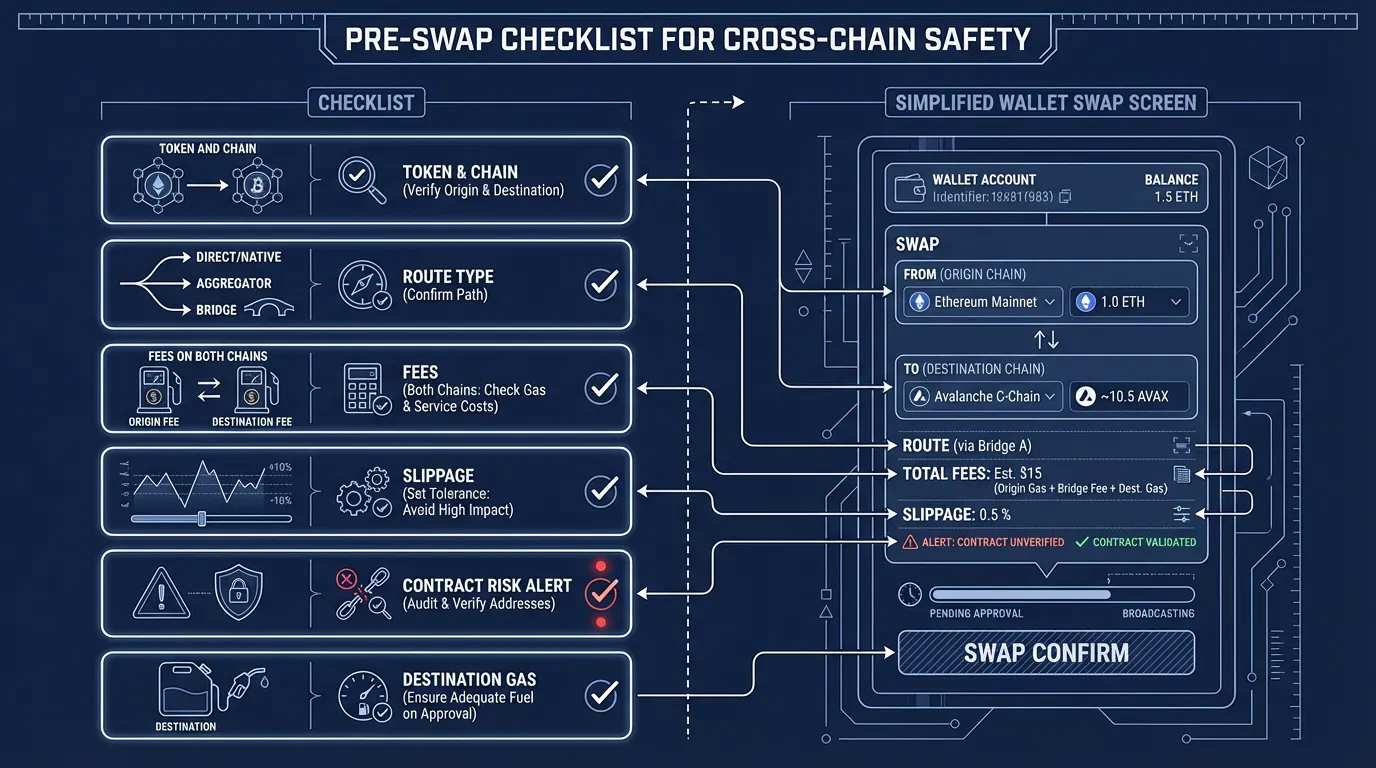
This is a wallet-agnostic process you can use whenever you are evaluating how cross-chain swap works in real conditions.
Step 1: Identify what you are really doing
Before confirming, answer:
- Is this a bridge transfer plus a swap, or a swap that includes bridging?
- Will you receive a wrapped asset representation on the destination chain, or the "native" version for that ecosystem?
If the UI does not make this clear, treat that as a risk signal, not a convenience feature.
Step 2: Break fees into components (do not trust a single headline number)
Cross-chain swaps typically include:
- Source chain gas (often approval + execution).
- Bridge or protocol fees.
- Relayer or routing fees (depending on design).
- Destination chain gas (claim, mint, release, and possible destination swap).
- Slippage from liquidity depth.
A common user failure mode is underestimating that they are paying gas twice (source and destination), plus protocol overhead.
Step 3: Plan for destination chain usability
Even if the swap "lands" successfully, you may still need the destination chain's native token for later actions (sending funds out, interacting with DeFi, or consolidating assets). If you are moving into a new chain, consider whether part of the output should be that chain's gas token.
Step 4: Review approval scope (when applicable)
If your token requires approval, check whether the approval is:
- Exact amount vs effectively unlimited.
- Granted to an expected contract address (not a suspicious or unfamiliar one).
Step 5: Know the failure modes so you can react calmly
Cross-chain is multi-leg. That means you can see states like:
- Confirmed on source chain, pending relay.
- Delivered to destination as an intermediate asset, then swapped.
- Delayed due to congestion, finality rules, or relayer processing.
A good wallet experience is largely about making these states visible and recoverable.
For a security-first perspective on why wallets should behave more like security tools across chains, see Learnfully's argument for multi-chain wallet security thinking.
Where FoxWallet fits: multi-chain and cross-chain by design (not bolt-on)
FoxWallet is built as a non-custodial, multi-chain decentralized wallet: users control keys locally, assets are not held by the wallet provider, and on-chain interactions are signed client-side. The important design point is that cross-chain functionality is treated as part of a broader multi-chain system, not the whole story.
How that maps to the real bottlenecks above:
- Full user control and non-custodial security: locally encrypted storage of mnemonic phrases and private keys, aligned with self-custody expectations.
- Multi-chain asset management: one-stop balances across networks, automatic detection of assets and NFTs, and a unified cross-chain asset view to reduce fragmentation.
- Built-in cross-chain swap and on-chain trading: native integration with swap aggregation to route trades across major blockchains, aiming to reduce slippage and unnecessary steps.
- Security architecture and risk protection: pre-transaction risk alerts and smart contract recognition to help users avoid malicious contracts and phishing patterns.
- Multi-platform support: mobile and browser extension experiences designed for consistent multi-chain operations.
Here is an overview of wallets in a broader market context https://foxwallet.com/blog/best-wallets-2026/.
CTA: apply the checklist, then test with a small swap
If you are evaluating a multi-chain wallet, do not judge it only by whether it offers "one-click" cross-chain. Use the checklist above, run a small cross-chain swap, and pay attention to what the wallet does well: status clarity, fee transparency, asset visibility across chains, and pre-transaction risk signaling. Those are the areas where multi-chain wallets succeed or fail in real usage.